What are OfficialStatistics?
• Statistics can be divided based on the body which is publishing
it. Statistics derived by Government agencies from statistical
surveys, registration records etc. are official statistics. E.g., the
Consumer Price Index (CPI), Index of Industrial
Production (IIP) etc.
• On the other hand, statistics published by non-government
bodies like the World Bank’s Ease of Doing Business Index
• (EoDB), NGO Pratham’s ASER Report etc. would come under
non-official statistics
2.
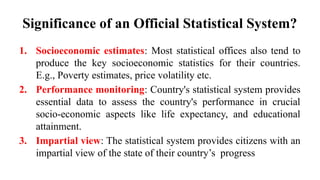
Significance of anOfficial Statistical System?
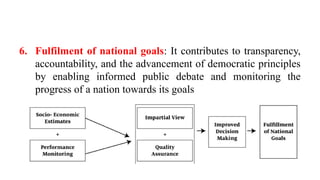
1. Socioeconomic estimates: Most statistical offices also tend to
produce the key socioeconomic statistics for their countries.
E.g., Poverty estimates, price volatility etc.
2. Performance monitoring: Country's statistical system provides
essential data to assess the country's performance in crucial
socio-economic aspects like life expectancy, and educational
attainment.
3. Impartial view: The statistical system provides citizens with an
impartial view of the state of their country’s progress
3.
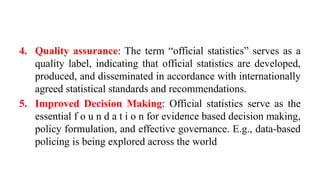
4. Quality assurance:The term “official statistics” serves as a
quality label, indicating that official statistics are developed,
produced, and disseminated in accordance with internationally
agreed statistical standards and recommendations.
5. Improved Decision Making: Official statistics serve as the
essential f o u n d a t i o n for evidence based decision making,
policy formulation, and effective governance. E.g., data-based
policing is being explored across the world
4.
6. Fulfilment ofnational goals: It contributes to transparency,
accountability, and the advancement of democratic principles
by enabling informed public debate and monitoring the
progress of a nation towards its goals
5.
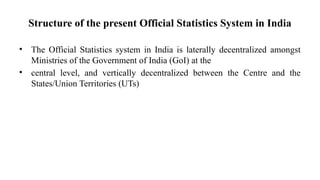
Structure of thepresent Official Statistics System in India
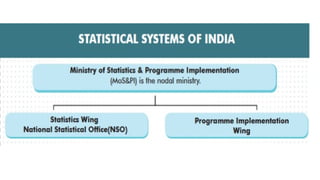
• The Official Statistics system in India is laterally decentralized amongst
Ministries of the Government of India (GoI) at the
• central level, and vertically decentralized between the Centre and the
States/Union Territories (UTs)
7.
Central Government
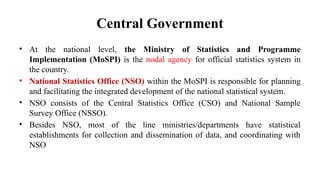
• Atthe national level, the Ministry of Statistics and Programme
Implementation (MoSPI) is the nodal agency for official statistics system in
the country.
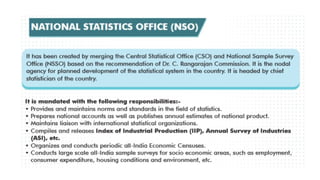
• National Statistics Office (NSO) within the MoSPI is responsible for planning
and facilitating the integrated development of the national statistical system.
• NSO consists of the Central Statistics Office (CSO) and National Sample
Survey Office (NSSO).
• Besides NSO, most of the line ministries/departments have statistical
establishments for collection and dissemination of data, and coordinating with
NSO
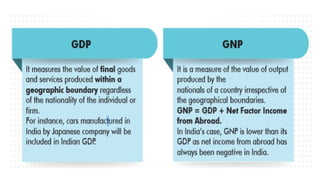
9.
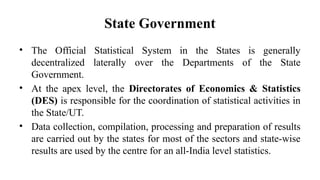
State Government
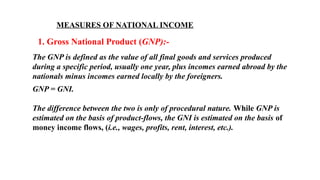
• TheOfficial Statistical System in the States is generally
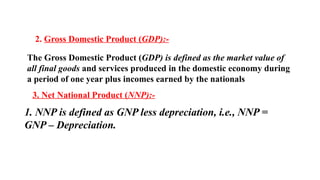
decentralized laterally over the Departments of the State
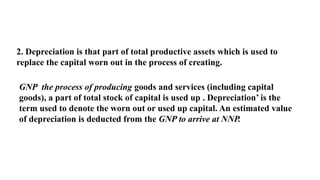
Government.
• At the apex level, the Directorates of Economics & Statistics
(DES) is responsible for the coordination of statistical activities in
the State/UT.
• Data collection, compilation, processing and preparation of results
are carried out by the states for most of the sectors and state-wise
results are used by the centre for an all-India level statistics.
10.
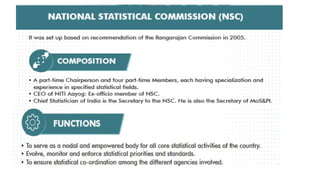
• National StatisticalCommission (NSC)- The government constituted the
NSC in 2006 as an apex advisory body on statistical matters on the
recommendations of C. Rangarajan Commission.
• Place in Seventh Schedule: The subject ‘Statistics’ is covered in both the
Union and Concurrent list in the Seventh Schedule of the Constitution of India
[Entry 94 of the Union List (List – I) and Entry 45 of Concurrent List (List –
III)].
• Legislations: Exclusive statistical laws apart from the above ecosystem include
the Census Act, 1948; the Registration of Births and Deaths Act, 1969; the
Collection of Statistics Act, 2008.
12.
Organizational setup forIndia’s Statistical System
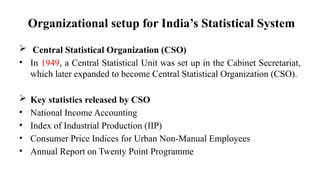
Central Statistical Organization (CSO)
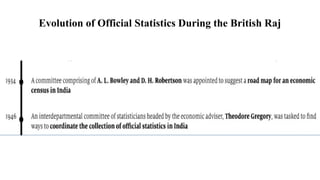
• In 1949, a Central Statistical Unit was set up in the Cabinet Secretariat,
which later expanded to become Central Statistical Organization (CSO).
Key statistics released by CSO
• National Income Accounting
• Index of Industrial Production (IIP)
• Consumer Price Indices for Urban Non-Manual Employees
• Annual Report on Twenty Point Programme
13.
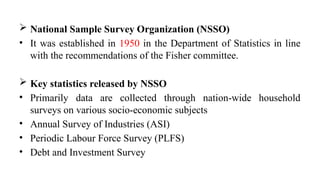
National SampleSurvey Organization (NSSO)
• It was established in 1950 in the Department of Statistics in line
with the recommendations of the Fisher committee.
Key statistics released by NSSO
• Primarily data are collected through nation-wide household
surveys on various socio-economic subjects
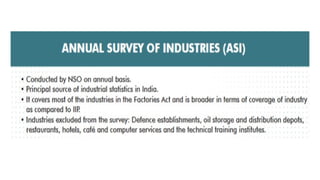
• Annual Survey of Industries (ASI)
• Periodic Labour Force Survey (PLFS)
• Debt and Investment Survey
16.
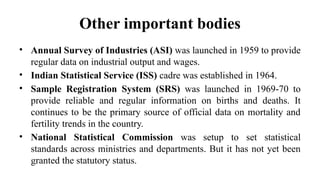
Other important bodies
•Annual Survey of Industries (ASI) was launched in 1959 to provide
regular data on industrial output and wages.
• Indian Statistical Service (ISS) cadre was established in 1964.
• Sample Registration System (SRS) was launched in 1969-70 to
provide reliable and regular information on births and deaths. It
continues to be the primary source of official data on mortality and
fertility trends in the country.
• National Statistical Commission was setup to set statistical
standards across ministries and departments. But it has not yet been
granted the statutory status.
17.
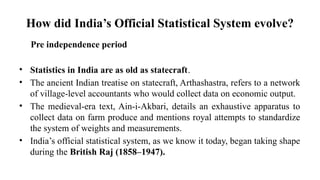
How did India’sOfficial Statistical System evolve?
Pre independence period
• Statistics in India are as old as statecraft.
• The ancient Indian treatise on statecraft, Arthashastra, refers to a network
of village-level accountants who would collect data on economic output.
• The medieval-era text, Ain-i-Akbari, details an exhaustive apparatus to
collect data on farm produce and mentions royal attempts to standardize
the system of weights and measurements.
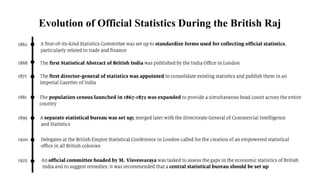
• India’s official statistical system, as we know it today, began taking shape
during the British Raj (1858–1947).
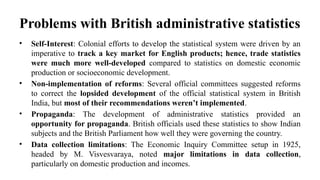
Problems with Britishadministrative statistics
• Self-Interest: Colonial efforts to develop the statistical system were driven by an
imperative to track a key market for English products; hence, trade statistics
were much more well-developed compared to statistics on domestic economic
production or socioeconomic development.
• Non-implementation of reforms: Several official committees suggested reforms
to correct the lopsided development of the official statistical system in British
India, but most of their recommendations weren’t implemented.
• Propaganda: The development of administrative statistics provided an
opportunity for propaganda. British officials used these statistics to show Indian
subjects and the British Parliament how well they were governing the country.
• Data collection limitations: The Economic Inquiry Committee setup in 1925,
headed by M. Visvesvaraya, noted major limitations in data collection,
particularly on domestic production and incomes.
21.
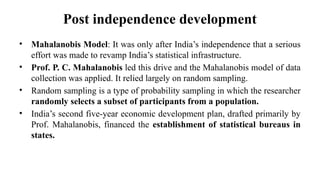
Post independence development
•Mahalanobis Model: It was only after India’s independence that a serious
effort was made to revamp India’s statistical infrastructure.
• Prof. P. C. Mahalanobis led this drive and the Mahalanobis model of data
collection was applied. It relied largely on random sampling.
• Random sampling is a type of probability sampling in which the researcher
randomly selects a subset of participants from a population.
• India’s second five-year economic development plan, drafted primarily by
Prof. Mahalanobis, financed the establishment of statistical bureaus in
states.
22.
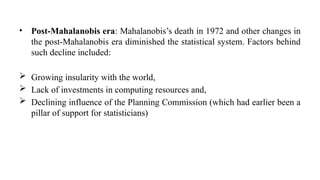
• Post-Mahalanobis era:Mahalanobis’s death in 1972 and other changes in
the post-Mahalanobis era diminished the statistical system. Factors behind
such decline included:
Growing insularity with the world,
Lack of investments in computing resources and,
Declining influence of the Planning Commission (which had earlier been a
pillar of support for statisticians)
23.
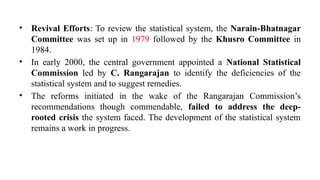
• Revival Efforts:To review the statistical system, the Narain-Bhatnagar
Committee was set up in 1979 followed by the Khusro Committee in
1984.
• In early 2000, the central government appointed a National Statistical
Commission led by C. Rangarajan to identify the deficiencies of the
statistical system and to suggest remedies.
• The reforms initiated in the wake of the Rangarajan Commission’s
recommendations though commendable, failed to address the deep-
rooted crisis the system faced. The development of the statistical system
remains a work in progress.
24.
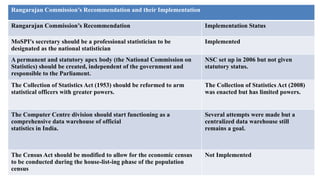
Rangarajan Commission’s Recommendationand their Implementation
Rangarajan Commission’s Recommendation Implementation Status
MoSPI's secretary should be a professional statistician to be
designated as the national statistician
Implemented
A permanent and statutory apex body (the National Commission on
Statistics) should be created, independent of the government and
responsible to the Parliament.
NSC set up in 2006 but not given
statutory status.
The Collection of Statistics Act (1953) should be reformed to arm
statistical officers with greater powers.
The Collection of Statistics Act (2008)
was enacted but has limited powers.
The Computer Centre division should start functioning as a
comprehensive data warehouse of official
statistics in India.
Several attempts were made but a
centralized data warehouse still
remains a goal.
The Census Act should be modified to allow for the economic census
to be conducted during the house-list-ing phase of the population
census
Not Implemented
25.
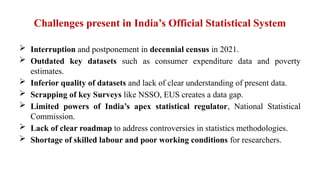
Challenges present inIndia’s Official Statistical System
Interruption and postponement in decennial census in 2021.
Outdated key datasets such as consumer expenditure data and poverty
estimates.
Inferior quality of datasets and lack of clear understanding of present data.
Scrapping of key Surveys like NSSO, EUS creates a data gap.
Limited powers of India’s apex statistical regulator, National Statistical
Commission.
Lack of clear roadmap to address controversies in statistics methodologies.
Shortage of skilled labour and poor working conditions for researchers.
26.
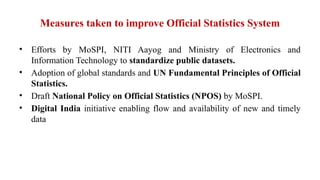
Measures taken toimprove Official Statistics System
• Efforts by MoSPI, NITI Aayog and Ministry of Electronics and
Information Technology to standardize public datasets.
• Adoption of global standards and UN Fundamental Principles of Official
Statistics.
• Draft National Policy on Official Statistics (NPOS) by MoSPI.
• Digital India initiative enabling flow and availability of new and timely
data
27.
Draft National Policyon Official Statistics
Creation of integrated data system with digital survey platform, data
warehouse, and innovation hub.
Optimizing use of administrative statistics for completion of statistical
indicators.
Designing of certain key statistical products such as GDP, Price indices,
SDGs etc. as Core Official Statistics.
Reorientation of planning and development of various surveys to
avoid duplication.
Augmentation of quality of official statistics through periodic review
28.
Way ahead
• Formationof Statistical Reforms Commission.
• Framing a new statistical architecture and strategy.
• Utilizing regular surveys to fill gaps in administrative datasets.
• Strengthening statistical infrastructure for real-time monitoring of the
Indian economy.
• Integrating technology such as artificial intelligence, big data, and cloud
computing with statistics.
• Improving the research ecosystem through capacity building and better
incentives for researchers.
• Setting up of India Data Management Office (IDMO).
29.
Census in India
•In 1872 the first Census was held in India.
• Since then, Census in India held uninterruptedly.
Definition:
• Population Census is the total process of collecting, compiling, analyzing and
• disseminating demographic, economic and social data pertaining, at a specific
time, of all persons in a country or a well-defined part of a country.
• It also provides the trends in population characteristics.
• The Indian Census is one of the largest administrative exercises undertaken in
the world.
29
30.
Nodal Ministry:
• Thedecennial Census is conducted by the Office of the Registrar General and
Census
• Commissioner, Ministry of Home Affairs.
• Until 1951, the Census Organisation was set up on an ad-hoc basis for each
Census.
Legal/Constitutional Backing:
• Census is conducted under the provisions of the Census Act, 1948.
• The bill for this Act was piloted by Sardar Vallabhbhai Patel, the then Home
• Minister of India.
• The population census is a Union subject under Article 246 of India Constitution.
• It is listed at serial number 69 of the seventh schedule of the constitution.
31.
Confidentiality of Information:
•The information collected during the population Census is so confidential
that it is not even accessible to the courts of law.
• The confidentiality is guaranteed by the Census Act, 1948. The law
specifies penalties for both public and census officials for non-compliance
or violation of any provision of the Act
32.
Significance of Census:
•Source of Information: The Indian Census is the largest single source of a variety of
statistical information on different characteristics of the people of India.
• Researchers and Demographers use census data to analyze growth and trends of
population and make projections.
• Good Governance: The data collected through the census is used for administration,
planning and policy making as well as management and evaluation of various
programmes by the Government.
• Demarcation: Census data is also used for demarcation of constituencies and allocation
of representation to Parliament, State legislative assemblies and the local bodies.
• Better Access for Businesses: The census data is also important for business houses and
industries for strengthening and planning their business for penetration into areas,
which had hitherto remained, uncovered.
• Giving Grants: Finance Commission provides grants to the states on the basis of
population figures available from the Census data
33.
History of Census
•Ancient and Medieval Period:
• Rigveda: The earliest literature 'Rig-Veda' reveals that some kind of
population count was maintained during 800-600 BC in India.
• Arthashastra: 'Arthashastra' by 'Kautilya' written in the 3rd Century
BC prescribed the collection of population statistics as a measure of
state policy for taxation.
• Ain-i-Akbari: During the regime of the Mughal king Akbar, the
administrative report 'Ain-e-Akbari' also included comprehensive
data pertaining to population, industry, wealth and many other
characteristics.
34.
Pre-independence Period:
• InitialAttempts:
• The history of the census began with 1800 when England had begun
its Census.
• In its continuation, a census was conducted in Allahabad (1824) and
in Banaras (1827-28) by James Prinsep.
• The first complete census of an Indian city was conducted in 1830
by Henry Walter in Dacca (now Dhaka).
• The Second Census was conducted in 1836-37 by Fort St. George.
35.
• In 1849,the Government of India ordered the local governments to
conduct quinquennial (five-yearly) returns of population.
• First Non-synchronous Census: It was conducted in India in 1872
during the reign of Governor-General Lord Mayo.
• First Synchronous Census: The first synchronous census was taken
under British rule on February 17, 1881, by W.C. Plowden (Census
Commissioner of India).
• Since then, censuses have been undertaken uninterruptedly once
every ten years.
36.
Major Events/Findings inIndia’s Census
1. First Census (1881):
• It laid main emphasis on the classification of demographic, economic and social
characteristics of the entire continent of British India (except Kashmir and French
and Portuguese colonies).
2. Second Census (1891):
• It was conducted almost on the same pattern as of the 1881 census.
• Efforts were made for 100% coverage and the Upper part of present-day Burma,
Kashmir and Sikkim were also included.
3. Third Census (1901):
• In this Census, Balochistan, Rajputana, Andaman Nicobar, Burma, Punjab and
remote areas of Kashmir were also included.
37.
4. Fifth Census(1921):
• The decade of 1911-21 has been the only one till now to witness a decadal
population decline of 0.31%.
• This was the decade that ended in the flu pandemic of 1918 which cost at
least 12 million lives.
• India’s population was continuously increasing until Census 1921 and still
has been doing so after the 1921 Census.
• Therefore, the census year of 1921 is called the year of “The Great Divide”
in the demographic history of India.
38.
5. Eleventh Census(1971):
• It was the second Census after independence.
• It added a question for information on fertility for currently married women.
6. Thirteenth Census (1991):
• It was the fifth Census of independent India.
• In this Census, the concept of literacy was changed and the children of the 7+ age
group were considered literate (as compared to 1981 when children up to the age group
of 4+ were treated as literate).
7. Fourteenth Census (2001):
• It witnessed a quantum leap in the technology front.
• The schedules for the phases were scanned through high speed scanners and
handwritten data from the schedules were converted into digitized form through
Intelligent Character Reading (ICR).
• An ICR captures handwriting from image files. It is an advanced version of Optical
Character Recognition (OCR) technology in which printed characters are captured.
39.
8. Fifteenth Census(2011):
• In the 2011 Census, significant fall in case of EAG States (Empowered action group
states: UP, Uttarakhand, Bihar, Jharkhand, MP, Chhattisgarh, Rajasthan & Orissa)
was noticed for the first time.
9. Sixteenth Census (2021):
• Census 2021 was postponed owing to the outbreak of Covid-19 pandemic.
• However, it will be the first digital Census, also with a provision for self-
enumeration.
• It is for the first time that information of households headed by a person from the
• Transgender Community and members living in the family will be collected.
• Earlier there was a column for male and female only
40.
Socio-Economic and CasteCensus (SECC)
• The Socio-Economic and Caste Census (SECC) was conducted in 2011 for
the first time since 1931.
• It seeks to canvass every Indian family in rural and urban India, and ask
about their:
• Economic status, to allow Central/State authorities to come up with a range
of indicators of deprivation which could be used by each authority to
define a poor or deprived person.
• Specific caste name, to allow the government to re-evaluate which caste
groups are economically worse off and which are better off.
41.
Difference Between Census& SECC:
• Field of Coverage: The Census provides a portrait of the Indian
population while the
• SECC is a tool to identify beneficiaries of state support.
• Confidentiality of Data: The Census data is considered confidential,
whereas the data of SECC is open for use by Government departments to
grant and/or restrict benefits to the people.
42.
Significance of SECC:
•Better Mapping of Inequalities: SECC has the potential to allow for a mapping of
inequalities at a broader level.
• It will be useful to establish statistical justification for preserving caste-based
affirmative action programmes or welfare schemes.
• Legally Imperative: It is also legally imperative as the courts require a ‘quantifiable
data’ to support the existing levels of reservation.
• Constitutional Mandate: The Constitution of India also favours conducting a caste
census.
• Article 340 mandates the appointment of a commission to investigate the conditions
of socially and educationally backward classes and make recommendations as to the
steps that should be taken by government
43.
Associated Concerns withSECC:
• Repercussions of a Caste Census: Caste has an emotive element and thus
there exist the political and social repercussions of a caste census.
• There have been concerns that counting caste may help solidify or harden
• identities.
• Due to these repercussions, nearly a decade after the SECC, a sizable
amount of its data remains unreleased or released only in parts.
• Caste is Context-specific: Caste has never been a proxy for class or
deprivation in India; it constitutes a distinct kind of embedded
discrimination that often transcends class.
44.
Census - Utility
•Only source of primary data at village, town and ward level.
• Valuable information for planning and formulation of polices for Central
& State Governments
• Widely used by National & International agencies, scholars, business
people, industrialists, and many more.
• Delimitation/Reservation of Constituencies -
Parliamentary/Assembly/Panchayats and other Local Bodies
44
45.
• Create acomprehensive identity database in the country
• Help in better targeting of the benefits and services under the Government
schemes / programmes
• Improve planning
• Strengthen security of the country
45
NPR - Utility
46.
o The CitizenshipAct, 1955 and The Citizenship (Registration of
Citizens and Issue of National Identity Cards) Rules, 2003
o The Census Act 1948 and Census Rules
46
Statutory Backing
47.
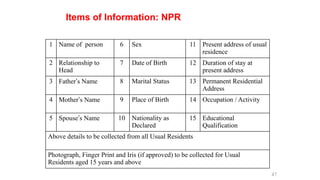
1 Name ofperson 6 Sex 11 Present address of usual
residence
2 Relationship to
Head
7 Date of Birth 12 Duration of stay at
present address
3 Father’s Name 8 Marital Status 13 Permanent Residential
Address
4 Mother’s Name 9 Place of Birth 14 Occupation / Activity
5 Spouse’s Name 10 Nationality as
Declared
15 Educational
Qualification
Above details to be collected from all Usual Residents
Photograph, Finger Print and Iris (if approved) to be collected for Usual
Residents aged 15 years and above
Items of Information: NPR
47
48.
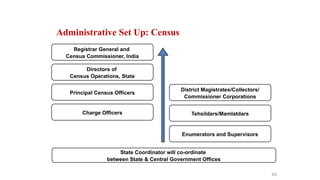
Registrar General and
CensusCommissioner, India
Directors of
Census Operations, State
Principal Census Officers
Charge Officers
State Coordinator will co-ordinate
between State & Central Government Offices
Administrative Set Up: Census
48
District Magistrates/Collectors/
Commissioner Corporations
Tehsildars/Mamlatdars
Enumerators and Supervisors
49.
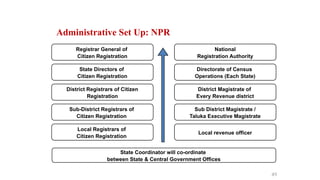
Registrar General of
CitizenRegistration
State Directors of
Citizen Registration
District Registrars of Citizen
Registration
Sub-District Registrars of
Citizen Registration
Local Registrars of
Citizen Registration
National
Registration Authority
Directorate of Census
Operations (Each State)
District Magistrate of
Every Revenue district
Sub District Magistrate /
Taluka Executive Magistrate
Local revenue officer
State Coordinator will co-ordinate
between State & Central Government Offices
Administrative Set Up: NPR
49
50.
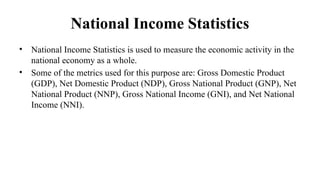
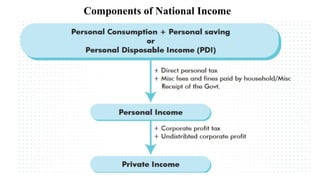
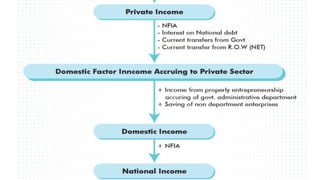
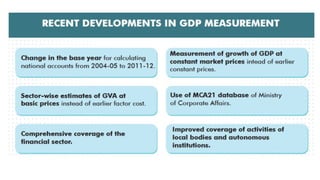
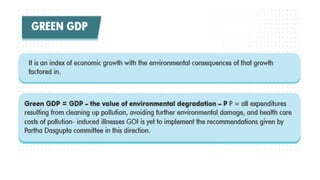
National Income Statistics
•National Income Statistics is used to measure the economic activity in the
national economy as a whole.
• Some of the metrics used for this purpose are: Gross Domestic Product
(GDP), Net Domestic Product (NDP), Gross National Product (GNP), Net
National Product (NNP), Gross National Income (GNI), and Net National
Income (NNI).
51.
DEFINITION OF NATIONALINCOME
•National income is the final outcome of all economic activities of a nation
valued in terms of money.
•National income is the most important macroeconomic variable and
determinant of the business level and environment of a country. The level of
national income determines the level of aggregate demand for goods and
services
•National income is the money value of the end result of all economic
activities of the nation.
•Economic activities generate a large number of goods and services, and make
net addition to the national stock of capital.
53.
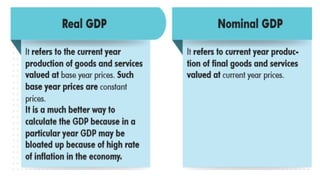
• National incomeis the market value of all final goods and services
produced in country over a period of time, generally one year. In
general, there are three important measures of national income, viz.,
(i) GNP
(ii)GDP
(iii) NNP
• In measuring GNP, income earned abroad by the nationals is added
and income earned
by foreigners in the country is subtracted from national income
estimates; on the contrary, a reverse process is used in estimating GDP.
54.
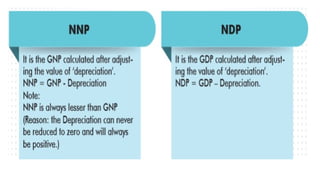
NNP is definedas GNP–Depreciation. Depreciation equals the loss of
national capital in the process of production. There are three methods of
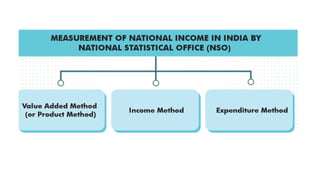
measuring national income:
(i) Value-added method,
(ii) factor-income method
(iii) expenditure method.
The choice of method
depends on the availability of data required for estimating national income.
Often two or all the three methods are combined to estimate national.
income In India, an organization called CSO estimates the national
income. It uses net output and factor
55.
MEASURES OF NATIONALINCOME
1. Gross National Product (GNP):-
The GNP is defined as the value of all final goods and services produced
during a specific period, usually one year, plus incomes earned abroad by the
nationals minus incomes earned locally by the foreigners.
GNP = GNI.
The difference between the two is only of procedural nature. While GNP is
estimated on the basis of product-flows, the GNI is estimated on the basis of
money income flows, (i.e., wages, profits, rent, interest, etc.).
56.
2. Gross DomesticProduct (GDP):-
The Gross Domestic Product (GDP) is defined as the market value of
all final goods and services produced in the domestic economy during
a period of one year plus incomes earned by the nationals
3. Net National Product (NNP):-
1. NNP is defined as GNP less depreciation, i.e., NNP =
GNP – Depreciation.
57.
2. Depreciation isthat part of total productive assets which is used to
replace the capital worn out in the process of creating.
GNP the process of producing goods and services (including capital
goods), a part of total stock of capital is used up . Depreciation’ is the
term used to denote the worn out or used up capital. An estimated value
of depreciation is deducted from the GNP to arrive at NNP.
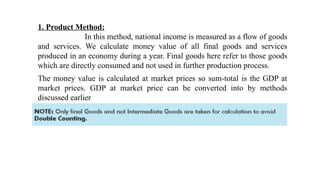
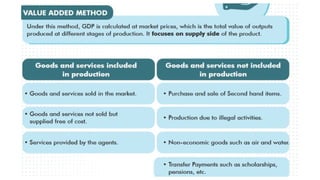
1. Product Method:
Inthis method, national income is measured as a flow of goods
and services. We calculate money value of all final goods and services
produced in an economy during a year. Final goods here refer to those goods
which are directly consumed and not used in further production process.
The money value is calculated at market prices so sum-total is the GDP at
market prices. GDP at market price can be converted into by methods
discussed earlier
69.
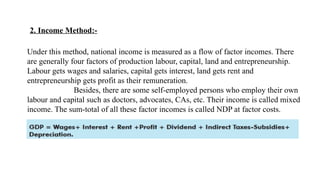
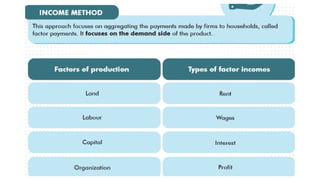
2. Income Method:-
Underthis method, national income is measured as a flow of factor incomes. There
are generally four factors of production labour, capital, land and entrepreneurship.
Labour gets wages and salaries, capital gets interest, land gets rent and
entrepreneurship gets profit as their remuneration.
Besides, there are some self-employed persons who employ their own
labour and capital such as doctors, advocates, CAs, etc. Their income is called mixed
income. The sum-total of all these factor incomes is called NDP at factor costs.
71.
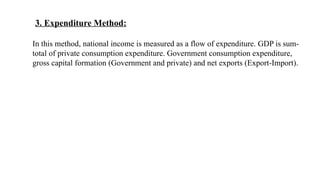
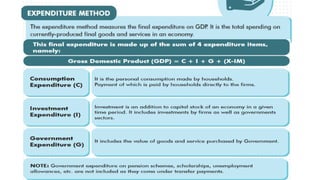
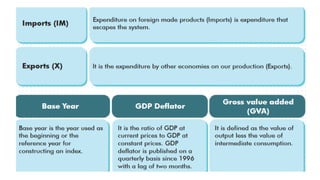
3. Expenditure Method:
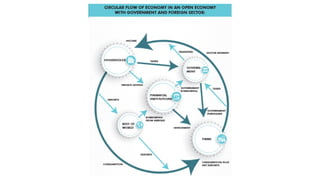
Inthis method, national income is measured as a flow of expenditure. GDP is sum-
total of private consumption expenditure. Government consumption expenditure,
gross capital formation (Government and private) and net exports (Export-Import).
75.
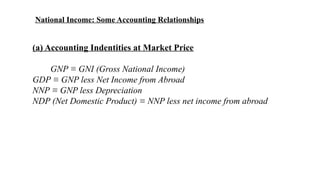
National Income: SomeAccounting Relationships
(a) Accounting Indentities at Market Price
GNP ≡ GNI (Gross National Income)
GDP ≡ GNP less Net Income from Abroad
NNP ≡ GNP less Depreciation
NDP (Net Domestic Product) ≡ NNP less net income from abroad
76.
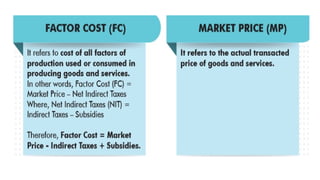
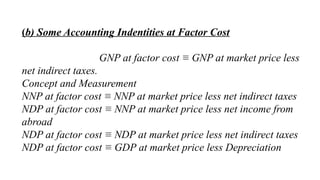
(b) Some AccountingIndentities at Factor Cost
GNP at factor cost ≡ GNP at market price less
net indirect taxes.
Concept and Measurement
NNP at factor cost ≡ NNP at market price less net indirect taxes
NDP at factor cost ≡ NNP at market price less net income from
abroad
NDP at factor cost ≡ NDP at market price less net indirect taxes
NDP at factor cost ≡ GDP at market price less Depreciation
77.
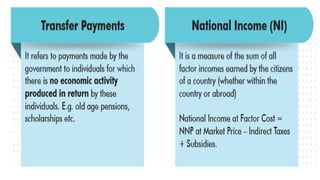
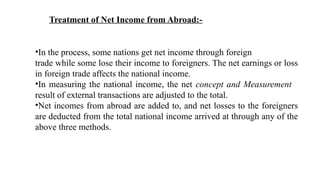
Treatment of NetIncome from Abroad:-
•In the process, some nations get net income through foreign
trade while some lose their income to foreigners. The net earnings or loss
in foreign trade affects the national income.
•In measuring the national income, the net concept and Measurement
result of external transactions are adjusted to the total.
•Net incomes from abroad are added to, and net losses to the foreigners
are deducted from the total national income arrived at through any of the
above three methods.
78.
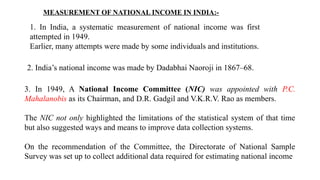
MEASUREMENT OF NATIONALINCOME IN INDIA:-
1. In India, a systematic measurement of national income was first
attempted in 1949.
Earlier, many attempts were made by some individuals and institutions.
2. India’s national income was made by Dadabhai Naoroji in 1867–68.
3. In 1949, A National Income Committee (NIC) was appointed with P.C.
Mahalanobis as its Chairman, and D.R. Gadgil and V.K.R.V. Rao as members.
The NIC not only highlighted the limitations of the statistical system of that time
but also suggested ways and means to improve data collection systems.
On the recommendation of the Committee, the Directorate of National Sample
Survey was set up to collect additional data required for estimating national income
79.
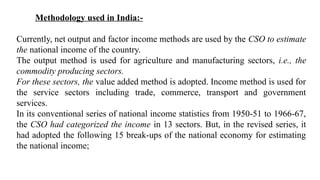
Methodology used inIndia:-
Currently, net output and factor income methods are used by the CSO to estimate
the national income of the country.
The output method is used for agriculture and manufacturing sectors, i.e., the
commodity producing sectors.
For these sectors, the value added method is adopted. Income method is used for
the service sectors including trade, commerce, transport and government
services.
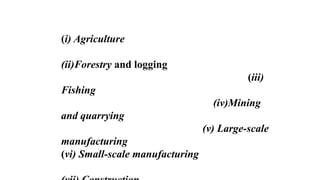
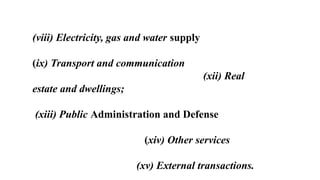
In its conventional series of national income statistics from 1950-51 to 1966-67,
the CSO had categorized the income in 13 sectors. But, in the revised series, it
had adopted the following 15 break-ups of the national economy for estimating
the national income;
(viii) Electricity, gasand water supply
(ix) Transport and communication
(xii) Real
estate and dwellings;
(xiii) Public Administration and Defense
(xiv) Other services
(xv) External transactions.

![• National Statistical Commission (NSC)- The government constituted the
NSC in 2006 as an apex advisory body on statistical matters on the
recommendations of C. Rangarajan Commission.
• Place in Seventh Schedule: The subject ‘Statistics’ is covered in both the
Union and Concurrent list in the Seventh Schedule of the Constitution of India
[Entry 94 of the Union List (List – I) and Entry 45 of Concurrent List (List –
III)].
• Legislations: Exclusive statistical laws apart from the above ecosystem include
the Census Act, 1948; the Registration of Births and Deaths Act, 1969; the
Collection of Statistics Act, 2008.](https://image.slidesharecdn.com/economicstatisticsandofficialstatistics-250606072225-05bec77e/85/Economic-Statistics-and-official-statistics-pptx-10-320.jpg)