LATCHES
Presented by
MD.SAYED HASAN
1
CONTENT
 What is latches
 Label sensitive device
 MUX based Latches
 Types of latches
2
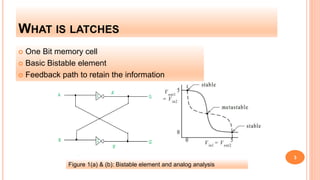
WHAT IS LATCHES
 One Bit memory cell
 Basic Bistable element
 Feedback path to retain the information
Figure 1(a) & (b): Bistable element and analog analysis
3
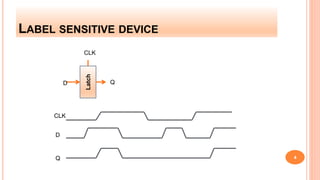
LABEL SENSITIVE DEVICE
Latch
D
CLK
Q
D Q
CLK
4
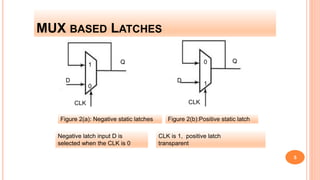
MUX BASED LATCHES
CLK CLK
D D
QQ 0
1
1
0
Figure 2(a): Negative static latches
Negative latch input D is
selected when the CLK is 0
Figure 2(b):Positive static latch
CLK is 1, positive latch
transparent
5
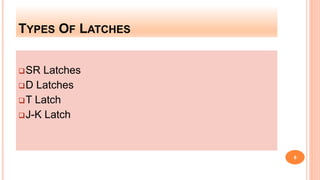
TYPES OF LATCHES
SR Latches
D Latches
T Latch
J-K Latch
6
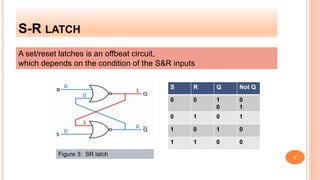
S-R LATCH
S R Q Not Q
0 0 1
0
0
1
0 1 0 1
1 0 1 0
1 1 0 0
A set/reset latches is an offbeat circuit,
which depends on the condition of the S&R inputs
Figure 3: SR latch 7
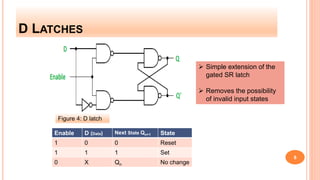
D LATCHES
Enable D (Data) Next State Qn+1 State
1 0 0 Reset
1 1 1 Set
0 X Qn No change
 Simple extension of the
gated SR latch
 Removes the possibility
of invalid input states
Figure 4: D latch
8
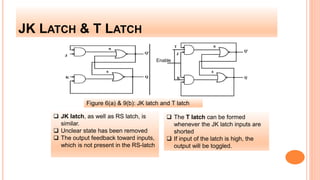
JK LATCH & T LATCH
Enable
 JK latch, as well as RS latch, is
similar.
 Unclear state has been removed
 The output feedback toward inputs,
which is not present in the RS-latch
 The T latch can be formed
whenever the JK latch inputs are
shorted
 If input of the latch is high, the
output will be toggled.
Figure 6(a) & 9(b): JK latch and T latch
9
APPLICATION
 Keep the conditions of the bits to encode binary
 Widely used in computing as well as data storage
 D latches are applicable for asynchronous systems
 Data latches are used in synchronous two-phase systems for
reducing the transit count.
These are the building blocks for sequential circuit.
10
ADVANTAGES & DISADVANTAGES
 Very flexible compare Flip Flop
 Latches utilize less power
 Small and occupies less area
 High-speed circuit because asynchronous design no CLK
 Chance to affect to
race conditions.
 Chance of meta-stability
 Difficult for testing and analyzing
11
12
THANK
YOU

Latches

  • 1.
  • 2.
    CONTENT  What islatches  Label sensitive device  MUX based Latches  Types of latches 2
  • 3.
    WHAT IS LATCHES One Bit memory cell  Basic Bistable element  Feedback path to retain the information Figure 1(a) & (b): Bistable element and analog analysis 3
  • 4.
  • 5.
    MUX BASED LATCHES CLKCLK D D QQ 0 1 1 0 Figure 2(a): Negative static latches Negative latch input D is selected when the CLK is 0 Figure 2(b):Positive static latch CLK is 1, positive latch transparent 5
  • 6.
    TYPES OF LATCHES SRLatches D Latches T Latch J-K Latch 6
  • 7.
    S-R LATCH S RQ Not Q 0 0 1 0 0 1 0 1 0 1 1 0 1 0 1 1 0 0 A set/reset latches is an offbeat circuit, which depends on the condition of the S&R inputs Figure 3: SR latch 7
  • 8.
    D LATCHES Enable D(Data) Next State Qn+1 State 1 0 0 Reset 1 1 1 Set 0 X Qn No change  Simple extension of the gated SR latch  Removes the possibility of invalid input states Figure 4: D latch 8
  • 9.
    JK LATCH &T LATCH Enable  JK latch, as well as RS latch, is similar.  Unclear state has been removed  The output feedback toward inputs, which is not present in the RS-latch  The T latch can be formed whenever the JK latch inputs are shorted  If input of the latch is high, the output will be toggled. Figure 6(a) & 9(b): JK latch and T latch 9
  • 10.
    APPLICATION  Keep theconditions of the bits to encode binary  Widely used in computing as well as data storage  D latches are applicable for asynchronous systems  Data latches are used in synchronous two-phase systems for reducing the transit count. These are the building blocks for sequential circuit. 10
  • 11.
    ADVANTAGES & DISADVANTAGES Very flexible compare Flip Flop  Latches utilize less power  Small and occupies less area  High-speed circuit because asynchronous design no CLK  Chance to affect to race conditions.  Chance of meta-stability  Difficult for testing and analyzing 11
  • 12.