SALAL MOHAMMAD
B.OPTOM (2ND YEAR)
LASER OPTICS
CONTENTS
• HISTORY
• INTRODUCTION
• PRINCIPLE
• APPLICATION
• CHARACTERSTICS
• USES
• TYPES
• ELEMENTS OF LASER
HISTORY
• Invented in 1958 by Charles Townes (N.P.1964) and Arthur
Schawlow.
• Based on Einstein’s idea of the particle wave duality of light.
• Originally called MASER (M=microwave).
INTRODUCTION
• LASER = Light Amplification by Stimulated Emission of
Radiation.
• Laser is an electric device that produced light (EM
radiation), through a process of optical amplification.
• When they return to lower energy levels by stimulated
emission ,they emit energy.
APPLICATION
• These application are used in CD, DVD, ROM.
• They are also used in barcode scanner.
• Used as an integral part of nuclear fusion.
• It is also used for alignment welding, swolding,
drilling, and surface treatment in the medical
equipment and cosmetic treatment also.
PRINCIPLE
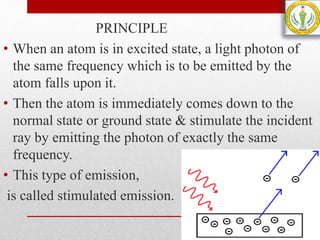
• When an atom is in excited state, a light photon of
the same frequency which is to be emitted by the
atom falls upon it.
• Then the atom is immediately comes down to the
normal state or ground state & stimulate the incident
ray by emitting the photon of exactly the same
frequency.
• This type of emission,
is called stimulated emission.
CHARACTERSTICS
• Laser light is highly Coherent
• Laser light is highly Monochromaticity
• Laser light is having Directionality
• These rays go to long distance without absorption.
• They are not absorb in water
• Laser beam can vaporized even the hardest material
• The colour of laser light can be changed
• Brightness
USES
 In the technique field-
• The laser beam is used for cutting steel, sheets, melting and
drilling of hard materials.
• It can create hole in diamond.
 In the medical field-
• The laser beam is used in delicate surgery as corneal grafting
with laser beam, and it’s completed in much shorter time.
• It is also used for laser treatment of retina & iris.
• It is also used in treatment of kidney stone, cancer, tumours
and depositing ,cutting the blood cells in the brain operation.
 During war times-
• Laser are used to detect and destroyed the enemy messiles.
• Used in laser pistols.
• In space laser has been use to controlled rockets, satellites and
unidirectional radio communication.
In science and research-
• It can be used to determine temperature of plasma and density of the
electrons laser torch is used to see objects as long distance.
Laser is used for 3D photography or holography.
There are used in measuring long distance ,the distance b/w earth and
moon has been measured by laser beam.
It is useful to detecting nuclear exposure and earthquakes in vaporizing
solid fuels of rocket.
Used to study od the surface of the distant planets and satellites.
TYPES
They are many types of laser-
• Gas laser
• Solid laser
• Liquid laser
• Semi conductor laser
• Dyes laser
• Metal vapour laser
• Excimer laser
• YAG laser
• Argon laser
Gas laser-
• These laser contains a mixture of He & Ne.
• This mixture is packed up into a glass tube.
• This packed mixture acts as an active medium.
• It is also k/a coherent light wave.
Solid laser-
• In this a ruby like crystal is used which acts as an active
medium.
• It is basically cylindrical in shape.
• The crystal is surrounded by a xenon flash pump.
• The flash pump is helical in shape.
Liquid laser-
• In this laser organic dyes are used as active medium inside the glass
tube.
Semi conductor laser-
• Sometimes semi conductor is c/d diode laser are not solid state laser.
• E.g.- the writing source in some laser printers or CD players, in these
laser junction diode are used.
• There is p-n junction diode is also used.
Dyes laser-
• This type of laser is used in laser medicine, spectroscopy, birthmark
removal, isotopes separation and research field.
Metal vapour laser-
• This type of metal laser are present in which are used in printing,
scientific, research, ametour laser, construction, dermatological used
,high speed photography etc.
• It include gold vapour laser, Cu laser ,Ne-Cu metal vapour laser ,He-
Cd laser ,He-Se laser ,He-Ag metal vapour laser.
Excimer laser-
• The excimer laser invented by Nikoloi Basove, 1970.
• An excimer laser is a form of UV laser which is commonly used in the
production of microelectronic division, eye surgery and
micromachining.
• It is also c/d Exiplox laser
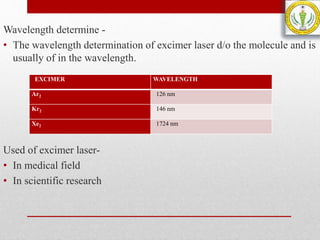
Wavelength determine -
• The wavelength determination of excimer laser d/o the molecule and is
usually of in the wavelength.
Used of excimer laser-
• In medical field
• In scientific research
EXCIMER WAVELENGTH
Ar2 126 nm
Kr2 146 nm
Xe2 1724 nm
YAG laser-
• YAG =yttrium aluminium-garnet
• Laser operation of YAG was first demonstrated by J.E.Geusic et
al.,1964.
• YAG is a crystal i.e used a lasing medium for solid state laser.
• It is the neodymium ion which provides the lasing activity in the
crystal,in the same fashion as red chromium ion in ruby laser.
Argon laser-
• Ar laser is a laser system that uses noble gas as the active medium.
• Ar gas laser are used in many application such as forensic
medicine,general surgery, ophthalmic surgery and holography.
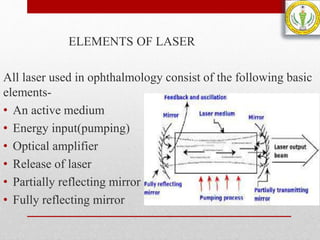
ELEMENTS OF LASER
All laser used in ophthalmology consist of the following basic
elements-
• An active medium
• Energy input(pumping)
• Optical amplifier
• Release of laser
• Partially reflecting mirror
• Fully reflecting mirror
An active medium-
• An active medium in laser provides an atomic or molecular
environment.
• Due to presence of this medium ,a large number of atoms in the active
medium( solid ,liquid or gas ) get energized above their original
ground state on stimulation by a photon of light followed by stimulated
emission.
Energy input(pumping)-
• Lasers systems also requires a source of energy to keep majority of
atoms in an energy state higher than their original ground state in the
active medium.
• This state is termed as population inversion.
Optical amplifier-
• Third requirement for a laser system is optical amplification where is
light amplified by an optical feedback system.
• Release of laser-
• Laser system also contains mechanism to release laser beam from the
laser cavity.
• Releasing of laser is achieved by making one mirror fully reflective
and another mirror partially reflective.
• Those amplified stimulated light waves which strike the partially
reflecting mirror gets emitted from the laser cavity as laser beam.
Laser optics

Laser optics

  • 1.
    SALAL MOHAMMAD B.OPTOM (2NDYEAR) LASER OPTICS
  • 2.
    CONTENTS • HISTORY • INTRODUCTION •PRINCIPLE • APPLICATION • CHARACTERSTICS • USES • TYPES • ELEMENTS OF LASER
  • 3.
    HISTORY • Invented in1958 by Charles Townes (N.P.1964) and Arthur Schawlow. • Based on Einstein’s idea of the particle wave duality of light. • Originally called MASER (M=microwave). INTRODUCTION • LASER = Light Amplification by Stimulated Emission of Radiation. • Laser is an electric device that produced light (EM radiation), through a process of optical amplification. • When they return to lower energy levels by stimulated emission ,they emit energy.
  • 4.
    APPLICATION • These applicationare used in CD, DVD, ROM. • They are also used in barcode scanner. • Used as an integral part of nuclear fusion. • It is also used for alignment welding, swolding, drilling, and surface treatment in the medical equipment and cosmetic treatment also.
  • 5.
    PRINCIPLE • When anatom is in excited state, a light photon of the same frequency which is to be emitted by the atom falls upon it. • Then the atom is immediately comes down to the normal state or ground state & stimulate the incident ray by emitting the photon of exactly the same frequency. • This type of emission, is called stimulated emission.
  • 6.
    CHARACTERSTICS • Laser lightis highly Coherent • Laser light is highly Monochromaticity • Laser light is having Directionality • These rays go to long distance without absorption. • They are not absorb in water • Laser beam can vaporized even the hardest material • The colour of laser light can be changed • Brightness
  • 7.
    USES  In thetechnique field- • The laser beam is used for cutting steel, sheets, melting and drilling of hard materials. • It can create hole in diamond.  In the medical field- • The laser beam is used in delicate surgery as corneal grafting with laser beam, and it’s completed in much shorter time. • It is also used for laser treatment of retina & iris. • It is also used in treatment of kidney stone, cancer, tumours and depositing ,cutting the blood cells in the brain operation.
  • 8.
     During wartimes- • Laser are used to detect and destroyed the enemy messiles. • Used in laser pistols. • In space laser has been use to controlled rockets, satellites and unidirectional radio communication. In science and research- • It can be used to determine temperature of plasma and density of the electrons laser torch is used to see objects as long distance. Laser is used for 3D photography or holography. There are used in measuring long distance ,the distance b/w earth and moon has been measured by laser beam. It is useful to detecting nuclear exposure and earthquakes in vaporizing solid fuels of rocket. Used to study od the surface of the distant planets and satellites.
  • 9.
    TYPES They are manytypes of laser- • Gas laser • Solid laser • Liquid laser • Semi conductor laser • Dyes laser • Metal vapour laser • Excimer laser • YAG laser • Argon laser
  • 10.
    Gas laser- • Theselaser contains a mixture of He & Ne. • This mixture is packed up into a glass tube. • This packed mixture acts as an active medium. • It is also k/a coherent light wave. Solid laser- • In this a ruby like crystal is used which acts as an active medium. • It is basically cylindrical in shape. • The crystal is surrounded by a xenon flash pump. • The flash pump is helical in shape.
  • 11.
    Liquid laser- • Inthis laser organic dyes are used as active medium inside the glass tube. Semi conductor laser- • Sometimes semi conductor is c/d diode laser are not solid state laser. • E.g.- the writing source in some laser printers or CD players, in these laser junction diode are used. • There is p-n junction diode is also used. Dyes laser- • This type of laser is used in laser medicine, spectroscopy, birthmark removal, isotopes separation and research field.
  • 12.
    Metal vapour laser- •This type of metal laser are present in which are used in printing, scientific, research, ametour laser, construction, dermatological used ,high speed photography etc. • It include gold vapour laser, Cu laser ,Ne-Cu metal vapour laser ,He- Cd laser ,He-Se laser ,He-Ag metal vapour laser. Excimer laser- • The excimer laser invented by Nikoloi Basove, 1970. • An excimer laser is a form of UV laser which is commonly used in the production of microelectronic division, eye surgery and micromachining. • It is also c/d Exiplox laser
  • 13.
    Wavelength determine - •The wavelength determination of excimer laser d/o the molecule and is usually of in the wavelength. Used of excimer laser- • In medical field • In scientific research EXCIMER WAVELENGTH Ar2 126 nm Kr2 146 nm Xe2 1724 nm
  • 14.
    YAG laser- • YAG=yttrium aluminium-garnet • Laser operation of YAG was first demonstrated by J.E.Geusic et al.,1964. • YAG is a crystal i.e used a lasing medium for solid state laser. • It is the neodymium ion which provides the lasing activity in the crystal,in the same fashion as red chromium ion in ruby laser. Argon laser- • Ar laser is a laser system that uses noble gas as the active medium. • Ar gas laser are used in many application such as forensic medicine,general surgery, ophthalmic surgery and holography.
  • 15.
    ELEMENTS OF LASER Alllaser used in ophthalmology consist of the following basic elements- • An active medium • Energy input(pumping) • Optical amplifier • Release of laser • Partially reflecting mirror • Fully reflecting mirror
  • 16.
    An active medium- •An active medium in laser provides an atomic or molecular environment. • Due to presence of this medium ,a large number of atoms in the active medium( solid ,liquid or gas ) get energized above their original ground state on stimulation by a photon of light followed by stimulated emission. Energy input(pumping)- • Lasers systems also requires a source of energy to keep majority of atoms in an energy state higher than their original ground state in the active medium. • This state is termed as population inversion.
  • 17.
    Optical amplifier- • Thirdrequirement for a laser system is optical amplification where is light amplified by an optical feedback system. • Release of laser- • Laser system also contains mechanism to release laser beam from the laser cavity. • Releasing of laser is achieved by making one mirror fully reflective and another mirror partially reflective. • Those amplified stimulated light waves which strike the partially reflecting mirror gets emitted from the laser cavity as laser beam.