LASERS IN BIOLOGY
AND MEDICINE
Submitted by,
NAVAMI S S
1st yr MSc. Biochemistry
Department of Life Sciences
Introduction
 Lasers are superior to LEDs and widely used as dedicated light
sources in various high perfomance applications.
 Laser is a device which amplifies light radiation which is
obtained by stimulated emission process and Laser light is
monochromatic, bright unidirectional and coherent.
 Lasers are used in various applications such as in medicinal
field, Communication, industries, science & technology etc.
LASERS
LASER stands for Light Amplification by Stimulated Emission of
Radiation Laser is a device that amplifies or increases the
intensity. Light and produces highly directional light. Laser not
only amplifies or increases the intensity of light but also
generates the light. Some lasers generate visible light but others
generate ultraviolet or infrared rays which are invisible.
In general, when electron jumps from a higher energy level to a
lower energy level, it emits light or photon. The energy of the
emitted photon is equal to the energy difference between the
energy levels. The loss of è energy is attributed to the entire
atom. Therefore it can be thought that the atom is moving from
a higher energy state to a lower energy state.Laser light is
different from the conventional light. Laser light has extra
ordinary properties which are not present in the ordinary light
sources like sun and incandescent lamp.
The conventional light sources such as electric bulb or tube light
does not emit highly directional and coherent light whereas later
produce highly directional, monochromatic, coherent and polarized
light beams. In conventional light sources, excited electrons emit
light at different times and in different directions so there is no
phase relation between the emitted photons.
On the other hand, the photons emitted by the electrons of lasers
are in same phase and move in the same direction. Einstein gave the
theoretical basic for the development of laser in 1917, when be
predicted the possibility of stimulated emission.
In 1954, C. H. Townes and his co-workers put Einstein’s prediction
for practical realization. Buy developed a microwave amplifies based
on stimulated emission of radiation. It was called as MASER
(Microwave Amplification by Stimulated Emission of Radiation.
Maser operates on principles Similar to laser but generates
microwaves rather than light radiation.
In 1958, CH. Townes and A. Schawlow extended the principle of
masers to light. In 1960, T.H. Maiman built the fight laser device.
Laser principle can be understood from Bohr’s model. Light is
made up of particles called “photons”. Each photon has energy (E)
expressed as follows:
 E h = v ;where v is the frequency of the light and h is Planck’s
constant.
 λv = c ;where λ is the wavelength of the light and c is the
speed of light in a vacuum.
 E = hc/λ
 The figure depicts three process viz absorption, spontaneous
emission and stimulated emissions.
 Absorption:- For an atom to absorb light the energy of
single photon must be equal, almost exactly. The energy
difference between the two states. Hence wavelength of
photon must be λ = hc/∆E, where ∆E= Em – En.
 Spontaneous emission: when electron from it & excited
energy state decays to lower level it gives off photon of
radiation. This is known as spontaneous emission.
 Stimulated emission: In this process, photon is emitted at
exactly the same wavelength, exactly same direction and
exactly the same phase as the passing photon. For stimulated
emission to dominate, there must be more atoms in excited
states than in ground state. Such a configuration of atoms is
called a population inversion.
 The construction of a typical red LASER is shown in the figure;
Construction &
Working
 It contains a long crystal made of ruby with a flash tube (which is
not shown for Simplicity, instead directly pump light is shown)
wrapped around it. Here, a high voltage electric power supply
makes the tube flash on and off. When the tube flashes, it pumps
energy into the ruby crystal.
 The flashes it makes Inject energy into the crystal in the form of
photons. The atoms of the ruby crystal absorb this energy and
thus the electrons of the atoms jump to a higher energy level.
 After few milliseconds, the electrons return to their ground level
by giving off a photon of light, this is known as spontaneous
emission.
 The Photons that atoms give off zoom up and down, inside the
ruby crystal and travelling at a speed of light. One of these
photons stimulate an already existing atom. When this happens,
the excited atom gives off a photon and get the orginal Photon
as well. This is known as stimulated emission.
 One photon of light has produced two photons. So the light has
Components of LASER
1.Active Medium:
It is the material in which the laser action takes place. The active
medium may be solid crystals such as ruby or Nd:YAG, liquid dyes,
gases like CO2 or Helium / Neon, or semiconductors such as GaAs. This
medium decides the wavelength of laser radiation. Active mediums
contain atoms which can produce more stimulated emission than
spontaneous emission and cause amplification they are called “Active
Centers”.
2. Pumping Energy Source (Excitation Mechanism):
Energy Source (Excitation mechanisms) pumps the active centers from
ground state to excited state to achieve population inversion. The
pumping by energy source can be optical, electrical or chemical
depending on the active medium.
3. Resonance Cavity:
Resonance cavity consists of active medium enclosed between
two mirrors one is highly reflective mirror (100% reflective)
and the other is partially transmissive mirror (99% reflective).
Characteristics of LASER
Laser light has four unique characteristics that differentiate it from ordinary
light: these are;
1. Coherence
2. Directionality
3. Monochromatic
4. High intensity
1. Coherence
 Visible light is emitted when excited electrons (electrons in
higher energy level) jumped into the lower energy level (ground
state). The process of electrons moving from higher energy level
to lower energy level or lower energy level to higher energy level
is called electron transition.
 In ordinary light sources (lamp, sodium lamp and torch light),
the electron transition occurs naturally. In other words,
electron transition in ordinary light sources is random in time.
The photons emitted from ordinary light sources have
different energies, frequencies, wavelengths, or colors. Hence,
the light waves of ordinary light sources have many
wavelengths. Therefore, photons emitted by an ordinary light
source are out of phase.
 In laser, the electron transition occurs artificially. In other
words, in laser, electron transition occurs in specific time. All
the photons emitted in laser have the same energy,
frequency, or wavelength. Hence, the light waves of laser light
have single wavelength or color. Therefore, the wavelengths
of the laser light are in phase in space and time. In laser, a
technique called stimulated emission is used to produce light.
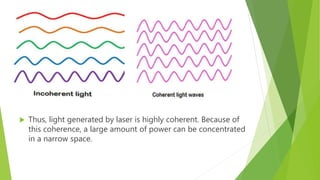
 Thus, light generated by laser is highly coherent. Because of
this coherence, a large amount of power can be concentrated
in a narrow space.
2. Directionality
 In conventional light sources (lamp, sodium lamp and
torchlight), photons will travel in random direction.
Therefore, these light sources emit light in all directions. On
the other hand, in laser, all photons will travel in same
direction. Therefore, laser emits light only in one direction.
This is called directionality of laser light. The width of a laser
beam is extremely narrow. Hence, a laser beam can travel to
long distances without spreading.
 If an ordinary light travels a distance of 2 km, it spreads to
about 2 km in diameter. On the other hand, if a laser light
travels a distance of 2 km, it spreads to a diameter less than
2 cm.
3. Monochromatic
 Monochromatic light means a light containing a single color or
wavelength.
 The photons emitted from ordinary light sources have different
energies, frequencies, wavelengths, or colors. Hence, the light
waves of ordinary light sources have many wavelengths or colors.
Therefore, ordinary light is a mixture of waves having different
frequencies or wavelengths.
 But in laser, all the emitted photons have the same energy,
frequency, or wavelength. Hence, the light waves of laser have
single wavelength or color. Therefore, laser light covers a very
narrow range of frequencies or wavelengths.
4. High Intensity
 The intensity of a wave is the energy per unit time flowing
through a unit normal area.
 In an ordinary light source, the light spreads out uniformly in all
directions.
 In laser, the light spreads in small region of space and in a small
wavelength range.
 Hence, laser light has greater intensity when compared to the
ordinary light.
 Thus, these four properties of laser beam enable us to cut a huge
block of steel by melting. They are also used for recording and
reproducing large information on a compact disc (CD).
Applications of LASERS
Laser is an optical device that generates intense beam of coherent
monochromatic light by stimulated emission of radiation. Laser
light is different from an ordinary light. It has various unique
properties such as coherence, monochromatic, directionality, and
high intensity. Because of these unique properties, lasers are used
in various applications. The most significant applications of lasers
include:
1. Lasers in medicine
2. Lasers in communications
3. Lasers in industries
4. Lasers in science and technology
5. Lasers in military
1.Lasers in Medicine
 Lasers are used for bloodless surgery.
 Lasers are used to destroy kidney stones.
 Lasers are used in cancer diagnosis and therapy.
 Lasers are used for eye lens curvature corrections.
 Lasers are used in fiber-optic endoscope to detect ulcers in the intestines.
 The liver and lung diseases could be treated by using lasers.
 Lasers are used to study the internal structure of microorganisms and cells.
 Lasers are used to produce chemical reactions.
 Lasers are used to create plasma.
 Lasers are used to remove tumors successfully.
 Lasers are used to remove the caries or decayed portion of the teeth.
 Lasers are used in cosmetic treatments such as acne treatment, cellulite
and hair removal.
2.Lasers in Communications
 Laser light is used in optical fiber communications to send information over large
distances with low loss.
 Laser light is used in underwater communication networks.
 Lasers are used in space communication, radars and satellites.
3.Lasers in Industries
 Lasers are used to cut glass and quartz and it is used in electronic industries for
trimming the components of Integrated Circuits (Ics).
 Lasers are used for heat treatment in the automotive industry.
 Laser light is used to collect the information about the prefixed prices of various
products in shops and business establishments from the bar code printed on the
product.
 Ultraviolet lasers are used in the semiconductor industries for photolithography.
Photolithography is the method used for manufacturing printed circuit board (PCB)
and microprocessor by using ultraviolet light.
 Lasers are used to drill aerosol nozzles and control orifices within the required
4.Lasers in Science and Technology
 A laser helps in studying the Brownian motion of particles.
 With the help of a helium-neon laser, it was proved that the velocity of light is
same in all directions.
 With the help of a laser, it is possible to count the number of atoms in a
substance.
 Lasers are used in computers to retrieve stored information from a Compact
Disc (CD).
 Lasers are used to store large amount of information or data in CD-ROM.
 Lasers are used to measure the pollutant gases and other contaminants of the
atmosphere.
 Lasers helps in determining the rate of rotation of the earth accurately.
 Lasers are used in computer printers.
 Lasers are used for producing three-dimensional pictures in space without the
use of lens.
 Lasers are used for detecting earthquakes and underwater nuclear blasts.
 A gallium arsenide diode laser can be used to setup an invisible fence to protect
an area.
5.Lasers in Military
 Laser range finders are used to determine the distance to an
object.
 The ring laser gyroscope is used for sensing and measuring very
small angle of rotation of the moving objects.
 Lasers can be used as a secretive illuminators for reconnaissance
during night with high precision.
 Lasers are used to dispose the energy of a warhead by
damaging the missile.
 Laser light is used in LIDAR’s to accurately measure the distance
to an object
ADVANTAGES
 LASER light travels to very long
distances without distortion.
 LASER has high information
carrying capability. Therefore, it
can be used in data
communication.
 It is free from electromagnetic
interference
 LASER provides minimum signal
leakage.
 LASER light is less harmful than
DISADVANTAGES
• LASER devices are very costly.
• While using LASER, Safety
precautions needed.
• LASER can damage the human
organs.
• LASER requires other
equipment like operating
Equipment and control gears
etc.
Different types of LASERS
Based on structure and principle of operation, Laser types are
categorised as follows:
 By active media, there are various types which include
semiconductor laser, solid state laser, gas laser, liquid laser or dye
laser etc.
 By mode of operation, there are two types; CW Laser and pulsed
laser. CW (continuous wave) Laser produces beam of constant
amplitude In normal pulsed laser, the excitation mechanism is
pulsed and laser is produced for shoot time while pumping
energy is great enough to keep the active medium above the gain
threshold.
 By pumping and laser levels, there are 2 types. Viz. 3-level laser
and hi-level laser.
Laser can also be classified based on other. Parameters such as gain
1.Semiconductor Laser
 Semiconductor lasers are compact in size as they are made
using semiconductor materials on nanometer scale accuracy. It
is similar to transistor and has operation like LED, but the output
beam has characteristics of laser light.
 The material most often used in semiconductor laser is GaAs
(Gallium Arsenide). Hence it is known as gallium arsenide laser.
It is also called as injection laser.
 The figure-1 depicts simple semiconductor p-n junction
structure known as homojunction laser diode.
 Based on their construction and materials used,
Semiconductor laser types include simple homojunction laser
diode, DH (Double Heterojunction) laser, QW (Quantum
Well) laser, DFB ( Distributed Feedback ) laser, Tunable laser,
Surface emitting laser etc.
 Based on types of laser, it is used in various applications such
as storing information in CDs and DVDs, high speed
transmission of information over fiber optic cable, welding,
surgery, military, holography etc.
 Semiconductor laser can be pulsed at varying rate and pulse
widths. Hence it is used as natural transmitter of digital data.
Advantages
 It employs passive cooling
technique in its design.
 It cosumes less power.
 It is very efficient. It offers excellent
efficiency with very high operation
duration.
 It is very easy in operation.
 Semiconductor lasers are cheap and
economical to afford.
 It offers long life, highly
monochromatic, tunable and
continuous beam.
 It is simple in design/construction
and compact in size. Mirrors are not
required unlike other laser types
Disadvantage
s
• This laser is not suited for many
applications due to its low power
production.
• The temperature affects its
output.
• The output beam profile has
unusual shape due to lasing
medium’s too short size and
rectangular shape.
• Beam divergence is much greater
compare to other laser types.
• Its cooling requirement is
considered to be its drawback in
some cases.
2.Solid State Lasers
 They are high power lasers and used for industrial applications
such as welding, drilling, cutting, molding etc. These applications
require very high power with peak value in kilowatts to
megawatts. Solid state lasers use high density solid media as
active laser materials.
Eg: Ruby laser, Nd:Yag laser
RUBY LASER
 It is solid state laser type used for high power applications such
as welding, cutting, drilling, molding etc.
 Following criterion are required for the operation of solid state
laser. By following these criterion, sufficient carriers are pumped
from ground state to metastable state and then allowed for
lasing action.
1. Two energy levels in active amplifying medium are required. Doped
2. Pumping or carrier inversion is necessary for stimulated emission. This is achieved by high
energy flash light excitation.
3. Optical feedback using external mirror or crystal of electro-optic type.
4. Cooling arrangement.
 The ruby laser uses ruby crystal as active or amplifying medium made from
aluminium oxide doped with chromium (Cr). The chromium ions (Cr+3) take
the site of Al in Al2O3 lattice, which provides metastable energy states in solid
state medium.
 It consits of cylindrical crystal ruby rod and cylidrical flash lamp housed along
focal lines of elliptical reflector. Hence reflected light from the lamp excites
crystal rod effectively.
 Here population inversion is achieved by flash lamp irradiation of
ruby rods. It is made of quartz tube filled with noble gas. Helical
type flash lamp is employed in certain special ruby laser types for
more effective carrier pumping.
 Water coolant is necessary for stability of this high power laser
system.
 Flash light intensity depends on several factors such as capacitor
size, applied voltage, tube diameter, gas pressure, gas type etc.
 When ruby laser is operated in pulse mode, it is possible to obtain
very high power light output. In short, pumping is done with flash
lamps and laser operates in pulsed regime.
Advantages
1. They are economical.
2. Beam diameter of ruby laser is
comparatively less than CO2
laser type.
3. Output power of ruby laser is
not as less as He-Ne laser type.
4. Ruby is in solid form and hence
there is no chance of wasting
material of the active medium.
5. Due to their low output power,
they are known as class-I lasers.
Hence they are used as toys for
children. They can also be used
as decoration piece and artistic
display.
Disadvantages
• No significant stimulated
emission occurs in ruby
laser until at least half of
the ground state
electrons have been
excited to the meta
stable state.
• Efficiency of this laser
type is comparatively
lower.
• Optical cavity of this
laser is short as compare
to other laser types.
Nd-YAG LASER
 Its structure and working operation is similar to ruby laser.
 It uses Neodymium doped with Yttrium Aluminium Garnet
(i.e. Nd:Y3Al5O12) as active material. Nd3+ ions are used to
achieve necessary metastable states. It is used in various
scientific and medical domains.
 Nd:YAG laser has lasing output wavelength of about 1.064
µm. This wavelength region is referred as near infrared
region. The laser also emits light at other wavelengths.
 This laser type can be used in CW and pulse modes with
peak power of about 1000 Watt and about 2 x 10⁸ Watt
respectively.
 The figure-1 depicts structure of Nd:YAG laser. As shown it
consists of energy source (e.g. Flashtube or laser diodes), active
medium (Nd:Y3Al5O12) and optical resonator.
 Energy source supplies energy to active medium in order to
achieve population inversion. Crystal is placed between the
two mirrors which are optically coated or silvered.
 This laser is four-level laser system. This means four energy
levels are employed in the laser action.
Advantages
 It is very useful for thin materials for quick processing.
 It offers high DPI capabilities.
 It is also useful for applications which need high power density such as
metal marking.
 It offers higher energy output and very high repetition rate.
 It is very easy to attain population inversion.
 It can be Q-switched for CW or pulse mode of operations. This helps in
minor laser ablation process.
 Nd:YAG laser machine can cut very high reflecting materials e.g. Aluminium,
copper, non-ferrous metals which can’t be cut by other laser cutting
machines.
 It is easy to operate and maintain.
 Purchasing cost is relatively lower.
Disadvantages
 It is not ideal to be used for materials which have moderate
thickness.
 Slow production is possible for thicker materials using this
laser type. Hence it offers lower efficiency.
 It has low absorption of radiation of lighter materials very
close to visible spectrum.
 It will not allow for larger scan gap inspite of high
engraving resolutions. This makes the process slower.
 Electron energy level structure of Nd3+ in YAG is complex.
3.Gas Lasers
 They are widely available for all power (mwatts to Mwatts) and
wavelength (UV, IR) requirements.
 It uses low density gaseous Materials as active media.
 Electrical pumping (Continuous, RF or pulsed) is used.
 Gas lasers can be made from neutral atoms (He-Ne, metal vapor
etc.), ions (eg: Ar+) or molecules (eg: CO₂).
 Eg: Argon lases, CO2 laser, He-Ne laser etc.
ARGON LASER
 It is one of the gas laser type which operates in
visible spectral region (about 0.488 µm
wavelength).
 It works both in CW and pulse mode.
 In this laser, carrier pumping is achieved by high
electric discharge through argon gas filled tube
using DC (Direct Current) or RF (Radio Frequency)
Process.
 Cooling jacket is employed due to large heat
generation in this laser.
 Lasing output occurs for carrier transition
between 4p level to 4s level in ionized state of
the argon gas.
 Average output power is in the order of 0.005 to
20 Watt (in CW mode). It is several Kwatts in
pulse mode.
Advantages
 It produces multiple
wavelengths similar to
other ion lasers.
 Argon laser produces
high power output
compare to He-Ne laser
type.
 It is high gain system.
 Argon laser has very less
divergence (about 1 milli
radian) like He-Ne laser.
Disadvantages
• Overall efficiency of argon
laser is very less usually
between 0.01 to 0.1%.
• It requires large amount of
power for its operation.
• Construction of argon laser
is very difficult.
• Its cost is not as low as He-
Ne laser type.
• It requires high voltage
power supply.
CO2 LASER
 It is very useful molecular gas laser.
 Lasing occurs at wavelength approx. Between 9.6 to 10.6 µm. It
is result of quantized vibrational and rotational energy levels of
its molecules.
 Its structural arrangement is similar to argon laser.
 In actual CO2 laser system, CO2 gas is mixed with N2 and He.
The function of N2 and He is to provide excited energy state to
CO2 molecules.
 The typical power of the laser is about 500 to 15000 Watt in
CW mode with efficiency of about 30%. This is highest among
other gas laser types.
 There are various types of CO2 lasers. High power
pulsed/CW lasers use transverse gas flow with fans which
move gas through a laminar flow discharge region into a
cooling region and back again. Low power lasers often use
waveguide structures coupled with RF excitation to produce
small and compact systems.
Advantages
 It produces very high power
with relative efficiency. Hence it
is used primarily for materials
processing applications.
 CO2 laser offers low cost per
watt in addition to good beam
quality. It generates high power
output which ranges from few
watts to 15 Kwatts.
 Its efficiency is better than He-
Ne and argon laser types.
 It has long life about 20,000
Hours.
 Small size per watt of output
Disadvantage
s
• Divergence of CO2 laser is
greater than He-Ne and
argon laser. Divergence is
ranging from 1 to 10 milli
radians.
• Beam width varies from 3
mm to 100 mm.
• It has short and thick optical
cavity.
• It requires cooling system
which is disadvantage for
some of the configurations.
• Its cost is comparatively
higher than other laser
He – Ne LASERS
 It is one of the most common gas laser type used for low
power operation (from 0.0005 to 0.05 Watts). It operates in
high voltage and low current (mA) glow discharge.
 It is widely used for LOS (Line of Communication), recording
or play back of holograms etc.
 Active medium is mixture of He (i.e. Helium) and Ne (i.e.
Neon) gases filled in quartz tube. Here helium (about 85%)
is major constituent of the gas mixture but neon
component acts as actual lasing medium.
 Its working operation is similar to other gas laser types
except cooling arrangement
• During pumping process, electrical discharge through gas mixture
is initiated by high voltage pulse with current strength of about
10 to 20 mA.
• The ultimate lasing comes from deexcitation of carriers between
energy levels (e.g. 3s to 2p) of Ne atoms. He atoms are used as
excitation energy provider for Ne atoms only.
• The He-Ne laser output is at wavelength of about 633 nm. He-Ne
lasers provide output at other wavelengths such as 543 nm, 594
nm, 612 nm and 1523 nm.
Advantages
 They are small and compact.
 They offer best inherent beam quality of any laser which
virtually pure single transverse mode beam (M2 < 1.05).
 They have longer life, usually 50,000 hours or more.
 They generate relatively little heat. Moreover they are
convection cooled easily in OEM packages.
 They have relatively low acquisition and operating cost.
 Construction of He-Ne laser is very simple.
 It has very good coherence property.
 It provides inherent safety.
Disadvantages
 Its output power is lower.
 It is a low gain device.
 In order to have operation at single wavelength, the other
two wavelengths are required to be suppressed. This
requires use of special techniques and extraordinary skills.
This increases cost of the device.
 It requires high voltage for its operation.
 Escaping of gas from laser plasma is considered to its
drawback.
4.Liquid Laser or Dye Laser
 Liquid lasers use liquid as active medium. In dye laser, liquid
material is called dye (eg: Rhodamine B, Sodium fluorescein,
Rhodamine 6G) is used as an active medium, which causes to
produce laser light.
 These lasers produce output ,whose wavelengths are in visible,
ultraviolet and near infrared spectrum. It is used as research tool
in medical applications.
Advantages
 It is available in visible form (also in non visible).
 Range of wavelengths can be produced by the using dye lasers.
 Beam diameter is very less.
 Its beam divergence (0.8 milli radians to 2 milli radians) is also
less from many lasers beam divergence.
 Construction of dye laser is not so complex and having the
greater efficiency 25%.
 High output power is also possible with dye Lasers
Disadvantages
 Cost of dye lasers is very high.
 Some cases need other laser beam.
 To tune at one frequency, the laser uses birefringent
element or filter making it more costly.
 In dye lasers it is very difficult to determine the element
that actually lases because dye has complex chemical
formula.
lasers ppt.pptx

lasers ppt.pptx

  • 1.
    LASERS IN BIOLOGY ANDMEDICINE Submitted by, NAVAMI S S 1st yr MSc. Biochemistry Department of Life Sciences
  • 2.
    Introduction  Lasers aresuperior to LEDs and widely used as dedicated light sources in various high perfomance applications.  Laser is a device which amplifies light radiation which is obtained by stimulated emission process and Laser light is monochromatic, bright unidirectional and coherent.  Lasers are used in various applications such as in medicinal field, Communication, industries, science & technology etc.
  • 3.
    LASERS LASER stands forLight Amplification by Stimulated Emission of Radiation Laser is a device that amplifies or increases the intensity. Light and produces highly directional light. Laser not only amplifies or increases the intensity of light but also generates the light. Some lasers generate visible light but others generate ultraviolet or infrared rays which are invisible. In general, when electron jumps from a higher energy level to a lower energy level, it emits light or photon. The energy of the emitted photon is equal to the energy difference between the energy levels. The loss of è energy is attributed to the entire atom. Therefore it can be thought that the atom is moving from a higher energy state to a lower energy state.Laser light is different from the conventional light. Laser light has extra ordinary properties which are not present in the ordinary light sources like sun and incandescent lamp.
  • 4.
    The conventional lightsources such as electric bulb or tube light does not emit highly directional and coherent light whereas later produce highly directional, monochromatic, coherent and polarized light beams. In conventional light sources, excited electrons emit light at different times and in different directions so there is no phase relation between the emitted photons. On the other hand, the photons emitted by the electrons of lasers are in same phase and move in the same direction. Einstein gave the theoretical basic for the development of laser in 1917, when be predicted the possibility of stimulated emission. In 1954, C. H. Townes and his co-workers put Einstein’s prediction for practical realization. Buy developed a microwave amplifies based on stimulated emission of radiation. It was called as MASER (Microwave Amplification by Stimulated Emission of Radiation. Maser operates on principles Similar to laser but generates microwaves rather than light radiation.
  • 5.
    In 1958, CH.Townes and A. Schawlow extended the principle of masers to light. In 1960, T.H. Maiman built the fight laser device. Laser principle can be understood from Bohr’s model. Light is made up of particles called “photons”. Each photon has energy (E) expressed as follows:  E h = v ;where v is the frequency of the light and h is Planck’s constant.  λv = c ;where λ is the wavelength of the light and c is the speed of light in a vacuum.  E = hc/λ
  • 6.
     The figuredepicts three process viz absorption, spontaneous emission and stimulated emissions.  Absorption:- For an atom to absorb light the energy of single photon must be equal, almost exactly. The energy difference between the two states. Hence wavelength of photon must be λ = hc/∆E, where ∆E= Em – En.  Spontaneous emission: when electron from it & excited energy state decays to lower level it gives off photon of radiation. This is known as spontaneous emission.  Stimulated emission: In this process, photon is emitted at exactly the same wavelength, exactly same direction and exactly the same phase as the passing photon. For stimulated emission to dominate, there must be more atoms in excited states than in ground state. Such a configuration of atoms is called a population inversion.
  • 7.
     The constructionof a typical red LASER is shown in the figure; Construction & Working
  • 8.
     It containsa long crystal made of ruby with a flash tube (which is not shown for Simplicity, instead directly pump light is shown) wrapped around it. Here, a high voltage electric power supply makes the tube flash on and off. When the tube flashes, it pumps energy into the ruby crystal.  The flashes it makes Inject energy into the crystal in the form of photons. The atoms of the ruby crystal absorb this energy and thus the electrons of the atoms jump to a higher energy level.  After few milliseconds, the electrons return to their ground level by giving off a photon of light, this is known as spontaneous emission.  The Photons that atoms give off zoom up and down, inside the ruby crystal and travelling at a speed of light. One of these photons stimulate an already existing atom. When this happens, the excited atom gives off a photon and get the orginal Photon as well. This is known as stimulated emission.  One photon of light has produced two photons. So the light has
  • 9.
    Components of LASER 1.ActiveMedium: It is the material in which the laser action takes place. The active medium may be solid crystals such as ruby or Nd:YAG, liquid dyes, gases like CO2 or Helium / Neon, or semiconductors such as GaAs. This medium decides the wavelength of laser radiation. Active mediums contain atoms which can produce more stimulated emission than spontaneous emission and cause amplification they are called “Active Centers”. 2. Pumping Energy Source (Excitation Mechanism): Energy Source (Excitation mechanisms) pumps the active centers from ground state to excited state to achieve population inversion. The pumping by energy source can be optical, electrical or chemical depending on the active medium.
  • 10.
    3. Resonance Cavity: Resonancecavity consists of active medium enclosed between two mirrors one is highly reflective mirror (100% reflective) and the other is partially transmissive mirror (99% reflective).
  • 11.
    Characteristics of LASER Laserlight has four unique characteristics that differentiate it from ordinary light: these are; 1. Coherence 2. Directionality 3. Monochromatic 4. High intensity 1. Coherence  Visible light is emitted when excited electrons (electrons in higher energy level) jumped into the lower energy level (ground state). The process of electrons moving from higher energy level to lower energy level or lower energy level to higher energy level is called electron transition.
  • 12.
     In ordinarylight sources (lamp, sodium lamp and torch light), the electron transition occurs naturally. In other words, electron transition in ordinary light sources is random in time. The photons emitted from ordinary light sources have different energies, frequencies, wavelengths, or colors. Hence, the light waves of ordinary light sources have many wavelengths. Therefore, photons emitted by an ordinary light source are out of phase.  In laser, the electron transition occurs artificially. In other words, in laser, electron transition occurs in specific time. All the photons emitted in laser have the same energy, frequency, or wavelength. Hence, the light waves of laser light have single wavelength or color. Therefore, the wavelengths of the laser light are in phase in space and time. In laser, a technique called stimulated emission is used to produce light.
  • 13.
     Thus, lightgenerated by laser is highly coherent. Because of this coherence, a large amount of power can be concentrated in a narrow space.
  • 14.
    2. Directionality  Inconventional light sources (lamp, sodium lamp and torchlight), photons will travel in random direction. Therefore, these light sources emit light in all directions. On the other hand, in laser, all photons will travel in same direction. Therefore, laser emits light only in one direction. This is called directionality of laser light. The width of a laser beam is extremely narrow. Hence, a laser beam can travel to long distances without spreading.  If an ordinary light travels a distance of 2 km, it spreads to about 2 km in diameter. On the other hand, if a laser light travels a distance of 2 km, it spreads to a diameter less than 2 cm.
  • 15.
    3. Monochromatic  Monochromaticlight means a light containing a single color or wavelength.  The photons emitted from ordinary light sources have different energies, frequencies, wavelengths, or colors. Hence, the light waves of ordinary light sources have many wavelengths or colors. Therefore, ordinary light is a mixture of waves having different frequencies or wavelengths.  But in laser, all the emitted photons have the same energy, frequency, or wavelength. Hence, the light waves of laser have single wavelength or color. Therefore, laser light covers a very narrow range of frequencies or wavelengths.
  • 16.
    4. High Intensity The intensity of a wave is the energy per unit time flowing through a unit normal area.  In an ordinary light source, the light spreads out uniformly in all directions.  In laser, the light spreads in small region of space and in a small wavelength range.  Hence, laser light has greater intensity when compared to the ordinary light.  Thus, these four properties of laser beam enable us to cut a huge block of steel by melting. They are also used for recording and reproducing large information on a compact disc (CD).
  • 17.
    Applications of LASERS Laseris an optical device that generates intense beam of coherent monochromatic light by stimulated emission of radiation. Laser light is different from an ordinary light. It has various unique properties such as coherence, monochromatic, directionality, and high intensity. Because of these unique properties, lasers are used in various applications. The most significant applications of lasers include: 1. Lasers in medicine 2. Lasers in communications 3. Lasers in industries 4. Lasers in science and technology 5. Lasers in military
  • 18.
    1.Lasers in Medicine Lasers are used for bloodless surgery.  Lasers are used to destroy kidney stones.  Lasers are used in cancer diagnosis and therapy.  Lasers are used for eye lens curvature corrections.  Lasers are used in fiber-optic endoscope to detect ulcers in the intestines.  The liver and lung diseases could be treated by using lasers.  Lasers are used to study the internal structure of microorganisms and cells.  Lasers are used to produce chemical reactions.  Lasers are used to create plasma.  Lasers are used to remove tumors successfully.  Lasers are used to remove the caries or decayed portion of the teeth.  Lasers are used in cosmetic treatments such as acne treatment, cellulite and hair removal.
  • 19.
    2.Lasers in Communications Laser light is used in optical fiber communications to send information over large distances with low loss.  Laser light is used in underwater communication networks.  Lasers are used in space communication, radars and satellites. 3.Lasers in Industries  Lasers are used to cut glass and quartz and it is used in electronic industries for trimming the components of Integrated Circuits (Ics).  Lasers are used for heat treatment in the automotive industry.  Laser light is used to collect the information about the prefixed prices of various products in shops and business establishments from the bar code printed on the product.  Ultraviolet lasers are used in the semiconductor industries for photolithography. Photolithography is the method used for manufacturing printed circuit board (PCB) and microprocessor by using ultraviolet light.  Lasers are used to drill aerosol nozzles and control orifices within the required
  • 20.
    4.Lasers in Scienceand Technology  A laser helps in studying the Brownian motion of particles.  With the help of a helium-neon laser, it was proved that the velocity of light is same in all directions.  With the help of a laser, it is possible to count the number of atoms in a substance.  Lasers are used in computers to retrieve stored information from a Compact Disc (CD).  Lasers are used to store large amount of information or data in CD-ROM.  Lasers are used to measure the pollutant gases and other contaminants of the atmosphere.  Lasers helps in determining the rate of rotation of the earth accurately.  Lasers are used in computer printers.  Lasers are used for producing three-dimensional pictures in space without the use of lens.  Lasers are used for detecting earthquakes and underwater nuclear blasts.  A gallium arsenide diode laser can be used to setup an invisible fence to protect an area.
  • 21.
    5.Lasers in Military Laser range finders are used to determine the distance to an object.  The ring laser gyroscope is used for sensing and measuring very small angle of rotation of the moving objects.  Lasers can be used as a secretive illuminators for reconnaissance during night with high precision.  Lasers are used to dispose the energy of a warhead by damaging the missile.  Laser light is used in LIDAR’s to accurately measure the distance to an object
  • 22.
    ADVANTAGES  LASER lighttravels to very long distances without distortion.  LASER has high information carrying capability. Therefore, it can be used in data communication.  It is free from electromagnetic interference  LASER provides minimum signal leakage.  LASER light is less harmful than DISADVANTAGES • LASER devices are very costly. • While using LASER, Safety precautions needed. • LASER can damage the human organs. • LASER requires other equipment like operating Equipment and control gears etc.
  • 23.
    Different types ofLASERS Based on structure and principle of operation, Laser types are categorised as follows:  By active media, there are various types which include semiconductor laser, solid state laser, gas laser, liquid laser or dye laser etc.  By mode of operation, there are two types; CW Laser and pulsed laser. CW (continuous wave) Laser produces beam of constant amplitude In normal pulsed laser, the excitation mechanism is pulsed and laser is produced for shoot time while pumping energy is great enough to keep the active medium above the gain threshold.  By pumping and laser levels, there are 2 types. Viz. 3-level laser and hi-level laser. Laser can also be classified based on other. Parameters such as gain
  • 24.
    1.Semiconductor Laser  Semiconductorlasers are compact in size as they are made using semiconductor materials on nanometer scale accuracy. It is similar to transistor and has operation like LED, but the output beam has characteristics of laser light.  The material most often used in semiconductor laser is GaAs (Gallium Arsenide). Hence it is known as gallium arsenide laser. It is also called as injection laser.
  • 25.
     The figure-1depicts simple semiconductor p-n junction structure known as homojunction laser diode.  Based on their construction and materials used, Semiconductor laser types include simple homojunction laser diode, DH (Double Heterojunction) laser, QW (Quantum Well) laser, DFB ( Distributed Feedback ) laser, Tunable laser, Surface emitting laser etc.  Based on types of laser, it is used in various applications such as storing information in CDs and DVDs, high speed transmission of information over fiber optic cable, welding, surgery, military, holography etc.  Semiconductor laser can be pulsed at varying rate and pulse widths. Hence it is used as natural transmitter of digital data.
  • 26.
    Advantages  It employspassive cooling technique in its design.  It cosumes less power.  It is very efficient. It offers excellent efficiency with very high operation duration.  It is very easy in operation.  Semiconductor lasers are cheap and economical to afford.  It offers long life, highly monochromatic, tunable and continuous beam.  It is simple in design/construction and compact in size. Mirrors are not required unlike other laser types Disadvantage s • This laser is not suited for many applications due to its low power production. • The temperature affects its output. • The output beam profile has unusual shape due to lasing medium’s too short size and rectangular shape. • Beam divergence is much greater compare to other laser types. • Its cooling requirement is considered to be its drawback in some cases.
  • 27.
    2.Solid State Lasers They are high power lasers and used for industrial applications such as welding, drilling, cutting, molding etc. These applications require very high power with peak value in kilowatts to megawatts. Solid state lasers use high density solid media as active laser materials. Eg: Ruby laser, Nd:Yag laser RUBY LASER  It is solid state laser type used for high power applications such as welding, cutting, drilling, molding etc.  Following criterion are required for the operation of solid state laser. By following these criterion, sufficient carriers are pumped from ground state to metastable state and then allowed for lasing action. 1. Two energy levels in active amplifying medium are required. Doped
  • 28.
    2. Pumping orcarrier inversion is necessary for stimulated emission. This is achieved by high energy flash light excitation. 3. Optical feedback using external mirror or crystal of electro-optic type. 4. Cooling arrangement.  The ruby laser uses ruby crystal as active or amplifying medium made from aluminium oxide doped with chromium (Cr). The chromium ions (Cr+3) take the site of Al in Al2O3 lattice, which provides metastable energy states in solid state medium.  It consits of cylindrical crystal ruby rod and cylidrical flash lamp housed along focal lines of elliptical reflector. Hence reflected light from the lamp excites crystal rod effectively.
  • 29.
     Here populationinversion is achieved by flash lamp irradiation of ruby rods. It is made of quartz tube filled with noble gas. Helical type flash lamp is employed in certain special ruby laser types for more effective carrier pumping.  Water coolant is necessary for stability of this high power laser system.  Flash light intensity depends on several factors such as capacitor size, applied voltage, tube diameter, gas pressure, gas type etc.  When ruby laser is operated in pulse mode, it is possible to obtain very high power light output. In short, pumping is done with flash lamps and laser operates in pulsed regime.
  • 30.
    Advantages 1. They areeconomical. 2. Beam diameter of ruby laser is comparatively less than CO2 laser type. 3. Output power of ruby laser is not as less as He-Ne laser type. 4. Ruby is in solid form and hence there is no chance of wasting material of the active medium. 5. Due to their low output power, they are known as class-I lasers. Hence they are used as toys for children. They can also be used as decoration piece and artistic display. Disadvantages • No significant stimulated emission occurs in ruby laser until at least half of the ground state electrons have been excited to the meta stable state. • Efficiency of this laser type is comparatively lower. • Optical cavity of this laser is short as compare to other laser types.
  • 31.
    Nd-YAG LASER  Itsstructure and working operation is similar to ruby laser.  It uses Neodymium doped with Yttrium Aluminium Garnet (i.e. Nd:Y3Al5O12) as active material. Nd3+ ions are used to achieve necessary metastable states. It is used in various scientific and medical domains.  Nd:YAG laser has lasing output wavelength of about 1.064 µm. This wavelength region is referred as near infrared region. The laser also emits light at other wavelengths.  This laser type can be used in CW and pulse modes with peak power of about 1000 Watt and about 2 x 10⁸ Watt respectively.
  • 32.
     The figure-1depicts structure of Nd:YAG laser. As shown it consists of energy source (e.g. Flashtube or laser diodes), active medium (Nd:Y3Al5O12) and optical resonator.  Energy source supplies energy to active medium in order to achieve population inversion. Crystal is placed between the two mirrors which are optically coated or silvered.  This laser is four-level laser system. This means four energy levels are employed in the laser action.
  • 33.
    Advantages  It isvery useful for thin materials for quick processing.  It offers high DPI capabilities.  It is also useful for applications which need high power density such as metal marking.  It offers higher energy output and very high repetition rate.  It is very easy to attain population inversion.  It can be Q-switched for CW or pulse mode of operations. This helps in minor laser ablation process.  Nd:YAG laser machine can cut very high reflecting materials e.g. Aluminium, copper, non-ferrous metals which can’t be cut by other laser cutting machines.  It is easy to operate and maintain.  Purchasing cost is relatively lower.
  • 34.
    Disadvantages  It isnot ideal to be used for materials which have moderate thickness.  Slow production is possible for thicker materials using this laser type. Hence it offers lower efficiency.  It has low absorption of radiation of lighter materials very close to visible spectrum.  It will not allow for larger scan gap inspite of high engraving resolutions. This makes the process slower.  Electron energy level structure of Nd3+ in YAG is complex.
  • 35.
    3.Gas Lasers  Theyare widely available for all power (mwatts to Mwatts) and wavelength (UV, IR) requirements.  It uses low density gaseous Materials as active media.  Electrical pumping (Continuous, RF or pulsed) is used.  Gas lasers can be made from neutral atoms (He-Ne, metal vapor etc.), ions (eg: Ar+) or molecules (eg: CO₂).  Eg: Argon lases, CO2 laser, He-Ne laser etc.
  • 36.
    ARGON LASER  Itis one of the gas laser type which operates in visible spectral region (about 0.488 µm wavelength).  It works both in CW and pulse mode.  In this laser, carrier pumping is achieved by high electric discharge through argon gas filled tube using DC (Direct Current) or RF (Radio Frequency) Process.  Cooling jacket is employed due to large heat generation in this laser.  Lasing output occurs for carrier transition between 4p level to 4s level in ionized state of the argon gas.  Average output power is in the order of 0.005 to 20 Watt (in CW mode). It is several Kwatts in pulse mode.
  • 37.
    Advantages  It producesmultiple wavelengths similar to other ion lasers.  Argon laser produces high power output compare to He-Ne laser type.  It is high gain system.  Argon laser has very less divergence (about 1 milli radian) like He-Ne laser. Disadvantages • Overall efficiency of argon laser is very less usually between 0.01 to 0.1%. • It requires large amount of power for its operation. • Construction of argon laser is very difficult. • Its cost is not as low as He- Ne laser type. • It requires high voltage power supply.
  • 38.
    CO2 LASER  Itis very useful molecular gas laser.  Lasing occurs at wavelength approx. Between 9.6 to 10.6 µm. It is result of quantized vibrational and rotational energy levels of its molecules.  Its structural arrangement is similar to argon laser.  In actual CO2 laser system, CO2 gas is mixed with N2 and He. The function of N2 and He is to provide excited energy state to CO2 molecules.  The typical power of the laser is about 500 to 15000 Watt in CW mode with efficiency of about 30%. This is highest among other gas laser types.
  • 39.
     There arevarious types of CO2 lasers. High power pulsed/CW lasers use transverse gas flow with fans which move gas through a laminar flow discharge region into a cooling region and back again. Low power lasers often use waveguide structures coupled with RF excitation to produce small and compact systems.
  • 40.
    Advantages  It producesvery high power with relative efficiency. Hence it is used primarily for materials processing applications.  CO2 laser offers low cost per watt in addition to good beam quality. It generates high power output which ranges from few watts to 15 Kwatts.  Its efficiency is better than He- Ne and argon laser types.  It has long life about 20,000 Hours.  Small size per watt of output Disadvantage s • Divergence of CO2 laser is greater than He-Ne and argon laser. Divergence is ranging from 1 to 10 milli radians. • Beam width varies from 3 mm to 100 mm. • It has short and thick optical cavity. • It requires cooling system which is disadvantage for some of the configurations. • Its cost is comparatively higher than other laser
  • 41.
    He – NeLASERS  It is one of the most common gas laser type used for low power operation (from 0.0005 to 0.05 Watts). It operates in high voltage and low current (mA) glow discharge.  It is widely used for LOS (Line of Communication), recording or play back of holograms etc.  Active medium is mixture of He (i.e. Helium) and Ne (i.e. Neon) gases filled in quartz tube. Here helium (about 85%) is major constituent of the gas mixture but neon component acts as actual lasing medium.  Its working operation is similar to other gas laser types except cooling arrangement
  • 42.
    • During pumpingprocess, electrical discharge through gas mixture is initiated by high voltage pulse with current strength of about 10 to 20 mA. • The ultimate lasing comes from deexcitation of carriers between energy levels (e.g. 3s to 2p) of Ne atoms. He atoms are used as excitation energy provider for Ne atoms only. • The He-Ne laser output is at wavelength of about 633 nm. He-Ne lasers provide output at other wavelengths such as 543 nm, 594 nm, 612 nm and 1523 nm.
  • 43.
    Advantages  They aresmall and compact.  They offer best inherent beam quality of any laser which virtually pure single transverse mode beam (M2 < 1.05).  They have longer life, usually 50,000 hours or more.  They generate relatively little heat. Moreover they are convection cooled easily in OEM packages.  They have relatively low acquisition and operating cost.  Construction of He-Ne laser is very simple.  It has very good coherence property.  It provides inherent safety.
  • 44.
    Disadvantages  Its outputpower is lower.  It is a low gain device.  In order to have operation at single wavelength, the other two wavelengths are required to be suppressed. This requires use of special techniques and extraordinary skills. This increases cost of the device.  It requires high voltage for its operation.  Escaping of gas from laser plasma is considered to its drawback.
  • 45.
    4.Liquid Laser orDye Laser  Liquid lasers use liquid as active medium. In dye laser, liquid material is called dye (eg: Rhodamine B, Sodium fluorescein, Rhodamine 6G) is used as an active medium, which causes to produce laser light.  These lasers produce output ,whose wavelengths are in visible, ultraviolet and near infrared spectrum. It is used as research tool in medical applications.
  • 46.
    Advantages  It isavailable in visible form (also in non visible).  Range of wavelengths can be produced by the using dye lasers.  Beam diameter is very less.  Its beam divergence (0.8 milli radians to 2 milli radians) is also less from many lasers beam divergence.  Construction of dye laser is not so complex and having the greater efficiency 25%.  High output power is also possible with dye Lasers
  • 47.
    Disadvantages  Cost ofdye lasers is very high.  Some cases need other laser beam.  To tune at one frequency, the laser uses birefringent element or filter making it more costly.  In dye lasers it is very difficult to determine the element that actually lases because dye has complex chemical formula.