DJI6062: AUTOMOTIVE
MANUFACTURING PROCESS
Rapid Prototyping
Selective laser sintering(SLS ) 
CIK SARAH NADIAH BINTI MOHD GHAZALI
KUMARAN A/L MANIMARAN (19DRA15F2103)
SHABIHA LIZA BINTI SATHIK HUSSAIN (19DRA15F2100)
INTRODUCTION
 (Selective laser sintering)SLS is a rapid prototyping (RP) technology that able to
produce physical model in a layer by layer manner directly from their CAD
models without any tools, dies and fixtures.
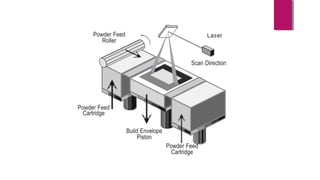
 The build media for SLS comes in powder form, which is fused together by a
powerful carbon dioxide laser to form the final product.
 RP is capable to fabricate parts quickly with too complex shape easily as
compared to traditional manufacturing technology. RP helps in earlier
detection and reduction of design errors.
 The SLS process begins, like most other RP processes, with the standard .STL
CAD file format, which is exported now by most 3D CAD packages.  SLS was
developed and patented by Dr. Carl Deckard and academic adviser, Dr. Joe
Beaman at the University of Texas at Austin in the mid-1980s.
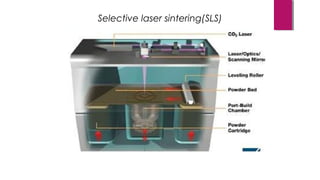
Selective laser sintering(SLS)
PROCESS
Process is simple. There is no milling, broaching, turning etc. steps are required
Powdering, porous surface unless sealant is used.
Recommended for chemically resistant parts.
High strength and stiffness.
Fully functional and high quality plastic parts.
excellent long–term stability.
Use in medical applications.
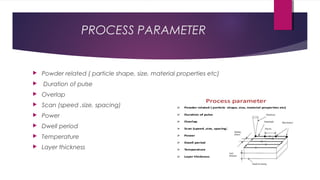
PROCESS PARAMETER
 Powder related ( particle shape, size, material properties etc)
 Duration of pulse
 Overlap
 Scan (speed ,size, spacing)
 Power
 Dwell period
 Temperature
 Layer thickness
MATERIALS
 Thermoplastic powders(nylon ,glass filled nylon, polystyrene etc)
 Metal powders
 Ceramic powders
 Glass powders
DEFECTS
 Bonus Z
 Clumping
 Curling, in-built curl
 Growth
 Cracking
ADVANTAGES AND DISADVANTAGES
Advantages
Highly dimensional accuracy
Capable of high detail and thin walls
Design changes and modification can be
easily
Flexibility in selection of material
Fabricate complex parts
No need to create a structure to support
the part
Parts do not require any post curing
Disadvantages
The price of machinery and materials are
expensive  The surface is usually rougher
than machined surfaces
Some materials are brittle
Shrinking and warping in fabricated parts
because of thermal distortion
During solidification, additional powder
may be hardened at the border line
The strength of RP-parts are weaker in z-
direction than in other
APPLICATION
 3D printing in rapid prototyping
 Parts for mechanical and thermal tests
 Fabricate small complex plastic parts
 Agricultural applications(greenhouse covering etc)
 Fabricate electrical devices(resistors etc )
 Aerospace and aviation industries
 Automotive industry
 Medical industry
 Architecture
DISSCUSION
Highly dimensional accuracy. Capable of high detail and thin walls. Design
changes and modification can be easily. Flexibility in selection of material.
Fabricate complex parts. No need to create a structure to support the part. Parts
do not require any post curing. Not good for small features, details and thin walls.
Reduced capital tied up in stocks, as parts can be printed quickly and easily. No
need for expensive tool costs. Shorter assembly times due to integrated function
lead to direct cost savings The high mechanical load capacity of the
components is comparable with conventional production techniques such as
forging.
CONCLUSION
  It can be conclude that, among various techniques of rapid prototyping
selective laser sintering is the most flexible process that accommodates
large variety of material being processed
 This technique have better control and superior qualities then it is used for
industrial applications
REFRENCES
 https://www.emeraldinsight.com/doi/abs/10.1108/13552549510086853?
journalCode=rpj
 https://en.wikipedia.org/wiki/Selective_laser_sintering
 https://www.protosystech.com/rapid-prototyping.htm

Dji6062 (sls)

  • 1.
    DJI6062: AUTOMOTIVE MANUFACTURING PROCESS RapidPrototyping Selective laser sintering(SLS )  CIK SARAH NADIAH BINTI MOHD GHAZALI KUMARAN A/L MANIMARAN (19DRA15F2103) SHABIHA LIZA BINTI SATHIK HUSSAIN (19DRA15F2100)
  • 2.
    INTRODUCTION  (Selective lasersintering)SLS is a rapid prototyping (RP) technology that able to produce physical model in a layer by layer manner directly from their CAD models without any tools, dies and fixtures.  The build media for SLS comes in powder form, which is fused together by a powerful carbon dioxide laser to form the final product.  RP is capable to fabricate parts quickly with too complex shape easily as compared to traditional manufacturing technology. RP helps in earlier detection and reduction of design errors.  The SLS process begins, like most other RP processes, with the standard .STL CAD file format, which is exported now by most 3D CAD packages.  SLS was developed and patented by Dr. Carl Deckard and academic adviser, Dr. Joe Beaman at the University of Texas at Austin in the mid-1980s.
  • 3.
  • 4.
    PROCESS Process is simple.There is no milling, broaching, turning etc. steps are required Powdering, porous surface unless sealant is used. Recommended for chemically resistant parts. High strength and stiffness. Fully functional and high quality plastic parts. excellent long–term stability. Use in medical applications.
  • 6.
    PROCESS PARAMETER  Powderrelated ( particle shape, size, material properties etc)  Duration of pulse  Overlap  Scan (speed ,size, spacing)  Power  Dwell period  Temperature  Layer thickness
  • 7.
    MATERIALS  Thermoplastic powders(nylon,glass filled nylon, polystyrene etc)  Metal powders  Ceramic powders  Glass powders
  • 8.
    DEFECTS  Bonus Z Clumping  Curling, in-built curl  Growth  Cracking
  • 9.
    ADVANTAGES AND DISADVANTAGES Advantages Highlydimensional accuracy Capable of high detail and thin walls Design changes and modification can be easily Flexibility in selection of material Fabricate complex parts No need to create a structure to support the part Parts do not require any post curing Disadvantages The price of machinery and materials are expensive  The surface is usually rougher than machined surfaces Some materials are brittle Shrinking and warping in fabricated parts because of thermal distortion During solidification, additional powder may be hardened at the border line The strength of RP-parts are weaker in z- direction than in other
  • 10.
    APPLICATION  3D printingin rapid prototyping  Parts for mechanical and thermal tests  Fabricate small complex plastic parts  Agricultural applications(greenhouse covering etc)  Fabricate electrical devices(resistors etc )  Aerospace and aviation industries  Automotive industry  Medical industry  Architecture
  • 11.
    DISSCUSION Highly dimensional accuracy.Capable of high detail and thin walls. Design changes and modification can be easily. Flexibility in selection of material. Fabricate complex parts. No need to create a structure to support the part. Parts do not require any post curing. Not good for small features, details and thin walls. Reduced capital tied up in stocks, as parts can be printed quickly and easily. No need for expensive tool costs. Shorter assembly times due to integrated function lead to direct cost savings The high mechanical load capacity of the components is comparable with conventional production techniques such as forging.
  • 12.
    CONCLUSION   It canbe conclude that, among various techniques of rapid prototyping selective laser sintering is the most flexible process that accommodates large variety of material being processed  This technique have better control and superior qualities then it is used for industrial applications
  • 13.