RAPID
PROTOTYPING
MANOJ K
1ST SEM
M.TECH (CIM)
TECHNICAL SEMINA
INTRODUCTION
 Revolutionary and powerful technology with
wide range of application.
 The process involve quick building up of a
prototype or working model for the purpose of
testing the various design features, ideas,
concepts, functionality, output and performance.
 Group of techniques used to quickly fabricate
a scale model of a part or assembly using 3D
CAD data.
 RP is an "additive" process, most machining
processes are "subtractive" processes
2
16/12/2016
HISTORY
3
 In 60’s, first RPT became accessible.
 In 70’s, Herbert Voelcker, engineering professor
developed the basic tools of mathematics that
describe the 3D aspects.
 In 80’s
 Carl Deckard ,researcher from the University of Texas.
 He pioneered the layer based manufacturing, he thought
of building up the model layer by layer.
 He printed 3D models by utilizing laser light for fusing
metal powder in solid prototypes, single layer at a time.
 Technique called ‘Selective Laser Sintering’.
16/12/2016
HISTORY(Cont...)
4
 Nowadays
 The computer engineer has to simply sketch the
ideas on the computer screen with the help of a
design program.
 CAD allows to make modification as required and
can create a physical prototype that is a precise and
proper 3D object.
16/12/2016
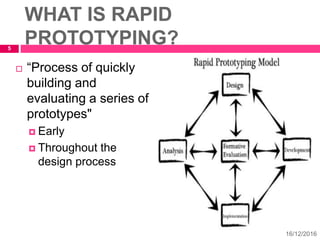
WHAT IS RAPID
PROTOTYPING?5
 “Process of quickly
building and
evaluating a series of
prototypes"
 Early
 Throughout the
design process
16/12/2016
WHY RAPID PROTOTYPING?
6
 Effective communication.
 Development time.
 Costly mistakes.
 To minimize sustaining engineering changes.
 To extend product lifetime by adding
necessary features
16/12/2016
Cont…
7
 The trends in manufacturing industries
continue to emphasize the following:
 Increasing number of variants of products.
 Increasing product complexity.
 Increasing product lifetime.
 Decreasing delivery time.
16/12/2016
HOW DOES RP WORK?
8
 The process begins with taking a virtual design
from modelling or CAD software.
 The 3D printing machine reads the data from
the CAD drawing
 lays down successive layers of liquid, powder,
or sheet material — building up the physical
model from a series of cross sections.
 These layers are automatically joined together
to create the final shape.
16/12/2016
APPLICATIONS
9
1. RAPID TOOLING
 Patterns for Sand Casting
 Patterns for Investment
Casting
 Pattern for Injection
moldings
2. RAPID MANUFACTURING
 Short productions runs
 Custom made parts
 On-Demand Manufacturing
 Manufacturing of very
complex shapes
16/12/2016
3. AEROSPACE & MARINE
 Wind tunnel models
 Functional prototypes
 Boeing’s On-Demand-
Manufacturing
4. AUTOMOTIVE RP SERVICES
 Production level
 Reduced time to market
 Functional testing
 Dies & Molds
Cont…
16/12/2016
10
5. BIOMEDICAL
APPLICATIONS
 Prosthetic parts
 Presurgical planning
models
 Mechanical bone replicas
 Anthropology
 Forensics
7. ARCHITECTURE
 3D visualization of design
space
 Iterations of shape
 Sectioned models
6. FASHION &
JEWELRY
 Shoe Design
 Jewellery
 Pattern for lost wax
 Other castings
BASIC PROCESS
16/12/2016
11
Create a CAD model of the design
 Object to be built is modelled using CAD software.
 Solid modellers like Pro-E yield better results.
 Existing CAD file may also be used
Convert the CAD model to STL (Standard
Tessellation Language) format
 STL format is the standard of rapid prototyping industry.
 This format represent 3D surface as an assembly of planar
triangles and describes only surface geometry.
Cont…
16/12/2016
12
Slice the STL file into thin cross-sectional layers
 Several programmes are available for this.
 STL models are sliced into a number of layers (.01mm to .7mm).
 Orientation size and location are adjusted using the software.
Construct the model one layer atop another
 RP machine builds one layer at a time from polymers, paper, or
powdered metal.
 Fairly autonomous needing little human intervention.
Clean and finish the model
 Post processing step.
 Prototype may require minor cleaning and surface treatment.
RP TECHNIQUES
16/12/2016
13
Most commercially available rapid prototyping
machines use one of the four techniques
 Stereo lithography (SL or SLA).
 Laminated object manufacturing.
 Selective Laser Sintering.
 3D ink jet printing.
STEREO LITHOGRAPHY(SL)
16/12/2016
14
 Builds 3D model from liquid photo sensitive polymers when exposed to UV rays.
 Model is built upon a platform situated just below the surface of liquid epoxy or acrylate
resin.
 A low power highly focused UV laser traces out the first layer, solidifying model cross
section.
 An elevator incrementally lowers the platform into the liquid polymer.
 Process is repeated until prototype is complete.
 Model is the placed in an UV oven for complete curing.
Cont…
16/12/2016
15
Laminated Object Manufacturing
16/12/2016
16
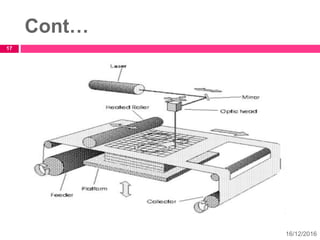
 Layer of adhesive coated sheet materials are bonded to form a prototype.
 Paper laminated with heat activated glue is rolled up on spools.
 Heated roller applies pressure to bond the paper to the base.
 Feeder/collector mechanism advances paper.
 Laser cuts the outline of first layer.
 Platform is lowered and fresh material is advanced.
 Process is repeated and a roller bonds the layers.
Cont…
16/12/2016
17
SELECTIVE LASER SINTERING
16/12/2016
18
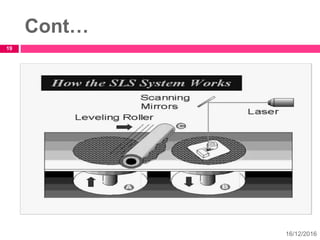
 Uses laser beam to selectively fuse powdered
materials such as nylon, elastomer or metal into a
solid object.
 Parts are built on a platform which sits below the
surface in a bin of heat fusible powder.
 Laser traces the pattern of first layer, sintering it
together.
 Then platform is lowered, powder is reapplied and
process is repeated.
Cont…
16/12/2016
19
3D INK JET PRINTING
16/12/2016
20
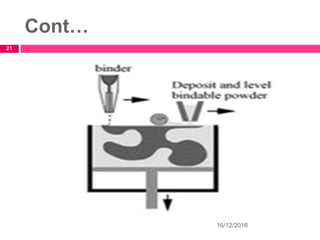
 Parts are built upon a platform situated in a bin full of powder material.
 An ink-jet printing head selectively deposits or "prints" a binder fluid to
fuse the powder together in the desired areas.
 Unbound powder remains to support the part.
 The platform is lowered, more powder added and levelled, and the process
repeated.
 Finished parts can be infiltrated with wax, glue, or other sealants to
improve durability and surface finish.
 Typical l
 ayer thicknesses are on the order of 0.1 mm.
 This process is very fast, and produces parts with a slightly grainy surface.
 There are also other different types of 3d printing available in the market
which gives very good accuracy.
Cont…
16/12/2016
21
ADVANTAGES
16/12/2016
22
 Accuracy
 Product complexity
 Minimal wastage
 No part supports required
 High speed
DISADVANTAGE
16/12/2016
23
 Not suitable for large sized applications.
 Limited materials
 Poor Surface finish
 High machine cost
CONCLUSION
16/12/2016
24
 Modern CNC machines have high removal rates which helps
in fast machining.
 For certain applications machining will continue to be a useful
manufacturing process.
 One should regard RPT as one more option in the toolkit for
manufacturing parts.
 No tooling: less tools is better
 One shot operation: no assembly of parts
 Reduce lead time: less time improve production rate
 Flexible: modification, addition of parameters, scaling
 Clean & safe operation
REFERENCES
16/12/2016
25
 Rapid Manufacturing, Flham D.T & Dingoy
S.S Verlog London 2001.
 Rapid Prototyping, Terry Wohlers Wohler’s
Report 2000” Wholers Association 2000.
THANK YOU
16/12/2016
26

RAPID PROTOTYPING(RPT)

  • 1.
  • 2.
    INTRODUCTION  Revolutionary andpowerful technology with wide range of application.  The process involve quick building up of a prototype or working model for the purpose of testing the various design features, ideas, concepts, functionality, output and performance.  Group of techniques used to quickly fabricate a scale model of a part or assembly using 3D CAD data.  RP is an "additive" process, most machining processes are "subtractive" processes 2 16/12/2016
  • 3.
    HISTORY 3  In 60’s,first RPT became accessible.  In 70’s, Herbert Voelcker, engineering professor developed the basic tools of mathematics that describe the 3D aspects.  In 80’s  Carl Deckard ,researcher from the University of Texas.  He pioneered the layer based manufacturing, he thought of building up the model layer by layer.  He printed 3D models by utilizing laser light for fusing metal powder in solid prototypes, single layer at a time.  Technique called ‘Selective Laser Sintering’. 16/12/2016
  • 4.
    HISTORY(Cont...) 4  Nowadays  Thecomputer engineer has to simply sketch the ideas on the computer screen with the help of a design program.  CAD allows to make modification as required and can create a physical prototype that is a precise and proper 3D object. 16/12/2016
  • 5.
    WHAT IS RAPID PROTOTYPING?5 “Process of quickly building and evaluating a series of prototypes"  Early  Throughout the design process 16/12/2016
  • 6.
    WHY RAPID PROTOTYPING? 6 Effective communication.  Development time.  Costly mistakes.  To minimize sustaining engineering changes.  To extend product lifetime by adding necessary features 16/12/2016
  • 7.
    Cont… 7  The trendsin manufacturing industries continue to emphasize the following:  Increasing number of variants of products.  Increasing product complexity.  Increasing product lifetime.  Decreasing delivery time. 16/12/2016
  • 8.
    HOW DOES RPWORK? 8  The process begins with taking a virtual design from modelling or CAD software.  The 3D printing machine reads the data from the CAD drawing  lays down successive layers of liquid, powder, or sheet material — building up the physical model from a series of cross sections.  These layers are automatically joined together to create the final shape. 16/12/2016
  • 9.
    APPLICATIONS 9 1. RAPID TOOLING Patterns for Sand Casting  Patterns for Investment Casting  Pattern for Injection moldings 2. RAPID MANUFACTURING  Short productions runs  Custom made parts  On-Demand Manufacturing  Manufacturing of very complex shapes 16/12/2016 3. AEROSPACE & MARINE  Wind tunnel models  Functional prototypes  Boeing’s On-Demand- Manufacturing 4. AUTOMOTIVE RP SERVICES  Production level  Reduced time to market  Functional testing  Dies & Molds
  • 10.
    Cont… 16/12/2016 10 5. BIOMEDICAL APPLICATIONS  Prostheticparts  Presurgical planning models  Mechanical bone replicas  Anthropology  Forensics 7. ARCHITECTURE  3D visualization of design space  Iterations of shape  Sectioned models 6. FASHION & JEWELRY  Shoe Design  Jewellery  Pattern for lost wax  Other castings
  • 11.
    BASIC PROCESS 16/12/2016 11 Create aCAD model of the design  Object to be built is modelled using CAD software.  Solid modellers like Pro-E yield better results.  Existing CAD file may also be used Convert the CAD model to STL (Standard Tessellation Language) format  STL format is the standard of rapid prototyping industry.  This format represent 3D surface as an assembly of planar triangles and describes only surface geometry.
  • 12.
    Cont… 16/12/2016 12 Slice the STLfile into thin cross-sectional layers  Several programmes are available for this.  STL models are sliced into a number of layers (.01mm to .7mm).  Orientation size and location are adjusted using the software. Construct the model one layer atop another  RP machine builds one layer at a time from polymers, paper, or powdered metal.  Fairly autonomous needing little human intervention. Clean and finish the model  Post processing step.  Prototype may require minor cleaning and surface treatment.
  • 13.
    RP TECHNIQUES 16/12/2016 13 Most commerciallyavailable rapid prototyping machines use one of the four techniques  Stereo lithography (SL or SLA).  Laminated object manufacturing.  Selective Laser Sintering.  3D ink jet printing.
  • 14.
    STEREO LITHOGRAPHY(SL) 16/12/2016 14  Builds3D model from liquid photo sensitive polymers when exposed to UV rays.  Model is built upon a platform situated just below the surface of liquid epoxy or acrylate resin.  A low power highly focused UV laser traces out the first layer, solidifying model cross section.  An elevator incrementally lowers the platform into the liquid polymer.  Process is repeated until prototype is complete.  Model is the placed in an UV oven for complete curing.
  • 15.
  • 16.
    Laminated Object Manufacturing 16/12/2016 16 Layer of adhesive coated sheet materials are bonded to form a prototype.  Paper laminated with heat activated glue is rolled up on spools.  Heated roller applies pressure to bond the paper to the base.  Feeder/collector mechanism advances paper.  Laser cuts the outline of first layer.  Platform is lowered and fresh material is advanced.  Process is repeated and a roller bonds the layers.
  • 17.
  • 18.
    SELECTIVE LASER SINTERING 16/12/2016 18 Uses laser beam to selectively fuse powdered materials such as nylon, elastomer or metal into a solid object.  Parts are built on a platform which sits below the surface in a bin of heat fusible powder.  Laser traces the pattern of first layer, sintering it together.  Then platform is lowered, powder is reapplied and process is repeated.
  • 19.
  • 20.
    3D INK JETPRINTING 16/12/2016 20  Parts are built upon a platform situated in a bin full of powder material.  An ink-jet printing head selectively deposits or "prints" a binder fluid to fuse the powder together in the desired areas.  Unbound powder remains to support the part.  The platform is lowered, more powder added and levelled, and the process repeated.  Finished parts can be infiltrated with wax, glue, or other sealants to improve durability and surface finish.  Typical l  ayer thicknesses are on the order of 0.1 mm.  This process is very fast, and produces parts with a slightly grainy surface.  There are also other different types of 3d printing available in the market which gives very good accuracy.
  • 21.
  • 22.
    ADVANTAGES 16/12/2016 22  Accuracy  Productcomplexity  Minimal wastage  No part supports required  High speed
  • 23.
    DISADVANTAGE 16/12/2016 23  Not suitablefor large sized applications.  Limited materials  Poor Surface finish  High machine cost
  • 24.
    CONCLUSION 16/12/2016 24  Modern CNCmachines have high removal rates which helps in fast machining.  For certain applications machining will continue to be a useful manufacturing process.  One should regard RPT as one more option in the toolkit for manufacturing parts.  No tooling: less tools is better  One shot operation: no assembly of parts  Reduce lead time: less time improve production rate  Flexible: modification, addition of parameters, scaling  Clean & safe operation
  • 25.
    REFERENCES 16/12/2016 25  Rapid Manufacturing,Flham D.T & Dingoy S.S Verlog London 2001.  Rapid Prototyping, Terry Wohlers Wohler’s Report 2000” Wholers Association 2000.
  • 26.