
Submitted By:
Shikhar Tripathi
Dual Ignition
 Dual Ignition is a system for spark-ignition engines,
whereby critical ignition components, such as
spark plugs and magnetos, are duplicated. Dual
ignition is most commonly employed on aero
engines, and is sometimes found on cars and
motorcycles.
 Dual ignition provides two advantages:
redundancy in the event of in-flight failure of one
ignition system; and more efficient burning of the
fuel-air mixture within the combustion chamber. In
aircraft, redundancy is the prime consideration,
but in other vehicles combustive efficiency is the
target.
What Is Twin Spark System
 Twin Spark Ignition has two spark plugs that
use to ignite the charge in the combustion
chamber.
 2 spark plugs at either ends of the
combustion chamber help in faster and
better combustion.
 It only use in the petrol engine.
Why do we use the Dual
spark in 4-stroke Petrol Engine
In 4-stroke petrol engine at ignition time the air and fuel
mixture does not burn completely. But when this system is used
in engine the rich mixture completely burn and the ignition
time decrease. And power of engine increases
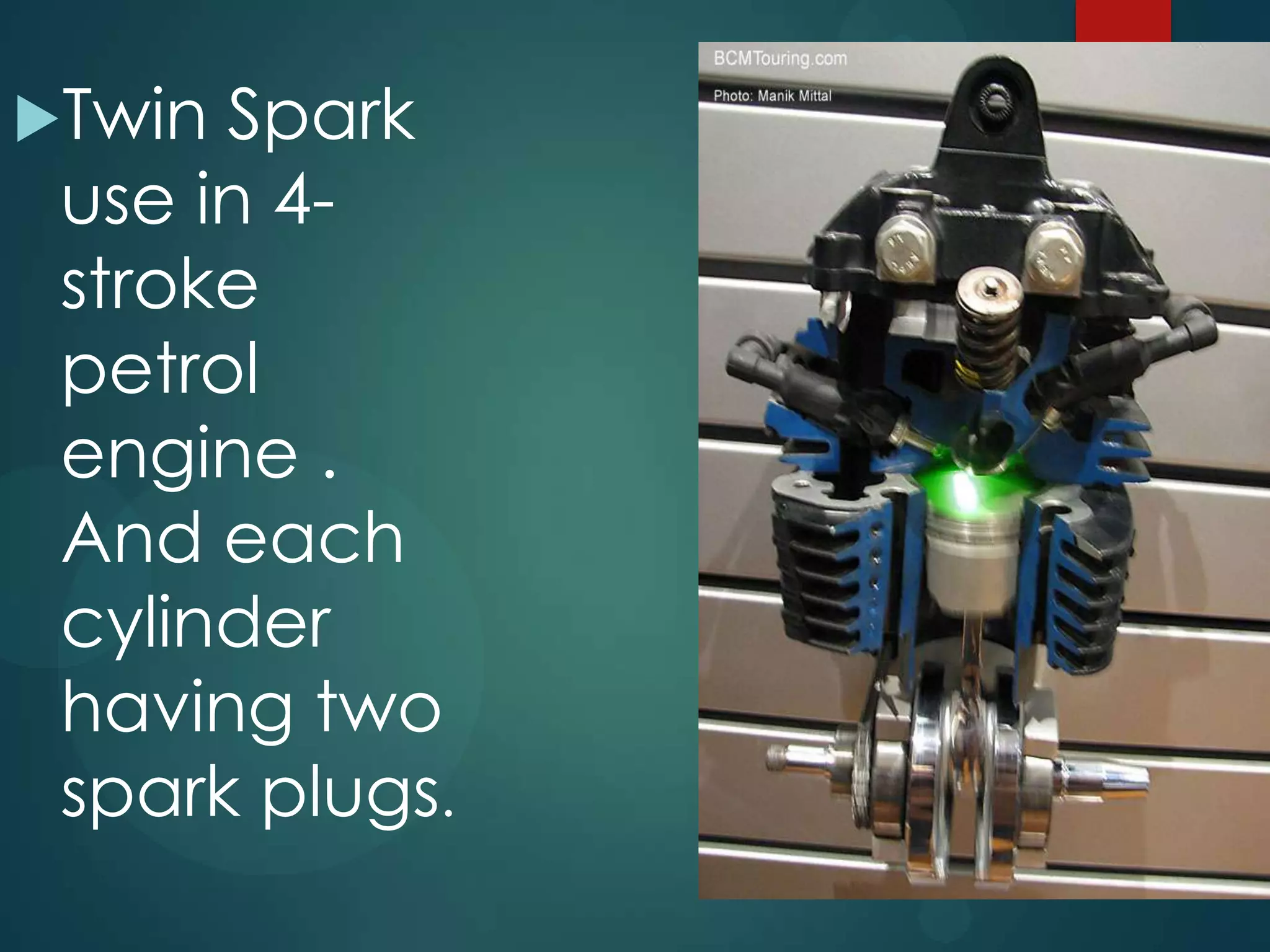
Twin Spark
use in 4-
stroke
petrol
engine .
And each
cylinder
having two
spark plugs.
Working of Twin Spark
system
 When the rich mixture of air and fuel enter in the
combustion chamber , the two spark plugs
fixed at opposite end of engine cylinder
generated spark and this spark burn the mixture
that burned mixture gives power to the 4-stroke
engine. Here spark generated by the microchip .
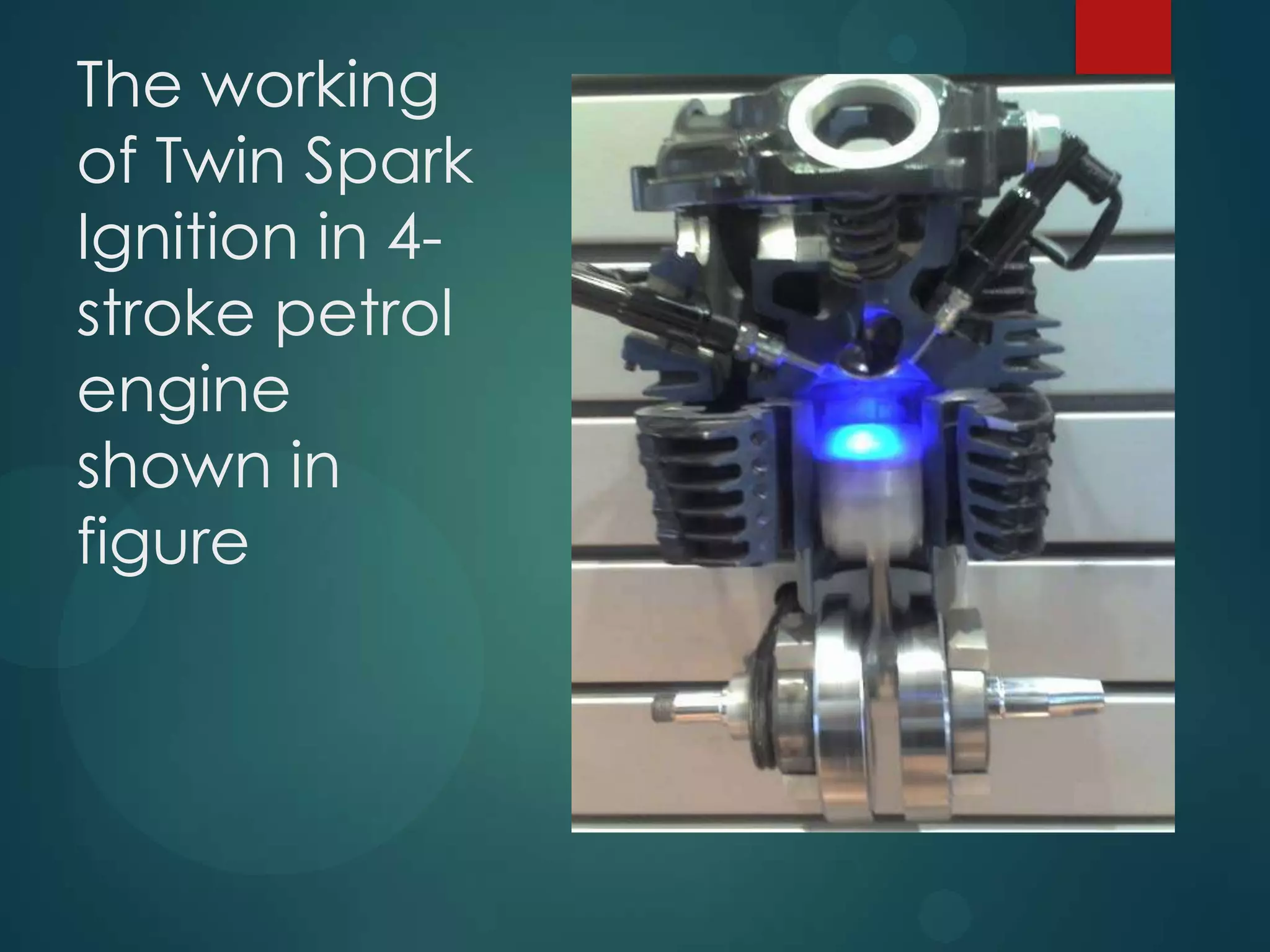
The working
of Twin Spark
Ignition in 4-
stroke petrol
engine
shown in
figure
Various functions of Twin
Spark system
 It use to increases the efficiency .
 It use for faster and better combustion.
 It has two spark plug , so it burns the complete
rich mixture (air and fuel) in 4stroke petrol engine.
 It use to increase the power output of engine.
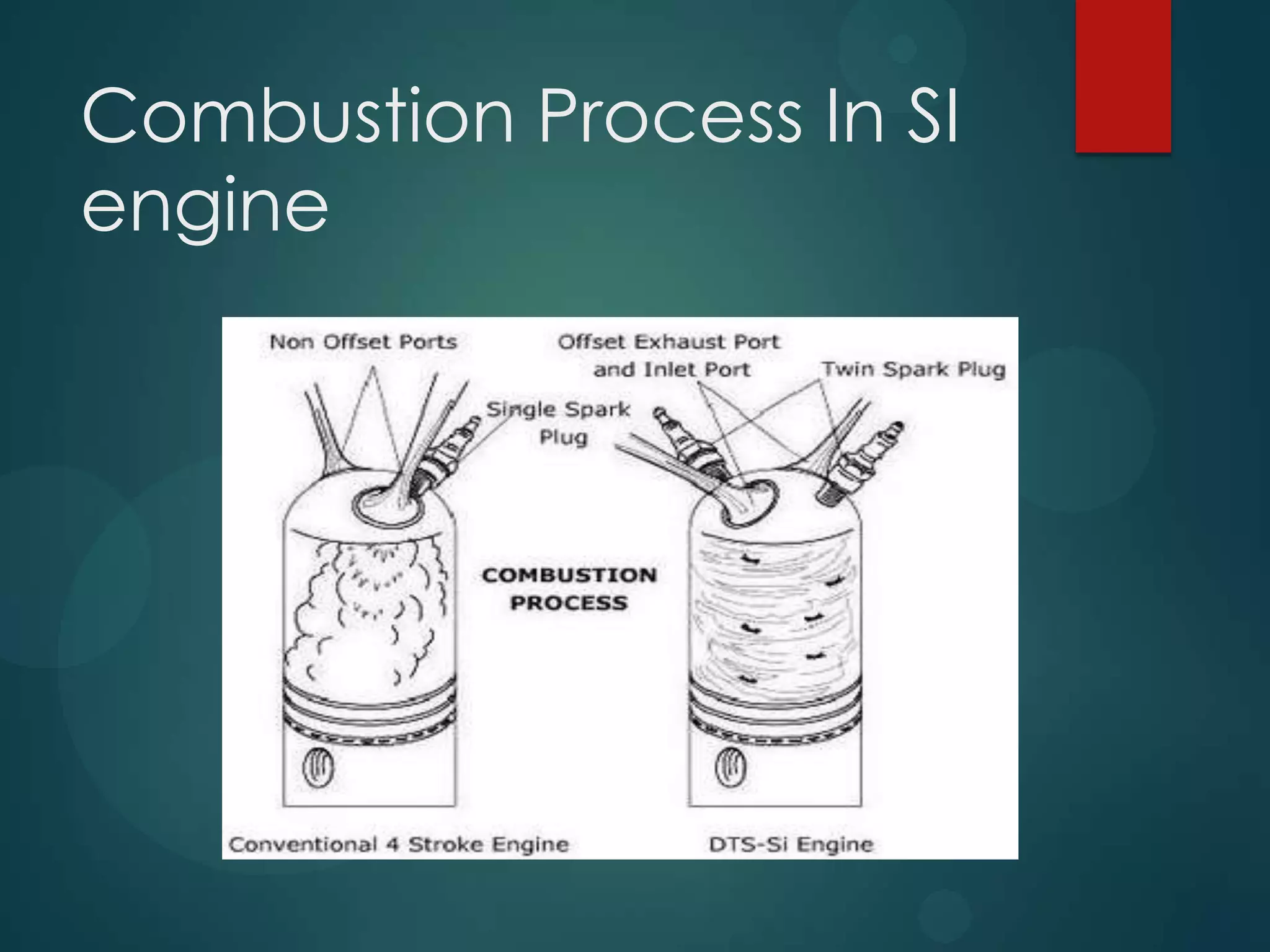
Combustion Process In SI
engine
What are the benefits of
twin spark system
 Ignition time decreases.
 The rich mixture (air and fuel) completely burns in
combustion chamber.
 Power produced by twin spark more compare to
single spark ignition system.
 Increase the pick up of engine
 Less vibrations and noise.
 Long life of the engine parts such as piston rings and valve
stem.
 Decrease in the specific fuel consumption.
 No over heating at low speeds.
 Gradual increase in the pressure.
Disadvantages of twin spark
system
 The engine tends to overheat and loose
power at higher speeds as compared to a
single plug engine.
 There may be a kind of knocking sound on
the machine.
 twin spark is actually a simpler, cheaper and
low-tech alternative to making more power
and burning less fuel. However owners
mistakenly think it is high-tech.
 Its use is limited to a Petrol Engine only.
Vehicles which use the twin
spark engine?
 In India Bajaj has patented for DTS-i
technology . At present
platina,xcd125,135,discover150,pulsar
135,150,180,200,220 are using the DTS-i
(digital twin spark ignition system).
which means the petrol enters into the
cylinder burns more efficiently.
 Bajaj bikes also use other technologies
namely DTS-Si (Digital Twin Spark Swirl
Induction), DTS-Fi (Digital Twin Spark
Fuel Ignition and DTS-I (Digital Triple
Spark Ignition)
Difference between DTS-I, DTS-
Si, DTS-Fi and DTS-i Triple Spark
 DTS-i Engine -
 DIGITAL TWIN SPARK ignition engine has two Spark
plugs located at opposite ends of the combustion
chamber and hence fast and efficient combustion is
obtained.
 DTS-i Engine can be further tuned to deliver
exhilarating performance as in DTS-FI or exceptional
mileage like in DTS-SI as claimed by Bajaj.
 DTS-Si Engine -
 Like DTS-i the engine has 2 spark plugs, but, instead
of conventionally positioned straight ports, the offset
positioning of the ports generate high swirl and
turbulence of the air fuel mixture in the combustion
chamber. This results in highly efficient combustion
that further results in exceptional mileage. Like the
mother DTS-i technology, the DTS-Si technology is a
patented technology developed by Bajaj Auto R&D.
Difference between DTS-I, DTS-Si,
DTS-Fi and DTS-i Triple Spark (Cont.)
 DTS-Fi Engine-
 In fuel injection the conventional carburettor has
been replaced by injector which injects fuel in to the
engine in a spray form based on the instructions of
the Engine Control Unit (ECU) which is a part of the
Engine Management System EMS. The Electronic
Control Unit (ECU) is microprocessor based and is the
brain of the fuel injection system. It processes
information sent by various sensors and instantly
determines optimum fuelling and spark timing for
various engine operating conditions. The ECU
contains detailed information of the engine’s
characteristics from which it picks the necessary
data for commanding both fuelling & spark timing.
Difference between DTS-I, DTS-Si,
DTS-Fi and DTS-i Triple Spark (Cont.)
 This technology comes in Pulsar 220cc version.
 The main advantages of Fuel Injection are:
a. Increased power output for same cc.
b. Better low end torque. c. Lower fuel delivery &
optimisation of spark timing.
d. Improved cold start, quick warm-up and
excellent response to sudden acceleration.
e. Lower emission levels.
f. Self-detection and communication of fuel
system malfunctioning if any.
Difference between DTS-I, DTS-
Si, DTS-Fi and DTS-i Triple Spark
(Cont.)
 DTS-i Triple Spark Engine-
 Three spark plugs provide unprecedented
performance and efficiency – Fast and optimal
combustion at part load conditions results in
better fuel efficiency and ensures lower emissions.
 The high performance triple spark engine
controlled by an advanced Electronic Control
Unit, is the technology of the future. Combustion
in a triple spark engine is 27% faster than a twin
spark and 50% faster than a single spark engine.
Difference between DTS-I, DTS-
Si, DTS-Fi and DTS-i Triple Spark
(Cont.)
 To make use of 3 spark plugs, the pulsar engine
houses a pent roof combustion chamber which in
turn allows to house 3 spark plugs in the engine
chamber. Out of the three plugs, the primary plug is
the center one and is mounted in an angle and
enters the chamber at the top-center. The other two
secondary plugs are mounted below, each
opposite each other and one of them being
vertically underneath the primary plug.
 The secondary plugs fires a bit after the primary one
has fired and the timings are controlled by the ECU
depending on various parameters like throttle
position, engine revs, load on engine and many
other stuffs. According to Bajaj, these plugs gain a
advantage in low-rev riding condition where it
extracts the best economy. Compared to KTM Duke
200 in similar conditions it gives as much as 10-
13kmpl more, however the difference vanishes at
higher revs and high speed.
Other Vehicles which use
twin spark technology
 Although a dual ignition system is a very effective
method of achieving optimum combustion and
better fuel consumption, it remains rare in cars and
motorcycles because of difficulties in siting the
second plug.
 Alfa Romeo Twin Spark cars (eponymously) use dual
ignition, as do Honda cars with the i-DSI series
engines.
 In 1980 Nissan installed twin sparkplugs on the Nissan
NAPS-Z engine, with Ford introducing it on the 1989
Ford Ranger and 1991 Ford Mustang four-cylinder
models.
 Mercedes Benz utilizes 2 spark plugs per cylinder on
certain models . Some motorcycles, such as the
Honda VT500 and the Honda NT400 Bros, also
employ dual ignition.
Other Vehicles which use twin
spark technology (cont.)
 The Ducati Multistrada has been modified for 2012
to have "twin-plug cylinder heads for smoother,
more efficient combustion", the change
contributing to a 5% increase in torque and a 10%
improvement in fuel consumption.
 Royal Enfield also have a lot of models with twin
spark technology.
THANK YOU

Dts i ppt

  • 1.
  • 2.
    Dual Ignition  DualIgnition is a system for spark-ignition engines, whereby critical ignition components, such as spark plugs and magnetos, are duplicated. Dual ignition is most commonly employed on aero engines, and is sometimes found on cars and motorcycles.  Dual ignition provides two advantages: redundancy in the event of in-flight failure of one ignition system; and more efficient burning of the fuel-air mixture within the combustion chamber. In aircraft, redundancy is the prime consideration, but in other vehicles combustive efficiency is the target.
  • 3.
    What Is TwinSpark System  Twin Spark Ignition has two spark plugs that use to ignite the charge in the combustion chamber.  2 spark plugs at either ends of the combustion chamber help in faster and better combustion.  It only use in the petrol engine.
  • 4.
    Why do weuse the Dual spark in 4-stroke Petrol Engine In 4-stroke petrol engine at ignition time the air and fuel mixture does not burn completely. But when this system is used in engine the rich mixture completely burn and the ignition time decrease. And power of engine increases
  • 5.
    Twin Spark use in4- stroke petrol engine . And each cylinder having two spark plugs.
  • 6.
    Working of TwinSpark system  When the rich mixture of air and fuel enter in the combustion chamber , the two spark plugs fixed at opposite end of engine cylinder generated spark and this spark burn the mixture that burned mixture gives power to the 4-stroke engine. Here spark generated by the microchip .
  • 7.
    The working of TwinSpark Ignition in 4- stroke petrol engine shown in figure
  • 8.
    Various functions ofTwin Spark system  It use to increases the efficiency .  It use for faster and better combustion.  It has two spark plug , so it burns the complete rich mixture (air and fuel) in 4stroke petrol engine.  It use to increase the power output of engine.
  • 9.
  • 10.
    What are thebenefits of twin spark system  Ignition time decreases.  The rich mixture (air and fuel) completely burns in combustion chamber.  Power produced by twin spark more compare to single spark ignition system.  Increase the pick up of engine
  • 11.
     Less vibrationsand noise.  Long life of the engine parts such as piston rings and valve stem.  Decrease in the specific fuel consumption.  No over heating at low speeds.  Gradual increase in the pressure.
  • 12.
    Disadvantages of twinspark system  The engine tends to overheat and loose power at higher speeds as compared to a single plug engine.  There may be a kind of knocking sound on the machine.  twin spark is actually a simpler, cheaper and low-tech alternative to making more power and burning less fuel. However owners mistakenly think it is high-tech.  Its use is limited to a Petrol Engine only.
  • 13.
    Vehicles which usethe twin spark engine?  In India Bajaj has patented for DTS-i technology . At present platina,xcd125,135,discover150,pulsar 135,150,180,200,220 are using the DTS-i (digital twin spark ignition system). which means the petrol enters into the cylinder burns more efficiently.  Bajaj bikes also use other technologies namely DTS-Si (Digital Twin Spark Swirl Induction), DTS-Fi (Digital Twin Spark Fuel Ignition and DTS-I (Digital Triple Spark Ignition)
  • 14.
    Difference between DTS-I,DTS- Si, DTS-Fi and DTS-i Triple Spark  DTS-i Engine -  DIGITAL TWIN SPARK ignition engine has two Spark plugs located at opposite ends of the combustion chamber and hence fast and efficient combustion is obtained.  DTS-i Engine can be further tuned to deliver exhilarating performance as in DTS-FI or exceptional mileage like in DTS-SI as claimed by Bajaj.  DTS-Si Engine -  Like DTS-i the engine has 2 spark plugs, but, instead of conventionally positioned straight ports, the offset positioning of the ports generate high swirl and turbulence of the air fuel mixture in the combustion chamber. This results in highly efficient combustion that further results in exceptional mileage. Like the mother DTS-i technology, the DTS-Si technology is a patented technology developed by Bajaj Auto R&D.
  • 15.
    Difference between DTS-I,DTS-Si, DTS-Fi and DTS-i Triple Spark (Cont.)  DTS-Fi Engine-  In fuel injection the conventional carburettor has been replaced by injector which injects fuel in to the engine in a spray form based on the instructions of the Engine Control Unit (ECU) which is a part of the Engine Management System EMS. The Electronic Control Unit (ECU) is microprocessor based and is the brain of the fuel injection system. It processes information sent by various sensors and instantly determines optimum fuelling and spark timing for various engine operating conditions. The ECU contains detailed information of the engine’s characteristics from which it picks the necessary data for commanding both fuelling & spark timing.
  • 16.
    Difference between DTS-I,DTS-Si, DTS-Fi and DTS-i Triple Spark (Cont.)  This technology comes in Pulsar 220cc version.  The main advantages of Fuel Injection are: a. Increased power output for same cc. b. Better low end torque. c. Lower fuel delivery & optimisation of spark timing. d. Improved cold start, quick warm-up and excellent response to sudden acceleration. e. Lower emission levels. f. Self-detection and communication of fuel system malfunctioning if any.
  • 17.
    Difference between DTS-I,DTS- Si, DTS-Fi and DTS-i Triple Spark (Cont.)  DTS-i Triple Spark Engine-  Three spark plugs provide unprecedented performance and efficiency – Fast and optimal combustion at part load conditions results in better fuel efficiency and ensures lower emissions.  The high performance triple spark engine controlled by an advanced Electronic Control Unit, is the technology of the future. Combustion in a triple spark engine is 27% faster than a twin spark and 50% faster than a single spark engine.
  • 18.
    Difference between DTS-I,DTS- Si, DTS-Fi and DTS-i Triple Spark (Cont.)  To make use of 3 spark plugs, the pulsar engine houses a pent roof combustion chamber which in turn allows to house 3 spark plugs in the engine chamber. Out of the three plugs, the primary plug is the center one and is mounted in an angle and enters the chamber at the top-center. The other two secondary plugs are mounted below, each opposite each other and one of them being vertically underneath the primary plug.  The secondary plugs fires a bit after the primary one has fired and the timings are controlled by the ECU depending on various parameters like throttle position, engine revs, load on engine and many other stuffs. According to Bajaj, these plugs gain a advantage in low-rev riding condition where it extracts the best economy. Compared to KTM Duke 200 in similar conditions it gives as much as 10- 13kmpl more, however the difference vanishes at higher revs and high speed.
  • 19.
    Other Vehicles whichuse twin spark technology  Although a dual ignition system is a very effective method of achieving optimum combustion and better fuel consumption, it remains rare in cars and motorcycles because of difficulties in siting the second plug.  Alfa Romeo Twin Spark cars (eponymously) use dual ignition, as do Honda cars with the i-DSI series engines.  In 1980 Nissan installed twin sparkplugs on the Nissan NAPS-Z engine, with Ford introducing it on the 1989 Ford Ranger and 1991 Ford Mustang four-cylinder models.  Mercedes Benz utilizes 2 spark plugs per cylinder on certain models . Some motorcycles, such as the Honda VT500 and the Honda NT400 Bros, also employ dual ignition.
  • 20.
    Other Vehicles whichuse twin spark technology (cont.)  The Ducati Multistrada has been modified for 2012 to have "twin-plug cylinder heads for smoother, more efficient combustion", the change contributing to a 5% increase in torque and a 10% improvement in fuel consumption.  Royal Enfield also have a lot of models with twin spark technology.
  • 21.