DIRECT METAL LASER
SINTERING
DMLS
Direct Metal Laser Sintering is a laser-based rapid tooling and
manufacturing (RTM) process developed in co-operation by Rapid
Product Innovations (formerly Electrolux Rapid Development, Rusko,
Finland) and M/s EOS GmbH (Planegg/München, Germany). The basic
principle of DMLS is to fabricate true net-shape metal parts directly in
a single process. Using a high power laser to sinter special non-
shrinking steel or bronze-based metal powders layer-by-layer does
this.
PROTOTYPE PART/ MOULD
BUILDING PROCESS
Creation of 3D CAD model of prototype part/mould.
 Converting the CAD model to .STL format.
Slicing the .STL model in to thin layers.
The layer file .STL is fed to RP machine.
DMLS PROCESS
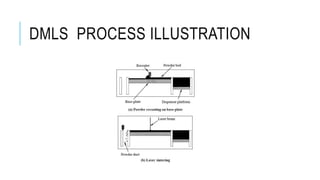
The process software processes the .STL file and accordingly instructs
the different parts of the machine for building the part. A steel base
plate of 250 X 250 X 25 mm is mounted on building platform. A layer of
metal powder of grain size 20 µm is spread on a steel base plate. The
laser beam sinters the first layer. The building platform moves down by
20 µm, which is equal to the layer thickness. The recoater moves
towards the dispenser. The dispenser moves up so that sufficient
powder is taken by the recoater to spread a new layer of powder on the
already sintered layer. The laser sinters the second layer and thus the
process continues.
DMLS PROCESS ILLUSTRATION
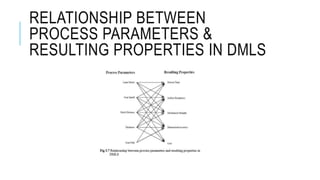
RELATIONSHIP BETWEEN
PROCESS PARAMETERS &
RESULTING PROPERTIES IN DMLS
Direct Metal Laser Sintering (DMLS) RP machine - EOSINT M250 Xtended
from M/s Electro Optical Systems, Germany (Build size: 250 X 250 X 150
mm3).
SINTERING PROCESS
DMLS PRODUCES HIGHLY COMPLEX
PARTS FOR THESE INDUSTRIES:
Dental and medical industries
Education
Engineering
Architecture
Aerospace
Manufacturing
Automotive
DM20
Direct Metal 20 is a very fine grained bronze-based metal powder. The
resulting parts offer good mechanical properties combined with excellent
detail resolution and surface quality. The surfaces can be easily post-
processed by shot-peening and can be polished with very little effort. The
specially developed powder mixture contains different components which
expand during the laser-sintering process, partially compensating for the
natural sintering shrinkage and thereby enabling a very high accuracy to be
achieved. This material is ideal for most prototype injection moulding
tooling applications and for many functional metal prototype applications
(Direct Part).
DM20
It offers the highest building speed so is particularly suitable for larger tools
and parts. It also offers a very broad window of usable process parameters,
e.g. a wide range of achievable mechanical properties and build speeds.
Standard parameters use 20 µm layer thickness for the skin and 60 µm
layers for the core, but for faster building the entire part can be built in 40
µm layers for the skin and 80 µm layers for the core, or even 60 µm layer
thickness for skin and core. Using standard skin parameters the mechanical
properties are fairly uniform in all directions, which is especially beneficial
for many Direct Part applications. Parts built from Direct Metal 20 also have
good corrosion resistance.
TYPICAL APPLICATIONS OF DM20
 Injection moulds and inserts for moulding up to a few tens of
thousands of parts in all standard thermoplastics using standard
injection parameters.
Direct manufacture of functional metal prototypes.
THANK YOU

DMLS (Direct metal laser sintering)

  • 1.
  • 2.
    DMLS Direct Metal LaserSintering is a laser-based rapid tooling and manufacturing (RTM) process developed in co-operation by Rapid Product Innovations (formerly Electrolux Rapid Development, Rusko, Finland) and M/s EOS GmbH (Planegg/München, Germany). The basic principle of DMLS is to fabricate true net-shape metal parts directly in a single process. Using a high power laser to sinter special non- shrinking steel or bronze-based metal powders layer-by-layer does this.
  • 3.
    PROTOTYPE PART/ MOULD BUILDINGPROCESS Creation of 3D CAD model of prototype part/mould.  Converting the CAD model to .STL format. Slicing the .STL model in to thin layers. The layer file .STL is fed to RP machine.
  • 4.
    DMLS PROCESS The processsoftware processes the .STL file and accordingly instructs the different parts of the machine for building the part. A steel base plate of 250 X 250 X 25 mm is mounted on building platform. A layer of metal powder of grain size 20 µm is spread on a steel base plate. The laser beam sinters the first layer. The building platform moves down by 20 µm, which is equal to the layer thickness. The recoater moves towards the dispenser. The dispenser moves up so that sufficient powder is taken by the recoater to spread a new layer of powder on the already sintered layer. The laser sinters the second layer and thus the process continues.
  • 5.
  • 7.
    RELATIONSHIP BETWEEN PROCESS PARAMETERS& RESULTING PROPERTIES IN DMLS
  • 8.
    Direct Metal LaserSintering (DMLS) RP machine - EOSINT M250 Xtended from M/s Electro Optical Systems, Germany (Build size: 250 X 250 X 150 mm3).
  • 9.
  • 11.
    DMLS PRODUCES HIGHLYCOMPLEX PARTS FOR THESE INDUSTRIES: Dental and medical industries Education Engineering Architecture Aerospace Manufacturing Automotive
  • 12.
    DM20 Direct Metal 20is a very fine grained bronze-based metal powder. The resulting parts offer good mechanical properties combined with excellent detail resolution and surface quality. The surfaces can be easily post- processed by shot-peening and can be polished with very little effort. The specially developed powder mixture contains different components which expand during the laser-sintering process, partially compensating for the natural sintering shrinkage and thereby enabling a very high accuracy to be achieved. This material is ideal for most prototype injection moulding tooling applications and for many functional metal prototype applications (Direct Part).
  • 13.
    DM20 It offers thehighest building speed so is particularly suitable for larger tools and parts. It also offers a very broad window of usable process parameters, e.g. a wide range of achievable mechanical properties and build speeds. Standard parameters use 20 µm layer thickness for the skin and 60 µm layers for the core, but for faster building the entire part can be built in 40 µm layers for the skin and 80 µm layers for the core, or even 60 µm layer thickness for skin and core. Using standard skin parameters the mechanical properties are fairly uniform in all directions, which is especially beneficial for many Direct Part applications. Parts built from Direct Metal 20 also have good corrosion resistance.
  • 14.
    TYPICAL APPLICATIONS OFDM20  Injection moulds and inserts for moulding up to a few tens of thousands of parts in all standard thermoplastics using standard injection parameters. Direct manufacture of functional metal prototypes.
  • 15.