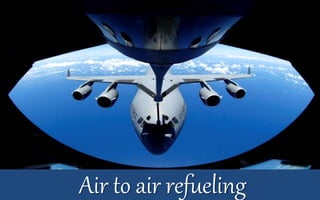
Air to air refueling
Content
• Introduction
• Probe-and-drogue
• Flying boom
• Systems in service
• Advantages
• Disadvantages
Introduction
• Aerial refueling, also referred to as air refueling,in-flight
refueling (IFR), air-to-air refueling (AAR), and tanking, is the process
of transferring fuel from one aircraft (the tanker) to another (the
receiver) during flight.
• The procedure allows the receiving aircraft to remain airborne longer,
extending its range or loiter time on station.
• Aerial refueling has also been considered as a means to reduce fuel
consumption on long distance flights greater than 3,000 nautical
miles (5,600 km; 3,500 mi).
• Potential fuel savings in the range of 35-40% have been estimated for
long haul flights
• The two main refueling systems are probe-and-drogue, which is
simpler to adapt to existing aircraft, and the flying boom, which offers
faster fuel transfer, but requires a dedicated operator station.
Probe-and-drogue
• Cobham's company FRL soon realized that their
looped-hose system left a lot to be desired and began
work on an improved system that is now commonly
called the probe-and-drogue.
• The first use of aerial refueling in combat took place
during the Korean War.
• The first ARS aircraft used FRL's looped-hose refueling
system, but testing with a boom system followed
quickly in the autumn of 1948.
• Refueling from converted B-29s using the drogue-and-
probe in-flight refueling system with the probe located
in one of the F-84's wing-tip fuel tanks.
Flying boom
• The flying boom is a rigid, telescoping tube with
movable flight control surfaces that an operator
on the tanker aircraft extends and inserts into a
receptacle on the receiving aircraft.
• All boom-equipped tankers (e.g. KC-135
Stratotanker, KC-10 Extender) have a single
boom, and can refuel one aircraft at a time with
this mechanism.
Systems in service
• US Air Force fixed-wing aircraft use the flying boom
system.
• Typically countries operating F-16 or F-15 variants
have had a need for boom equipped tankers.
• Therefore, in addition to the USAF, the boom system
is used by the Netherlands (KDC-10), Israel Turkey
and Iran (Boeing 747).
• New tankers are under development.
Advantages
• Higher fuel flow rates can be achieved with the
large diameter of the pipe in the flying boom,
requiring less time to complete refueling
operations than probe-and-drogue systems.
• Less susceptible to receiving aircraft pilot error
and fatigue.
• Less susceptible to adverse weather conditions.
• Boom equipped tankers are readily convertible to
multisystem refuel methods.
Disadvantages
• Requires a boom operator.
• Added complexity of modification with
attaching a boom to an aircraft.
• Boom only allows for one receiver at a time.
Thank You

Aerial refueling

  • 1.
    Air to airrefueling
  • 2.
    Content • Introduction • Probe-and-drogue •Flying boom • Systems in service • Advantages • Disadvantages
  • 4.
    Introduction • Aerial refueling,also referred to as air refueling,in-flight refueling (IFR), air-to-air refueling (AAR), and tanking, is the process of transferring fuel from one aircraft (the tanker) to another (the receiver) during flight. • The procedure allows the receiving aircraft to remain airborne longer, extending its range or loiter time on station. • Aerial refueling has also been considered as a means to reduce fuel consumption on long distance flights greater than 3,000 nautical miles (5,600 km; 3,500 mi). • Potential fuel savings in the range of 35-40% have been estimated for long haul flights • The two main refueling systems are probe-and-drogue, which is simpler to adapt to existing aircraft, and the flying boom, which offers faster fuel transfer, but requires a dedicated operator station.
  • 6.
    Probe-and-drogue • Cobham's companyFRL soon realized that their looped-hose system left a lot to be desired and began work on an improved system that is now commonly called the probe-and-drogue. • The first use of aerial refueling in combat took place during the Korean War. • The first ARS aircraft used FRL's looped-hose refueling system, but testing with a boom system followed quickly in the autumn of 1948. • Refueling from converted B-29s using the drogue-and- probe in-flight refueling system with the probe located in one of the F-84's wing-tip fuel tanks.
  • 8.
    Flying boom • Theflying boom is a rigid, telescoping tube with movable flight control surfaces that an operator on the tanker aircraft extends and inserts into a receptacle on the receiving aircraft. • All boom-equipped tankers (e.g. KC-135 Stratotanker, KC-10 Extender) have a single boom, and can refuel one aircraft at a time with this mechanism.
  • 10.
    Systems in service •US Air Force fixed-wing aircraft use the flying boom system. • Typically countries operating F-16 or F-15 variants have had a need for boom equipped tankers. • Therefore, in addition to the USAF, the boom system is used by the Netherlands (KDC-10), Israel Turkey and Iran (Boeing 747). • New tankers are under development.
  • 12.
    Advantages • Higher fuelflow rates can be achieved with the large diameter of the pipe in the flying boom, requiring less time to complete refueling operations than probe-and-drogue systems. • Less susceptible to receiving aircraft pilot error and fatigue. • Less susceptible to adverse weather conditions. • Boom equipped tankers are readily convertible to multisystem refuel methods.
  • 14.
    Disadvantages • Requires aboom operator. • Added complexity of modification with attaching a boom to an aircraft. • Boom only allows for one receiver at a time.
  • 15.