
Download as PDF, PPTX




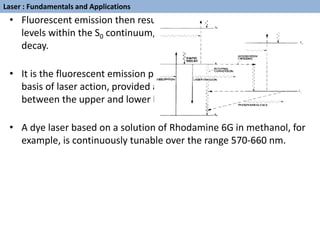












![• In surgery, femtosecond pulses allow for much more precise cutting than do
nanosecond lasers.
• The biggest advantage of ultrashort pulsed lasers in surgical applications is limiting
biological tissue damage. The pulse interacts with the tissue faster than thermal
energy can diffuse to surrounding tissues. It simply means less, if any, burning and
destruction of neighbouring tissue.
• The radiation–biological tissue interaction is determined mainly by the laser
irradiance [W/cm2], which depends on the pulse energy, pulse duration, and the
spectral range of the laser light. The interaction depends also on thermal
properties of tissue – such as heat conduction, heat capacity and the coefficients
of reflection, scattering and absorption.
• The main components of biological tissue that contribute to the absorption are
melanin, haemoglobin, water and proteins.
Laser : Fundamentals and Applications
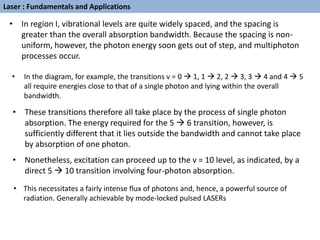
A few important points](https://image.slidesharecdn.com/lec26merged-220611094808-5f456da7/85/LASER-ENGEENERING-2-pdf-98-320.jpg)












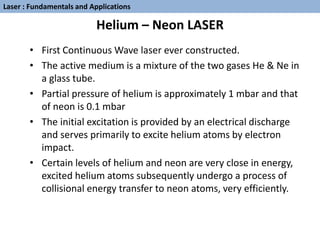
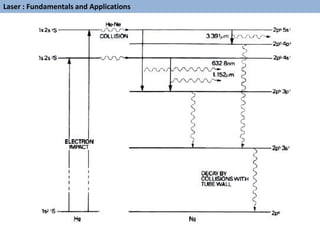
The Helium-Neon laser was the first continuous wave laser constructed. It uses a mixture of helium and neon gases as the active medium, with partial pressures of 1 mbar and 0.1 mbar respectively. Electron impact excitation of helium atoms leads to energy transfer via collisions to neon atoms, creating a population inversion that enables laser emission at wavelengths including 632.8 nm. Following emission, neon undergoes radiationless decay back to the ground state facilitated by the laser tube's small diameter.


