SEMINAR ON : CO2 & N2 LASER
GUIDE : PROF. (DR.) PRAMOD GOPINATH
BY: KESHAV KUMAR JHA
M.TECH (1ST YEAR), OE & LT
International School of
Photonics
Introduction
 The co2 laser was one of the earliest gas laser
invented by Kumar Patel of Bell Labs in 1964 is
one of the most useful lasers.
 Carbon dioxide gas lasers are the highest power
continuous wave lasers that are currently
available. They are also quite efficient, the ratio
of output power to pump power can be as large as
20%.
 The co2 laser produces a beam of infrared light
ie. This laser is not visible with bare eyes, its
principle wavelength bands centring around 9.6
and 10.6 micron.
Principle of CO2 Lasers
 For the laser action two points are important one is
the population inversion between the two levels
and second increased density of the incident
radiation.
 Principle of a CO2 laser is transition between
vibrational states of the same electronic state by
achieving population inversion between these
states.
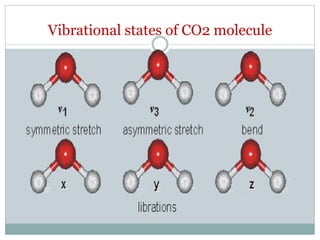
Vibrational states of CO2 molecule
Laser Structure and Discharge Mechanism
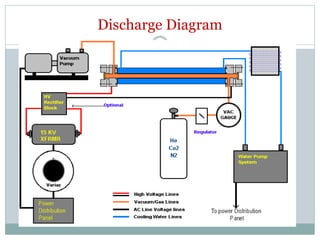
 It consist of discharge tube of size 2.5cm in diameter
and 5.0cm in length. Two optically plane and parallel
mirrors, one is completely reflector and another is
partially reflector.
 The discharge is filled with a mixture of CO2, N2 and
He gases at a pressure of few mm of mercury.
 A high value of DC voltage is used for electric
discharge in the tube due to which CO2 molecules
breaks into CO & O so periodic replacement of gas is
required, O2 can corrode the electrodes.
Discharge Diagram
Working of CO2 Laser
 The vibrational and rotational modes of the CO2 can’t
be excited themselves by photons ie. by optical
pumping.
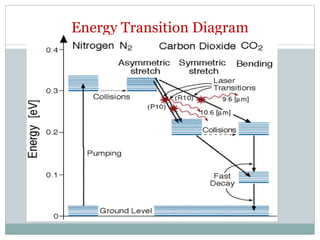
 When a voltage is placed across the gas, electrons
collide with the N2 molecules and excite them to their
vibrational levels.
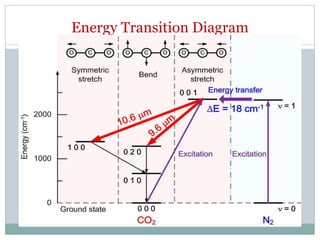
 These vibrational levels happen to be at an energy very
close to the energy of the asymmetric vibrational states
in the CO2 molecules. Now the excited N2 molecule
populates the asymmetric vibtarational states in the
CO2 molecules through collisions.
Energy Transition Diagram
Working of CO2 laser
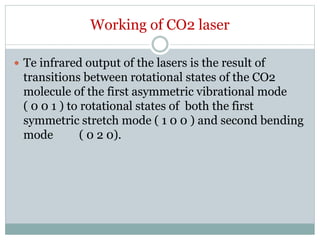
 Te infrared output of the lasers is the result of
transitions between rotational states of the CO2
molecule of the first asymmetric vibrational mode
( 0 0 1 ) to rotational states of both the first
symmetric stretch mode ( 1 0 0 ) and second bending
mode ( 0 2 0).
TEA CO2 Laser
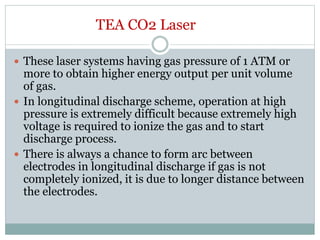
 These laser systems having gas pressure of 1 ATM or
more to obtain higher energy output per unit volume
of gas.
 In longitudinal discharge scheme, operation at high
pressure is extremely difficult because extremely high
voltage is required to ionize the gas and to start
discharge process.
 There is always a chance to form arc between
electrodes in longitudinal discharge if gas is not
completely ionized, it is due to longer distance between
the electrodes.
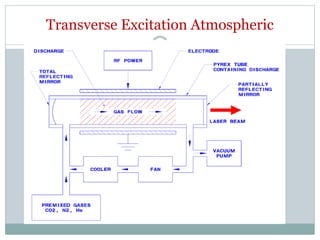
Transverse Excitation
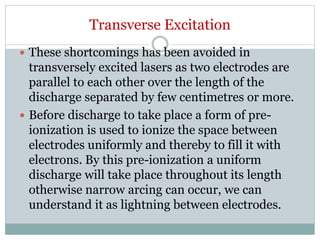
 These shortcomings has been avoided in
transversely excited lasers as two electrodes are
parallel to each other over the length of the
discharge separated by few centimetres or more.
 Before discharge to take place a form of pre-
ionization is used to ionize the space between
electrodes uniformly and thereby to fill it with
electrons. By this pre-ionization a uniform
discharge will take place throughout its length
otherwise narrow arcing can occur, we can
understand it as lightning between electrodes.
•UV spark is used for pre-ionizing the gas.
 Now on the application of high voltage across
electrodes lasers are produced. One of the advantage
of this configuration is many Joules of energy can be
produced for each litre of discharge volume.
 This configuration has resulted in some of the
highest energy pulsed lasers yet produced.
Transverse Excitation Atmospheric
Application
 The advantage of using a laser for these
applications is that very intense heating source can
be applied to a very small area.
 Because of the high power CO2 laser are frequently
used in industrial applications for cutting and
welding.
 They are also very useful in surgical procedures
because water absorbs this frequency of light very
well.
 Some examples of medical uses are laser surgery,
skin resurfacing(laser facelifts).
Nitrogen Lasers
 The nitrogen laser is gas discharge laser that
produces ultraviolet laser output at 337.1nm.
 This laser produced from N2 mlecules which
involves a change in both electronic and vibrational
energy levels.
 Pressure which is applied on N2 molecule ranges
from 20torr(1torr =1/760mm of Hg) to atmospheric
pressure in a sealed chamber.
• The laser has high gain and thereby produces a highly
multimode output that is useful for pumping dye lasers.
 N2 lasers produce peak power outputs of up to
100KW over a duration of 10ns corresponding to a
pulse energy of 100mJ per pulse.
 With development of excimer lasers that produces
several hundred miliJoules per pulse at a much
higher efficiency, N2 laser as seen a significant
decrease in its usage in recent years.
Laser Structure and Excitation Mechanism
 Excitation of N2 laser is same that is used in TEA
CO2 lasers. There is transverse electrodes in which
N2 is filled at high pressure. The complete setup
comes in a chamber and transverse electrodes and
gas accommodation is sealed.
 The upper laser level lifetime is very short only 40ns,
so an extreme rapid pumping is required which is
done via direct pumping from N2 ground state.
• The lower laser level lifetime is much longer
10micro seconds w.r.t. Lifetime of upper laser level,
so this N2 laser is self terminating type i.e. N2
molecules get relaxed by their own without any
external agent.
 The laser output duration ranges from 2 to 20ns.
 A high reflecting rear and 4% reflecting mirror is
used as feedback to continue stimulated emission.
 The discharge system and other constructional
features are same as that of CO2 TEA laser.
Efficiency
 The wall plug efficiency of N2 laser is very low,
typically 0.1% or less, though nitrogen laser with
efficiency 3% has been reported.
Application of N2 Lasers
 Transverse optical pumping of dye lasers.
 Measurement of air pollution.
THE END
Thank You

CO2 and N2 Lasers

  • 1.
    SEMINAR ON :CO2 & N2 LASER GUIDE : PROF. (DR.) PRAMOD GOPINATH BY: KESHAV KUMAR JHA M.TECH (1ST YEAR), OE & LT International School of Photonics
  • 2.
    Introduction  The co2laser was one of the earliest gas laser invented by Kumar Patel of Bell Labs in 1964 is one of the most useful lasers.  Carbon dioxide gas lasers are the highest power continuous wave lasers that are currently available. They are also quite efficient, the ratio of output power to pump power can be as large as 20%.  The co2 laser produces a beam of infrared light ie. This laser is not visible with bare eyes, its principle wavelength bands centring around 9.6 and 10.6 micron.
  • 3.
    Principle of CO2Lasers  For the laser action two points are important one is the population inversion between the two levels and second increased density of the incident radiation.  Principle of a CO2 laser is transition between vibrational states of the same electronic state by achieving population inversion between these states.
  • 4.
  • 5.
    Laser Structure andDischarge Mechanism  It consist of discharge tube of size 2.5cm in diameter and 5.0cm in length. Two optically plane and parallel mirrors, one is completely reflector and another is partially reflector.  The discharge is filled with a mixture of CO2, N2 and He gases at a pressure of few mm of mercury.  A high value of DC voltage is used for electric discharge in the tube due to which CO2 molecules breaks into CO & O so periodic replacement of gas is required, O2 can corrode the electrodes.
  • 6.
  • 7.
    Working of CO2Laser  The vibrational and rotational modes of the CO2 can’t be excited themselves by photons ie. by optical pumping.  When a voltage is placed across the gas, electrons collide with the N2 molecules and excite them to their vibrational levels.  These vibrational levels happen to be at an energy very close to the energy of the asymmetric vibrational states in the CO2 molecules. Now the excited N2 molecule populates the asymmetric vibtarational states in the CO2 molecules through collisions.
  • 8.
  • 9.
  • 10.
    Working of CO2laser  Te infrared output of the lasers is the result of transitions between rotational states of the CO2 molecule of the first asymmetric vibrational mode ( 0 0 1 ) to rotational states of both the first symmetric stretch mode ( 1 0 0 ) and second bending mode ( 0 2 0).
  • 11.
    TEA CO2 Laser These laser systems having gas pressure of 1 ATM or more to obtain higher energy output per unit volume of gas.  In longitudinal discharge scheme, operation at high pressure is extremely difficult because extremely high voltage is required to ionize the gas and to start discharge process.  There is always a chance to form arc between electrodes in longitudinal discharge if gas is not completely ionized, it is due to longer distance between the electrodes.
  • 12.
    Transverse Excitation  Theseshortcomings has been avoided in transversely excited lasers as two electrodes are parallel to each other over the length of the discharge separated by few centimetres or more.  Before discharge to take place a form of pre- ionization is used to ionize the space between electrodes uniformly and thereby to fill it with electrons. By this pre-ionization a uniform discharge will take place throughout its length otherwise narrow arcing can occur, we can understand it as lightning between electrodes.
  • 13.
    •UV spark isused for pre-ionizing the gas.  Now on the application of high voltage across electrodes lasers are produced. One of the advantage of this configuration is many Joules of energy can be produced for each litre of discharge volume.  This configuration has resulted in some of the highest energy pulsed lasers yet produced.
  • 14.
  • 15.
    Application  The advantageof using a laser for these applications is that very intense heating source can be applied to a very small area.  Because of the high power CO2 laser are frequently used in industrial applications for cutting and welding.  They are also very useful in surgical procedures because water absorbs this frequency of light very well.  Some examples of medical uses are laser surgery, skin resurfacing(laser facelifts).
  • 16.
    Nitrogen Lasers  Thenitrogen laser is gas discharge laser that produces ultraviolet laser output at 337.1nm.  This laser produced from N2 mlecules which involves a change in both electronic and vibrational energy levels.  Pressure which is applied on N2 molecule ranges from 20torr(1torr =1/760mm of Hg) to atmospheric pressure in a sealed chamber.
  • 17.
    • The laserhas high gain and thereby produces a highly multimode output that is useful for pumping dye lasers.  N2 lasers produce peak power outputs of up to 100KW over a duration of 10ns corresponding to a pulse energy of 100mJ per pulse.  With development of excimer lasers that produces several hundred miliJoules per pulse at a much higher efficiency, N2 laser as seen a significant decrease in its usage in recent years.
  • 18.
    Laser Structure andExcitation Mechanism  Excitation of N2 laser is same that is used in TEA CO2 lasers. There is transverse electrodes in which N2 is filled at high pressure. The complete setup comes in a chamber and transverse electrodes and gas accommodation is sealed.  The upper laser level lifetime is very short only 40ns, so an extreme rapid pumping is required which is done via direct pumping from N2 ground state.
  • 19.
    • The lowerlaser level lifetime is much longer 10micro seconds w.r.t. Lifetime of upper laser level, so this N2 laser is self terminating type i.e. N2 molecules get relaxed by their own without any external agent.  The laser output duration ranges from 2 to 20ns.  A high reflecting rear and 4% reflecting mirror is used as feedback to continue stimulated emission.  The discharge system and other constructional features are same as that of CO2 TEA laser.
  • 20.
    Efficiency  The wallplug efficiency of N2 laser is very low, typically 0.1% or less, though nitrogen laser with efficiency 3% has been reported.
  • 21.
    Application of N2Lasers  Transverse optical pumping of dye lasers.  Measurement of air pollution.
  • 22.