
Submitted to:
Ms. Rini Saxena
Submitted by:
Sachin Sharma
C.S.E(2nd year)
 A nitrogen laser is a gas laser operating in
the ultraviolet (UV) range by using molecular
nitrogen as its gain medium. Nitrogen lasers
were first developed in 1963, and began to
be used commercially in 1972.
 Nitrogen lasers operate based on a fast
electrical discharge through nitrogen gas.
The nitrogen gas can be supplied through a
gas cylinder, or from liquid nitrogen. The
laser light emitted is in the UV range, with a
short pulse width and high intensity.
 Input power of high-power N2-lasers
equipped with vacuum pumps may draw total
current of 20 A at 110 V, or draw a smaller
amperage at 220 V for cooling using forced-
air system or water cooling system as an
option for operation at high repetition rates.
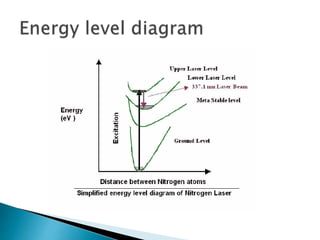
 The nitrogen laser uses electricity to excite
the nitrogen. When an electric spark crosses a
spark gap in the laser, the electrons hit the
nitrogen atoms in air thereby exciting them
into a metastable state. When a photon with a
wavelength of 337 nm passes the excited
nitrogen atoms, stimulated emission occurs
and a laser state is generated.
 Standard nitrogen lasers emitting at 337.11 nm
can also emit additional lines at 357.60 nm in the
near-infrared, but emission on those lines is
suppressed in standard models.
 The single ionized species, N2+ has laser line at
428.00 nm, but it is not produced by standard
N2 lasers and is rarely used because of low
power.
 The low pulse energy levels reflect the gas's very
limited energy storage capacity which originates
with the short upper-state life time.
 The efficiency of pulsed N2 laser is 0.11nm
and the spectral bandwidth is of 0.1 nm.
 The coherence length with this bandwidth
can be estimated in order of 1.0 mm.
 Spatial coherence is also small.
Laser type gas
Pump source electrical discharge
Operating wavelength 337.1nm
Pulse energy 170micro j
Bandwidth 1.1nm
 Nitrogen lasers can be used for a wide range of
applications in the UV-visible region. They can be
easily coupled to a microscope for carrying out
experiments in life science laboratories. They are also
efficient sources for laser-induced fluorescence and
photochemistry and general spectroscopy.
 Other major applications of nitrogen lasers include:
 Measurement of air pollution
 Treatment of nonhealing wounds, pulmonary
tuberculosis, etc
 Transverse optical pumping of dye lasers.
Nitogen laser ( N2 Laser )

Nitogen laser ( N2 Laser )

  • 1.
    Submitted to: Ms. RiniSaxena Submitted by: Sachin Sharma C.S.E(2nd year)
  • 2.
     A nitrogenlaser is a gas laser operating in the ultraviolet (UV) range by using molecular nitrogen as its gain medium. Nitrogen lasers were first developed in 1963, and began to be used commercially in 1972.  Nitrogen lasers operate based on a fast electrical discharge through nitrogen gas. The nitrogen gas can be supplied through a gas cylinder, or from liquid nitrogen. The laser light emitted is in the UV range, with a short pulse width and high intensity.
  • 3.
     Input powerof high-power N2-lasers equipped with vacuum pumps may draw total current of 20 A at 110 V, or draw a smaller amperage at 220 V for cooling using forced- air system or water cooling system as an option for operation at high repetition rates.
  • 5.
     The nitrogenlaser uses electricity to excite the nitrogen. When an electric spark crosses a spark gap in the laser, the electrons hit the nitrogen atoms in air thereby exciting them into a metastable state. When a photon with a wavelength of 337 nm passes the excited nitrogen atoms, stimulated emission occurs and a laser state is generated.
  • 7.
     Standard nitrogenlasers emitting at 337.11 nm can also emit additional lines at 357.60 nm in the near-infrared, but emission on those lines is suppressed in standard models.  The single ionized species, N2+ has laser line at 428.00 nm, but it is not produced by standard N2 lasers and is rarely used because of low power.  The low pulse energy levels reflect the gas's very limited energy storage capacity which originates with the short upper-state life time.
  • 8.
     The efficiencyof pulsed N2 laser is 0.11nm and the spectral bandwidth is of 0.1 nm.  The coherence length with this bandwidth can be estimated in order of 1.0 mm.  Spatial coherence is also small.
  • 9.
    Laser type gas Pumpsource electrical discharge Operating wavelength 337.1nm Pulse energy 170micro j Bandwidth 1.1nm
  • 10.
     Nitrogen laserscan be used for a wide range of applications in the UV-visible region. They can be easily coupled to a microscope for carrying out experiments in life science laboratories. They are also efficient sources for laser-induced fluorescence and photochemistry and general spectroscopy.  Other major applications of nitrogen lasers include:  Measurement of air pollution  Treatment of nonhealing wounds, pulmonary tuberculosis, etc  Transverse optical pumping of dye lasers.