Fourier Transform Infrared
FTIR
 History
 Introduction
 Theory
 Technique
 Principle
 Working
 Working Diagram
 Actual Diagram
 Graph
FTIR
 History
infrared spectrophotometers were developed in the US in the mid 1940s. Initially,
their applications were confined to R&D work on organic compounds, mainly in
the petrochemical field. The first Japanese instruments were manufactured in
1954 by the Applied Optics Research Institute, the predecessor of JASCO.
FTIR
 Introduction:
A Fourier Transform InfraRed (FT-IR) Spectrometer is an
instrument which acquires broadband Near InfraRed (NIR) to Far
InfraRed (FIR) spectra.
FTIR
 Theory of FTIR:
 FTIR spectrophotometry was developed in order to overcome the limitations
encountered with dispersive instruments.
 The main difficulty was the slow scanning process. A method for measuring all the
infrared frequencies simultaneously, rather than individually, was needed.
 A solution was developed which employed a very simple optical device called an
interferometer. The interferometer produces unique type of signal which has all
the infrared frequencies “ encoded” into it.
Techniques of FTIR
 Following techniques of FTIR used by university researches scientists and process
engineers
 Attenuated Total Reflectance (ATR)
 Specular Reflectance (SR)
 Reflection absorption (RA)
 Transmission (TR)
 Photoacoustic (PA)
FTIR
 Principle
Principle Of FTIR is that many gases absorb IR radiation at species-specific frequencies.
FTIR spectroscopy is a disperse method, which means that measurements are performed over
a broad spectrum instead of a narrow band of frequencies.
The absorption corresponds specifically to the bonds present in the molecule. The frequency
range are measured as wave numbers typically over range 400-600m-1.
FTIR
 Working of FTIR
The FTIR uses interferometry to record information about a material placed in the IR
beam. The Fourier Transform results in spectra that analysts can use to identify or quantify
the material.
FTIR
 Working diagram:
FTIR
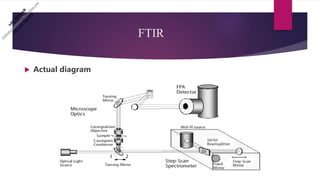
 Actual diagram
FTIR
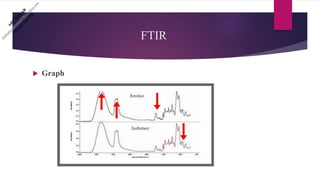
 Graph
FTIR
• Applications of FTIR
• Quality verification of incoming/outgoing materials
• Deformulation of polymers, rubbers, and other materials through thermogravimetric infra-
red (TGA-IR) or gas chromatography infra-red (GC-IR) analysis
• Microanalysis of small sections of materials to identify contaminants
• Analysis of thin films and coatings
• Monitoring of automotive or smokestack emissions
• Failure analysis
FTIR

Fourier Transform Infrared.pptx

  • 1.
  • 3.
    FTIR  History  Introduction Theory  Technique  Principle  Working  Working Diagram  Actual Diagram  Graph
  • 4.
    FTIR  History infrared spectrophotometerswere developed in the US in the mid 1940s. Initially, their applications were confined to R&D work on organic compounds, mainly in the petrochemical field. The first Japanese instruments were manufactured in 1954 by the Applied Optics Research Institute, the predecessor of JASCO.
  • 5.
    FTIR  Introduction: A FourierTransform InfraRed (FT-IR) Spectrometer is an instrument which acquires broadband Near InfraRed (NIR) to Far InfraRed (FIR) spectra.
  • 6.
    FTIR  Theory ofFTIR:  FTIR spectrophotometry was developed in order to overcome the limitations encountered with dispersive instruments.  The main difficulty was the slow scanning process. A method for measuring all the infrared frequencies simultaneously, rather than individually, was needed.  A solution was developed which employed a very simple optical device called an interferometer. The interferometer produces unique type of signal which has all the infrared frequencies “ encoded” into it.
  • 7.
    Techniques of FTIR Following techniques of FTIR used by university researches scientists and process engineers  Attenuated Total Reflectance (ATR)  Specular Reflectance (SR)  Reflection absorption (RA)  Transmission (TR)  Photoacoustic (PA)
  • 8.
    FTIR  Principle Principle OfFTIR is that many gases absorb IR radiation at species-specific frequencies. FTIR spectroscopy is a disperse method, which means that measurements are performed over a broad spectrum instead of a narrow band of frequencies. The absorption corresponds specifically to the bonds present in the molecule. The frequency range are measured as wave numbers typically over range 400-600m-1.
  • 9.
    FTIR  Working ofFTIR The FTIR uses interferometry to record information about a material placed in the IR beam. The Fourier Transform results in spectra that analysts can use to identify or quantify the material.
  • 10.
  • 11.
  • 12.
  • 13.
    FTIR • Applications ofFTIR • Quality verification of incoming/outgoing materials • Deformulation of polymers, rubbers, and other materials through thermogravimetric infra- red (TGA-IR) or gas chromatography infra-red (GC-IR) analysis • Microanalysis of small sections of materials to identify contaminants • Analysis of thin films and coatings • Monitoring of automotive or smokestack emissions • Failure analysis
  • 14.