Dielectrics
Unit – 1
Sub.- Physics
Dielectrics are the materials having electric dipole moment permantly.
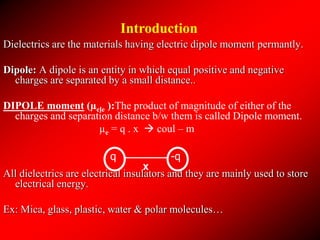
Dipole: A dipole is an entity in which equal positive and negative
charges are separated by a small distance..
DIPOLE moment (µele ):The product of magnitude of either of the
charges and separation distance b/w them is called Dipole moment.
µe = q . x  coul – m
All dielectrics are electrical insulators and they are mainly used to store
electrical energy.
Ex: Mica, glass, plastic, water & polar molecules…
X
q -q
Introduction
POLARISATION OF DIELECRICS
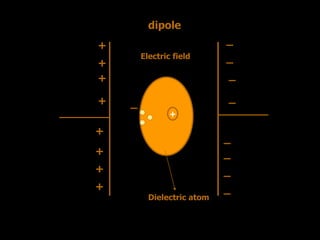
 When we are applying external electric field, it causes the
electron cloud to move away. Thus the centroides of the
positive and negative charges now no longer coincides and as a
result of that an electric dipole is induced in the atom. Thus,
atom is said to be polarized.
 Polarization : the process of creating or inducing dipoles in a
dielectric medium by an external field.
 On the basis on that dielectrics are the material that have
either permanent diploes or induced in the presence of
external electric field .
 They are classified into two categories (1) Non polar (2)polar
Dielectrics
 Non Polar Dielectrics : There is no permanent
dipole existence in the absence of an electric field .
 Centroids of positive and negative charges of molecules
constituting the dielectric material coincide .
 Examples :H2, N2, O2, CO2
 Polar Dielectrics : there is permanent dipole exists
even in the absence of an electric field .
 Centroids of posistive and negative charges of molecules
constituting the dielectric material do not coinside even in the
absence of electric field
 Examples : HCL , CO
+
Electric field
Dielectric atom
+
+
+
+
+
+
+
+
_
_
_
_
_
_
_
__
dipole
Dielectric Constant
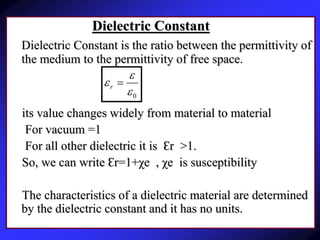
Dielectric Constant is the ratio between the permittivity of
the medium to the permittivity of free space.
its value changes widely from material to material
For vacuum =1
For all other dielectric it is Ɛr >1.
So, we can write Ɛr=1+χe , χe is susceptibility
The characteristics of a dielectric material are determined
by the dielectric constant and it has no units.
0

 r
Electric field
 The region surrounded by charged body is always under
stress because of electrostatic charge . If a small charge q or
a charged body is placed in this region ,then the charge q or
a charged body will experienced a force according Coulomb
s law . This stressed region around charged body is called
electric field .
 Electric field at a point define as the force that acts on a unit
positive charge placed at that point thus E.
 According to coulomb law when two point charges Q1 and
Q2 are separated by a distance r, the force of attraction or
repulsion between two charges is given by
Various polarization processes:
When the specimen is placed inside a d.c.
electric field, polarization is due to four
types of processes….
1.Electronic polarization
2.Ionic polarization
3.Orientation polarization
4.Space charge polarization
Electronic Polarization
When an EF is applied to an atom, +vely charged
nucleus displaces in the direction of field and ẽ could in
opposite direction. This kind of displacement will produce an
electric dipole with in the atom.
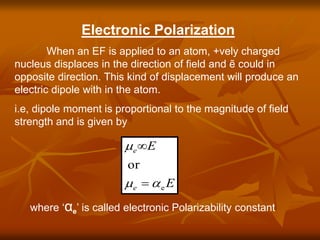
i.e, dipole moment is proportional to the magnitude of field
strength and is given by
E
E
e
e
e
or




where ‘αe’ is called electronic Polarizability constant
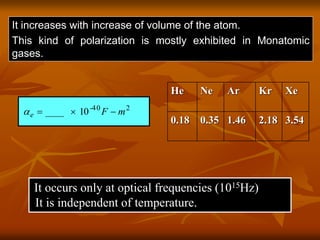
It increases with increase of volume of the atom.
This kind of polarization is mostly exhibited in Monatomic
gases.
10____ 2-40
mFe 
He Ne Ar Kr Xe
0.18 0.35 1.46 2.18 3.54
It occurs only at optical frequencies (1015Hz)
It is independent of temperature.
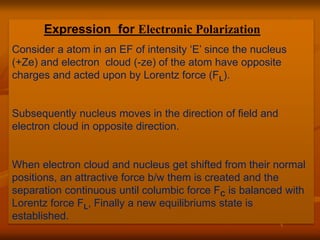
Expression for Electronic Polarization
Consider a atom in an EF of intensity ‘E’ since the nucleus
(+Ze) and electron cloud (-ze) of the atom have opposite
charges and acted upon by Lorentz force (FL).
Subsequently nucleus moves in the direction of field and
electron cloud in opposite direction.
When electron cloud and nucleus get shifted from their normal
positions, an attractive force b/w them is created and the
separation continuous until columbic force FC is balanced with
Lorentz force FL, Finally a new equilibriums state is
established.
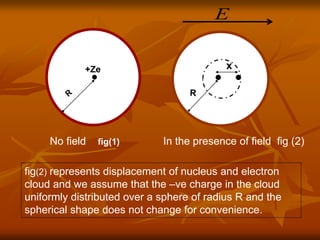
fig(2) represents displacement of nucleus and electron
cloud and we assume that the –ve charge in the cloud
uniformly distributed over a sphere of radius R and the
spherical shape does not change for convenience.
+Ze
No field fig(1)
x
In the presence of field fig (2)
E
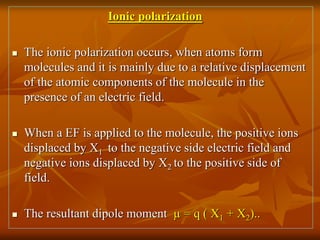
Ionic polarization
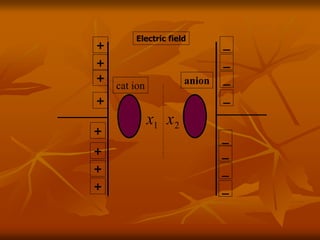
 The ionic polarization occurs, when atoms form
molecules and it is mainly due to a relative displacement
of the atomic components of the molecule in the
presence of an electric field.
 When a EF is applied to the molecule, the positive ions
displaced by X1 to the negative side electric field and
negative ions displaced by X2 to the positive side of
field.
 The resultant dipole moment µ = q ( X1 + X2)..
Electric field
+
+
+
+
+
+
+
+
_
_
_
_
_
_
_
_
1x 2x
anioncat ion
Orientation Polarization
It is also called dipolar or molecular polarization. The
molecules such as H2 , N2,O2,Cl2 ,CH4,CCl4 etc., does not carry
any dipole because centre of positive charge and centre of
negative charge coincides. On the other hand molecules like
CH3Cl, H2O,HCl, ethyl acetate ( polar molecules) carries
dipoles even in the absence of electric field.
How ever the net dipole moment is negligibly small since all
the molecular dipoles are oriented randomly when there is no
EF. In the presence of the electric field these all dipoles orient
them selves in the direction of field as a result the net dipole
moment becomes enormous.
 It occurs at a frequency 106 Hz to 1010Hz.
 It is slow process compare to ionic
polarization.
 It greatly depends on temperature.
Internal fields or local fields
Local field or internal field in a dielectric is the
space and time average of the electric field
intensity acting on a particular molecule in the
dielectric material.
It is also known as a Microscopic field which
acts at an Atom.
TYPES OF DIELECTRIC MATERIAL
 Dielectric material can be solid, liquid or gas.
 High vacuum can also be used as a dielectric.
 Solid dielectrics are most commonly use like glass,
rubber, mica etc..
 As a liquid dielectric material Transformer oil, cable
oil, Capacitor oil, Vegetable oil etc can be used.
 Gaseous dielectric materials are used for both as
insulators and
also as a cooling agents.
For example: Air, Hydrogen, nitrogen, Helium,
Sulphur- dioxide, Propen, methane etc..
1) Solid Dielectric Material:
I) Mica: It is inorganic mineral material made up of silicate of
aluminium with silicate of soda, potash and magnesia.
It is rigid, tough and strong. It has high dielectric strength
and is not affected by moisture.
It is widely used in irons, hot plates and toasters.
II) Glass: It is inorganic material made by the fusion of different
oxides like SiO2, ZnO and MgO.
It is Brittle and hard material and has good dielectric strength
It is mostly used in the capacitors. Also used as dielectric tubes
in radios and television.
III) Asbestos: It is naturally occurring material. In general it
consist of magnesium silicate.
It has low dielectric strength. It is used as insulating material
to prevent current flow in the outer body. It is widely used in
the form of the paper, tap, cloth etc.
IV) Rubber: It is organic polymer. It may be natural or synthetic.
It has good electrical and thermal properties and also
it has good tensile strength.
It is used for the insulating materials on electrical wires.
V) Ceramics: They are generally non-matalic inorganic compounds
such as silicates, aluminates, oxides, carbides, borides etc.
Ceramics can be classified as:
clay products, refractories, and glasses.
Ceramics are hard, strong and dense. They have exellent
dielectric and mechanical properties.
They widely used as insulators in switches, plug holders etc.
They are also used as dielectric in capacitors.
2) Liquid Dielectric Material:
I) Mineral Insulating Oil : These oils are obtained from crude
petroleum. These have good thermal stability.
They are used in Transformers as cooling and insulating
material and also in Capacitors.
Transformer oil, cable oil and capacitor oil belong to the
category of mineral insulating oil.
II) Synthetic Insulating Oil : Askarels, aroclors, sovol and
savtol are a few synthetic oils that are widely used.
They are very much resistant to fire hazards.
Due to longer life and safety in operating condition, these
oils are used as coolants and insulators in high voltage
transformers in place of Transformer oil.
II) Miscellaneous Insulating Oil :
Vaseline, vegetable oils and silicon liquid belongs to these
category. Silicon liquids has thermal stability upto 200 C and
are very costly.
The dielectric strength of these oils are same as mineral oils so
they are also used in the H.V transformers.
3) Gaseous Dielectric Material:
I) Air : It is naturally available dielectric material.
Dielectric loss is practically zero. The dielectric constant of air
linearly increase with increase in pressure.
It is used as dielectrics in air condensers.
It can be used as an insulator only in low voltage
applications.
II) Nitrogen : It is important gaseous dielectric material. It prevent
oxidation.
It is used in cables and capacitors under pressure.
III) Sulphure Hexafluoride:
It is formed by burning of Sulphure in fluorine atmosphere.
It has superior cooling properties than air and nitrogen.
It is used in the transformers, electrical switches, voltage
stabilizer and X-ray apparatus.
IV) Inert Gases: They are used in electronic tubes and discharge
tubes as insulators.
Properties of Good Dielectric Material
 It should have high resistivity to reduce the leakage current.
 It should have high dielectric strength.
 It should have high mechanical strength.
 It should have high fire resistance.
 It should have low thermal expansion.
 It should have high thermal conductivity.
 It should have low dielectric loss.
 It should have low water absorption quality.
Applications of Dielectrics
1. Capacitors
2. Transformers
3. Polymeric film
4. Electrolytic
5. Power and Distribution transformers
6. Other applications

Dielectric constant

  • 1.
  • 2.
    Dielectrics are thematerials having electric dipole moment permantly. Dipole: A dipole is an entity in which equal positive and negative charges are separated by a small distance.. DIPOLE moment (µele ):The product of magnitude of either of the charges and separation distance b/w them is called Dipole moment. µe = q . x  coul – m All dielectrics are electrical insulators and they are mainly used to store electrical energy. Ex: Mica, glass, plastic, water & polar molecules… X q -q Introduction
  • 3.
    POLARISATION OF DIELECRICS When we are applying external electric field, it causes the electron cloud to move away. Thus the centroides of the positive and negative charges now no longer coincides and as a result of that an electric dipole is induced in the atom. Thus, atom is said to be polarized.  Polarization : the process of creating or inducing dipoles in a dielectric medium by an external field.  On the basis on that dielectrics are the material that have either permanent diploes or induced in the presence of external electric field .  They are classified into two categories (1) Non polar (2)polar
  • 4.
    Dielectrics  Non PolarDielectrics : There is no permanent dipole existence in the absence of an electric field .  Centroids of positive and negative charges of molecules constituting the dielectric material coincide .  Examples :H2, N2, O2, CO2  Polar Dielectrics : there is permanent dipole exists even in the absence of an electric field .  Centroids of posistive and negative charges of molecules constituting the dielectric material do not coinside even in the absence of electric field  Examples : HCL , CO
  • 5.
  • 6.
    Dielectric Constant Dielectric Constantis the ratio between the permittivity of the medium to the permittivity of free space. its value changes widely from material to material For vacuum =1 For all other dielectric it is Ɛr >1. So, we can write Ɛr=1+χe , χe is susceptibility The characteristics of a dielectric material are determined by the dielectric constant and it has no units. 0   r
  • 7.
    Electric field  Theregion surrounded by charged body is always under stress because of electrostatic charge . If a small charge q or a charged body is placed in this region ,then the charge q or a charged body will experienced a force according Coulomb s law . This stressed region around charged body is called electric field .  Electric field at a point define as the force that acts on a unit positive charge placed at that point thus E.  According to coulomb law when two point charges Q1 and Q2 are separated by a distance r, the force of attraction or repulsion between two charges is given by
  • 8.
    Various polarization processes: Whenthe specimen is placed inside a d.c. electric field, polarization is due to four types of processes…. 1.Electronic polarization 2.Ionic polarization 3.Orientation polarization 4.Space charge polarization
  • 9.
    Electronic Polarization When anEF is applied to an atom, +vely charged nucleus displaces in the direction of field and ẽ could in opposite direction. This kind of displacement will produce an electric dipole with in the atom. i.e, dipole moment is proportional to the magnitude of field strength and is given by E E e e e or     where ‘αe’ is called electronic Polarizability constant
  • 10.
    It increases withincrease of volume of the atom. This kind of polarization is mostly exhibited in Monatomic gases. 10____ 2-40 mFe  He Ne Ar Kr Xe 0.18 0.35 1.46 2.18 3.54 It occurs only at optical frequencies (1015Hz) It is independent of temperature.
  • 11.
    Expression for ElectronicPolarization Consider a atom in an EF of intensity ‘E’ since the nucleus (+Ze) and electron cloud (-ze) of the atom have opposite charges and acted upon by Lorentz force (FL). Subsequently nucleus moves in the direction of field and electron cloud in opposite direction. When electron cloud and nucleus get shifted from their normal positions, an attractive force b/w them is created and the separation continuous until columbic force FC is balanced with Lorentz force FL, Finally a new equilibriums state is established.
  • 12.
    fig(2) represents displacementof nucleus and electron cloud and we assume that the –ve charge in the cloud uniformly distributed over a sphere of radius R and the spherical shape does not change for convenience. +Ze No field fig(1) x In the presence of field fig (2) E
  • 13.
    Ionic polarization  Theionic polarization occurs, when atoms form molecules and it is mainly due to a relative displacement of the atomic components of the molecule in the presence of an electric field.  When a EF is applied to the molecule, the positive ions displaced by X1 to the negative side electric field and negative ions displaced by X2 to the positive side of field.  The resultant dipole moment µ = q ( X1 + X2)..
  • 14.
  • 15.
    Orientation Polarization It isalso called dipolar or molecular polarization. The molecules such as H2 , N2,O2,Cl2 ,CH4,CCl4 etc., does not carry any dipole because centre of positive charge and centre of negative charge coincides. On the other hand molecules like CH3Cl, H2O,HCl, ethyl acetate ( polar molecules) carries dipoles even in the absence of electric field. How ever the net dipole moment is negligibly small since all the molecular dipoles are oriented randomly when there is no EF. In the presence of the electric field these all dipoles orient them selves in the direction of field as a result the net dipole moment becomes enormous.
  • 16.
     It occursat a frequency 106 Hz to 1010Hz.  It is slow process compare to ionic polarization.  It greatly depends on temperature.
  • 17.
    Internal fields orlocal fields Local field or internal field in a dielectric is the space and time average of the electric field intensity acting on a particular molecule in the dielectric material. It is also known as a Microscopic field which acts at an Atom.
  • 18.
    TYPES OF DIELECTRICMATERIAL  Dielectric material can be solid, liquid or gas.  High vacuum can also be used as a dielectric.  Solid dielectrics are most commonly use like glass, rubber, mica etc..  As a liquid dielectric material Transformer oil, cable oil, Capacitor oil, Vegetable oil etc can be used.  Gaseous dielectric materials are used for both as insulators and also as a cooling agents. For example: Air, Hydrogen, nitrogen, Helium, Sulphur- dioxide, Propen, methane etc..
  • 19.
    1) Solid DielectricMaterial: I) Mica: It is inorganic mineral material made up of silicate of aluminium with silicate of soda, potash and magnesia. It is rigid, tough and strong. It has high dielectric strength and is not affected by moisture. It is widely used in irons, hot plates and toasters. II) Glass: It is inorganic material made by the fusion of different oxides like SiO2, ZnO and MgO. It is Brittle and hard material and has good dielectric strength It is mostly used in the capacitors. Also used as dielectric tubes in radios and television. III) Asbestos: It is naturally occurring material. In general it consist of magnesium silicate. It has low dielectric strength. It is used as insulating material to prevent current flow in the outer body. It is widely used in the form of the paper, tap, cloth etc.
  • 20.
    IV) Rubber: Itis organic polymer. It may be natural or synthetic. It has good electrical and thermal properties and also it has good tensile strength. It is used for the insulating materials on electrical wires. V) Ceramics: They are generally non-matalic inorganic compounds such as silicates, aluminates, oxides, carbides, borides etc. Ceramics can be classified as: clay products, refractories, and glasses. Ceramics are hard, strong and dense. They have exellent dielectric and mechanical properties. They widely used as insulators in switches, plug holders etc. They are also used as dielectric in capacitors.
  • 21.
    2) Liquid DielectricMaterial: I) Mineral Insulating Oil : These oils are obtained from crude petroleum. These have good thermal stability. They are used in Transformers as cooling and insulating material and also in Capacitors. Transformer oil, cable oil and capacitor oil belong to the category of mineral insulating oil. II) Synthetic Insulating Oil : Askarels, aroclors, sovol and savtol are a few synthetic oils that are widely used. They are very much resistant to fire hazards. Due to longer life and safety in operating condition, these oils are used as coolants and insulators in high voltage transformers in place of Transformer oil.
  • 22.
    II) Miscellaneous InsulatingOil : Vaseline, vegetable oils and silicon liquid belongs to these category. Silicon liquids has thermal stability upto 200 C and are very costly. The dielectric strength of these oils are same as mineral oils so they are also used in the H.V transformers.
  • 23.
    3) Gaseous DielectricMaterial: I) Air : It is naturally available dielectric material. Dielectric loss is practically zero. The dielectric constant of air linearly increase with increase in pressure. It is used as dielectrics in air condensers. It can be used as an insulator only in low voltage applications. II) Nitrogen : It is important gaseous dielectric material. It prevent oxidation. It is used in cables and capacitors under pressure. III) Sulphure Hexafluoride: It is formed by burning of Sulphure in fluorine atmosphere. It has superior cooling properties than air and nitrogen. It is used in the transformers, electrical switches, voltage stabilizer and X-ray apparatus. IV) Inert Gases: They are used in electronic tubes and discharge tubes as insulators.
  • 24.
    Properties of GoodDielectric Material  It should have high resistivity to reduce the leakage current.  It should have high dielectric strength.  It should have high mechanical strength.  It should have high fire resistance.  It should have low thermal expansion.  It should have high thermal conductivity.  It should have low dielectric loss.  It should have low water absorption quality.
  • 25.
    Applications of Dielectrics 1.Capacitors 2. Transformers 3. Polymeric film 4. Electrolytic 5. Power and Distribution transformers 6. Other applications