Student’s Name: Hazim Abdullah
Advisor’s Name: Dr.Saad Murad
Objective:
At the end of this Seminar, the Student should be able
to:
 Define the Laryngitis
 Identify the Etiology of Laryngitis
 Explain the Clinical Manifestation of Laryngitis
 Discuss the Nursing Management for Patient with
Laryngitis.
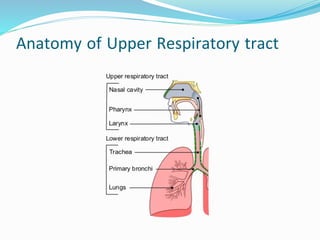
Anatomy of Upper Respiratory tract
Outlines of Seminar
I. Definition of Laryngitis
II. Etiology of Laryngitis
III. Clinical Manifestation of Laryngitis
IV. Medical Management
V. Nursing Management
Introduction:
Laryngitis occurs when your voice box or vocal cords
become inflamed from overuse, irritation, or
infection. Laryngitis can be acute (short-term),
lasting less than three weeks. Or it can be chronic
(long-term), lasting more than three weeks.
Many conditions can cause the inflammation that
results in laryngitis. Viral infections, environmental
factors, and bacterial infections can all cause
laryngitis. [1]
Definition of Laryngitis
an inflammation of the larynx, often occurs as a result of
voice abuse or exposure to dust, chemicals, smoke, and other
pollutants or as part of a URI. It also may be caused by
isolated infection involving only the vocal cords.
Etiology
 Laryngitis is very often caused by the pathogens that
cause the common cold and pharyngitis; the most
common cause is a virus, and laryngitis is often
associated with allergic rhinitis or pharyngitis.
Bacterial invasion may be secondary.
Clinical Manifestation of Laryngitis
1. Signs of acute laryngitis include : hoarseness or aphonia
(complete loss of voice) and severe cough, sudden onset
made worse by cold dry wind. The throat feels worse in
the morning and improves when the patient is indoors in
a warmer climate.
2. At times, the patient presents with a dry cough and a dry,
sore throat that worsens in the evening hours.
3. Many patients also complain of a “tickle” in the throat
that is made worse by cold air or cold liquids.
4. Chronic laryngitis is marked by persistent hoarseness.
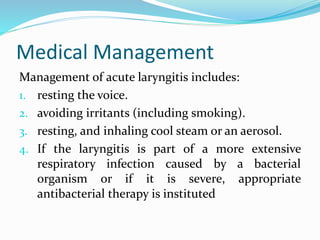
Medical Management
Management of acute laryngitis includes:
1. resting the voice.
2. avoiding irritants (including smoking).
3. resting, and inhaling cool steam or an aerosol.
4. If the laryngitis is part of a more extensive
respiratory infection caused by a bacterial
organism or if it is severe, appropriate
antibacterial therapy is instituted
Medical Management
For chronic laryngitis, the treatment includes:
1. Resting the voice.
2. eliminating any primary respiratory tract
infection.
3. eliminating smoking and avoiding secondhand
smoke.
4. Topical corticosteroids, such as beclomethasone
dipropionate (Vanceril), may be given by inhalation.
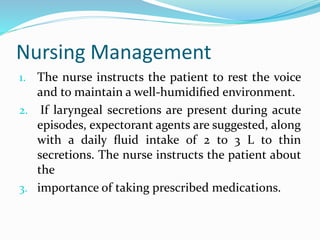
Nursing Management
1. The nurse instructs the patient to rest the voice
and to maintain a well-humidified environment.
2. If laryngeal secretions are present during acute
episodes, expectorant agents are suggested, along
with a daily fluid intake of 2 to 3 L to thin
secretions. The nurse instructs the patient about
the
3. importance of taking prescribed medications.
Nursing Management
4. the nurse informs the patient that the symptoms of
laryngitis often extend a week to 10 days after completion
of antibiotic therapy.
5. The nurse instructs the patient about signs and
symptoms that require contacting the health care
provider.
6. These signs and symptoms include loss of voice with
sore throat that makes swallowing saliva difficult,
hemoptysis, and noisy respirations.
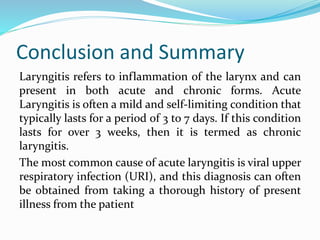
Conclusion and Summary
Laryngitis refers to inflammation of the larynx and can
present in both acute and chronic forms. Acute
Laryngitis is often a mild and self-limiting condition that
typically lasts for a period of 3 to 7 days. If this condition
lasts for over 3 weeks, then it is termed as chronic
laryngitis.
The most common cause of acute laryngitis is viral upper
respiratory infection (URI), and this diagnosis can often
be obtained from taking a thorough history of present
illness from the patient
Conclusion and Summary
Presenting symptoms often include voice changes
(patients may report hoarseness or a "raspy" voice), early
vocal fatigue (particularly in singers or professional voice
users), or a dry cough. Breathing difficulties are rare
(though possible) in acute laryngitis, but the presence of
significant dyspnea, shortness of breath (SOB), or
audible stridor should alert the clinician that a more
dangerous disease process may be present. [2]
FAQ?
 Define the Laryngitis?
 What’s the Clinical Manifestation of Laryngitis?
 How can the Nurse Management the Laryngitis?
Reference
 Brunner, L. S., Suddarth, D. S., Smeltzer, S. C. O., & Bare, B. G.
(2018). Brunner & Suddarth’s textbook of medical-surgical nursing
(14th ed.). Philadelphia: Lippincott Williams & Wilkins.
 [1]
 https://www.healthline.com/health/laryngitis-2
 Abdallah C. (2012). Acute epiglottitis: Trends, diagnosis and
management. DOI:
10.4103/1658-354X.101222
 [2]
 https://www.ncbi.nlm.nih.gov/books/NBK534871
 Jaworek AJ, Earasi K, Lyons KM, Daggumati S, Hu A, Sataloff RT. Acute
infectious laryngitis: A case series. Ear Nose Throat J. 2018
Sep;97(9):306-313. [PubMed] [Ref list]
YOU
THANK
I WISH FOR YOU ALL THE BEST

LARYNGITIS.pptx

  • 1.
    Student’s Name: HazimAbdullah Advisor’s Name: Dr.Saad Murad
  • 2.
    Objective: At the endof this Seminar, the Student should be able to:  Define the Laryngitis  Identify the Etiology of Laryngitis  Explain the Clinical Manifestation of Laryngitis  Discuss the Nursing Management for Patient with Laryngitis.
  • 3.
    Anatomy of UpperRespiratory tract
  • 5.
    Outlines of Seminar I.Definition of Laryngitis II. Etiology of Laryngitis III. Clinical Manifestation of Laryngitis IV. Medical Management V. Nursing Management
  • 6.
    Introduction: Laryngitis occurs whenyour voice box or vocal cords become inflamed from overuse, irritation, or infection. Laryngitis can be acute (short-term), lasting less than three weeks. Or it can be chronic (long-term), lasting more than three weeks. Many conditions can cause the inflammation that results in laryngitis. Viral infections, environmental factors, and bacterial infections can all cause laryngitis. [1]
  • 7.
    Definition of Laryngitis aninflammation of the larynx, often occurs as a result of voice abuse or exposure to dust, chemicals, smoke, and other pollutants or as part of a URI. It also may be caused by isolated infection involving only the vocal cords.
  • 8.
    Etiology  Laryngitis isvery often caused by the pathogens that cause the common cold and pharyngitis; the most common cause is a virus, and laryngitis is often associated with allergic rhinitis or pharyngitis. Bacterial invasion may be secondary.
  • 9.
    Clinical Manifestation ofLaryngitis 1. Signs of acute laryngitis include : hoarseness or aphonia (complete loss of voice) and severe cough, sudden onset made worse by cold dry wind. The throat feels worse in the morning and improves when the patient is indoors in a warmer climate. 2. At times, the patient presents with a dry cough and a dry, sore throat that worsens in the evening hours. 3. Many patients also complain of a “tickle” in the throat that is made worse by cold air or cold liquids. 4. Chronic laryngitis is marked by persistent hoarseness.
  • 10.
    Medical Management Management ofacute laryngitis includes: 1. resting the voice. 2. avoiding irritants (including smoking). 3. resting, and inhaling cool steam or an aerosol. 4. If the laryngitis is part of a more extensive respiratory infection caused by a bacterial organism or if it is severe, appropriate antibacterial therapy is instituted
  • 11.
    Medical Management For chroniclaryngitis, the treatment includes: 1. Resting the voice. 2. eliminating any primary respiratory tract infection. 3. eliminating smoking and avoiding secondhand smoke. 4. Topical corticosteroids, such as beclomethasone dipropionate (Vanceril), may be given by inhalation.
  • 12.
    Nursing Management 1. Thenurse instructs the patient to rest the voice and to maintain a well-humidified environment. 2. If laryngeal secretions are present during acute episodes, expectorant agents are suggested, along with a daily fluid intake of 2 to 3 L to thin secretions. The nurse instructs the patient about the 3. importance of taking prescribed medications.
  • 13.
    Nursing Management 4. thenurse informs the patient that the symptoms of laryngitis often extend a week to 10 days after completion of antibiotic therapy. 5. The nurse instructs the patient about signs and symptoms that require contacting the health care provider. 6. These signs and symptoms include loss of voice with sore throat that makes swallowing saliva difficult, hemoptysis, and noisy respirations.
  • 14.
    Conclusion and Summary Laryngitisrefers to inflammation of the larynx and can present in both acute and chronic forms. Acute Laryngitis is often a mild and self-limiting condition that typically lasts for a period of 3 to 7 days. If this condition lasts for over 3 weeks, then it is termed as chronic laryngitis. The most common cause of acute laryngitis is viral upper respiratory infection (URI), and this diagnosis can often be obtained from taking a thorough history of present illness from the patient
  • 15.
    Conclusion and Summary Presentingsymptoms often include voice changes (patients may report hoarseness or a "raspy" voice), early vocal fatigue (particularly in singers or professional voice users), or a dry cough. Breathing difficulties are rare (though possible) in acute laryngitis, but the presence of significant dyspnea, shortness of breath (SOB), or audible stridor should alert the clinician that a more dangerous disease process may be present. [2]
  • 16.
    FAQ?  Define theLaryngitis?  What’s the Clinical Manifestation of Laryngitis?  How can the Nurse Management the Laryngitis?
  • 17.
    Reference  Brunner, L.S., Suddarth, D. S., Smeltzer, S. C. O., & Bare, B. G. (2018). Brunner & Suddarth’s textbook of medical-surgical nursing (14th ed.). Philadelphia: Lippincott Williams & Wilkins.  [1]  https://www.healthline.com/health/laryngitis-2  Abdallah C. (2012). Acute epiglottitis: Trends, diagnosis and management. DOI: 10.4103/1658-354X.101222  [2]  https://www.ncbi.nlm.nih.gov/books/NBK534871  Jaworek AJ, Earasi K, Lyons KM, Daggumati S, Hu A, Sataloff RT. Acute infectious laryngitis: A case series. Ear Nose Throat J. 2018 Sep;97(9):306-313. [PubMed] [Ref list]
  • 18.
    YOU THANK I WISH FORYOU ALL THE BEST