Laplace Transform
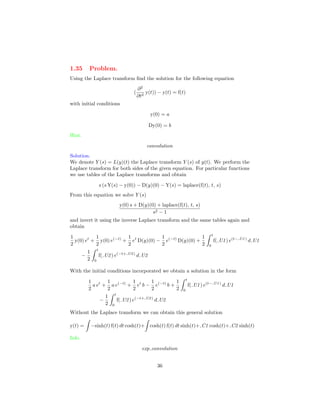
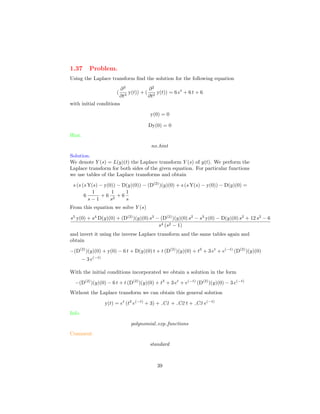
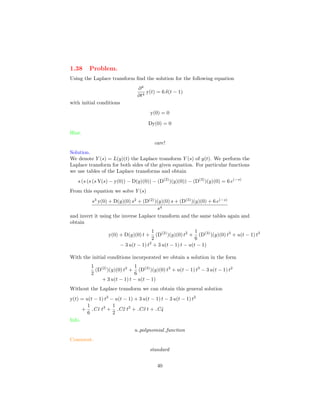
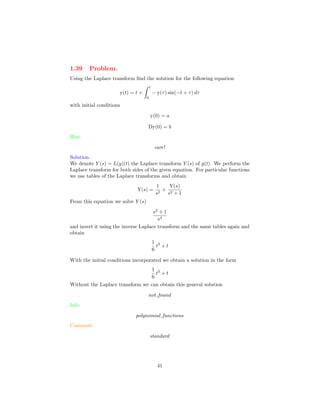
solved problems
Pavel Pyrih
May 24, 2012
( public domain )
Acknowledgement. The following problems were solved using my own procedure
in a program Maple V, release 5, using commands from
Bent E. Petersen: Laplace Transform in Maple
http://people.oregonstate.edu/˜peterseb/mth256/docs/256winter2001 laplace.pdf
All possible errors are my faults.

1 Solving equations using the Laplace transform
Theorem.(Lerch) If two functions have the same integral transform then they
are equal almost everywhere.
This is the right key to the following problems.
Notation.(Dirac & Heaviside) The Dirac unit impuls function will be denoted
by δ(t). The Heaviside step function will be denoted by u(t).
1
1.1 Problem.
Using the Laplace transform find the solution for the following equation
∂
∂t
y(t) = 3 − 2 t
with initial conditions
y(0) = 0
Dy(0) = 0
Hint.
no hint
Solution.
We denote Y (s) = L(y)(t) the Laplace transform Y (s) of y(t). We perform the
Laplace transform for both sides of the given equation. For particular functions
we use tables of the Laplace transforms and obtain
s Y(s) − y(0) = 3
1
s
− 2
1
s2
From this equation we solve Y (s)
y(0) s2
+ 3 s − 2
s3
and invert it using the inverse Laplace transform and the same tables again and
obtain
−t2
+ 3 t + y(0)
With the initial conditions incorporated we obtain a solution in the form
−t2
+ 3 t
Without the Laplace transform we can obtain this general solution
y(t) = −t2
+ 3 t + C1
Info.
polynomial
Comment.
elementary
2
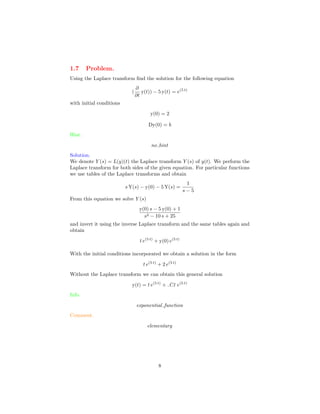
1.2 Problem.
Using the Laplace transform find the solution for the following equation
∂
∂t
y(t) = e(−3 t)
with initial conditions
y(0) = 4
Dy(0) = 0
Hint.
no hint
Solution.
We denote Y (s) = L(y)(t) the Laplace transform Y (s) of y(t). We perform the
Laplace transform for both sides of the given equation. For particular functions
we use tables of the Laplace transforms and obtain
s Y(s) − y(0) =
1
s + 3
From this equation we solve Y (s)
y(0) s + 3 y(0) + 1
s (s + 3)
and invert it using the inverse Laplace transform and the same tables again and
obtain
1
3
+ y(0) −
1
3
e(−3 t)
With the initial conditions incorporated we obtain a solution in the form
13
3
−
1
3
e(−3 t)
Without the Laplace transform we can obtain this general solution
y(t) = −
1
3
e(−3 t)
+ C1
Info.
exponential function
Comment.
elementary
3
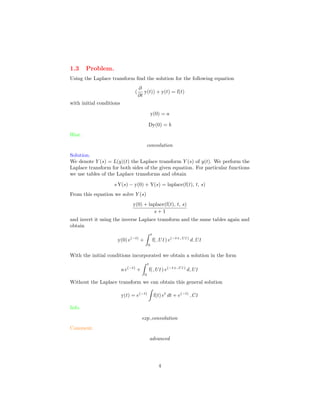
1.3 Problem.
Using the Laplace transform find the solution for the following equation
(
∂
∂t
y(t)) + y(t) = f(t)
with initial conditions
y(0) = a
Dy(0) = b
Hint.
convolution
Solution.
We denote Y (s) = L(y)(t) the Laplace transform Y (s) of y(t). We perform the
Laplace transform for both sides of the given equation. For particular functions
we use tables of the Laplace transforms and obtain
s Y(s) − y(0) + Y(s) = laplace(f(t), t, s)
From this equation we solve Y (s)
y(0) + laplace(f(t), t, s)
s + 1
and invert it using the inverse Laplace transform and the same tables again and
obtain
y(0) e(−t)
+
t
0
f( U1) e(−t+ U1)
d U1
With the initial conditions incorporated we obtain a solution in the form
a e(−t)
+
t
0
f( U1) e(−t+ U1)
d U1
Without the Laplace transform we can obtain this general solution
y(t) = e(−t)
f(t) et
dt + e(−t)
C1
Info.
exp convolution
Comment.
advanced
4
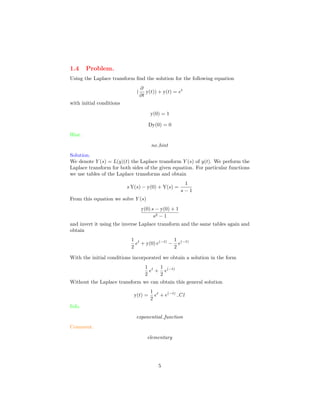
1.4 Problem.
Using the Laplace transform find the solution for the following equation
(
∂
∂t
y(t)) + y(t) = et
with initial conditions
y(0) = 1
Dy(0) = 0
Hint.
no hint
Solution.
We denote Y (s) = L(y)(t) the Laplace transform Y (s) of y(t). We perform the
Laplace transform for both sides of the given equation. For particular functions
we use tables of the Laplace transforms and obtain
s Y(s) − y(0) + Y(s) =
1
s − 1
From this equation we solve Y (s)
y(0) s − y(0) + 1
s2 − 1
and invert it using the inverse Laplace transform and the same tables again and
obtain
1
2
et
+ y(0) e(−t)
−
1
2
e(−t)
With the initial conditions incorporated we obtain a solution in the form
1
2
et
+
1
2
e(−t)
Without the Laplace transform we can obtain this general solution
y(t) =
1
2
et
+ e(−t)
C1
Info.
exponential function
Comment.
elementary
5
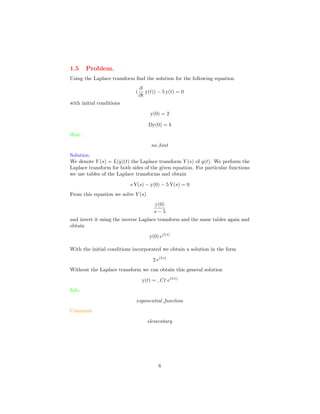
1.5 Problem.
Using the Laplace transform find the solution for the following equation
(
∂
∂t
y(t)) − 5 y(t) = 0
with initial conditions
y(0) = 2
Dy(0) = b
Hint.
no hint
Solution.
We denote Y (s) = L(y)(t) the Laplace transform Y (s) of y(t). We perform the
Laplace transform for both sides of the given equation. For particular functions
we use tables of the Laplace transforms and obtain
s Y(s) − y(0) − 5 Y(s) = 0
From this equation we solve Y (s)
y(0)
s − 5
and invert it using the inverse Laplace transform and the same tables again and
obtain
y(0) e(5 t)
With the initial conditions incorporated we obtain a solution in the form
2 e(5 t)
Without the Laplace transform we can obtain this general solution
y(t) = C1 e(5 t)
Info.
exponential function
Comment.
elementary
6
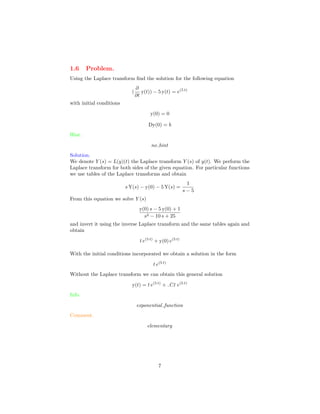
1.6 Problem.
Using the Laplace transform find the solution for the following equation
(
∂
∂t
y(t)) − 5 y(t) = e(5 t)
with initial conditions
y(0) = 0
Dy(0) = b
Hint.
no hint
Solution.
We denote Y (s) = L(y)(t) the Laplace transform Y (s) of y(t). We perform the
Laplace transform for both sides of the given equation. For particular functions
we use tables of the Laplace transforms and obtain
s Y(s) − y(0) − 5 Y(s) =
1
s − 5
From this equation we solve Y (s)
y(0) s − 5 y(0) + 1
s2 − 10 s + 25
and invert it using the inverse Laplace transform and the same tables again and
obtain
t e(5 t)
+ y(0) e(5 t)
With the initial conditions incorporated we obtain a solution in the form
t e(5 t)
Without the Laplace transform we can obtain this general solution
y(t) = t e(5 t)
+ C1 e(5 t)
Info.
exponential function
Comment.
elementary
7
1.7 Problem.
Using the Laplace transform find the solution for the following equation
(
∂
∂t
y(t)) − 5 y(t) = e(5 t)
with initial conditions
y(0) = 2
Dy(0) = b
Hint.
no hint
Solution.
We denote Y (s) = L(y)(t) the Laplace transform Y (s) of y(t). We perform the
Laplace transform for both sides of the given equation. For particular functions
we use tables of the Laplace transforms and obtain
s Y(s) − y(0) − 5 Y(s) =
1
s − 5
From this equation we solve Y (s)
y(0) s − 5 y(0) + 1
s2 − 10 s + 25
and invert it using the inverse Laplace transform and the same tables again and
obtain
t e(5 t)
+ y(0) e(5 t)
With the initial conditions incorporated we obtain a solution in the form
t e(5 t)
+ 2 e(5 t)
Without the Laplace transform we can obtain this general solution
y(t) = t e(5 t)
+ C1 e(5 t)
Info.
exponential function
Comment.
elementary
8
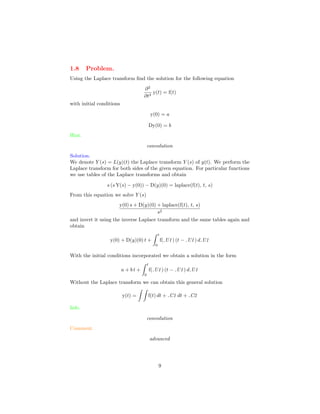
1.8 Problem.
Using the Laplace transform find the solution for the following equation
∂2
∂t2
y(t) = f(t)
with initial conditions
y(0) = a
Dy(0) = b
Hint.
convolution
Solution.
We denote Y (s) = L(y)(t) the Laplace transform Y (s) of y(t). We perform the
Laplace transform for both sides of the given equation. For particular functions
we use tables of the Laplace transforms and obtain
s (s Y(s) − y(0)) − D(y)(0) = laplace(f(t), t, s)
From this equation we solve Y (s)
y(0) s + D(y)(0) + laplace(f(t), t, s)
s2
and invert it using the inverse Laplace transform and the same tables again and
obtain
y(0) + D(y)(0) t +
t
0
f( U1) (t − U1) d U1
With the initial conditions incorporated we obtain a solution in the form
a + b t +
t
0
f( U1) (t − U1) d U1
Without the Laplace transform we can obtain this general solution
y(t) = f(t) dt + C1 dt + C2
Info.
convolution
Comment.
advanced
9
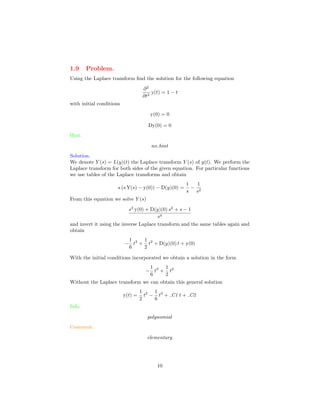
1.9 Problem.
Using the Laplace transform find the solution for the following equation
∂2
∂t2
y(t) = 1 − t
with initial conditions
y(0) = 0
Dy(0) = 0
Hint.
no hint
Solution.
We denote Y (s) = L(y)(t) the Laplace transform Y (s) of y(t). We perform the
Laplace transform for both sides of the given equation. For particular functions
we use tables of the Laplace transforms and obtain
s (s Y(s) − y(0)) − D(y)(0) =
1
s
−
1
s2
From this equation we solve Y (s)
s3
y(0) + D(y)(0) s2
+ s − 1
s4
and invert it using the inverse Laplace transform and the same tables again and
obtain
−
1
6
t3
+
1
2
t2
+ D(y)(0) t + y(0)
With the initial conditions incorporated we obtain a solution in the form
−
1
6
t3
+
1
2
t2
Without the Laplace transform we can obtain this general solution
y(t) =
1
2
t2
−
1
6
t3
+ C1 t + C2
Info.
polynomial
Comment.
elementary
10
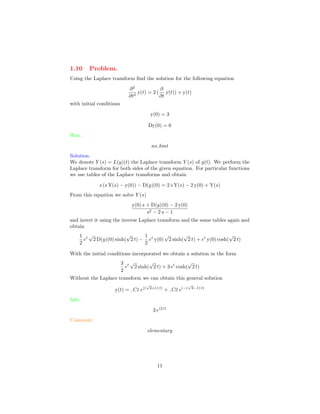
1.10 Problem.
Using the Laplace transform find the solution for the following equation
∂2
∂t2
y(t) = 2 (
∂
∂t
y(t)) + y(t)
with initial conditions
y(0) = 3
Dy(0) = 6
Hint.
no hint
Solution.
We denote Y (s) = L(y)(t) the Laplace transform Y (s) of y(t). We perform the
Laplace transform for both sides of the given equation. For particular functions
we use tables of the Laplace transforms and obtain
s (s Y(s) − y(0)) − D(y)(0) = 2 s Y(s) − 2 y(0) + Y(s)
From this equation we solve Y (s)
y(0) s + D(y)(0) − 2 y(0)
s2 − 2 s − 1
and invert it using the inverse Laplace transform and the same tables again and
obtain
1
2
et
√
2 D(y)(0) sinh(
√
2 t) −
1
2
et
y(0)
√
2 sinh(
√
2 t) + et
y(0) cosh(
√
2 t)
With the initial conditions incorporated we obtain a solution in the form
3
2
et
√
2 sinh(
√
2 t) + 3 et
cosh(
√
2 t)
Without the Laplace transform we can obtain this general solution
y(t) = C1 e((
√
2+1) t)
+ C2 e(−(
√
2−1) t)
Info.
3 e(2 t)
Comment.
elementary
11
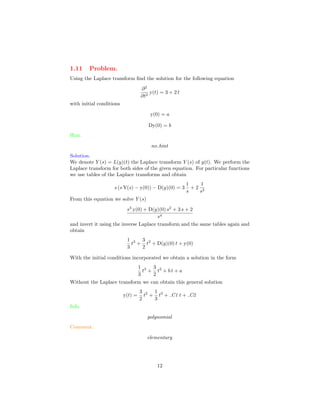
1.11 Problem.
Using the Laplace transform find the solution for the following equation
∂2
∂t2
y(t) = 3 + 2 t
with initial conditions
y(0) = a
Dy(0) = b
Hint.
no hint
Solution.
We denote Y (s) = L(y)(t) the Laplace transform Y (s) of y(t). We perform the
Laplace transform for both sides of the given equation. For particular functions
we use tables of the Laplace transforms and obtain
s (s Y(s) − y(0)) − D(y)(0) = 3
1
s
+ 2
1
s2
From this equation we solve Y (s)
s3
y(0) + D(y)(0) s2
+ 3 s + 2
s4
and invert it using the inverse Laplace transform and the same tables again and
obtain
1
3
t3
+
3
2
t2
+ D(y)(0) t + y(0)
With the initial conditions incorporated we obtain a solution in the form
1
3
t3
+
3
2
t2
+ b t + a
Without the Laplace transform we can obtain this general solution
y(t) =
3
2
t2
+
1
3
t3
+ C1 t + C2
Info.
polynomial
Comment.
elementary
12
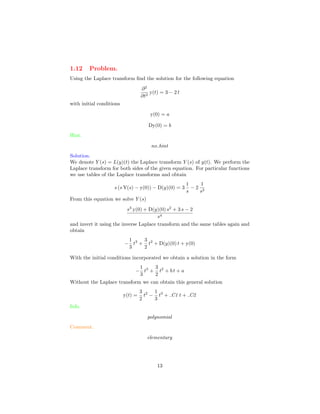
1.12 Problem.
Using the Laplace transform find the solution for the following equation
∂2
∂t2
y(t) = 3 − 2 t
with initial conditions
y(0) = a
Dy(0) = b
Hint.
no hint
Solution.
We denote Y (s) = L(y)(t) the Laplace transform Y (s) of y(t). We perform the
Laplace transform for both sides of the given equation. For particular functions
we use tables of the Laplace transforms and obtain
s (s Y(s) − y(0)) − D(y)(0) = 3
1
s
− 2
1
s2
From this equation we solve Y (s)
s3
y(0) + D(y)(0) s2
+ 3 s − 2
s4
and invert it using the inverse Laplace transform and the same tables again and
obtain
−
1
3
t3
+
3
2
t2
+ D(y)(0) t + y(0)
With the initial conditions incorporated we obtain a solution in the form
−
1
3
t3
+
3
2
t2
+ b t + a
Without the Laplace transform we can obtain this general solution
y(t) =
3
2
t2
−
1
3
t3
+ C1 t + C2
Info.
polynomial
Comment.
elementary
13
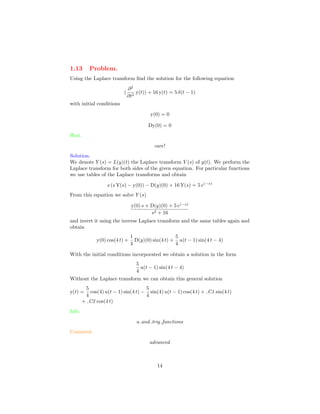
1.13 Problem.
Using the Laplace transform find the solution for the following equation
(
∂2
∂t2
y(t)) + 16 y(t) = 5 δ(t − 1)
with initial conditions
y(0) = 0
Dy(0) = 0
Hint.
care!
Solution.
We denote Y (s) = L(y)(t) the Laplace transform Y (s) of y(t). We perform the
Laplace transform for both sides of the given equation. For particular functions
we use tables of the Laplace transforms and obtain
s (s Y(s) − y(0)) − D(y)(0) + 16 Y(s) = 5 e(−s)
From this equation we solve Y (s)
y(0) s + D(y)(0) + 5 e(−s)
s2 + 16
and invert it using the inverse Laplace transform and the same tables again and
obtain
y(0) cos(4 t) +
1
4
D(y)(0) sin(4 t) +
5
4
u(t − 1) sin(4 t − 4)
With the initial conditions incorporated we obtain a solution in the form
5
4
u(t − 1) sin(4 t − 4)
Without the Laplace transform we can obtain this general solution
y(t) =
5
4
cos(4) u(t − 1) sin(4 t) −
5
4
sin(4) u(t − 1) cos(4 t) + C1 sin(4 t)
+ C2 cos(4 t)
Info.
u and trig functions
Comment.
advanced
14
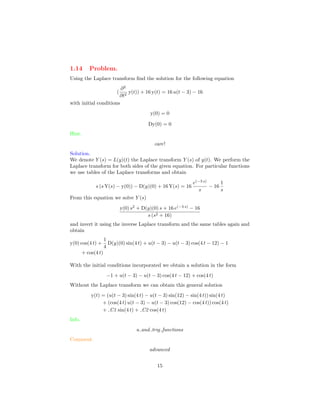
1.14 Problem.
Using the Laplace transform find the solution for the following equation
(
∂2
∂t2
y(t)) + 16 y(t) = 16 u(t − 3) − 16
with initial conditions
y(0) = 0
Dy(0) = 0
Hint.
care!
Solution.
We denote Y (s) = L(y)(t) the Laplace transform Y (s) of y(t). We perform the
Laplace transform for both sides of the given equation. For particular functions
we use tables of the Laplace transforms and obtain
s (s Y(s) − y(0)) − D(y)(0) + 16 Y(s) = 16
e(−3 s)
s
− 16
1
s
From this equation we solve Y (s)
y(0) s2
+ D(y)(0) s + 16 e(−3 s)
− 16
s (s2 + 16)
and invert it using the inverse Laplace transform and the same tables again and
obtain
y(0) cos(4 t) +
1
4
D(y)(0) sin(4 t) + u(t − 3) − u(t − 3) cos(4 t − 12) − 1
+ cos(4 t)
With the initial conditions incorporated we obtain a solution in the form
−1 + u(t − 3) − u(t − 3) cos(4 t − 12) + cos(4 t)
Without the Laplace transform we can obtain this general solution
y(t) = (u(t − 3) sin(4 t) − u(t − 3) sin(12) − sin(4 t)) sin(4 t)
+ (cos(4 t) u(t − 3) − u(t − 3) cos(12) − cos(4 t)) cos(4 t)
+ C1 sin(4 t) + C2 cos(4 t)
Info.
u and trig functions
Comment.
advanced
15
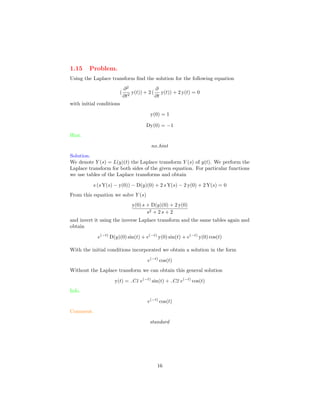
1.15 Problem.
Using the Laplace transform find the solution for the following equation
(
∂2
∂t2
y(t)) + 2 (
∂
∂t
y(t)) + 2 y(t) = 0
with initial conditions
y(0) = 1
Dy(0) = −1
Hint.
no hint
Solution.
We denote Y (s) = L(y)(t) the Laplace transform Y (s) of y(t). We perform the
Laplace transform for both sides of the given equation. For particular functions
we use tables of the Laplace transforms and obtain
s (s Y(s) − y(0)) − D(y)(0) + 2 s Y(s) − 2 y(0) + 2 Y(s) = 0
From this equation we solve Y (s)
y(0) s + D(y)(0) + 2 y(0)
s2 + 2 s + 2
and invert it using the inverse Laplace transform and the same tables again and
obtain
e(−t)
D(y)(0) sin(t) + e(−t)
y(0) sin(t) + e(−t)
y(0) cos(t)
With the initial conditions incorporated we obtain a solution in the form
e(−t)
cos(t)
Without the Laplace transform we can obtain this general solution
y(t) = C1 e(−t)
sin(t) + C2 e(−t)
cos(t)
Info.
e(−t)
cos(t)
Comment.
standard
16
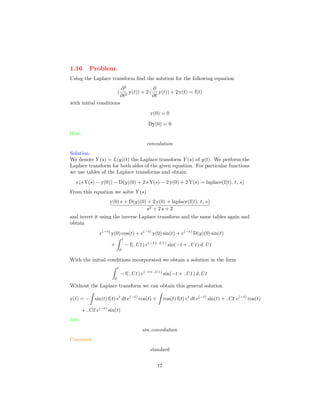
1.16 Problem.
Using the Laplace transform find the solution for the following equation
(
∂2
∂t2
y(t)) + 2 (
∂
∂t
y(t)) + 2 y(t) = f(t)
with initial conditions
y(0) = 0
Dy(0) = 0
Hint.
convolution
Solution.
We denote Y (s) = L(y)(t) the Laplace transform Y (s) of y(t). We perform the
Laplace transform for both sides of the given equation. For particular functions
we use tables of the Laplace transforms and obtain
s (s Y(s) − y(0)) − D(y)(0) + 2 s Y(s) − 2 y(0) + 2 Y(s) = laplace(f(t), t, s)
From this equation we solve Y (s)
y(0) s + D(y)(0) + 2 y(0) + laplace(f(t), t, s)
s2 + 2 s + 2
and invert it using the inverse Laplace transform and the same tables again and
obtain
e(−t)
y(0) cos(t) + e(−t)
y(0) sin(t) + e(−t)
D(y)(0) sin(t)
+
t
0
− f( U1) e(−t+ U1)
sin(−t + U1) d U1
With the initial conditions incorporated we obtain a solution in the form
t
0
− f( U1) e(−t+ U1)
sin(−t + U1) d U1
Without the Laplace transform we can obtain this general solution
y(t) = − sin(t) f(t) et
dt e(−t)
cos(t) + cos(t) f(t) et
dt e(−t)
sin(t) + C1 e(−t)
cos(t)
+ C2 e(−t)
sin(t)
Info.
sin convolution
Comment.
standard
17
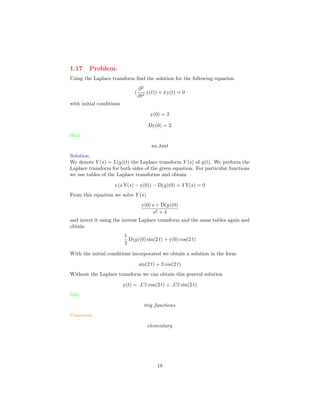
1.17 Problem.
Using the Laplace transform find the solution for the following equation
(
∂2
∂t2
y(t)) + 4 y(t) = 0
with initial conditions
y(0) = 2
Dy(0) = 2
Hint.
no hint
Solution.
We denote Y (s) = L(y)(t) the Laplace transform Y (s) of y(t). We perform the
Laplace transform for both sides of the given equation. For particular functions
we use tables of the Laplace transforms and obtain
s (s Y(s) − y(0)) − D(y)(0) + 4 Y(s) = 0
From this equation we solve Y (s)
y(0) s + D(y)(0)
s2 + 4
and invert it using the inverse Laplace transform and the same tables again and
obtain
1
2
D(y)(0) sin(2 t) + y(0) cos(2 t)
With the initial conditions incorporated we obtain a solution in the form
sin(2 t) + 2 cos(2 t)
Without the Laplace transform we can obtain this general solution
y(t) = C1 cos(2 t) + C2 sin(2 t)
Info.
trig functions
Comment.
elementary
18
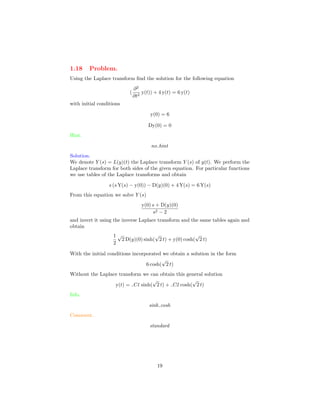
1.18 Problem.
Using the Laplace transform find the solution for the following equation
(
∂2
∂t2
y(t)) + 4 y(t) = 6 y(t)
with initial conditions
y(0) = 6
Dy(0) = 0
Hint.
no hint
Solution.
We denote Y (s) = L(y)(t) the Laplace transform Y (s) of y(t). We perform the
Laplace transform for both sides of the given equation. For particular functions
we use tables of the Laplace transforms and obtain
s (s Y(s) − y(0)) − D(y)(0) + 4 Y(s) = 6 Y(s)
From this equation we solve Y (s)
y(0) s + D(y)(0)
s2 − 2
and invert it using the inverse Laplace transform and the same tables again and
obtain
1
2
√
2 D(y)(0) sinh(
√
2 t) + y(0) cosh(
√
2 t)
With the initial conditions incorporated we obtain a solution in the form
6 cosh(
√
2 t)
Without the Laplace transform we can obtain this general solution
y(t) = C1 sinh(
√
2 t) + C2 cosh(
√
2 t)
Info.
sinh cosh
Comment.
standard
19
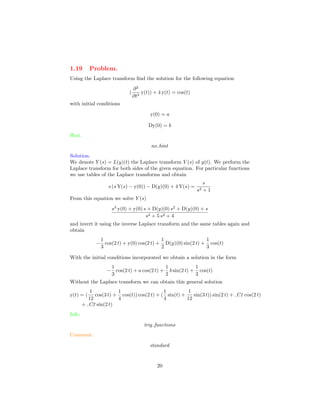
1.19 Problem.
Using the Laplace transform find the solution for the following equation
(
∂2
∂t2
y(t)) + 4 y(t) = cos(t)
with initial conditions
y(0) = a
Dy(0) = b
Hint.
no hint
Solution.
We denote Y (s) = L(y)(t) the Laplace transform Y (s) of y(t). We perform the
Laplace transform for both sides of the given equation. For particular functions
we use tables of the Laplace transforms and obtain
s (s Y(s) − y(0)) − D(y)(0) + 4 Y(s) =
s
s2 + 1
From this equation we solve Y (s)
s3
y(0) + y(0) s + D(y)(0) s2
+ D(y)(0) + s
s4 + 5 s2 + 4
and invert it using the inverse Laplace transform and the same tables again and
obtain
−
1
3
cos(2 t) + y(0) cos(2 t) +
1
2
D(y)(0) sin(2 t) +
1
3
cos(t)
With the initial conditions incorporated we obtain a solution in the form
−
1
3
cos(2 t) + a cos(2 t) +
1
2
b sin(2 t) +
1
3
cos(t)
Without the Laplace transform we can obtain this general solution
y(t) = (
1
12
cos(3 t) +
1
4
cos(t)) cos(2 t) + (
1
4
sin(t) +
1
12
sin(3 t)) sin(2 t) + C1 cos(2 t)
+ C2 sin(2 t)
Info.
trig functions
Comment.
standard
20
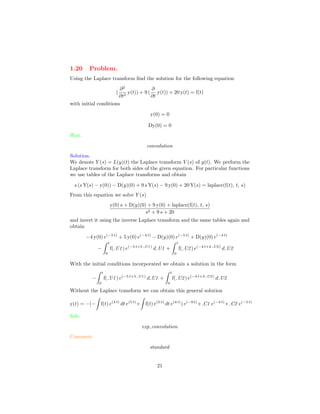
1.20 Problem.
Using the Laplace transform find the solution for the following equation
(
∂2
∂t2
y(t)) + 9 (
∂
∂t
y(t)) + 20 y(t) = f(t)
with initial conditions
y(0) = 0
Dy(0) = 0
Hint.
convolution
Solution.
We denote Y (s) = L(y)(t) the Laplace transform Y (s) of y(t). We perform the
Laplace transform for both sides of the given equation. For particular functions
we use tables of the Laplace transforms and obtain
s (s Y(s) − y(0)) − D(y)(0) + 9 s Y(s) − 9 y(0) + 20 Y(s) = laplace(f(t), t, s)
From this equation we solve Y (s)
y(0) s + D(y)(0) + 9 y(0) + laplace(f(t), t, s)
s2 + 9 s + 20
and invert it using the inverse Laplace transform and the same tables again and
obtain
−4 y(0) e(−5 t)
+ 5 y(0) e(−4 t)
− D(y)(0) e(−5 t)
+ D(y)(0) e(−4 t)
−
t
0
f( U1) e(−5 t+5 U1)
d U1 +
t
0
f( U2) e(−4 t+4 U2)
d U2
With the initial conditions incorporated we obtain a solution in the form
−
t
0
f( U1) e(−5 t+5 U1)
d U1 +
t
0
f( U2) e(−4 t+4 U2)
d U2
Without the Laplace transform we can obtain this general solution
y(t) = −(− f(t) e(4 t)
dt e(5 t)
+ f(t) e(5 t)
dt e(4 t)
) e(−9 t)
+ C1 e(−4 t)
+ C2 e(−5 t)
Info.
exp convolution
Comment.
standard
21
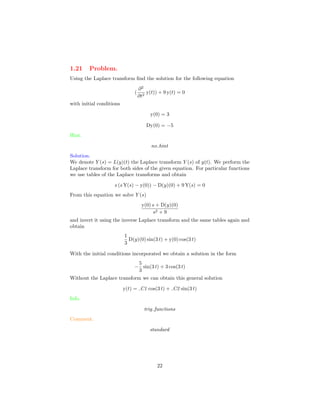
1.21 Problem.
Using the Laplace transform find the solution for the following equation
(
∂2
∂t2
y(t)) + 9 y(t) = 0
with initial conditions
y(0) = 3
Dy(0) = −5
Hint.
no hint
Solution.
We denote Y (s) = L(y)(t) the Laplace transform Y (s) of y(t). We perform the
Laplace transform for both sides of the given equation. For particular functions
we use tables of the Laplace transforms and obtain
s (s Y(s) − y(0)) − D(y)(0) + 9 Y(s) = 0
From this equation we solve Y (s)
y(0) s + D(y)(0)
s2 + 9
and invert it using the inverse Laplace transform and the same tables again and
obtain
1
3
D(y)(0) sin(3 t) + y(0) cos(3 t)
With the initial conditions incorporated we obtain a solution in the form
−
5
3
sin(3 t) + 3 cos(3 t)
Without the Laplace transform we can obtain this general solution
y(t) = C1 cos(3 t) + C2 sin(3 t)
Info.
trig functions
Comment.
standard
22
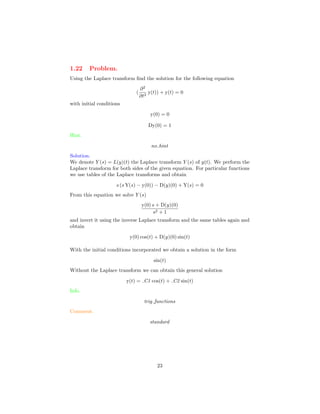
1.22 Problem.
Using the Laplace transform find the solution for the following equation
(
∂2
∂t2
y(t)) + y(t) = 0
with initial conditions
y(0) = 0
Dy(0) = 1
Hint.
no hint
Solution.
We denote Y (s) = L(y)(t) the Laplace transform Y (s) of y(t). We perform the
Laplace transform for both sides of the given equation. For particular functions
we use tables of the Laplace transforms and obtain
s (s Y(s) − y(0)) − D(y)(0) + Y(s) = 0
From this equation we solve Y (s)
y(0) s + D(y)(0)
s2 + 1
and invert it using the inverse Laplace transform and the same tables again and
obtain
y(0) cos(t) + D(y)(0) sin(t)
With the initial conditions incorporated we obtain a solution in the form
sin(t)
Without the Laplace transform we can obtain this general solution
y(t) = C1 cos(t) + C2 sin(t)
Info.
trig functions
Comment.
standard
23
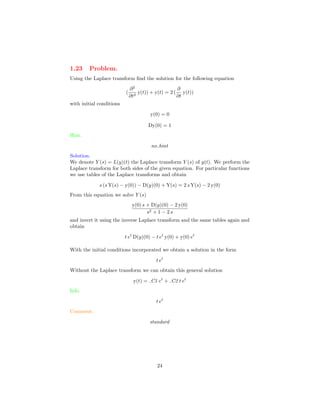
1.23 Problem.
Using the Laplace transform find the solution for the following equation
(
∂2
∂t2
y(t)) + y(t) = 2 (
∂
∂t
y(t))
with initial conditions
y(0) = 0
Dy(0) = 1
Hint.
no hint
Solution.
We denote Y (s) = L(y)(t) the Laplace transform Y (s) of y(t). We perform the
Laplace transform for both sides of the given equation. For particular functions
we use tables of the Laplace transforms and obtain
s (s Y(s) − y(0)) − D(y)(0) + Y(s) = 2 s Y(s) − 2 y(0)
From this equation we solve Y (s)
y(0) s + D(y)(0) − 2 y(0)
s2 + 1 − 2 s
and invert it using the inverse Laplace transform and the same tables again and
obtain
t et
D(y)(0) − t et
y(0) + y(0) et
With the initial conditions incorporated we obtain a solution in the form
t et
Without the Laplace transform we can obtain this general solution
y(t) = C1 et
+ C2 t et
Info.
t et
Comment.
standard
24
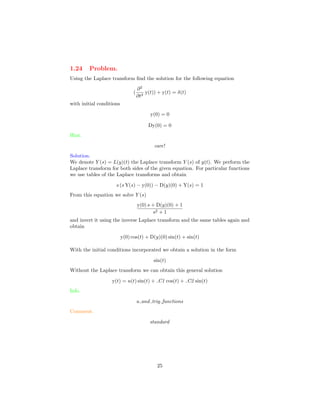
1.24 Problem.
Using the Laplace transform find the solution for the following equation
(
∂2
∂t2
y(t)) + y(t) = δ(t)
with initial conditions
y(0) = 0
Dy(0) = 0
Hint.
care!
Solution.
We denote Y (s) = L(y)(t) the Laplace transform Y (s) of y(t). We perform the
Laplace transform for both sides of the given equation. For particular functions
we use tables of the Laplace transforms and obtain
s (s Y(s) − y(0)) − D(y)(0) + Y(s) = 1
From this equation we solve Y (s)
y(0) s + D(y)(0) + 1
s2 + 1
and invert it using the inverse Laplace transform and the same tables again and
obtain
y(0) cos(t) + D(y)(0) sin(t) + sin(t)
With the initial conditions incorporated we obtain a solution in the form
sin(t)
Without the Laplace transform we can obtain this general solution
y(t) = u(t) sin(t) + C1 cos(t) + C2 sin(t)
Info.
u and trig functions
Comment.
standard
25
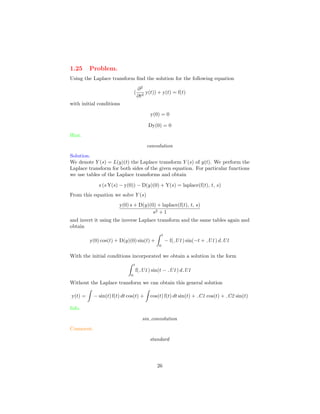
1.25 Problem.
Using the Laplace transform find the solution for the following equation
(
∂2
∂t2
y(t)) + y(t) = f(t)
with initial conditions
y(0) = 0
Dy(0) = 0
Hint.
convolution
Solution.
We denote Y (s) = L(y)(t) the Laplace transform Y (s) of y(t). We perform the
Laplace transform for both sides of the given equation. For particular functions
we use tables of the Laplace transforms and obtain
s (s Y(s) − y(0)) − D(y)(0) + Y(s) = laplace(f(t), t, s)
From this equation we solve Y (s)
y(0) s + D(y)(0) + laplace(f(t), t, s)
s2 + 1
and invert it using the inverse Laplace transform and the same tables again and
obtain
y(0) cos(t) + D(y)(0) sin(t) +
t
0
− f( U1) sin(−t + U1) d U1
With the initial conditions incorporated we obtain a solution in the form
t
0
f( U1) sin(t − U1) d U1
Without the Laplace transform we can obtain this general solution
y(t) = − sin(t) f(t) dt cos(t) + cos(t) f(t) dt sin(t) + C1 cos(t) + C2 sin(t)
Info.
sin convolution
Comment.
standard
26
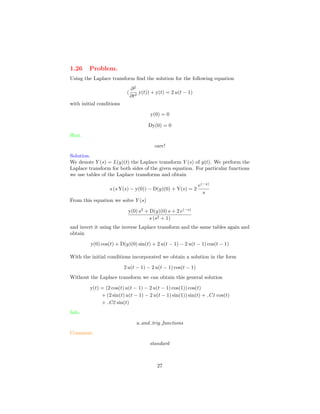
1.26 Problem.
Using the Laplace transform find the solution for the following equation
(
∂2
∂t2
y(t)) + y(t) = 2 u(t − 1)
with initial conditions
y(0) = 0
Dy(0) = 0
Hint.
care!
Solution.
We denote Y (s) = L(y)(t) the Laplace transform Y (s) of y(t). We perform the
Laplace transform for both sides of the given equation. For particular functions
we use tables of the Laplace transforms and obtain
s (s Y(s) − y(0)) − D(y)(0) + Y(s) = 2
e(−s)
s
From this equation we solve Y (s)
y(0) s2
+ D(y)(0) s + 2 e(−s)
s (s2 + 1)
and invert it using the inverse Laplace transform and the same tables again and
obtain
y(0) cos(t) + D(y)(0) sin(t) + 2 u(t − 1) − 2 u(t − 1) cos(t − 1)
With the initial conditions incorporated we obtain a solution in the form
2 u(t − 1) − 2 u(t − 1) cos(t − 1)
Without the Laplace transform we can obtain this general solution
y(t) = (2 cos(t) u(t − 1) − 2 u(t − 1) cos(1)) cos(t)
+ (2 sin(t) u(t − 1) − 2 u(t − 1) sin(1)) sin(t) + C1 cos(t)
+ C2 sin(t)
Info.
u and trig functions
Comment.
standard
27
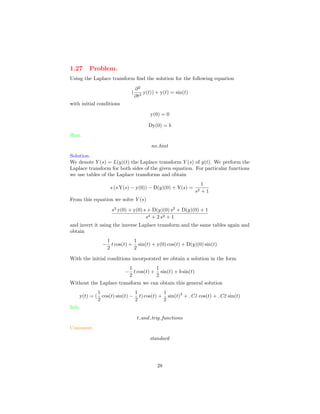
1.27 Problem.
Using the Laplace transform find the solution for the following equation
(
∂2
∂t2
y(t)) + y(t) = sin(t)
with initial conditions
y(0) = 0
Dy(0) = b
Hint.
no hint
Solution.
We denote Y (s) = L(y)(t) the Laplace transform Y (s) of y(t). We perform the
Laplace transform for both sides of the given equation. For particular functions
we use tables of the Laplace transforms and obtain
s (s Y(s) − y(0)) − D(y)(0) + Y(s) =
1
s2 + 1
From this equation we solve Y (s)
s3
y(0) + y(0) s + D(y)(0) s2
+ D(y)(0) + 1
s4 + 2 s2 + 1
and invert it using the inverse Laplace transform and the same tables again and
obtain
−
1
2
t cos(t) +
1
2
sin(t) + y(0) cos(t) + D(y)(0) sin(t)
With the initial conditions incorporated we obtain a solution in the form
−
1
2
t cos(t) +
1
2
sin(t) + b sin(t)
Without the Laplace transform we can obtain this general solution
y(t) = (
1
2
cos(t) sin(t) −
1
2
t) cos(t) +
1
2
sin(t)3
+ C1 cos(t) + C2 sin(t)
Info.
t and trig functions
Comment.
standard
28
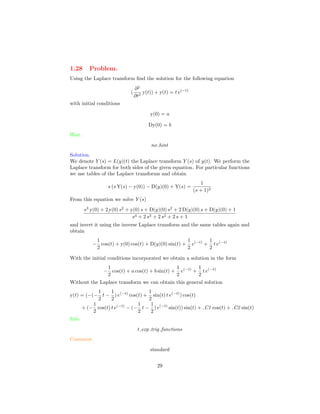
1.28 Problem.
Using the Laplace transform find the solution for the following equation
(
∂2
∂t2
y(t)) + y(t) = t e(−t)
with initial conditions
y(0) = a
Dy(0) = b
Hint.
no hint
Solution.
We denote Y (s) = L(y)(t) the Laplace transform Y (s) of y(t). We perform the
Laplace transform for both sides of the given equation. For particular functions
we use tables of the Laplace transforms and obtain
s (s Y(s) − y(0)) − D(y)(0) + Y(s) =
1
(s + 1)2
From this equation we solve Y (s)
s3
y(0) + 2 y(0) s2
+ y(0) s + D(y)(0) s2
+ 2 D(y)(0) s + D(y)(0) + 1
s4 + 2 s3 + 2 s2 + 2 s + 1
and invert it using the inverse Laplace transform and the same tables again and
obtain
−
1
2
cos(t) + y(0) cos(t) + D(y)(0) sin(t) +
1
2
e(−t)
+
1
2
t e(−t)
With the initial conditions incorporated we obtain a solution in the form
−
1
2
cos(t) + a cos(t) + b sin(t) +
1
2
e(−t)
+
1
2
t e(−t)
Without the Laplace transform we can obtain this general solution
y(t) = (−(−
1
2
t −
1
2
) e(−t)
cos(t) +
1
2
sin(t) t e(−t)
) cos(t)
+ (−
1
2
cos(t) t e(−t)
− (−
1
2
t −
1
2
) e(−t)
sin(t)) sin(t) + C1 cos(t) + C2 sin(t)
Info.
t exp trig functions
Comment.
standard
29
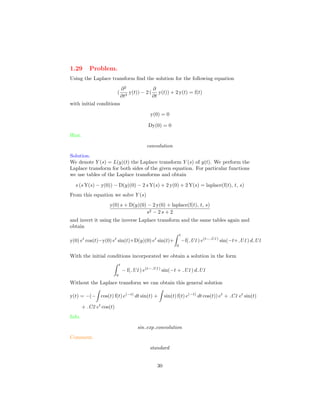
1.29 Problem.
Using the Laplace transform find the solution for the following equation
(
∂2
∂t2
y(t)) − 2 (
∂
∂t
y(t)) + 2 y(t) = f(t)
with initial conditions
y(0) = 0
Dy(0) = 0
Hint.
convolution
Solution.
We denote Y (s) = L(y)(t) the Laplace transform Y (s) of y(t). We perform the
Laplace transform for both sides of the given equation. For particular functions
we use tables of the Laplace transforms and obtain
s (s Y(s) − y(0)) − D(y)(0) − 2 s Y(s) + 2 y(0) + 2 Y(s) = laplace(f(t), t, s)
From this equation we solve Y (s)
y(0) s + D(y)(0) − 2 y(0) + laplace(f(t), t, s)
s2 − 2 s + 2
and invert it using the inverse Laplace transform and the same tables again and
obtain
y(0) et
cos(t)−y(0) et
sin(t)+D(y)(0) et
sin(t)+
t
0
−f( U1) e(t− U1)
sin(−t+ U1) d U1
With the initial conditions incorporated we obtain a solution in the form
t
0
− f( U1) e(t− U1)
sin(−t + U1) d U1
Without the Laplace transform we can obtain this general solution
y(t) = −(− cos(t) f(t) e(−t)
dt sin(t) + sin(t) f(t) e(−t)
dt cos(t)) et
+ C1 et
sin(t)
+ C2 et
cos(t)
Info.
sin exp convolution
Comment.
standard
30
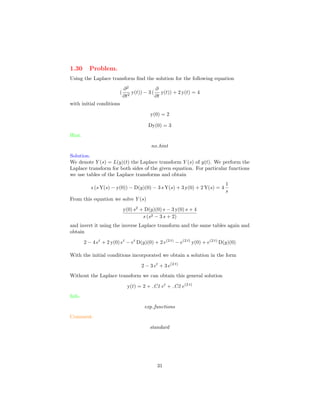
1.30 Problem.
Using the Laplace transform find the solution for the following equation
(
∂2
∂t2
y(t)) − 3 (
∂
∂t
y(t)) + 2 y(t) = 4
with initial conditions
y(0) = 2
Dy(0) = 3
Hint.
no hint
Solution.
We denote Y (s) = L(y)(t) the Laplace transform Y (s) of y(t). We perform the
Laplace transform for both sides of the given equation. For particular functions
we use tables of the Laplace transforms and obtain
s (s Y(s) − y(0)) − D(y)(0) − 3 s Y(s) + 3 y(0) + 2 Y(s) = 4
1
s
From this equation we solve Y (s)
y(0) s2
+ D(y)(0) s − 3 y(0) s + 4
s (s2 − 3 s + 2)
and invert it using the inverse Laplace transform and the same tables again and
obtain
2 − 4 et
+ 2 y(0) et
− et
D(y)(0) + 2 e(2 t)
− e(2 t)
y(0) + e(2 t)
D(y)(0)
With the initial conditions incorporated we obtain a solution in the form
2 − 3 et
+ 3 e(2 t)
Without the Laplace transform we can obtain this general solution
y(t) = 2 + C1 et
+ C2 e(2 t)
Info.
exp functions
Comment.
standard
31
1.31 Problem.
Using the Laplace transform find the solution for the following equation
(
∂2
∂t2
y(t)) − 3 (
∂
∂t
y(t)) + 4 y(t) = 0
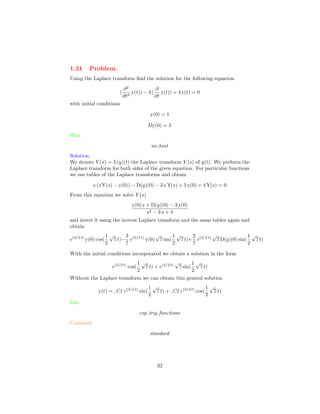
with initial conditions
y(0) = 1
Dy(0) = 5
Hint.
no hint
Solution.
We denote Y (s) = L(y)(t) the Laplace transform Y (s) of y(t). We perform the
Laplace transform for both sides of the given equation. For particular functions
we use tables of the Laplace transforms and obtain
s (s Y(s) − y(0)) − D(y)(0) − 3 s Y(s) + 3 y(0) + 4 Y(s) = 0
From this equation we solve Y (s)
y(0) s + D(y)(0) − 3 y(0)
s2 − 3 s + 4
and invert it using the inverse Laplace transform and the same tables again and
obtain
e(3/2 t)
y(0) cos(
1
2
√
7 t)−
3
7
e(3/2 t)
y(0)
√
7 sin(
1
2
√
7 t)+
2
7
e(3/2 t)
√
7 D(y)(0) sin(
1
2
√
7 t)
With the initial conditions incorporated we obtain a solution in the form
e(3/2 t)
cos(
1
2
√
7 t) + e(3/2 t)
√
7 sin(
1
2
√
7 t)
Without the Laplace transform we can obtain this general solution
y(t) = C1 e(3/2 t)
sin(
1
2
√
7 t) + C2 e(3/2 t)
cos(
1
2
√
7 t)
Info.
exp trig functions
Comment.
standard
32
1.32 Problem.
Using the Laplace transform find the solution for the following equation
(
∂2
∂t2
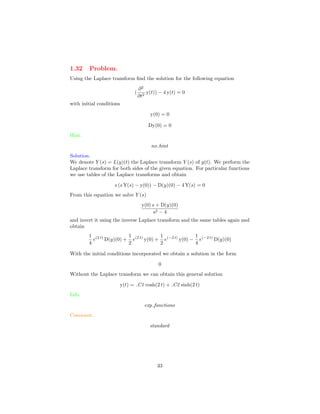
y(t)) − 4 y(t) = 0
with initial conditions
y(0) = 0
Dy(0) = 0
Hint.
no hint
Solution.
We denote Y (s) = L(y)(t) the Laplace transform Y (s) of y(t). We perform the
Laplace transform for both sides of the given equation. For particular functions
we use tables of the Laplace transforms and obtain
s (s Y(s) − y(0)) − D(y)(0) − 4 Y(s) = 0
From this equation we solve Y (s)
y(0) s + D(y)(0)
s2 − 4
and invert it using the inverse Laplace transform and the same tables again and
obtain
1
4
e(2 t)
D(y)(0) +
1
2
e(2 t)
y(0) +
1
2
e(−2 t)
y(0) −
1
4
e(−2 t)
D(y)(0)
With the initial conditions incorporated we obtain a solution in the form
0
Without the Laplace transform we can obtain this general solution
y(t) = C1 cosh(2 t) + C2 sinh(2 t)
Info.
exp functions
Comment.
standard
33
1.33 Problem.
Using the Laplace transform find the solution for the following equation
(
∂2
∂t2
y(t)) − (
∂
∂t
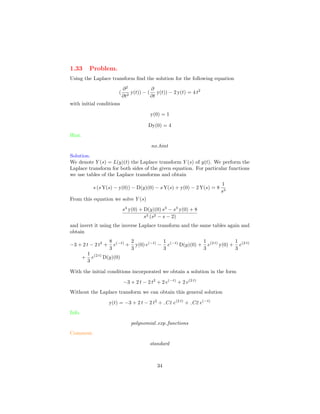
y(t)) − 2 y(t) = 4 t2
with initial conditions
y(0) = 1
Dy(0) = 4
Hint.
no hint
Solution.
We denote Y (s) = L(y)(t) the Laplace transform Y (s) of y(t). We perform the
Laplace transform for both sides of the given equation. For particular functions
we use tables of the Laplace transforms and obtain
s (s Y(s) − y(0)) − D(y)(0) − s Y(s) + y(0) − 2 Y(s) = 8
1
s3
From this equation we solve Y (s)
s4
y(0) + D(y)(0) s3
− s3
y(0) + 8
s3 (s2 − s − 2)
and invert it using the inverse Laplace transform and the same tables again and
obtain
−3 + 2 t − 2 t2
+
8
3
e(−t)
+
2
3
y(0) e(−t)
−
1
3
e(−t)
D(y)(0) +
1
3
e(2 t)
y(0) +
1
3
e(2 t)
+
1
3
e(2 t)
D(y)(0)
With the initial conditions incorporated we obtain a solution in the form
−3 + 2 t − 2 t2
+ 2 e(−t)
+ 2 e(2 t)
Without the Laplace transform we can obtain this general solution
y(t) = −3 + 2 t − 2 t2
+ C1 e(2 t)
+ C2 e(−t)
Info.
polynomial exp functions
Comment.
standard
34
1.34 Problem.
Using the Laplace transform find the solution for the following equation
(
∂2
∂t2
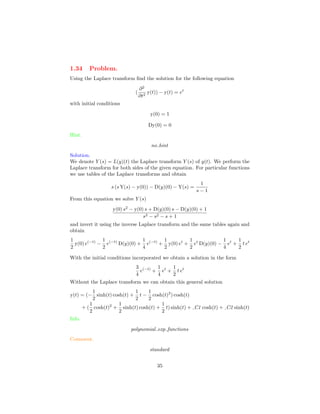
y(t)) − y(t) = et
with initial conditions
y(0) = 1
Dy(0) = 0
Hint.
no hint
Solution.
We denote Y (s) = L(y)(t) the Laplace transform Y (s) of y(t). We perform the
Laplace transform for both sides of the given equation. For particular functions
we use tables of the Laplace transforms and obtain
s (s Y(s) − y(0)) − D(y)(0) − Y(s) =
1
s − 1
From this equation we solve Y (s)
y(0) s2
− y(0) s + D(y)(0) s − D(y)(0) + 1
s3 − s2 − s + 1
and invert it using the inverse Laplace transform and the same tables again and
obtain
1
2
y(0) e(−t)
−
1
2
e(−t)
D(y)(0) +
1
4
e(−t)
+
1
2
y(0) et
+
1
2
et
D(y)(0) −
1
4
et
+
1
2
t et
With the initial conditions incorporated we obtain a solution in the form
3
4
e(−t)
+
1
4
et
+
1
2
t et
Without the Laplace transform we can obtain this general solution
y(t) = (−
1
2
sinh(t) cosh(t) +
1
2
t −
1
2
cosh(t)2
) cosh(t)
+ (
1
2
cosh(t)2
+
1
2
sinh(t) cosh(t) +
1
2
t) sinh(t) + C1 cosh(t) + C2 sinh(t)
Info.
polynomial exp functions
Comment.
standard
35
1.35 Problem.
Using the Laplace transform find the solution for the following equation
(
∂2
∂t2
y(t)) − y(t) = f(t)
with initial conditions
y(0) = a
Dy(0) = b
Hint.
convolution
Solution.
We denote Y (s) = L(y)(t) the Laplace transform Y (s) of y(t). We perform the
Laplace transform for both sides of the given equation. For particular functions
we use tables of the Laplace transforms and obtain
s (s Y(s) − y(0)) − D(y)(0) − Y(s) = laplace(f(t), t, s)
From this equation we solve Y (s)
y(0) s + D(y)(0) + laplace(f(t), t, s)
s2 − 1
and invert it using the inverse Laplace transform and the same tables again and
obtain
1
2
y(0) et
+
1
2
y(0) e(−t)
+
1
2
et
D(y)(0) −
1
2
e(−t)
D(y)(0) +
1
2
t
0
f( U1) e(t− U1)
d U1
−
1
2
t
0
f( U2) e(−t+ U2)
d U2
With the initial conditions incorporated we obtain a solution in the form
1
2
a et
+
1
2
a e(−t)
+
1
2
et
b −
1
2
e(−t)
b +
1
2
t
0
f( U1) e(t− U1)
d U1
−
1
2
t
0
f( U2) e(−t+ U2)
d U2
Without the Laplace transform we can obtain this general solution
y(t) = −sinh(t) f(t) dt cosh(t)+ cosh(t) f(t) dt sinh(t)+ C1 cosh(t)+ C2 sinh(t)
Info.
exp convolution
36
Comment.
standard
37
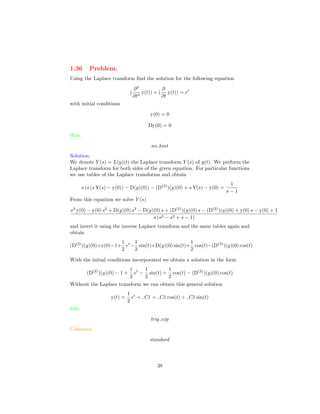
1.36 Problem.
Using the Laplace transform find the solution for the following equation
(
∂3
∂t3
y(t)) + (
∂
∂t
y(t)) = et
with initial conditions
y(0) = 0
Dy(0) = 0
Hint.
no hint
Solution.
We denote Y (s) = L(y)(t) the Laplace transform Y (s) of y(t). We perform the
Laplace transform for both sides of the given equation. For particular functions
we use tables of the Laplace transforms and obtain
s (s (s Y(s) − y(0)) − D(y)(0)) − (D(2)
)(y)(0) + s Y(s) − y(0) =
1
s − 1
From this equation we solve Y (s)
s3
y(0) − y(0) s2
+ D(y)(0) s2
− D(y)(0) s + (D(2)
)(y)(0) s − (D(2)
)(y)(0) + y(0) s − y(0) + 1
s (s3 − s2 + s − 1)
and invert it using the inverse Laplace transform and the same tables again and
obtain
(D(2)
)(y)(0)+y(0)−1+
1
2
et
−
1
2
sin(t)+D(y)(0) sin(t)+
1
2
cos(t)−(D(2)
)(y)(0) cos(t)
With the initial conditions incorporated we obtain a solution in the form
(D(2)
)(y)(0) − 1 +
1
2
et
−
1
2
sin(t) +
1
2
cos(t) − (D(2)
)(y)(0) cos(t)
Without the Laplace transform we can obtain this general solution
y(t) =
1
2
et
+ C1 + C2 cos(t) + C3 sin(t)
Info.
trig exp
Comment.
standard
38
1.37 Problem.
Using the Laplace transform find the solution for the following equation
(
∂3
∂t3
y(t)) + (
∂2
∂t2
y(t)) = 6 et
+ 6 t + 6
with initial conditions
y(0) = 0
Dy(0) = 0
Hint.
no hint
Solution.
We denote Y (s) = L(y)(t) the Laplace transform Y (s) of y(t). We perform the
Laplace transform for both sides of the given equation. For particular functions
we use tables of the Laplace transforms and obtain
s (s (s Y(s) − y(0)) − D(y)(0)) − (D(2)
)(y)(0) + s (s Y(s) − y(0)) − D(y)(0) =
6
1
s − 1
+ 6
1
s2
+ 6
1
s
From this equation we solve Y (s)
s5
y(0) + s4
D(y)(0) + (D(2)
)(y)(0) s3
− (D(2)
)(y)(0) s2
− s3
y(0) − D(y)(0) s2
+ 12 s2
− 6
s4 (s2 − 1)
and invert it using the inverse Laplace transform and the same tables again and
obtain
−(D(2)
)(y)(0) + y(0) − 6 t + D(y)(0) t + t (D(2)
)(y)(0) + t3
+ 3 et
+ e(−t)
(D(2)
)(y)(0)
− 3 e(−t)
With the initial conditions incorporated we obtain a solution in the form
−(D(2)
)(y)(0) − 6 t + t (D(2)
)(y)(0) + t3
+ 3 et
+ e(−t)
(D(2)
)(y)(0) − 3 e(−t)
Without the Laplace transform we can obtain this general solution
y(t) = et
(t3
e(−t)
+ 3) + C1 + C2 t + C3 e(−t)
Info.
polynomial exp functions
Comment.
standard
39
1.38 Problem.
Using the Laplace transform find the solution for the following equation
∂4
∂t4
y(t) = 6 δ(t − 1)
with initial conditions
y(0) = 0
Dy(0) = 0
Hint.
care!
Solution.
We denote Y (s) = L(y)(t) the Laplace transform Y (s) of y(t). We perform the
Laplace transform for both sides of the given equation. For particular functions
we use tables of the Laplace transforms and obtain
s (s (s (s Y(s) − y(0)) − D(y)(0)) − (D(2)
)(y)(0)) − (D(3)
)(y)(0) = 6 e(−s)
From this equation we solve Y (s)
s3
y(0) + D(y)(0) s2
+ (D(2)
)(y)(0) s + (D(3)
)(y)(0) + 6 e(−s)
s4
and invert it using the inverse Laplace transform and the same tables again and
obtain
y(0) + D(y)(0) t +
1
2
(D(2)
)(y)(0) t2
+
1
6
(D(3)
)(y)(0) t3
+ u(t − 1) t3
− 3 u(t − 1) t2
+ 3 u(t − 1) t − u(t − 1)
With the initial conditions incorporated we obtain a solution in the form
1
2
(D(2)
)(y)(0) t2
+
1
6
(D(3)
)(y)(0) t3
+ u(t − 1) t3
− 3 u(t − 1) t2
+ 3 u(t − 1) t − u(t − 1)
Without the Laplace transform we can obtain this general solution
y(t) = u(t − 1) t3
− u(t − 1) + 3 u(t − 1) t − 3 u(t − 1) t2
+
1
6
C1 t3
+
1
2
C2 t2
+ C3 t + C4
Info.
u polynomial function
Comment.
standard
40
1.39 Problem.
Using the Laplace transform find the solution for the following equation
y(t) = t +
t
0
− y(τ) sin(−t + τ) dτ
with initial conditions
y(0) = a
Dy(0) = b
Hint.
care!
Solution.
We denote Y (s) = L(y)(t) the Laplace transform Y (s) of y(t). We perform the
Laplace transform for both sides of the given equation. For particular functions
we use tables of the Laplace transforms and obtain
Y(s) =
1
s2
+
Y(s)
s2 + 1
From this equation we solve Y (s)
s2
+ 1
s4
and invert it using the inverse Laplace transform and the same tables again and
obtain
1
6
t3
+ t
With the initial conditions incorporated we obtain a solution in the form
1
6
t3
+ t
Without the Laplace transform we can obtain this general solution
not found
Info.
polynomial functions
Comment.
standard
41

Laplace problems

  • 1.
    Laplace Transform solved problems PavelPyrih May 24, 2012 ( public domain ) Acknowledgement. The following problems were solved using my own procedure in a program Maple V, release 5, using commands from Bent E. Petersen: Laplace Transform in Maple http://people.oregonstate.edu/˜peterseb/mth256/docs/256winter2001 laplace.pdf All possible errors are my faults. 1 Solving equations using the Laplace transform Theorem.(Lerch) If two functions have the same integral transform then they are equal almost everywhere. This is the right key to the following problems. Notation.(Dirac & Heaviside) The Dirac unit impuls function will be denoted by δ(t). The Heaviside step function will be denoted by u(t). 1
  • 2.
    1.1 Problem. Using theLaplace transform find the solution for the following equation ∂ ∂t y(t) = 3 − 2 t with initial conditions y(0) = 0 Dy(0) = 0 Hint. no hint Solution. We denote Y (s) = L(y)(t) the Laplace transform Y (s) of y(t). We perform the Laplace transform for both sides of the given equation. For particular functions we use tables of the Laplace transforms and obtain s Y(s) − y(0) = 3 1 s − 2 1 s2 From this equation we solve Y (s) y(0) s2 + 3 s − 2 s3 and invert it using the inverse Laplace transform and the same tables again and obtain −t2 + 3 t + y(0) With the initial conditions incorporated we obtain a solution in the form −t2 + 3 t Without the Laplace transform we can obtain this general solution y(t) = −t2 + 3 t + C1 Info. polynomial Comment. elementary 2
  • 3.
    1.2 Problem. Using theLaplace transform find the solution for the following equation ∂ ∂t y(t) = e(−3 t) with initial conditions y(0) = 4 Dy(0) = 0 Hint. no hint Solution. We denote Y (s) = L(y)(t) the Laplace transform Y (s) of y(t). We perform the Laplace transform for both sides of the given equation. For particular functions we use tables of the Laplace transforms and obtain s Y(s) − y(0) = 1 s + 3 From this equation we solve Y (s) y(0) s + 3 y(0) + 1 s (s + 3) and invert it using the inverse Laplace transform and the same tables again and obtain 1 3 + y(0) − 1 3 e(−3 t) With the initial conditions incorporated we obtain a solution in the form 13 3 − 1 3 e(−3 t) Without the Laplace transform we can obtain this general solution y(t) = − 1 3 e(−3 t) + C1 Info. exponential function Comment. elementary 3
  • 4.
    1.3 Problem. Using theLaplace transform find the solution for the following equation ( ∂ ∂t y(t)) + y(t) = f(t) with initial conditions y(0) = a Dy(0) = b Hint. convolution Solution. We denote Y (s) = L(y)(t) the Laplace transform Y (s) of y(t). We perform the Laplace transform for both sides of the given equation. For particular functions we use tables of the Laplace transforms and obtain s Y(s) − y(0) + Y(s) = laplace(f(t), t, s) From this equation we solve Y (s) y(0) + laplace(f(t), t, s) s + 1 and invert it using the inverse Laplace transform and the same tables again and obtain y(0) e(−t) + t 0 f( U1) e(−t+ U1) d U1 With the initial conditions incorporated we obtain a solution in the form a e(−t) + t 0 f( U1) e(−t+ U1) d U1 Without the Laplace transform we can obtain this general solution y(t) = e(−t) f(t) et dt + e(−t) C1 Info. exp convolution Comment. advanced 4
  • 5.
    1.4 Problem. Using theLaplace transform find the solution for the following equation ( ∂ ∂t y(t)) + y(t) = et with initial conditions y(0) = 1 Dy(0) = 0 Hint. no hint Solution. We denote Y (s) = L(y)(t) the Laplace transform Y (s) of y(t). We perform the Laplace transform for both sides of the given equation. For particular functions we use tables of the Laplace transforms and obtain s Y(s) − y(0) + Y(s) = 1 s − 1 From this equation we solve Y (s) y(0) s − y(0) + 1 s2 − 1 and invert it using the inverse Laplace transform and the same tables again and obtain 1 2 et + y(0) e(−t) − 1 2 e(−t) With the initial conditions incorporated we obtain a solution in the form 1 2 et + 1 2 e(−t) Without the Laplace transform we can obtain this general solution y(t) = 1 2 et + e(−t) C1 Info. exponential function Comment. elementary 5
  • 6.
    1.5 Problem. Using theLaplace transform find the solution for the following equation ( ∂ ∂t y(t)) − 5 y(t) = 0 with initial conditions y(0) = 2 Dy(0) = b Hint. no hint Solution. We denote Y (s) = L(y)(t) the Laplace transform Y (s) of y(t). We perform the Laplace transform for both sides of the given equation. For particular functions we use tables of the Laplace transforms and obtain s Y(s) − y(0) − 5 Y(s) = 0 From this equation we solve Y (s) y(0) s − 5 and invert it using the inverse Laplace transform and the same tables again and obtain y(0) e(5 t) With the initial conditions incorporated we obtain a solution in the form 2 e(5 t) Without the Laplace transform we can obtain this general solution y(t) = C1 e(5 t) Info. exponential function Comment. elementary 6
  • 7.
    1.6 Problem. Using theLaplace transform find the solution for the following equation ( ∂ ∂t y(t)) − 5 y(t) = e(5 t) with initial conditions y(0) = 0 Dy(0) = b Hint. no hint Solution. We denote Y (s) = L(y)(t) the Laplace transform Y (s) of y(t). We perform the Laplace transform for both sides of the given equation. For particular functions we use tables of the Laplace transforms and obtain s Y(s) − y(0) − 5 Y(s) = 1 s − 5 From this equation we solve Y (s) y(0) s − 5 y(0) + 1 s2 − 10 s + 25 and invert it using the inverse Laplace transform and the same tables again and obtain t e(5 t) + y(0) e(5 t) With the initial conditions incorporated we obtain a solution in the form t e(5 t) Without the Laplace transform we can obtain this general solution y(t) = t e(5 t) + C1 e(5 t) Info. exponential function Comment. elementary 7
  • 8.
    1.7 Problem. Using theLaplace transform find the solution for the following equation ( ∂ ∂t y(t)) − 5 y(t) = e(5 t) with initial conditions y(0) = 2 Dy(0) = b Hint. no hint Solution. We denote Y (s) = L(y)(t) the Laplace transform Y (s) of y(t). We perform the Laplace transform for both sides of the given equation. For particular functions we use tables of the Laplace transforms and obtain s Y(s) − y(0) − 5 Y(s) = 1 s − 5 From this equation we solve Y (s) y(0) s − 5 y(0) + 1 s2 − 10 s + 25 and invert it using the inverse Laplace transform and the same tables again and obtain t e(5 t) + y(0) e(5 t) With the initial conditions incorporated we obtain a solution in the form t e(5 t) + 2 e(5 t) Without the Laplace transform we can obtain this general solution y(t) = t e(5 t) + C1 e(5 t) Info. exponential function Comment. elementary 8
  • 9.
    1.8 Problem. Using theLaplace transform find the solution for the following equation ∂2 ∂t2 y(t) = f(t) with initial conditions y(0) = a Dy(0) = b Hint. convolution Solution. We denote Y (s) = L(y)(t) the Laplace transform Y (s) of y(t). We perform the Laplace transform for both sides of the given equation. For particular functions we use tables of the Laplace transforms and obtain s (s Y(s) − y(0)) − D(y)(0) = laplace(f(t), t, s) From this equation we solve Y (s) y(0) s + D(y)(0) + laplace(f(t), t, s) s2 and invert it using the inverse Laplace transform and the same tables again and obtain y(0) + D(y)(0) t + t 0 f( U1) (t − U1) d U1 With the initial conditions incorporated we obtain a solution in the form a + b t + t 0 f( U1) (t − U1) d U1 Without the Laplace transform we can obtain this general solution y(t) = f(t) dt + C1 dt + C2 Info. convolution Comment. advanced 9
  • 10.
    1.9 Problem. Using theLaplace transform find the solution for the following equation ∂2 ∂t2 y(t) = 1 − t with initial conditions y(0) = 0 Dy(0) = 0 Hint. no hint Solution. We denote Y (s) = L(y)(t) the Laplace transform Y (s) of y(t). We perform the Laplace transform for both sides of the given equation. For particular functions we use tables of the Laplace transforms and obtain s (s Y(s) − y(0)) − D(y)(0) = 1 s − 1 s2 From this equation we solve Y (s) s3 y(0) + D(y)(0) s2 + s − 1 s4 and invert it using the inverse Laplace transform and the same tables again and obtain − 1 6 t3 + 1 2 t2 + D(y)(0) t + y(0) With the initial conditions incorporated we obtain a solution in the form − 1 6 t3 + 1 2 t2 Without the Laplace transform we can obtain this general solution y(t) = 1 2 t2 − 1 6 t3 + C1 t + C2 Info. polynomial Comment. elementary 10
  • 11.
    1.10 Problem. Using theLaplace transform find the solution for the following equation ∂2 ∂t2 y(t) = 2 ( ∂ ∂t y(t)) + y(t) with initial conditions y(0) = 3 Dy(0) = 6 Hint. no hint Solution. We denote Y (s) = L(y)(t) the Laplace transform Y (s) of y(t). We perform the Laplace transform for both sides of the given equation. For particular functions we use tables of the Laplace transforms and obtain s (s Y(s) − y(0)) − D(y)(0) = 2 s Y(s) − 2 y(0) + Y(s) From this equation we solve Y (s) y(0) s + D(y)(0) − 2 y(0) s2 − 2 s − 1 and invert it using the inverse Laplace transform and the same tables again and obtain 1 2 et √ 2 D(y)(0) sinh( √ 2 t) − 1 2 et y(0) √ 2 sinh( √ 2 t) + et y(0) cosh( √ 2 t) With the initial conditions incorporated we obtain a solution in the form 3 2 et √ 2 sinh( √ 2 t) + 3 et cosh( √ 2 t) Without the Laplace transform we can obtain this general solution y(t) = C1 e(( √ 2+1) t) + C2 e(−( √ 2−1) t) Info. 3 e(2 t) Comment. elementary 11
  • 12.
    1.11 Problem. Using theLaplace transform find the solution for the following equation ∂2 ∂t2 y(t) = 3 + 2 t with initial conditions y(0) = a Dy(0) = b Hint. no hint Solution. We denote Y (s) = L(y)(t) the Laplace transform Y (s) of y(t). We perform the Laplace transform for both sides of the given equation. For particular functions we use tables of the Laplace transforms and obtain s (s Y(s) − y(0)) − D(y)(0) = 3 1 s + 2 1 s2 From this equation we solve Y (s) s3 y(0) + D(y)(0) s2 + 3 s + 2 s4 and invert it using the inverse Laplace transform and the same tables again and obtain 1 3 t3 + 3 2 t2 + D(y)(0) t + y(0) With the initial conditions incorporated we obtain a solution in the form 1 3 t3 + 3 2 t2 + b t + a Without the Laplace transform we can obtain this general solution y(t) = 3 2 t2 + 1 3 t3 + C1 t + C2 Info. polynomial Comment. elementary 12
  • 13.
    1.12 Problem. Using theLaplace transform find the solution for the following equation ∂2 ∂t2 y(t) = 3 − 2 t with initial conditions y(0) = a Dy(0) = b Hint. no hint Solution. We denote Y (s) = L(y)(t) the Laplace transform Y (s) of y(t). We perform the Laplace transform for both sides of the given equation. For particular functions we use tables of the Laplace transforms and obtain s (s Y(s) − y(0)) − D(y)(0) = 3 1 s − 2 1 s2 From this equation we solve Y (s) s3 y(0) + D(y)(0) s2 + 3 s − 2 s4 and invert it using the inverse Laplace transform and the same tables again and obtain − 1 3 t3 + 3 2 t2 + D(y)(0) t + y(0) With the initial conditions incorporated we obtain a solution in the form − 1 3 t3 + 3 2 t2 + b t + a Without the Laplace transform we can obtain this general solution y(t) = 3 2 t2 − 1 3 t3 + C1 t + C2 Info. polynomial Comment. elementary 13
  • 14.
    1.13 Problem. Using theLaplace transform find the solution for the following equation ( ∂2 ∂t2 y(t)) + 16 y(t) = 5 δ(t − 1) with initial conditions y(0) = 0 Dy(0) = 0 Hint. care! Solution. We denote Y (s) = L(y)(t) the Laplace transform Y (s) of y(t). We perform the Laplace transform for both sides of the given equation. For particular functions we use tables of the Laplace transforms and obtain s (s Y(s) − y(0)) − D(y)(0) + 16 Y(s) = 5 e(−s) From this equation we solve Y (s) y(0) s + D(y)(0) + 5 e(−s) s2 + 16 and invert it using the inverse Laplace transform and the same tables again and obtain y(0) cos(4 t) + 1 4 D(y)(0) sin(4 t) + 5 4 u(t − 1) sin(4 t − 4) With the initial conditions incorporated we obtain a solution in the form 5 4 u(t − 1) sin(4 t − 4) Without the Laplace transform we can obtain this general solution y(t) = 5 4 cos(4) u(t − 1) sin(4 t) − 5 4 sin(4) u(t − 1) cos(4 t) + C1 sin(4 t) + C2 cos(4 t) Info. u and trig functions Comment. advanced 14
  • 15.
    1.14 Problem. Using theLaplace transform find the solution for the following equation ( ∂2 ∂t2 y(t)) + 16 y(t) = 16 u(t − 3) − 16 with initial conditions y(0) = 0 Dy(0) = 0 Hint. care! Solution. We denote Y (s) = L(y)(t) the Laplace transform Y (s) of y(t). We perform the Laplace transform for both sides of the given equation. For particular functions we use tables of the Laplace transforms and obtain s (s Y(s) − y(0)) − D(y)(0) + 16 Y(s) = 16 e(−3 s) s − 16 1 s From this equation we solve Y (s) y(0) s2 + D(y)(0) s + 16 e(−3 s) − 16 s (s2 + 16) and invert it using the inverse Laplace transform and the same tables again and obtain y(0) cos(4 t) + 1 4 D(y)(0) sin(4 t) + u(t − 3) − u(t − 3) cos(4 t − 12) − 1 + cos(4 t) With the initial conditions incorporated we obtain a solution in the form −1 + u(t − 3) − u(t − 3) cos(4 t − 12) + cos(4 t) Without the Laplace transform we can obtain this general solution y(t) = (u(t − 3) sin(4 t) − u(t − 3) sin(12) − sin(4 t)) sin(4 t) + (cos(4 t) u(t − 3) − u(t − 3) cos(12) − cos(4 t)) cos(4 t) + C1 sin(4 t) + C2 cos(4 t) Info. u and trig functions Comment. advanced 15
  • 16.
    1.15 Problem. Using theLaplace transform find the solution for the following equation ( ∂2 ∂t2 y(t)) + 2 ( ∂ ∂t y(t)) + 2 y(t) = 0 with initial conditions y(0) = 1 Dy(0) = −1 Hint. no hint Solution. We denote Y (s) = L(y)(t) the Laplace transform Y (s) of y(t). We perform the Laplace transform for both sides of the given equation. For particular functions we use tables of the Laplace transforms and obtain s (s Y(s) − y(0)) − D(y)(0) + 2 s Y(s) − 2 y(0) + 2 Y(s) = 0 From this equation we solve Y (s) y(0) s + D(y)(0) + 2 y(0) s2 + 2 s + 2 and invert it using the inverse Laplace transform and the same tables again and obtain e(−t) D(y)(0) sin(t) + e(−t) y(0) sin(t) + e(−t) y(0) cos(t) With the initial conditions incorporated we obtain a solution in the form e(−t) cos(t) Without the Laplace transform we can obtain this general solution y(t) = C1 e(−t) sin(t) + C2 e(−t) cos(t) Info. e(−t) cos(t) Comment. standard 16
  • 17.
    1.16 Problem. Using theLaplace transform find the solution for the following equation ( ∂2 ∂t2 y(t)) + 2 ( ∂ ∂t y(t)) + 2 y(t) = f(t) with initial conditions y(0) = 0 Dy(0) = 0 Hint. convolution Solution. We denote Y (s) = L(y)(t) the Laplace transform Y (s) of y(t). We perform the Laplace transform for both sides of the given equation. For particular functions we use tables of the Laplace transforms and obtain s (s Y(s) − y(0)) − D(y)(0) + 2 s Y(s) − 2 y(0) + 2 Y(s) = laplace(f(t), t, s) From this equation we solve Y (s) y(0) s + D(y)(0) + 2 y(0) + laplace(f(t), t, s) s2 + 2 s + 2 and invert it using the inverse Laplace transform and the same tables again and obtain e(−t) y(0) cos(t) + e(−t) y(0) sin(t) + e(−t) D(y)(0) sin(t) + t 0 − f( U1) e(−t+ U1) sin(−t + U1) d U1 With the initial conditions incorporated we obtain a solution in the form t 0 − f( U1) e(−t+ U1) sin(−t + U1) d U1 Without the Laplace transform we can obtain this general solution y(t) = − sin(t) f(t) et dt e(−t) cos(t) + cos(t) f(t) et dt e(−t) sin(t) + C1 e(−t) cos(t) + C2 e(−t) sin(t) Info. sin convolution Comment. standard 17
  • 18.
    1.17 Problem. Using theLaplace transform find the solution for the following equation ( ∂2 ∂t2 y(t)) + 4 y(t) = 0 with initial conditions y(0) = 2 Dy(0) = 2 Hint. no hint Solution. We denote Y (s) = L(y)(t) the Laplace transform Y (s) of y(t). We perform the Laplace transform for both sides of the given equation. For particular functions we use tables of the Laplace transforms and obtain s (s Y(s) − y(0)) − D(y)(0) + 4 Y(s) = 0 From this equation we solve Y (s) y(0) s + D(y)(0) s2 + 4 and invert it using the inverse Laplace transform and the same tables again and obtain 1 2 D(y)(0) sin(2 t) + y(0) cos(2 t) With the initial conditions incorporated we obtain a solution in the form sin(2 t) + 2 cos(2 t) Without the Laplace transform we can obtain this general solution y(t) = C1 cos(2 t) + C2 sin(2 t) Info. trig functions Comment. elementary 18
  • 19.
    1.18 Problem. Using theLaplace transform find the solution for the following equation ( ∂2 ∂t2 y(t)) + 4 y(t) = 6 y(t) with initial conditions y(0) = 6 Dy(0) = 0 Hint. no hint Solution. We denote Y (s) = L(y)(t) the Laplace transform Y (s) of y(t). We perform the Laplace transform for both sides of the given equation. For particular functions we use tables of the Laplace transforms and obtain s (s Y(s) − y(0)) − D(y)(0) + 4 Y(s) = 6 Y(s) From this equation we solve Y (s) y(0) s + D(y)(0) s2 − 2 and invert it using the inverse Laplace transform and the same tables again and obtain 1 2 √ 2 D(y)(0) sinh( √ 2 t) + y(0) cosh( √ 2 t) With the initial conditions incorporated we obtain a solution in the form 6 cosh( √ 2 t) Without the Laplace transform we can obtain this general solution y(t) = C1 sinh( √ 2 t) + C2 cosh( √ 2 t) Info. sinh cosh Comment. standard 19
  • 20.
    1.19 Problem. Using theLaplace transform find the solution for the following equation ( ∂2 ∂t2 y(t)) + 4 y(t) = cos(t) with initial conditions y(0) = a Dy(0) = b Hint. no hint Solution. We denote Y (s) = L(y)(t) the Laplace transform Y (s) of y(t). We perform the Laplace transform for both sides of the given equation. For particular functions we use tables of the Laplace transforms and obtain s (s Y(s) − y(0)) − D(y)(0) + 4 Y(s) = s s2 + 1 From this equation we solve Y (s) s3 y(0) + y(0) s + D(y)(0) s2 + D(y)(0) + s s4 + 5 s2 + 4 and invert it using the inverse Laplace transform and the same tables again and obtain − 1 3 cos(2 t) + y(0) cos(2 t) + 1 2 D(y)(0) sin(2 t) + 1 3 cos(t) With the initial conditions incorporated we obtain a solution in the form − 1 3 cos(2 t) + a cos(2 t) + 1 2 b sin(2 t) + 1 3 cos(t) Without the Laplace transform we can obtain this general solution y(t) = ( 1 12 cos(3 t) + 1 4 cos(t)) cos(2 t) + ( 1 4 sin(t) + 1 12 sin(3 t)) sin(2 t) + C1 cos(2 t) + C2 sin(2 t) Info. trig functions Comment. standard 20
  • 21.
    1.20 Problem. Using theLaplace transform find the solution for the following equation ( ∂2 ∂t2 y(t)) + 9 ( ∂ ∂t y(t)) + 20 y(t) = f(t) with initial conditions y(0) = 0 Dy(0) = 0 Hint. convolution Solution. We denote Y (s) = L(y)(t) the Laplace transform Y (s) of y(t). We perform the Laplace transform for both sides of the given equation. For particular functions we use tables of the Laplace transforms and obtain s (s Y(s) − y(0)) − D(y)(0) + 9 s Y(s) − 9 y(0) + 20 Y(s) = laplace(f(t), t, s) From this equation we solve Y (s) y(0) s + D(y)(0) + 9 y(0) + laplace(f(t), t, s) s2 + 9 s + 20 and invert it using the inverse Laplace transform and the same tables again and obtain −4 y(0) e(−5 t) + 5 y(0) e(−4 t) − D(y)(0) e(−5 t) + D(y)(0) e(−4 t) − t 0 f( U1) e(−5 t+5 U1) d U1 + t 0 f( U2) e(−4 t+4 U2) d U2 With the initial conditions incorporated we obtain a solution in the form − t 0 f( U1) e(−5 t+5 U1) d U1 + t 0 f( U2) e(−4 t+4 U2) d U2 Without the Laplace transform we can obtain this general solution y(t) = −(− f(t) e(4 t) dt e(5 t) + f(t) e(5 t) dt e(4 t) ) e(−9 t) + C1 e(−4 t) + C2 e(−5 t) Info. exp convolution Comment. standard 21
  • 22.
    1.21 Problem. Using theLaplace transform find the solution for the following equation ( ∂2 ∂t2 y(t)) + 9 y(t) = 0 with initial conditions y(0) = 3 Dy(0) = −5 Hint. no hint Solution. We denote Y (s) = L(y)(t) the Laplace transform Y (s) of y(t). We perform the Laplace transform for both sides of the given equation. For particular functions we use tables of the Laplace transforms and obtain s (s Y(s) − y(0)) − D(y)(0) + 9 Y(s) = 0 From this equation we solve Y (s) y(0) s + D(y)(0) s2 + 9 and invert it using the inverse Laplace transform and the same tables again and obtain 1 3 D(y)(0) sin(3 t) + y(0) cos(3 t) With the initial conditions incorporated we obtain a solution in the form − 5 3 sin(3 t) + 3 cos(3 t) Without the Laplace transform we can obtain this general solution y(t) = C1 cos(3 t) + C2 sin(3 t) Info. trig functions Comment. standard 22
  • 23.
    1.22 Problem. Using theLaplace transform find the solution for the following equation ( ∂2 ∂t2 y(t)) + y(t) = 0 with initial conditions y(0) = 0 Dy(0) = 1 Hint. no hint Solution. We denote Y (s) = L(y)(t) the Laplace transform Y (s) of y(t). We perform the Laplace transform for both sides of the given equation. For particular functions we use tables of the Laplace transforms and obtain s (s Y(s) − y(0)) − D(y)(0) + Y(s) = 0 From this equation we solve Y (s) y(0) s + D(y)(0) s2 + 1 and invert it using the inverse Laplace transform and the same tables again and obtain y(0) cos(t) + D(y)(0) sin(t) With the initial conditions incorporated we obtain a solution in the form sin(t) Without the Laplace transform we can obtain this general solution y(t) = C1 cos(t) + C2 sin(t) Info. trig functions Comment. standard 23
  • 24.
    1.23 Problem. Using theLaplace transform find the solution for the following equation ( ∂2 ∂t2 y(t)) + y(t) = 2 ( ∂ ∂t y(t)) with initial conditions y(0) = 0 Dy(0) = 1 Hint. no hint Solution. We denote Y (s) = L(y)(t) the Laplace transform Y (s) of y(t). We perform the Laplace transform for both sides of the given equation. For particular functions we use tables of the Laplace transforms and obtain s (s Y(s) − y(0)) − D(y)(0) + Y(s) = 2 s Y(s) − 2 y(0) From this equation we solve Y (s) y(0) s + D(y)(0) − 2 y(0) s2 + 1 − 2 s and invert it using the inverse Laplace transform and the same tables again and obtain t et D(y)(0) − t et y(0) + y(0) et With the initial conditions incorporated we obtain a solution in the form t et Without the Laplace transform we can obtain this general solution y(t) = C1 et + C2 t et Info. t et Comment. standard 24
  • 25.
    1.24 Problem. Using theLaplace transform find the solution for the following equation ( ∂2 ∂t2 y(t)) + y(t) = δ(t) with initial conditions y(0) = 0 Dy(0) = 0 Hint. care! Solution. We denote Y (s) = L(y)(t) the Laplace transform Y (s) of y(t). We perform the Laplace transform for both sides of the given equation. For particular functions we use tables of the Laplace transforms and obtain s (s Y(s) − y(0)) − D(y)(0) + Y(s) = 1 From this equation we solve Y (s) y(0) s + D(y)(0) + 1 s2 + 1 and invert it using the inverse Laplace transform and the same tables again and obtain y(0) cos(t) + D(y)(0) sin(t) + sin(t) With the initial conditions incorporated we obtain a solution in the form sin(t) Without the Laplace transform we can obtain this general solution y(t) = u(t) sin(t) + C1 cos(t) + C2 sin(t) Info. u and trig functions Comment. standard 25
  • 26.
    1.25 Problem. Using theLaplace transform find the solution for the following equation ( ∂2 ∂t2 y(t)) + y(t) = f(t) with initial conditions y(0) = 0 Dy(0) = 0 Hint. convolution Solution. We denote Y (s) = L(y)(t) the Laplace transform Y (s) of y(t). We perform the Laplace transform for both sides of the given equation. For particular functions we use tables of the Laplace transforms and obtain s (s Y(s) − y(0)) − D(y)(0) + Y(s) = laplace(f(t), t, s) From this equation we solve Y (s) y(0) s + D(y)(0) + laplace(f(t), t, s) s2 + 1 and invert it using the inverse Laplace transform and the same tables again and obtain y(0) cos(t) + D(y)(0) sin(t) + t 0 − f( U1) sin(−t + U1) d U1 With the initial conditions incorporated we obtain a solution in the form t 0 f( U1) sin(t − U1) d U1 Without the Laplace transform we can obtain this general solution y(t) = − sin(t) f(t) dt cos(t) + cos(t) f(t) dt sin(t) + C1 cos(t) + C2 sin(t) Info. sin convolution Comment. standard 26
  • 27.
    1.26 Problem. Using theLaplace transform find the solution for the following equation ( ∂2 ∂t2 y(t)) + y(t) = 2 u(t − 1) with initial conditions y(0) = 0 Dy(0) = 0 Hint. care! Solution. We denote Y (s) = L(y)(t) the Laplace transform Y (s) of y(t). We perform the Laplace transform for both sides of the given equation. For particular functions we use tables of the Laplace transforms and obtain s (s Y(s) − y(0)) − D(y)(0) + Y(s) = 2 e(−s) s From this equation we solve Y (s) y(0) s2 + D(y)(0) s + 2 e(−s) s (s2 + 1) and invert it using the inverse Laplace transform and the same tables again and obtain y(0) cos(t) + D(y)(0) sin(t) + 2 u(t − 1) − 2 u(t − 1) cos(t − 1) With the initial conditions incorporated we obtain a solution in the form 2 u(t − 1) − 2 u(t − 1) cos(t − 1) Without the Laplace transform we can obtain this general solution y(t) = (2 cos(t) u(t − 1) − 2 u(t − 1) cos(1)) cos(t) + (2 sin(t) u(t − 1) − 2 u(t − 1) sin(1)) sin(t) + C1 cos(t) + C2 sin(t) Info. u and trig functions Comment. standard 27
  • 28.
    1.27 Problem. Using theLaplace transform find the solution for the following equation ( ∂2 ∂t2 y(t)) + y(t) = sin(t) with initial conditions y(0) = 0 Dy(0) = b Hint. no hint Solution. We denote Y (s) = L(y)(t) the Laplace transform Y (s) of y(t). We perform the Laplace transform for both sides of the given equation. For particular functions we use tables of the Laplace transforms and obtain s (s Y(s) − y(0)) − D(y)(0) + Y(s) = 1 s2 + 1 From this equation we solve Y (s) s3 y(0) + y(0) s + D(y)(0) s2 + D(y)(0) + 1 s4 + 2 s2 + 1 and invert it using the inverse Laplace transform and the same tables again and obtain − 1 2 t cos(t) + 1 2 sin(t) + y(0) cos(t) + D(y)(0) sin(t) With the initial conditions incorporated we obtain a solution in the form − 1 2 t cos(t) + 1 2 sin(t) + b sin(t) Without the Laplace transform we can obtain this general solution y(t) = ( 1 2 cos(t) sin(t) − 1 2 t) cos(t) + 1 2 sin(t)3 + C1 cos(t) + C2 sin(t) Info. t and trig functions Comment. standard 28
  • 29.
    1.28 Problem. Using theLaplace transform find the solution for the following equation ( ∂2 ∂t2 y(t)) + y(t) = t e(−t) with initial conditions y(0) = a Dy(0) = b Hint. no hint Solution. We denote Y (s) = L(y)(t) the Laplace transform Y (s) of y(t). We perform the Laplace transform for both sides of the given equation. For particular functions we use tables of the Laplace transforms and obtain s (s Y(s) − y(0)) − D(y)(0) + Y(s) = 1 (s + 1)2 From this equation we solve Y (s) s3 y(0) + 2 y(0) s2 + y(0) s + D(y)(0) s2 + 2 D(y)(0) s + D(y)(0) + 1 s4 + 2 s3 + 2 s2 + 2 s + 1 and invert it using the inverse Laplace transform and the same tables again and obtain − 1 2 cos(t) + y(0) cos(t) + D(y)(0) sin(t) + 1 2 e(−t) + 1 2 t e(−t) With the initial conditions incorporated we obtain a solution in the form − 1 2 cos(t) + a cos(t) + b sin(t) + 1 2 e(−t) + 1 2 t e(−t) Without the Laplace transform we can obtain this general solution y(t) = (−(− 1 2 t − 1 2 ) e(−t) cos(t) + 1 2 sin(t) t e(−t) ) cos(t) + (− 1 2 cos(t) t e(−t) − (− 1 2 t − 1 2 ) e(−t) sin(t)) sin(t) + C1 cos(t) + C2 sin(t) Info. t exp trig functions Comment. standard 29
  • 30.
    1.29 Problem. Using theLaplace transform find the solution for the following equation ( ∂2 ∂t2 y(t)) − 2 ( ∂ ∂t y(t)) + 2 y(t) = f(t) with initial conditions y(0) = 0 Dy(0) = 0 Hint. convolution Solution. We denote Y (s) = L(y)(t) the Laplace transform Y (s) of y(t). We perform the Laplace transform for both sides of the given equation. For particular functions we use tables of the Laplace transforms and obtain s (s Y(s) − y(0)) − D(y)(0) − 2 s Y(s) + 2 y(0) + 2 Y(s) = laplace(f(t), t, s) From this equation we solve Y (s) y(0) s + D(y)(0) − 2 y(0) + laplace(f(t), t, s) s2 − 2 s + 2 and invert it using the inverse Laplace transform and the same tables again and obtain y(0) et cos(t)−y(0) et sin(t)+D(y)(0) et sin(t)+ t 0 −f( U1) e(t− U1) sin(−t+ U1) d U1 With the initial conditions incorporated we obtain a solution in the form t 0 − f( U1) e(t− U1) sin(−t + U1) d U1 Without the Laplace transform we can obtain this general solution y(t) = −(− cos(t) f(t) e(−t) dt sin(t) + sin(t) f(t) e(−t) dt cos(t)) et + C1 et sin(t) + C2 et cos(t) Info. sin exp convolution Comment. standard 30
  • 31.
    1.30 Problem. Using theLaplace transform find the solution for the following equation ( ∂2 ∂t2 y(t)) − 3 ( ∂ ∂t y(t)) + 2 y(t) = 4 with initial conditions y(0) = 2 Dy(0) = 3 Hint. no hint Solution. We denote Y (s) = L(y)(t) the Laplace transform Y (s) of y(t). We perform the Laplace transform for both sides of the given equation. For particular functions we use tables of the Laplace transforms and obtain s (s Y(s) − y(0)) − D(y)(0) − 3 s Y(s) + 3 y(0) + 2 Y(s) = 4 1 s From this equation we solve Y (s) y(0) s2 + D(y)(0) s − 3 y(0) s + 4 s (s2 − 3 s + 2) and invert it using the inverse Laplace transform and the same tables again and obtain 2 − 4 et + 2 y(0) et − et D(y)(0) + 2 e(2 t) − e(2 t) y(0) + e(2 t) D(y)(0) With the initial conditions incorporated we obtain a solution in the form 2 − 3 et + 3 e(2 t) Without the Laplace transform we can obtain this general solution y(t) = 2 + C1 et + C2 e(2 t) Info. exp functions Comment. standard 31
  • 32.
    1.31 Problem. Using theLaplace transform find the solution for the following equation ( ∂2 ∂t2 y(t)) − 3 ( ∂ ∂t y(t)) + 4 y(t) = 0 with initial conditions y(0) = 1 Dy(0) = 5 Hint. no hint Solution. We denote Y (s) = L(y)(t) the Laplace transform Y (s) of y(t). We perform the Laplace transform for both sides of the given equation. For particular functions we use tables of the Laplace transforms and obtain s (s Y(s) − y(0)) − D(y)(0) − 3 s Y(s) + 3 y(0) + 4 Y(s) = 0 From this equation we solve Y (s) y(0) s + D(y)(0) − 3 y(0) s2 − 3 s + 4 and invert it using the inverse Laplace transform and the same tables again and obtain e(3/2 t) y(0) cos( 1 2 √ 7 t)− 3 7 e(3/2 t) y(0) √ 7 sin( 1 2 √ 7 t)+ 2 7 e(3/2 t) √ 7 D(y)(0) sin( 1 2 √ 7 t) With the initial conditions incorporated we obtain a solution in the form e(3/2 t) cos( 1 2 √ 7 t) + e(3/2 t) √ 7 sin( 1 2 √ 7 t) Without the Laplace transform we can obtain this general solution y(t) = C1 e(3/2 t) sin( 1 2 √ 7 t) + C2 e(3/2 t) cos( 1 2 √ 7 t) Info. exp trig functions Comment. standard 32
  • 33.
    1.32 Problem. Using theLaplace transform find the solution for the following equation ( ∂2 ∂t2 y(t)) − 4 y(t) = 0 with initial conditions y(0) = 0 Dy(0) = 0 Hint. no hint Solution. We denote Y (s) = L(y)(t) the Laplace transform Y (s) of y(t). We perform the Laplace transform for both sides of the given equation. For particular functions we use tables of the Laplace transforms and obtain s (s Y(s) − y(0)) − D(y)(0) − 4 Y(s) = 0 From this equation we solve Y (s) y(0) s + D(y)(0) s2 − 4 and invert it using the inverse Laplace transform and the same tables again and obtain 1 4 e(2 t) D(y)(0) + 1 2 e(2 t) y(0) + 1 2 e(−2 t) y(0) − 1 4 e(−2 t) D(y)(0) With the initial conditions incorporated we obtain a solution in the form 0 Without the Laplace transform we can obtain this general solution y(t) = C1 cosh(2 t) + C2 sinh(2 t) Info. exp functions Comment. standard 33
  • 34.
    1.33 Problem. Using theLaplace transform find the solution for the following equation ( ∂2 ∂t2 y(t)) − ( ∂ ∂t y(t)) − 2 y(t) = 4 t2 with initial conditions y(0) = 1 Dy(0) = 4 Hint. no hint Solution. We denote Y (s) = L(y)(t) the Laplace transform Y (s) of y(t). We perform the Laplace transform for both sides of the given equation. For particular functions we use tables of the Laplace transforms and obtain s (s Y(s) − y(0)) − D(y)(0) − s Y(s) + y(0) − 2 Y(s) = 8 1 s3 From this equation we solve Y (s) s4 y(0) + D(y)(0) s3 − s3 y(0) + 8 s3 (s2 − s − 2) and invert it using the inverse Laplace transform and the same tables again and obtain −3 + 2 t − 2 t2 + 8 3 e(−t) + 2 3 y(0) e(−t) − 1 3 e(−t) D(y)(0) + 1 3 e(2 t) y(0) + 1 3 e(2 t) + 1 3 e(2 t) D(y)(0) With the initial conditions incorporated we obtain a solution in the form −3 + 2 t − 2 t2 + 2 e(−t) + 2 e(2 t) Without the Laplace transform we can obtain this general solution y(t) = −3 + 2 t − 2 t2 + C1 e(2 t) + C2 e(−t) Info. polynomial exp functions Comment. standard 34
  • 35.
    1.34 Problem. Using theLaplace transform find the solution for the following equation ( ∂2 ∂t2 y(t)) − y(t) = et with initial conditions y(0) = 1 Dy(0) = 0 Hint. no hint Solution. We denote Y (s) = L(y)(t) the Laplace transform Y (s) of y(t). We perform the Laplace transform for both sides of the given equation. For particular functions we use tables of the Laplace transforms and obtain s (s Y(s) − y(0)) − D(y)(0) − Y(s) = 1 s − 1 From this equation we solve Y (s) y(0) s2 − y(0) s + D(y)(0) s − D(y)(0) + 1 s3 − s2 − s + 1 and invert it using the inverse Laplace transform and the same tables again and obtain 1 2 y(0) e(−t) − 1 2 e(−t) D(y)(0) + 1 4 e(−t) + 1 2 y(0) et + 1 2 et D(y)(0) − 1 4 et + 1 2 t et With the initial conditions incorporated we obtain a solution in the form 3 4 e(−t) + 1 4 et + 1 2 t et Without the Laplace transform we can obtain this general solution y(t) = (− 1 2 sinh(t) cosh(t) + 1 2 t − 1 2 cosh(t)2 ) cosh(t) + ( 1 2 cosh(t)2 + 1 2 sinh(t) cosh(t) + 1 2 t) sinh(t) + C1 cosh(t) + C2 sinh(t) Info. polynomial exp functions Comment. standard 35
  • 36.
    1.35 Problem. Using theLaplace transform find the solution for the following equation ( ∂2 ∂t2 y(t)) − y(t) = f(t) with initial conditions y(0) = a Dy(0) = b Hint. convolution Solution. We denote Y (s) = L(y)(t) the Laplace transform Y (s) of y(t). We perform the Laplace transform for both sides of the given equation. For particular functions we use tables of the Laplace transforms and obtain s (s Y(s) − y(0)) − D(y)(0) − Y(s) = laplace(f(t), t, s) From this equation we solve Y (s) y(0) s + D(y)(0) + laplace(f(t), t, s) s2 − 1 and invert it using the inverse Laplace transform and the same tables again and obtain 1 2 y(0) et + 1 2 y(0) e(−t) + 1 2 et D(y)(0) − 1 2 e(−t) D(y)(0) + 1 2 t 0 f( U1) e(t− U1) d U1 − 1 2 t 0 f( U2) e(−t+ U2) d U2 With the initial conditions incorporated we obtain a solution in the form 1 2 a et + 1 2 a e(−t) + 1 2 et b − 1 2 e(−t) b + 1 2 t 0 f( U1) e(t− U1) d U1 − 1 2 t 0 f( U2) e(−t+ U2) d U2 Without the Laplace transform we can obtain this general solution y(t) = −sinh(t) f(t) dt cosh(t)+ cosh(t) f(t) dt sinh(t)+ C1 cosh(t)+ C2 sinh(t) Info. exp convolution 36
  • 37.
  • 38.
    1.36 Problem. Using theLaplace transform find the solution for the following equation ( ∂3 ∂t3 y(t)) + ( ∂ ∂t y(t)) = et with initial conditions y(0) = 0 Dy(0) = 0 Hint. no hint Solution. We denote Y (s) = L(y)(t) the Laplace transform Y (s) of y(t). We perform the Laplace transform for both sides of the given equation. For particular functions we use tables of the Laplace transforms and obtain s (s (s Y(s) − y(0)) − D(y)(0)) − (D(2) )(y)(0) + s Y(s) − y(0) = 1 s − 1 From this equation we solve Y (s) s3 y(0) − y(0) s2 + D(y)(0) s2 − D(y)(0) s + (D(2) )(y)(0) s − (D(2) )(y)(0) + y(0) s − y(0) + 1 s (s3 − s2 + s − 1) and invert it using the inverse Laplace transform and the same tables again and obtain (D(2) )(y)(0)+y(0)−1+ 1 2 et − 1 2 sin(t)+D(y)(0) sin(t)+ 1 2 cos(t)−(D(2) )(y)(0) cos(t) With the initial conditions incorporated we obtain a solution in the form (D(2) )(y)(0) − 1 + 1 2 et − 1 2 sin(t) + 1 2 cos(t) − (D(2) )(y)(0) cos(t) Without the Laplace transform we can obtain this general solution y(t) = 1 2 et + C1 + C2 cos(t) + C3 sin(t) Info. trig exp Comment. standard 38
  • 39.
    1.37 Problem. Using theLaplace transform find the solution for the following equation ( ∂3 ∂t3 y(t)) + ( ∂2 ∂t2 y(t)) = 6 et + 6 t + 6 with initial conditions y(0) = 0 Dy(0) = 0 Hint. no hint Solution. We denote Y (s) = L(y)(t) the Laplace transform Y (s) of y(t). We perform the Laplace transform for both sides of the given equation. For particular functions we use tables of the Laplace transforms and obtain s (s (s Y(s) − y(0)) − D(y)(0)) − (D(2) )(y)(0) + s (s Y(s) − y(0)) − D(y)(0) = 6 1 s − 1 + 6 1 s2 + 6 1 s From this equation we solve Y (s) s5 y(0) + s4 D(y)(0) + (D(2) )(y)(0) s3 − (D(2) )(y)(0) s2 − s3 y(0) − D(y)(0) s2 + 12 s2 − 6 s4 (s2 − 1) and invert it using the inverse Laplace transform and the same tables again and obtain −(D(2) )(y)(0) + y(0) − 6 t + D(y)(0) t + t (D(2) )(y)(0) + t3 + 3 et + e(−t) (D(2) )(y)(0) − 3 e(−t) With the initial conditions incorporated we obtain a solution in the form −(D(2) )(y)(0) − 6 t + t (D(2) )(y)(0) + t3 + 3 et + e(−t) (D(2) )(y)(0) − 3 e(−t) Without the Laplace transform we can obtain this general solution y(t) = et (t3 e(−t) + 3) + C1 + C2 t + C3 e(−t) Info. polynomial exp functions Comment. standard 39
  • 40.
    1.38 Problem. Using theLaplace transform find the solution for the following equation ∂4 ∂t4 y(t) = 6 δ(t − 1) with initial conditions y(0) = 0 Dy(0) = 0 Hint. care! Solution. We denote Y (s) = L(y)(t) the Laplace transform Y (s) of y(t). We perform the Laplace transform for both sides of the given equation. For particular functions we use tables of the Laplace transforms and obtain s (s (s (s Y(s) − y(0)) − D(y)(0)) − (D(2) )(y)(0)) − (D(3) )(y)(0) = 6 e(−s) From this equation we solve Y (s) s3 y(0) + D(y)(0) s2 + (D(2) )(y)(0) s + (D(3) )(y)(0) + 6 e(−s) s4 and invert it using the inverse Laplace transform and the same tables again and obtain y(0) + D(y)(0) t + 1 2 (D(2) )(y)(0) t2 + 1 6 (D(3) )(y)(0) t3 + u(t − 1) t3 − 3 u(t − 1) t2 + 3 u(t − 1) t − u(t − 1) With the initial conditions incorporated we obtain a solution in the form 1 2 (D(2) )(y)(0) t2 + 1 6 (D(3) )(y)(0) t3 + u(t − 1) t3 − 3 u(t − 1) t2 + 3 u(t − 1) t − u(t − 1) Without the Laplace transform we can obtain this general solution y(t) = u(t − 1) t3 − u(t − 1) + 3 u(t − 1) t − 3 u(t − 1) t2 + 1 6 C1 t3 + 1 2 C2 t2 + C3 t + C4 Info. u polynomial function Comment. standard 40
  • 41.
    1.39 Problem. Using theLaplace transform find the solution for the following equation y(t) = t + t 0 − y(τ) sin(−t + τ) dτ with initial conditions y(0) = a Dy(0) = b Hint. care! Solution. We denote Y (s) = L(y)(t) the Laplace transform Y (s) of y(t). We perform the Laplace transform for both sides of the given equation. For particular functions we use tables of the Laplace transforms and obtain Y(s) = 1 s2 + Y(s) s2 + 1 From this equation we solve Y (s) s2 + 1 s4 and invert it using the inverse Laplace transform and the same tables again and obtain 1 6 t3 + t With the initial conditions incorporated we obtain a solution in the form 1 6 t3 + t Without the Laplace transform we can obtain this general solution not found Info. polynomial functions Comment. standard 41