Applying Language-based
Approach in the poem, In the Midst
of Hardship”
A Simple Guide
SKVB 4033 TEACHING OF
LITERATURE IN ENGLISH
PREPARED BY:
FAIDATUL SYUHADA BT. SHAMSUDDIN (A 135714)
WAN NAZIRA BT. CHE NOR (A 135711)
W. SYAZWANI NASUHA BT. WAN MAZLAN
(A 135727)
LECTURER’S NAME: DR. ZALINA BT MOHD. LAZIM
To start with..
It is an approach that remarks on how
certain specific ways of using the language in
literary texts could have better impact on
students’ understanding of the language
which leads us to…
“Literary texts are seen as means to helping
students improve language proficiency by
providing them exposure to the target
language and connecting them to specific
vocabulary and other aspects of the
language.” (p. 33)
Too, W, K., (2007). Language-based approach. In: Ganakumaran,
Subramaniam (Ed.,), Approaches to teaching literature: theory and
practice Petaling Jaya, Malaysia: Sasbadi Sdn. Bhd.. 33-49.
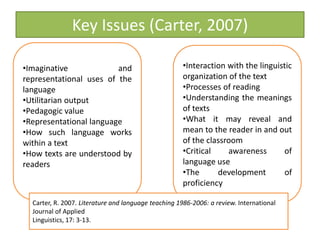
Key Issues (Carter, 2007)
•Imaginative and
representational uses of the
language
•Utilitarian output
•Pedagogic value
•Representational language
•How such language works
within a text
•How texts are understood by
readers
•Interaction with the linguistic
organization of the text
•Processes of reading
•Understanding the meanings
of texts
•What it may reveal and
mean to the reader in and out
of the classroom
•Critical awareness of
language use
•The development of
proficiency
Carter, R. 2007. Literature and language teaching 1986-2006: a review. International
Journal of Applied
Linguistics, 17: 3-13.
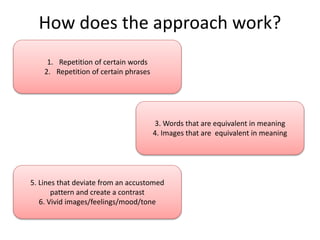
How does the approach work?
1. Repetition of certain words
2. Repetition of certain phrases
5. Lines that deviate from an accustomed
pattern and create a contrast
6. Vivid images/feelings/mood/tone
3. Words that are equivalent in meaning
4. Images that are equivalent in meaning
Language Based Approach to Poetry
• Identify what parts of the poem seem most
significant
• Identify major patterns of sounds that exist in
the poem
• Identify the major patterns of imagery that
exist in the poem
• Identify elements of contrasts and deviations
within a poem
Indications of LBA from the lesson
plan..
• The teaching of theme ‘perseverance in life’ in
relation to imagery elements in the poem
• The creation of dialogue script added with
words from the poem in order to give better
impact on meaning

Language-based approach

  • 1.
    Applying Language-based Approach inthe poem, In the Midst of Hardship” A Simple Guide SKVB 4033 TEACHING OF LITERATURE IN ENGLISH PREPARED BY: FAIDATUL SYUHADA BT. SHAMSUDDIN (A 135714) WAN NAZIRA BT. CHE NOR (A 135711) W. SYAZWANI NASUHA BT. WAN MAZLAN (A 135727) LECTURER’S NAME: DR. ZALINA BT MOHD. LAZIM
  • 2.
    To start with.. Itis an approach that remarks on how certain specific ways of using the language in literary texts could have better impact on students’ understanding of the language which leads us to…
  • 3.
    “Literary texts areseen as means to helping students improve language proficiency by providing them exposure to the target language and connecting them to specific vocabulary and other aspects of the language.” (p. 33) Too, W, K., (2007). Language-based approach. In: Ganakumaran, Subramaniam (Ed.,), Approaches to teaching literature: theory and practice Petaling Jaya, Malaysia: Sasbadi Sdn. Bhd.. 33-49.
  • 4.
    Key Issues (Carter,2007) •Imaginative and representational uses of the language •Utilitarian output •Pedagogic value •Representational language •How such language works within a text •How texts are understood by readers •Interaction with the linguistic organization of the text •Processes of reading •Understanding the meanings of texts •What it may reveal and mean to the reader in and out of the classroom •Critical awareness of language use •The development of proficiency Carter, R. 2007. Literature and language teaching 1986-2006: a review. International Journal of Applied Linguistics, 17: 3-13.
  • 5.
    How does theapproach work? 1. Repetition of certain words 2. Repetition of certain phrases 5. Lines that deviate from an accustomed pattern and create a contrast 6. Vivid images/feelings/mood/tone 3. Words that are equivalent in meaning 4. Images that are equivalent in meaning
  • 6.
    Language Based Approachto Poetry • Identify what parts of the poem seem most significant • Identify major patterns of sounds that exist in the poem • Identify the major patterns of imagery that exist in the poem • Identify elements of contrasts and deviations within a poem
  • 7.
    Indications of LBAfrom the lesson plan.. • The teaching of theme ‘perseverance in life’ in relation to imagery elements in the poem • The creation of dialogue script added with words from the poem in order to give better impact on meaning