Early Literacy &Reading InstructionDeveloped by William M. Tweedie
PRIME TASKBrainstorm!As your colleagues are settling in, write on a separate sheet of paper as many words as you know about the topic ofPHONICSTurn your sheets in at the end of the first half of thissession. Write clearly and neatly. You need not signyour paper.
Early Literacy and Reading InstructionA 5 Part CourseSetting Goals, Objectives and the Stage for ActionUsing Computer Based ProgramsTeaching in the Regular Classroom – Text, Print & The Alphabetic Code Teaching in the Regular Classroom Phonological Awareness & The Alphabetic PrincipleTeaching in the Regular Classroom Vocabulary, Fluency, Comprehension
Session OneSetting Goals and the Stage for ActionThe Most Important Principles of Early Childhood PedagogyLove, appreciate, praise students to build confidence, curiosity, and independenceSet clear rules, expectations, and routines - Be consistentStimulate a love of learning - Focus on literacyFacilitate and participate in appropriate activities Help make meaningful connections with the worldHelp develop social and personal skills and abilitiesInvolve students in planning their learningBe a positive role modelLaugh – a lotAdapted from A Summary of Early Childhood Education Principles Into Practice:A Kindergarten to Grade 3 Needs Assessment, Saskatchewan Learning, February 2006
Session One continuedLiteracy in RompinSetting Goals per School and DistrictWhat is Early Literacy?What is Reading?Early Literacy Instruction TheoryPredominant MethodsWhole LanguageAnalyticalSyntheticWhat Are the Elements of Early Reading Instruction?Screening, Assessment, Evaluation
Session One continuedLiteracy in RompinSetting Goals School Review your numbersSet a realistic goal and specific objectives to guide you to achieve it.Share your course learning with your colleaguesDistrictReview of NumbersGoals and Objectives
Setting Class & School GoalsSchool Examplenumbersrealistic goal list of the objectivesSession One continued
DistrictReview of numbersGoals and ObjectivesSession One continuedInsert GraphInsert Text
Session One continuedWhat is Early Literacy?It’s a complex topic involving many issues:The ability to communicate through Reading and WritingOracyNew Literacies: Visual, Computer LiteracyWhole Language vs. Phonics ApproachesPace & Elements of Child Development Home, School, Community environment     Direct Teaching or Implicit LearningAssessment, Intervention, etc.
Session One continuedWhat is Early Literacy?It is a tool; a way to learn about the world and a means to participate more fully in the technological society of the 21st century. 						Rafferty (1999) Practical, Relevant, Integrated, Meaningful and Enriching (PRIME ©) use of Communication in context within a print-rich environment. Skills and strategies are taught in these meaningful contexts rather than in isolation.Tweedie (1999)
What is Reading?Four Definitions:Bringing meaning to text to get meaning from itLearning to identify words and get their meaning Learning to pronounce wordsAll of the above definitions and developing learning skills in the context of authentic, balanced reading and writing activities.	adapted from http://www.ncrel.org/sdrs/areas/issues/content/cntareas/reading/li7lk1.htmSession One continued
Early Reading Instruction TheoryPredominant MethodsWhole LanguageAnalytic PhonicsSynthetic PhonicsSession One continued
Whole LanguageIs a meaning-centered method based on the following principles: people learn best when actively involved in learning not all children will learn the same things, much less learn them at the same time, no matter how we teacheducational assessment of learning should both focus on and promote continued learningSession One continued
Session One continuedChildren learn to read and write by being supported in actually reading and writing whole texts.Phonics (Alphabetic Principle) has always been at the heart of whole language, acknowledged and taught as one of the three major language cueing systems (i.e., semantic, syntactic, and graphophonic) that must be orchestrated as one reads  	(Mills, O'Keefe, & Stephens, 1992; Powell & Hornsby, 1993; Wagstaff, 1994).        (NCREL)North Central Regional Education Laboratory www.ncrel.org
Session One continuedAnalytic Phonics (whole to part)Involves development of phonemic awareness (recognising the sounds in speech) and analysis of whole words to detect phonetic (sound) or orthographic (spelling) patterns, then splitting them into smaller parts to help with decoding. For example: onset and rime - onset (vowel sound(s)) at the beginning of a word or syllable and rime (always beginning with a vowel to form the remainder of that word or syllable).Basics normally take 2+ years in L1 & ESL contexts
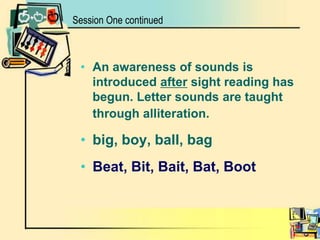
An awareness of sounds is introduced after sight reading has begun. Letter sounds are taught through alliteration.big, boy, ball, bagBeat, Bit, Bait, Bat, BootSession One continued
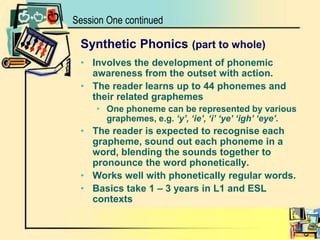
Session One continuedSynthetic Phonics (part to whole)Involves the development of phonemic awareness from the outset with action. The reader learns up to 44 phonemes and their related graphemes One phoneme can be represented by various graphemes, e.g. ‘y’, ‘ie’, ‘i’ ‘ye’ ‘igh’ ‘eye’.The reader is expected to recognise each grapheme, sound out each phoneme in a word, blending the sounds together to pronounce the word phonetically. Works well with phonetically regular words.Basics take 1 – 3 years in L1 and ESL contexts
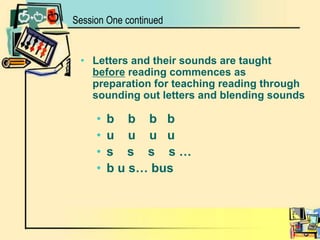
Letters and their sounds are taught before reading commences as preparation for teaching reading through sounding out letters and blending soundsb    b    b   bu    u    u   us    s    s    s … b u s… bus      Session One continued
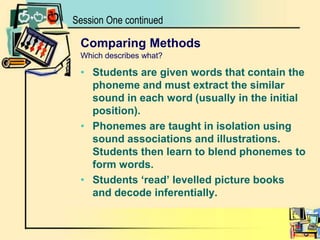
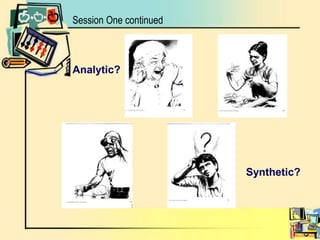
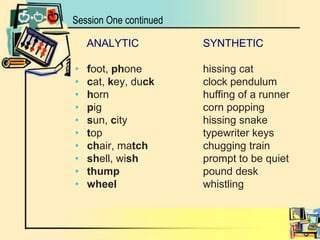
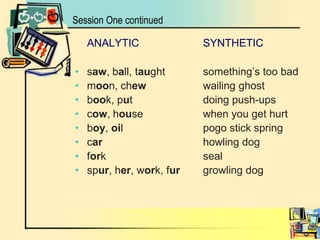
Session One continuedComparing MethodsWhich describes what?Students are given words that contain the phoneme and must extract the similar sound in each word (usually in the initial position).Phonemes are taught in isolation using sound associations and illustrations. Students then learn to blend phonemes to form words.Students ‘read’ levelled picture books and decode inferentially.
Session One continuedAnalytic?Synthetic?
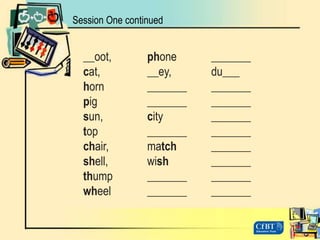
Session One continued__oot,		phone 	_______cat, 		__ey, 		du___ 		horn 		_______	_______pig 		_______	_______sun, 		city 		_______	top 		_______	_______chair, 		match 	_______shell, 		wish 		_______thump		_______	_______wheel		_______	_______
Session One continuedANALYTIC 		SYNTHETICfoot, phone 		hissing catcat, key, duck 		clock pendulumhorn 			huffing of a runnerpig 				corn poppingsun, city 			hissing snaketop 				typewriter keyschair, match 		chugging trainshell, wish 		prompt to be quietthump			pound deskwheel			whistling
Session One continuedANALYTIC 		SYNTHETICsaw, ball, taught 		something’s too badmoon, chew 		wailing ghostbook, put 			doing push-upscow, house 		when you get hurtboy, oil 			pogo stick springcar 				howling dogfork 			sealspur, her, work, fur 	growling dog
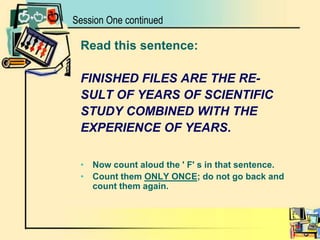
Session One continuedRead this sentence: FINISHED FILES ARE THE RE- SULT OF YEARS OF SCIENTIFICSTUDY COMBINED WITH THE EXPERIENCE OF YEARS. Now count aloud the ' F' s in that sentence. Count them ONLY ONCE; do not go back and count them again.
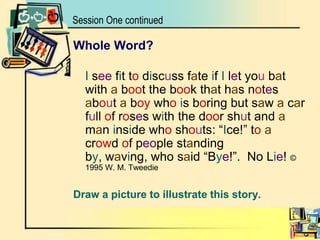
Session One continuedWhole Word?I see fit to discuss fate if I let you bat with a boot the book that has notes about a boy whois boring but saw a car full of roses with the door shut and a man inside who shouts: “Ice!” toa crowd of people standing by, waving, who said “Bye!”.  No Lie! © 1995 W. M. TweedieDraw a picture to illustrate this story.
Session One continuedBreak Time!Please fill in the Muddiest Point form andreturn it to me after the break. Thanks.
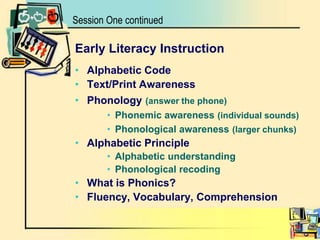
Session One continuedEarly Literacy InstructionAlphabetic CodeText/Print AwarenessPhonology(answer the phone)Phonemic awareness(individual sounds)Phonological awareness(larger chunks)Alphabetic PrincipleAlphabetic understanding Phonological recoding What is Phonics?Fluency, Vocabulary, Comprehension
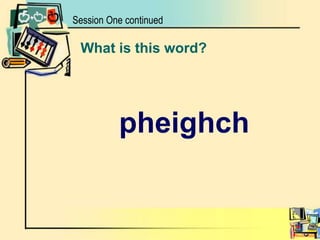
Session One continuedWhat is this word?pheighch
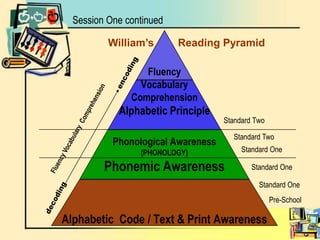
William’s	  Reading PyramidencodingFluency Vocabulary  ComprehensionStandard TwoStandard OneStandard One decodingStandard OnePre-School
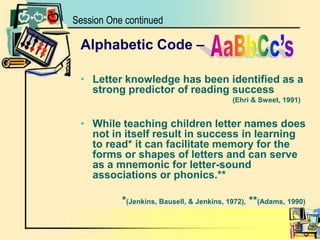
Session One continuedAaBbCc’sAlphabetic Code –Letter knowledge has been identified as a strong predictor of reading success       				            (Ehri & Sweet, 1991) While teaching children letter names does not in itself result in success in learning to read* it can facilitate memory for the forms or shapes of letters and can serve as a mnemonic for letter-sound associations or phonics.** 	          *(Jenkins, Bausell, & Jenkins, 1972), **(Adams, 1990)
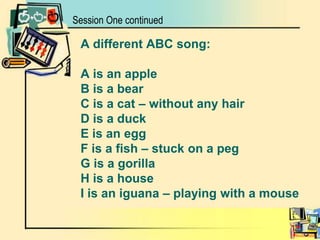
A different ABC song:A is an appleB is a bearC is a cat – without any hairD is a duckE is an eggF is a fish – stuck on a pegG is a gorilla H is a houseI is an iguana – playing with a mouse Session One continued
Session One continuedJ is a jungleK a kangarooL is a lion – with only one shoeM is a monkeyN is a nurseO is an ostrich – with a big purseP is a penguinQ is a queenR is a rabbit – with a big bean
S is a silly snakeT is a tigerU is an umbrella – caught on fire!V is a vampireW is a whaleX is a fox – with a bushy tailY is a yakZ is a zooAnd that’s the alphabet – just for you!					© 2007 William M. TweedieSession One continued
Session One continued*%&$#^$Not knowing letter names is related to children's difficulty in learning letter sounds and in recognizing words. Children cannot understand and apply the alphabetic principle until they can recognize and name a number of letters.Texas Education Agency (2002)
Session One continuedInstruction in the Alphabetic Principle does not follow the order of the alphabet. It usually follows the frequency of letter usage and the graduation of ease and ability to decode words in the reading process.Different ‘phonics’ programs follow different orders.
Session One continuedOne way of introducing the idea of capitals and lower case letters is to describe the capital as the name of the letter and the lower case as the sound of the letterTalking about when we use capitals – names, beginning of sentences etc. – will help students differentiate between the two
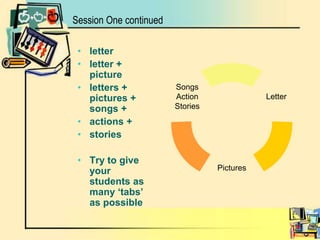
Session One continuedletterletter + picture letters + pictures + songs + actions + storiesTry to give your students as many ‘tabs’ as possible
Text Print Awareness(mechanics of text)Children need to know: Parts of a book Texts are written from left to right Spaces between words matter There is a one-to-one correspondence between writing and speakingTeach parts, directionality & vocabulary using:Big BooksTotal physical responseUse realia and kinaesthetic activitiesPantomimeDaily review of concepts of printSmall group instruction if neededSession One continued
OOOO /K/A/Session One continuedPhonologyPhonemic Awareness (PA)is the ability to manipulate the smallestunits of sound that make up spokenlanguage: phonemesA child who possesses phonemic awareness can segment sounds in wordsblend strings of isolated sounds together to form recognizable word formsmanipulate sounds to create words
Session One continuedPA is auditory and does notinvolve words in print Without phonemic awareness, phonics instruction makes little senseEssential to learning to read in an alphabetic writing systemA strong predictor of children who experience early reading success Rhyming & Alliteration precedes Isolation, Segmentation, Blending and Manipulating abilities
Session One continuedRhyming/AlliterationThe cat sat to pat his rat! (picture)Isolating/DistinguishingWhat’s the first sound in Cat?SegmentingHow many sounds in cat ? /k/ /a/ /t/Deleting	What’s the word if you take out the /k/?BlendingWhat is this word: /p/  /aaaa/  /t/ ?Manipulating What is the word if you put /r/ in front of /at/ ?
Session One continuedPhonological AwarenessIn addition to Phonemic AwarenessPhonological Awareness encompasseslarger units of sound, such as syllables, body/coda, onsets/rimes, prefixes, and suffixes.Sta te Sta le Sta ll Sta ff (body) / (coda) S ay D ay M ay W ay L ay (onset) / (rime)Rea / d  Pai / d  Be/ d  Li / d  Trie / d (body) / (coda)F / at  - F / ate (onset) / (rime)Con struc tion (prefix) (root) (suffix) (syllables)
Session One continuedThe Alphabetic Principleis the understanding that there are systematicand predictable relationships between writtenletters and spoken sounds. There are 2 aspects:Alphabetic Understanding:	Words are composed of letters that represent sounds.Phonological Recoding	Using systematic relationships between letters and phonemes (letter-sound correspondence) to retrieve the pronunciation of an unknown printed string or to spell words 	(Reading & Writing)
Beginning decoding is the ability to: read from left to right, simple, unfamiliar regular words Listen to and generate the sounds for all letters blend sounds into recognizable wordsBeginning encoding (spelling/writing) is the ability to:translate speech to print using phonemic awareness and knowledge of letter-sounds (Alphabetic Principle)Session One continued
What is Phonics?– a method of teaching children to read(not something they need to learn)Phonics instruction teaches children the relationships between the letters (graphemes) of written language and the individual sounds (phonemes) of spoken language.It teaches children to use these relationships to read and write words.It is NOT Phonemic awareness.Session One continued
What Is Fluency?Fluency (automaticity) is reading words with no noticeable cognitive or mental effort. It is having mastered word recognition skills to the point of over-learning. Fundamental skills are so "automatic" that they do not require conscious attention. Fluency is not an end in itself but a critical gateway to comprehension. Fluent reading frees resources to process meaning. Session One continued
Session One continuedFor students to develop fluency, they must:perform the task or demonstrate the skill accuratelyperform the preskills of the task quickly and effortlessly.Research says successful readers: rely on the letters not context or pictures process virtually every letter use letter-sound links to identify wordshave a strategy for decoding wordsread words repeatedly            									(Hasbrouck, 1998)
Session One continuedWhat Is Having Vocabulary?The ability to understand (receptive)and use (expressive) words toacquire and convey meaningVocabulary refers to the words we must understand to communicate effectivelyVocabulary plays a fundamental role in the reading process, and contributes greatly to a reader's comprehensionIt is the CORE(Central Operating Resource for Engagement)in an EFL Early Literacy program
Session One continuedPrimary focus of instruction in grades K-3 should be on developing criticalreading skills Read storybooks to younger children to develop vocabulary – every day!
Session One continuedWhat Is Reading Comprehension?The complex cognitive process involvingthe intentional interaction between reader and text to convey meaningthe essence of reading active and intentional thinking in which the meaning is constructed through interactions between the text and the reader 			                  			        (Durkin, 1973)The content of meaning is influenced by the text and by the contribution of the reader's prior knowledge(Anderson & Pearson, 1984)
Session One continuedScreening, Evaluation and AssessmentScreening?Program readiness Evaluation? - ongoingMonitoring of Progress– daily, weeklyAssessment? - cumulativeDegree of Success at end of a section/Program Final Assessment
Translation, Adaptation,Modification ExercisesGRTR Screening Development Phases in Print AwarenessSkill Assessment SheetExamine your handoutsSession One continued
Session One continuedTeaching the ElementsIntroduction and OverviewFocused, Personal, Intensive, Explicit, Systematic, and Patient (FPI/ESP)Related to TextComputer BasedMainstream Classroom BasedIntervention“Up until the age of 8, children are in the Acquisition Stage of literacy learning. During this stage, a child's reading potential is developing and can be affected positively by systematic, intentional instruction.”- NAEYC
Session One continuedSummary of Session OneTeaching the fundamental elements as the essential components of a balanced approach to the teaching of reading, at any stage, alongside:promoting a positive attitude to reading for pleasure and for informationmotivating readers to read for themselves, not just for school purposes teaching sight vocabulary teaching of comprehension strategies and how, when and why to apply them actively raising awareness and appreciation of the writer's craft
Session One continuedAssignmentsComplete the Minute paper and hand it in.Read the first part of each section of the Text and use the CD to Review and Clarify this SessionSubmit a Copy of Your Goals and Objectives by the END of the CourseRevise and Translate the ‘Tests’ by the END of THIS WEEK. You will use them after the course to identify your students who need specific intervention strategies.Finish your ABC song flashcards.
Session TwoTeaching the Elements Using Computer Based ProgramsReview of the ElementsLook for the Elements and how they are learned as you experiment with each of the following two ProgramsThink about the differences in Managing Computer Based Learning vs. Regular Classrooms
Computer Based ProgramsPart 1 – On-disk programCD Program: Hooked on PhonicsComplete the Muddiest Point form – return it  Part 2 – On-line programOn-line Program: StarfallComplete the Minute paper – return itSession Two continued
Session Two continuedhttp://asia.groups.yahoo.com/group/Connecting_the_Dots_in_RompinAssignmentsPreview the Activity Resources for teaching the Alphabet, Text Awareness, you’ll find in the files section (Early Literacy) in the Connecting the Dots in Rompin Group site or that I send to you via email:Print the documents and Prepareto presentone of the activities during the next session.
Teaching the Elements in the Regular ClassroomPay Attention to Attention TrainingStrategies and ActivitiesAlphabetic CodeText and Print AwarenessSession Three
Attention TrainingClassroom rulesGetting students' attentionFocusing students' attentionKeeping students on-task during seat workMaintaining students' attention	    Review your handoutsSession Three continued
Session Three continuedAlphabetic Code	Research shows it is important for young children to be able to:Recognize and name lettersRecognize beginning letters in familiar words (especially their own name)Recognize both capital and lowercase lettersRelate some letters to the specific sounds they represent
Strategies and Activities forTeaching the AlphabetRecognitionRememberingWriting & Spelling (beginnings)Refer to your handoutsSession Three continued
Session Three continuedFlashcardsSight recognitionHearing the soundPracticing vocabularyConnecting sounds and words with objectsVisual, Aural/Oral, & Kinaesthetic
Session Three continuedLarge flashcards can be used for whole class teaching – smaller ones for group workActivities can be teacher led – “b for …?” or students can ask each other to find particular cards, either by their initial sound or by their pictureIf you have separate pictures and sounds, memory and matching games can be playedFlashcards provide good cues for talking about objects, their uses, colours, size and characteristics
Session Three continuedText & Print AwarenessTeach Children About Books:Know how to handle the book appropriatelyRecognize book features such as the front and back covers, and the top and bottom, of the bookUnderstand that a book has a title, an author, words and picturesRecognize that printed letters and words run from left to right and from top to bottom
Teach Children About Text:We see text in a variety of settings and applications.Field Trips:Around schoolIn the communityText Collecting & Display ActivitiesShopping listsProduct wrappings, etc.Session Three continued
Session Three continuedBreak Time!	Please fill in the Muddiest Point form and return it to me after the break. Thanks.
Session Three continuedStrategies & Activities for Teaching Text and Print AwarenessRefer to your handouts
Session Three continuedAssignmentsComplete the Minute paper – return it. Download and review the Phonological andAlphabetic Principle files from the CtDiRGroup site or that I send to you via email.Begin preparation of large flashcards of words from the text and for things in your classrooms.Bring the Handouts to the next session
Classroom Based LearningStrategies and ActivitiesPhonological AwarenessPhonemic AwarenessAlphabetic PrincipleAlphabetic UnderstandingPhonological RecodingSession Four
Phonemic AwarenessAs children begin to learn to read, it becomes necessary for them to be able to explicitly identify the smaller units of speech (i.e. phonemes) in order to be able to make the connections between orthographic representations and the sounds that they represent. Individuals who have developed phonemic awareness will be able to identify the “beginning sound” of please as /p/, and to segment the word into its component phonemes: /p/–/l/–/i/–/z/.Session Four continued
Session Four continuedStrategies and Activities for Teaching Phonemic AwarenessRefer to your handouts
Session Four continuedBreak Time!Please fill in the Muddiest Point form andreturn it to me after the break. Thanks.
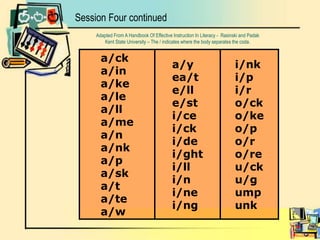
Phonological AwarenessChildren, who have been given lots of practice with Phonemic Awareness and onsets and rimes (or body/coda) to generate word families, have a larger bank of words to draw upon and a means to decode many unfamiliar words.Over 500 words can be generated from the following 37 rimes or codas! Session Four continued
Session Four continuedAdapted From A Handbook Of Effective Instruction In Literacy -  Rasinski and PadakKent State University – The / indicates where the body separates the coda.
Alphabetic PrincipleAlphabetic UnderstandingAlphabetic DecodingRefer to your handoutsSession Four continued
AssignmentsDownload and review the Fluency, Vocabulary and Comprehension files from the CtDiR Group site or that I send to you via email.Bring the Handouts to the nextsessionSession Four continued
Classroom Based LearningStrategies and ActivitiesVocabularyFluency and ComprehensionPutting It All TogetherSyllabus and ContentOutline of Research ProjectConclusionSession Five
Session Five continuedStrategies and ActivitiesVocabulary – The Critical ElementPrinciples and Practice FluencySongs, Chants & Read AloudsComprehensionQuestioning StrategiesRefer to your handouts
Session Five continuedVocabulary Principles & PracticeExplicitly teach vocabularyCritical to reading comprehension Often neglected component of instruction for ELLsScaffold reading by asking frequent Questions to check and clarifyCritical to mastery
Session Five continuedThe Language of Instruction Matters.TEACH in L1 to TRANSFER and BUILDskills and knowledge.Components of L1 are the foundationPhonological (Alphabetic Principle) skills transfer regardless of language of instructionWord reading and background knowledge require instruction in primary language firstReading Rockets/Colorin Colorado 2001
CorrectionTechnical mistakes should be correctedCorrect with PRAISEDon’t over correctDO NOT LABEL studentsAssess individually and OFTENProvide extra instruction time – not lessSession Five continued
Session Five continuedGive extra time for practice especially for words and sounds as these lay the foundation for literacy development Make sure EVERY student ‘gets it’ before increasing the complexity of the learning material Start small and simple to build student confidence - PRACTICALMake EVERYTHINGRELEVANT for the learnersINTEGRATE abilities, content, skills and they will stay MEANINGFULLY ENGAGED			(PRIME©)
Translating ExercisesEnglish/L1 – Common AlphabetWords in Common - CognatesClassroom Language & LabelsRefer to your handoutsSession Five continued
Fluency and ComprehensionSongsChantsRead AloudsQuestioning, AssessmentFocused Review & PracticeSession Five continued
Session Five continuedBreak Time!Please fill in the Muddiest Point Form and return it to me after the break. Thanks.
Session Five continuedPutting It All TogetherReview of Existing Programs for Content and SyllabusPrescriptive and InflexibleC-A-T CATOpen Court ReadingScientifically based and context appropriateTampa Reads		• MES-EnglishEnglish Raven	• RAZ
Session Five continuedThe SyllabusContent and SequenceAlphabetic CodeTeach letters 4 at a time in sequenceTeach sounds of letters but not as focusIllustrate the letters in pictures, etc.Distinguish capital from small lettersIntroduce sight wordsAlways explain in L1 for comprehensionTeach text and word awareness skills (use text)Begin copying & writing of lettersMake sure all students have a complete grasp before moving on
Phonological AwarenessPhonemic Awareness - Teach as focusTeach consonants and consonant blends first (Tampa Reads program)Teach single vowels with two consonantsTeach simple sound manipulationsAlways ensure vocabulary understandingAssess students as a class and individually oftenIntroduce concepts of larger pieces of speech (chunks) and words (syllables)Reinforce Alphabetic Code and Concepts of Print (use text)Session Five continued
Alphabetic PrincipleTeach letter sound identity with written letters including digraphsTeach blends, 2 consonant endings, double vowels, vowel blendsTeach manipulations of lettersIntroduce sight wordsTeach long vowels and silent ‘e’Teach ‘r’ controlled vowelsKnow and teach the AP rules as they arise. Practice writing and spelling as you go.Session Five continued
Vocabulary, Fluency ComprehensionBegin VFC activities from the startAlways ensure ALL students understand the meaning of the words they are expected to work with except when another skill development which doesn’t require it is in focus.Vocabulary and Comprehension are the CORE, fluency activities will help build both.Expose students to books from the startMake weekly trips to the library with some specific purpose mandatory.Elicit the help and cooperation of EVERYONE in the school community.Session Five continuedBE A PRIME©TEACHER ! Practical, Relevant, Integrated, Meaningful, Enriching
Outline of Research Project:(designated school)1 full class using a computer based program½ of another class receiving intensive Early Reading Instruction½ receiving regular class Instruction (control)Other schools may be includedYear long monitoring with regular progress assessmentsSession Five continued
Course SummaryCommunity and Parent InvolvementSchedule of Follow-up VisitsConclusionSession Five continued
Early Literacy and Reading Instruction		              For more information PLEASE contact :William M. TweedieEFL Education Specialistwilliam.tweedie@yahoo.cahttp://asia.groups.yahoo.com/group/Connecting_the_Dots_in_Rompin

Early Literacy And Reading Course

  • 1.
    Early Literacy &ReadingInstructionDeveloped by William M. Tweedie
  • 2.
    PRIME TASKBrainstorm!As yourcolleagues are settling in, write on a separate sheet of paper as many words as you know about the topic ofPHONICSTurn your sheets in at the end of the first half of thissession. Write clearly and neatly. You need not signyour paper.
  • 3.
    Early Literacy andReading InstructionA 5 Part CourseSetting Goals, Objectives and the Stage for ActionUsing Computer Based ProgramsTeaching in the Regular Classroom – Text, Print & The Alphabetic Code Teaching in the Regular Classroom Phonological Awareness & The Alphabetic PrincipleTeaching in the Regular Classroom Vocabulary, Fluency, Comprehension
  • 4.
    Session OneSetting Goalsand the Stage for ActionThe Most Important Principles of Early Childhood PedagogyLove, appreciate, praise students to build confidence, curiosity, and independenceSet clear rules, expectations, and routines - Be consistentStimulate a love of learning - Focus on literacyFacilitate and participate in appropriate activities Help make meaningful connections with the worldHelp develop social and personal skills and abilitiesInvolve students in planning their learningBe a positive role modelLaugh – a lotAdapted from A Summary of Early Childhood Education Principles Into Practice:A Kindergarten to Grade 3 Needs Assessment, Saskatchewan Learning, February 2006
  • 5.
    Session One continuedLiteracyin RompinSetting Goals per School and DistrictWhat is Early Literacy?What is Reading?Early Literacy Instruction TheoryPredominant MethodsWhole LanguageAnalyticalSyntheticWhat Are the Elements of Early Reading Instruction?Screening, Assessment, Evaluation
  • 6.
    Session One continuedLiteracyin RompinSetting Goals School Review your numbersSet a realistic goal and specific objectives to guide you to achieve it.Share your course learning with your colleaguesDistrictReview of NumbersGoals and Objectives
  • 7.
    Setting Class &School GoalsSchool Examplenumbersrealistic goal list of the objectivesSession One continued
  • 8.
    DistrictReview of numbersGoalsand ObjectivesSession One continuedInsert GraphInsert Text
  • 9.
    Session One continuedWhatis Early Literacy?It’s a complex topic involving many issues:The ability to communicate through Reading and WritingOracyNew Literacies: Visual, Computer LiteracyWhole Language vs. Phonics ApproachesPace & Elements of Child Development Home, School, Community environment Direct Teaching or Implicit LearningAssessment, Intervention, etc.
  • 10.
    Session One continuedWhatis Early Literacy?It is a tool; a way to learn about the world and a means to participate more fully in the technological society of the 21st century. Rafferty (1999) Practical, Relevant, Integrated, Meaningful and Enriching (PRIME ©) use of Communication in context within a print-rich environment. Skills and strategies are taught in these meaningful contexts rather than in isolation.Tweedie (1999)
  • 11.
    What is Reading?FourDefinitions:Bringing meaning to text to get meaning from itLearning to identify words and get their meaning Learning to pronounce wordsAll of the above definitions and developing learning skills in the context of authentic, balanced reading and writing activities. adapted from http://www.ncrel.org/sdrs/areas/issues/content/cntareas/reading/li7lk1.htmSession One continued
  • 12.
    Early Reading InstructionTheoryPredominant MethodsWhole LanguageAnalytic PhonicsSynthetic PhonicsSession One continued
  • 13.
    Whole LanguageIs ameaning-centered method based on the following principles: people learn best when actively involved in learning not all children will learn the same things, much less learn them at the same time, no matter how we teacheducational assessment of learning should both focus on and promote continued learningSession One continued
  • 14.
    Session One continuedChildrenlearn to read and write by being supported in actually reading and writing whole texts.Phonics (Alphabetic Principle) has always been at the heart of whole language, acknowledged and taught as one of the three major language cueing systems (i.e., semantic, syntactic, and graphophonic) that must be orchestrated as one reads (Mills, O'Keefe, & Stephens, 1992; Powell & Hornsby, 1993; Wagstaff, 1994). (NCREL)North Central Regional Education Laboratory www.ncrel.org
  • 15.
    Session One continuedAnalyticPhonics (whole to part)Involves development of phonemic awareness (recognising the sounds in speech) and analysis of whole words to detect phonetic (sound) or orthographic (spelling) patterns, then splitting them into smaller parts to help with decoding. For example: onset and rime - onset (vowel sound(s)) at the beginning of a word or syllable and rime (always beginning with a vowel to form the remainder of that word or syllable).Basics normally take 2+ years in L1 & ESL contexts
  • 16.
    An awareness ofsounds is introduced after sight reading has begun. Letter sounds are taught through alliteration.big, boy, ball, bagBeat, Bit, Bait, Bat, BootSession One continued
  • 17.
    Session One continuedSyntheticPhonics (part to whole)Involves the development of phonemic awareness from the outset with action. The reader learns up to 44 phonemes and their related graphemes One phoneme can be represented by various graphemes, e.g. ‘y’, ‘ie’, ‘i’ ‘ye’ ‘igh’ ‘eye’.The reader is expected to recognise each grapheme, sound out each phoneme in a word, blending the sounds together to pronounce the word phonetically. Works well with phonetically regular words.Basics take 1 – 3 years in L1 and ESL contexts
  • 18.
    Letters and theirsounds are taught before reading commences as preparation for teaching reading through sounding out letters and blending soundsb b b bu u u us s s s … b u s… bus Session One continued
  • 19.
    Session One continuedComparingMethodsWhich describes what?Students are given words that contain the phoneme and must extract the similar sound in each word (usually in the initial position).Phonemes are taught in isolation using sound associations and illustrations. Students then learn to blend phonemes to form words.Students ‘read’ levelled picture books and decode inferentially.
  • 20.
  • 21.
    Session One continued__oot, phone _______cat, __ey, du___ horn _______ _______pig _______ _______sun, city _______ top _______ _______chair, match _______shell, wish _______thump _______ _______wheel _______ _______
  • 22.
    Session One continuedANALYTIC SYNTHETICfoot, phone hissing catcat, key, duck clock pendulumhorn huffing of a runnerpig corn poppingsun, city hissing snaketop typewriter keyschair, match chugging trainshell, wish prompt to be quietthump pound deskwheel whistling
  • 23.
    Session One continuedANALYTIC SYNTHETICsaw, ball, taught something’s too badmoon, chew wailing ghostbook, put doing push-upscow, house when you get hurtboy, oil pogo stick springcar howling dogfork sealspur, her, work, fur growling dog
  • 24.
    Session One continuedReadthis sentence: FINISHED FILES ARE THE RE- SULT OF YEARS OF SCIENTIFICSTUDY COMBINED WITH THE EXPERIENCE OF YEARS. Now count aloud the ' F' s in that sentence. Count them ONLY ONCE; do not go back and count them again.
  • 25.
    Session One continuedWholeWord?I see fit to discuss fate if I let you bat with a boot the book that has notes about a boy whois boring but saw a car full of roses with the door shut and a man inside who shouts: “Ice!” toa crowd of people standing by, waving, who said “Bye!”. No Lie! © 1995 W. M. TweedieDraw a picture to illustrate this story.
  • 26.
    Session One continuedBreakTime!Please fill in the Muddiest Point form andreturn it to me after the break. Thanks.
  • 27.
    Session One continuedEarlyLiteracy InstructionAlphabetic CodeText/Print AwarenessPhonology(answer the phone)Phonemic awareness(individual sounds)Phonological awareness(larger chunks)Alphabetic PrincipleAlphabetic understanding Phonological recoding What is Phonics?Fluency, Vocabulary, Comprehension
  • 28.
    Session One continuedWhatis this word?pheighch
  • 29.
    William’s ReadingPyramidencodingFluency Vocabulary ComprehensionStandard TwoStandard OneStandard One decodingStandard OnePre-School
  • 30.
    Session One continuedAaBbCc’sAlphabeticCode –Letter knowledge has been identified as a strong predictor of reading success (Ehri & Sweet, 1991) While teaching children letter names does not in itself result in success in learning to read* it can facilitate memory for the forms or shapes of letters and can serve as a mnemonic for letter-sound associations or phonics.** *(Jenkins, Bausell, & Jenkins, 1972), **(Adams, 1990)
  • 31.
    A different ABCsong:A is an appleB is a bearC is a cat – without any hairD is a duckE is an eggF is a fish – stuck on a pegG is a gorilla H is a houseI is an iguana – playing with a mouse Session One continued
  • 32.
    Session One continuedJis a jungleK a kangarooL is a lion – with only one shoeM is a monkeyN is a nurseO is an ostrich – with a big purseP is a penguinQ is a queenR is a rabbit – with a big bean
  • 33.
    S is asilly snakeT is a tigerU is an umbrella – caught on fire!V is a vampireW is a whaleX is a fox – with a bushy tailY is a yakZ is a zooAnd that’s the alphabet – just for you! © 2007 William M. TweedieSession One continued
  • 34.
    Session One continued*%&$#^$Notknowing letter names is related to children's difficulty in learning letter sounds and in recognizing words. Children cannot understand and apply the alphabetic principle until they can recognize and name a number of letters.Texas Education Agency (2002)
  • 35.
    Session One continuedInstructionin the Alphabetic Principle does not follow the order of the alphabet. It usually follows the frequency of letter usage and the graduation of ease and ability to decode words in the reading process.Different ‘phonics’ programs follow different orders.
  • 36.
    Session One continuedOneway of introducing the idea of capitals and lower case letters is to describe the capital as the name of the letter and the lower case as the sound of the letterTalking about when we use capitals – names, beginning of sentences etc. – will help students differentiate between the two
  • 37.
    Session One continuedletterletter+ picture letters + pictures + songs + actions + storiesTry to give your students as many ‘tabs’ as possible
  • 38.
    Text Print Awareness(mechanicsof text)Children need to know: Parts of a book Texts are written from left to right Spaces between words matter There is a one-to-one correspondence between writing and speakingTeach parts, directionality & vocabulary using:Big BooksTotal physical responseUse realia and kinaesthetic activitiesPantomimeDaily review of concepts of printSmall group instruction if neededSession One continued
  • 39.
    OOOO /K/A/Session OnecontinuedPhonologyPhonemic Awareness (PA)is the ability to manipulate the smallestunits of sound that make up spokenlanguage: phonemesA child who possesses phonemic awareness can segment sounds in wordsblend strings of isolated sounds together to form recognizable word formsmanipulate sounds to create words
  • 40.
    Session One continuedPAis auditory and does notinvolve words in print Without phonemic awareness, phonics instruction makes little senseEssential to learning to read in an alphabetic writing systemA strong predictor of children who experience early reading success Rhyming & Alliteration precedes Isolation, Segmentation, Blending and Manipulating abilities
  • 41.
    Session One continuedRhyming/AlliterationThecat sat to pat his rat! (picture)Isolating/DistinguishingWhat’s the first sound in Cat?SegmentingHow many sounds in cat ? /k/ /a/ /t/Deleting What’s the word if you take out the /k/?BlendingWhat is this word: /p/ /aaaa/ /t/ ?Manipulating What is the word if you put /r/ in front of /at/ ?
  • 42.
    Session One continuedPhonologicalAwarenessIn addition to Phonemic AwarenessPhonological Awareness encompasseslarger units of sound, such as syllables, body/coda, onsets/rimes, prefixes, and suffixes.Sta te Sta le Sta ll Sta ff (body) / (coda) S ay D ay M ay W ay L ay (onset) / (rime)Rea / d Pai / d Be/ d Li / d Trie / d (body) / (coda)F / at - F / ate (onset) / (rime)Con struc tion (prefix) (root) (suffix) (syllables)
  • 43.
    Session One continuedTheAlphabetic Principleis the understanding that there are systematicand predictable relationships between writtenletters and spoken sounds. There are 2 aspects:Alphabetic Understanding: Words are composed of letters that represent sounds.Phonological Recoding Using systematic relationships between letters and phonemes (letter-sound correspondence) to retrieve the pronunciation of an unknown printed string or to spell words (Reading & Writing)
  • 44.
    Beginning decoding isthe ability to: read from left to right, simple, unfamiliar regular words Listen to and generate the sounds for all letters blend sounds into recognizable wordsBeginning encoding (spelling/writing) is the ability to:translate speech to print using phonemic awareness and knowledge of letter-sounds (Alphabetic Principle)Session One continued
  • 45.
    What is Phonics?–a method of teaching children to read(not something they need to learn)Phonics instruction teaches children the relationships between the letters (graphemes) of written language and the individual sounds (phonemes) of spoken language.It teaches children to use these relationships to read and write words.It is NOT Phonemic awareness.Session One continued
  • 46.
    What Is Fluency?Fluency(automaticity) is reading words with no noticeable cognitive or mental effort. It is having mastered word recognition skills to the point of over-learning. Fundamental skills are so "automatic" that they do not require conscious attention. Fluency is not an end in itself but a critical gateway to comprehension. Fluent reading frees resources to process meaning. Session One continued
  • 47.
    Session One continuedForstudents to develop fluency, they must:perform the task or demonstrate the skill accuratelyperform the preskills of the task quickly and effortlessly.Research says successful readers: rely on the letters not context or pictures process virtually every letter use letter-sound links to identify wordshave a strategy for decoding wordsread words repeatedly (Hasbrouck, 1998)
  • 48.
    Session One continuedWhatIs Having Vocabulary?The ability to understand (receptive)and use (expressive) words toacquire and convey meaningVocabulary refers to the words we must understand to communicate effectivelyVocabulary plays a fundamental role in the reading process, and contributes greatly to a reader's comprehensionIt is the CORE(Central Operating Resource for Engagement)in an EFL Early Literacy program
  • 49.
    Session One continuedPrimaryfocus of instruction in grades K-3 should be on developing criticalreading skills Read storybooks to younger children to develop vocabulary – every day!
  • 50.
    Session One continuedWhatIs Reading Comprehension?The complex cognitive process involvingthe intentional interaction between reader and text to convey meaningthe essence of reading active and intentional thinking in which the meaning is constructed through interactions between the text and the reader (Durkin, 1973)The content of meaning is influenced by the text and by the contribution of the reader's prior knowledge(Anderson & Pearson, 1984)
  • 51.
    Session One continuedScreening,Evaluation and AssessmentScreening?Program readiness Evaluation? - ongoingMonitoring of Progress– daily, weeklyAssessment? - cumulativeDegree of Success at end of a section/Program Final Assessment
  • 52.
    Translation, Adaptation,Modification ExercisesGRTRScreening Development Phases in Print AwarenessSkill Assessment SheetExamine your handoutsSession One continued
  • 53.
    Session One continuedTeachingthe ElementsIntroduction and OverviewFocused, Personal, Intensive, Explicit, Systematic, and Patient (FPI/ESP)Related to TextComputer BasedMainstream Classroom BasedIntervention“Up until the age of 8, children are in the Acquisition Stage of literacy learning. During this stage, a child's reading potential is developing and can be affected positively by systematic, intentional instruction.”- NAEYC
  • 54.
    Session One continuedSummaryof Session OneTeaching the fundamental elements as the essential components of a balanced approach to the teaching of reading, at any stage, alongside:promoting a positive attitude to reading for pleasure and for informationmotivating readers to read for themselves, not just for school purposes teaching sight vocabulary teaching of comprehension strategies and how, when and why to apply them actively raising awareness and appreciation of the writer's craft
  • 55.
    Session One continuedAssignmentsCompletethe Minute paper and hand it in.Read the first part of each section of the Text and use the CD to Review and Clarify this SessionSubmit a Copy of Your Goals and Objectives by the END of the CourseRevise and Translate the ‘Tests’ by the END of THIS WEEK. You will use them after the course to identify your students who need specific intervention strategies.Finish your ABC song flashcards.
  • 56.
    Session TwoTeaching theElements Using Computer Based ProgramsReview of the ElementsLook for the Elements and how they are learned as you experiment with each of the following two ProgramsThink about the differences in Managing Computer Based Learning vs. Regular Classrooms
  • 57.
    Computer Based ProgramsPart1 – On-disk programCD Program: Hooked on PhonicsComplete the Muddiest Point form – return it Part 2 – On-line programOn-line Program: StarfallComplete the Minute paper – return itSession Two continued
  • 58.
    Session Two continuedhttp://asia.groups.yahoo.com/group/Connecting_the_Dots_in_RompinAssignmentsPreviewthe Activity Resources for teaching the Alphabet, Text Awareness, you’ll find in the files section (Early Literacy) in the Connecting the Dots in Rompin Group site or that I send to you via email:Print the documents and Prepareto presentone of the activities during the next session.
  • 59.
    Teaching the Elementsin the Regular ClassroomPay Attention to Attention TrainingStrategies and ActivitiesAlphabetic CodeText and Print AwarenessSession Three
  • 60.
    Attention TrainingClassroom rulesGettingstudents' attentionFocusing students' attentionKeeping students on-task during seat workMaintaining students' attention Review your handoutsSession Three continued
  • 61.
    Session Three continuedAlphabeticCode Research shows it is important for young children to be able to:Recognize and name lettersRecognize beginning letters in familiar words (especially their own name)Recognize both capital and lowercase lettersRelate some letters to the specific sounds they represent
  • 62.
    Strategies and ActivitiesforTeaching the AlphabetRecognitionRememberingWriting & Spelling (beginnings)Refer to your handoutsSession Three continued
  • 63.
    Session Three continuedFlashcardsSightrecognitionHearing the soundPracticing vocabularyConnecting sounds and words with objectsVisual, Aural/Oral, & Kinaesthetic
  • 64.
    Session Three continuedLargeflashcards can be used for whole class teaching – smaller ones for group workActivities can be teacher led – “b for …?” or students can ask each other to find particular cards, either by their initial sound or by their pictureIf you have separate pictures and sounds, memory and matching games can be playedFlashcards provide good cues for talking about objects, their uses, colours, size and characteristics
  • 65.
    Session Three continuedText& Print AwarenessTeach Children About Books:Know how to handle the book appropriatelyRecognize book features such as the front and back covers, and the top and bottom, of the bookUnderstand that a book has a title, an author, words and picturesRecognize that printed letters and words run from left to right and from top to bottom
  • 66.
    Teach Children AboutText:We see text in a variety of settings and applications.Field Trips:Around schoolIn the communityText Collecting & Display ActivitiesShopping listsProduct wrappings, etc.Session Three continued
  • 67.
    Session Three continuedBreakTime! Please fill in the Muddiest Point form and return it to me after the break. Thanks.
  • 68.
    Session Three continuedStrategies& Activities for Teaching Text and Print AwarenessRefer to your handouts
  • 69.
    Session Three continuedAssignmentsCompletethe Minute paper – return it. Download and review the Phonological andAlphabetic Principle files from the CtDiRGroup site or that I send to you via email.Begin preparation of large flashcards of words from the text and for things in your classrooms.Bring the Handouts to the next session
  • 70.
    Classroom Based LearningStrategiesand ActivitiesPhonological AwarenessPhonemic AwarenessAlphabetic PrincipleAlphabetic UnderstandingPhonological RecodingSession Four
  • 71.
    Phonemic AwarenessAs childrenbegin to learn to read, it becomes necessary for them to be able to explicitly identify the smaller units of speech (i.e. phonemes) in order to be able to make the connections between orthographic representations and the sounds that they represent. Individuals who have developed phonemic awareness will be able to identify the “beginning sound” of please as /p/, and to segment the word into its component phonemes: /p/–/l/–/i/–/z/.Session Four continued
  • 72.
    Session Four continuedStrategiesand Activities for Teaching Phonemic AwarenessRefer to your handouts
  • 73.
    Session Four continuedBreakTime!Please fill in the Muddiest Point form andreturn it to me after the break. Thanks.
  • 74.
    Phonological AwarenessChildren, whohave been given lots of practice with Phonemic Awareness and onsets and rimes (or body/coda) to generate word families, have a larger bank of words to draw upon and a means to decode many unfamiliar words.Over 500 words can be generated from the following 37 rimes or codas! Session Four continued
  • 75.
    Session Four continuedAdaptedFrom A Handbook Of Effective Instruction In Literacy - Rasinski and PadakKent State University – The / indicates where the body separates the coda.
  • 76.
    Alphabetic PrincipleAlphabetic UnderstandingAlphabeticDecodingRefer to your handoutsSession Four continued
  • 77.
    AssignmentsDownload and reviewthe Fluency, Vocabulary and Comprehension files from the CtDiR Group site or that I send to you via email.Bring the Handouts to the nextsessionSession Four continued
  • 78.
    Classroom Based LearningStrategiesand ActivitiesVocabularyFluency and ComprehensionPutting It All TogetherSyllabus and ContentOutline of Research ProjectConclusionSession Five
  • 79.
    Session Five continuedStrategiesand ActivitiesVocabulary – The Critical ElementPrinciples and Practice FluencySongs, Chants & Read AloudsComprehensionQuestioning StrategiesRefer to your handouts
  • 80.
    Session Five continuedVocabularyPrinciples & PracticeExplicitly teach vocabularyCritical to reading comprehension Often neglected component of instruction for ELLsScaffold reading by asking frequent Questions to check and clarifyCritical to mastery
  • 81.
    Session Five continuedTheLanguage of Instruction Matters.TEACH in L1 to TRANSFER and BUILDskills and knowledge.Components of L1 are the foundationPhonological (Alphabetic Principle) skills transfer regardless of language of instructionWord reading and background knowledge require instruction in primary language firstReading Rockets/Colorin Colorado 2001
  • 82.
    CorrectionTechnical mistakes shouldbe correctedCorrect with PRAISEDon’t over correctDO NOT LABEL studentsAssess individually and OFTENProvide extra instruction time – not lessSession Five continued
  • 83.
    Session Five continuedGiveextra time for practice especially for words and sounds as these lay the foundation for literacy development Make sure EVERY student ‘gets it’ before increasing the complexity of the learning material Start small and simple to build student confidence - PRACTICALMake EVERYTHINGRELEVANT for the learnersINTEGRATE abilities, content, skills and they will stay MEANINGFULLY ENGAGED (PRIME©)
  • 84.
    Translating ExercisesEnglish/L1 –Common AlphabetWords in Common - CognatesClassroom Language & LabelsRefer to your handoutsSession Five continued
  • 85.
    Fluency and ComprehensionSongsChantsReadAloudsQuestioning, AssessmentFocused Review & PracticeSession Five continued
  • 86.
    Session Five continuedBreakTime!Please fill in the Muddiest Point Form and return it to me after the break. Thanks.
  • 87.
    Session Five continuedPuttingIt All TogetherReview of Existing Programs for Content and SyllabusPrescriptive and InflexibleC-A-T CATOpen Court ReadingScientifically based and context appropriateTampa Reads • MES-EnglishEnglish Raven • RAZ
  • 88.
    Session Five continuedTheSyllabusContent and SequenceAlphabetic CodeTeach letters 4 at a time in sequenceTeach sounds of letters but not as focusIllustrate the letters in pictures, etc.Distinguish capital from small lettersIntroduce sight wordsAlways explain in L1 for comprehensionTeach text and word awareness skills (use text)Begin copying & writing of lettersMake sure all students have a complete grasp before moving on
  • 89.
    Phonological AwarenessPhonemic Awareness- Teach as focusTeach consonants and consonant blends first (Tampa Reads program)Teach single vowels with two consonantsTeach simple sound manipulationsAlways ensure vocabulary understandingAssess students as a class and individually oftenIntroduce concepts of larger pieces of speech (chunks) and words (syllables)Reinforce Alphabetic Code and Concepts of Print (use text)Session Five continued
  • 90.
    Alphabetic PrincipleTeach lettersound identity with written letters including digraphsTeach blends, 2 consonant endings, double vowels, vowel blendsTeach manipulations of lettersIntroduce sight wordsTeach long vowels and silent ‘e’Teach ‘r’ controlled vowelsKnow and teach the AP rules as they arise. Practice writing and spelling as you go.Session Five continued
  • 91.
    Vocabulary, Fluency ComprehensionBeginVFC activities from the startAlways ensure ALL students understand the meaning of the words they are expected to work with except when another skill development which doesn’t require it is in focus.Vocabulary and Comprehension are the CORE, fluency activities will help build both.Expose students to books from the startMake weekly trips to the library with some specific purpose mandatory.Elicit the help and cooperation of EVERYONE in the school community.Session Five continuedBE A PRIME©TEACHER ! Practical, Relevant, Integrated, Meaningful, Enriching
  • 92.
    Outline of ResearchProject:(designated school)1 full class using a computer based program½ of another class receiving intensive Early Reading Instruction½ receiving regular class Instruction (control)Other schools may be includedYear long monitoring with regular progress assessmentsSession Five continued
  • 93.
    Course SummaryCommunity andParent InvolvementSchedule of Follow-up VisitsConclusionSession Five continued
  • 94.
    Early Literacy andReading Instruction For more information PLEASE contact :William M. TweedieEFL Education Specialistwilliam.tweedie@yahoo.cahttp://asia.groups.yahoo.com/group/Connecting_the_Dots_in_Rompin