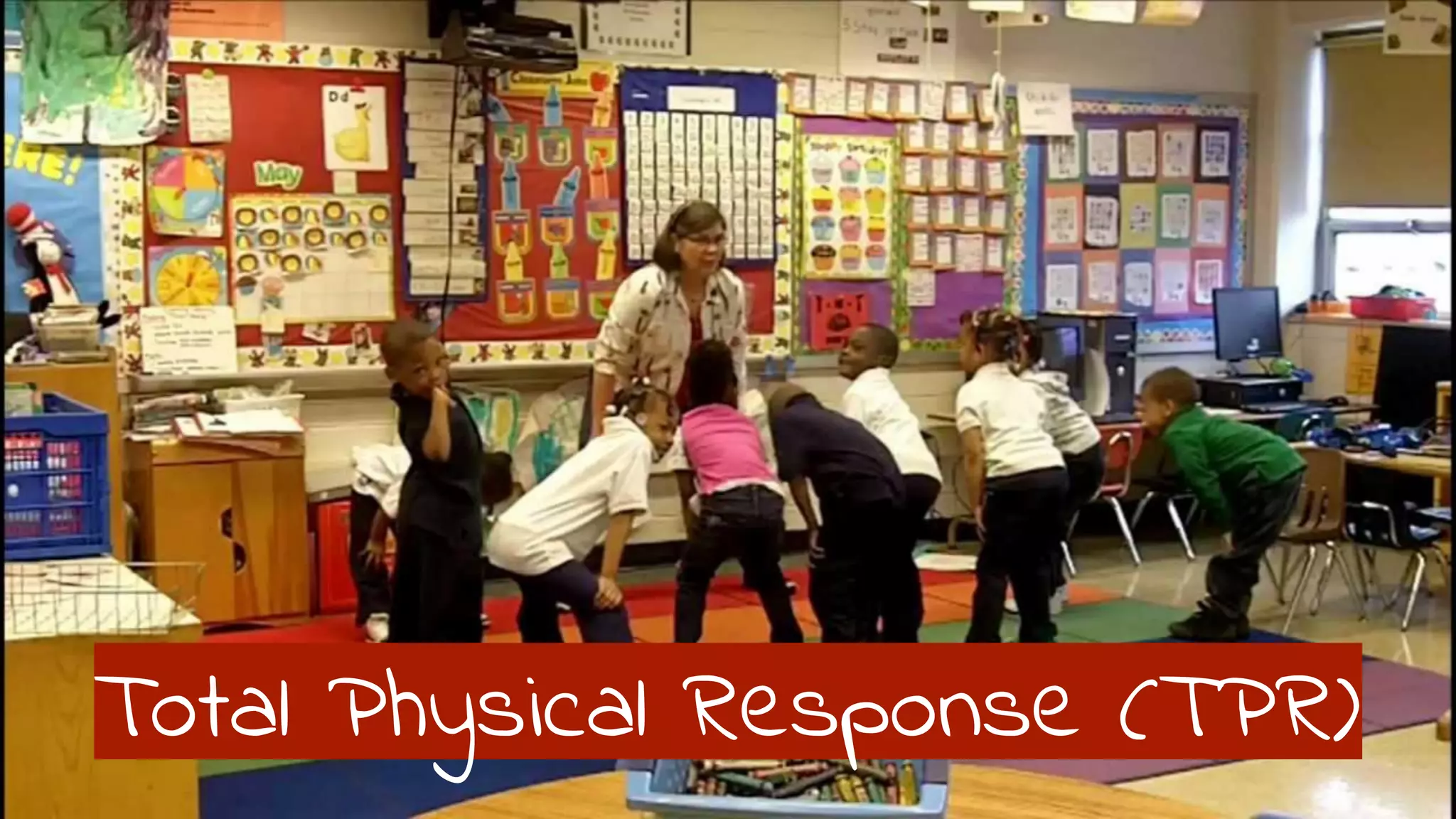
Total Physical Response (TPR)
What is TPR?
Total Physical Response is a method developed by James Asher in the 1960s. It was created with
the goal of helping students learn a second language. TPR helps students learn by associating
a physical action with new vocabulary.
Some benefits of TPR:
● It helps students remember new phrases or words
● It can be used in both large and small classes
● It doesn’t require much preparation (bye bye worksheets!)
● It gets students excited about learning and involved in the lesson
● It is effective for all age groups and abilities
Approach
Theory of language
- TPR classroom drill seem to be built
on assumptions that owe much to
structure or grammar-based views
of language.
- Language is composed by
abstractions and non-abstractions.
Cognitive model Lexical model
Theory of language
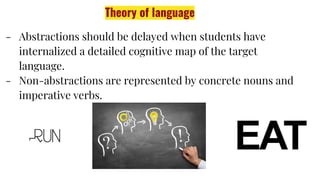
- Abstractions should be delayed when students have
internalized a detailed cognitive map of the target
language.
- Non-abstractions are represented by concrete nouns and
imperative verbs.
- Once that students have internalized the code, abstractions
can be introduced and explained in the target language.
(Language can be internalized as wholes or chunks)
Theory of language
Theory of learning
-It is seen as a behavioral view, based on the stimulus-response and
reinforcement model
There are three influential learning hypothesis:
It exists a specific innate bio-program for language learning
Brain lateralization defines different learning functions in the left- and right- brain hemispheres
The lower the stress, the greater the learning
Theory of learning
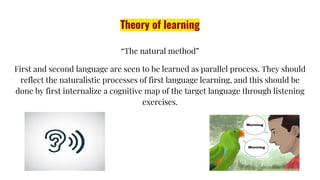
“The natural method”
First and second language are seen to be learned as parallel process. They should
reflect the naturalistic processes of first language learning, and this should be
done by first internalize a cognitive map of the target language through listening
exercises.
Theory of learning
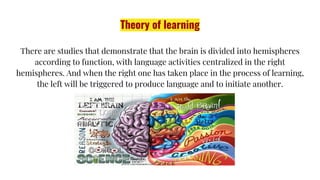
There are studies that demonstrate that the brain is divided into hemispheres
according to function, with language activities centralized in the right
hemispheres. And when the right one has taken place in the process of learning,
the left will be triggered to produce language and to initiate another.
Design
Objective
● Oral proficiency.
● Basic speaking skills.
● Learners capable of an uninhibited communication.
The Syllabus
● Use of a sentence-based syllabus.
● Grammar and lexical criteria primary in selecting teaching.
● Grammatical features and vocabulary items are selected
according to the situations in which they can be used in the
classroom.
● If is not learn rapidly then they are not ready for the item.
● Movements are a powerful mediator for understanding.
Types of learning and teaching
activities
● Imperative drills.
● Role plays and slide presentations.
● Reading and writing activities.
Learner Roles
● It is a listener and performer.
● They have influence over the content
● Expected to recognize and respond to novel
combinations of previously taught and to
produce by their own
Teacher roles
● Active and direct role.
● Provides opportunities for learning.
The Role of Instructional Materials
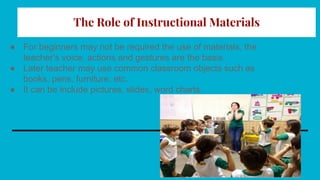
● For beginners may not be required the use of materials, the
teacher’s voice, actions and gestures are the basis.
● Later teacher may use common classroom objects such as
books, pens, furniture, etc.
● It can be include pictures, slides, word charts.
Procedure
Nature of the TPR
procedure
TPR procedure is totally based
in kinesthetic activities, this is
why, usually, TPR is more
suited to children and people
with a strong kinesthetic
preferences, Also; it is a good
method to grab Special
Students´attention; as ADHD Dx
students
REVIEW, NEW COMMANDS, ROLE
REVERSAL READING & WRITING.
STUDENTS BECOME ACTORS.
VERBAL RESPONSE IS NOT
NECESSARY.
TPR FOCUSES ON THE MEANING
& COMPREHENSION
THE MOST COMMON
TECHNIQUES ARE:
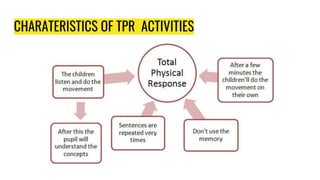
CHARATERISTICS OF TPR ACTIVITIES
AS EVERYTHING SEEN IN TPR
HAS TO BE ASSOCIATED WITH A
PHYSICAL ACTIVITIES,
FLASHCARDS ARE A GOOD
MATERIAL TO USE.
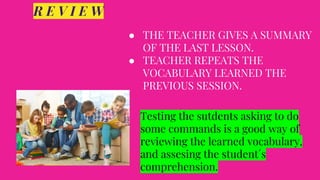
● THE TEACHER GIVES A SUMMARY
OF THE LAST LESSON.
● TEACHER REPEATS THE
VOCABULARY LEARNED THE
PREVIOUS SESSION.
R E V I E W
Testing the sutdents asking to do
some commands is a good way of
reviewing the learned vocabulary,
and assesing the student´s
comprehension.
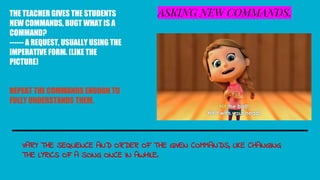
ASKING NEW COMMANDS.THE TEACHER GIVES THE STUDENTS
NEW COMMANDS, BUGT WHAT IS A
COMMAND?
------ A REQUEST, USUALLY USING THE
IMPERATIVE FORM. (LIKE THE
PICTURE)
REPEAT THE COMMANDS ENOUGH TO
FULLY UNDERSTANDS THEM.
VARY THE SEQUENCE AND ORDER OF THE GIVEN COMMANDS, LIKE CHANGING
THE LYRICS OF A SONG ONCE IN AWHILE.
ROLE REVERSAL
THE STUDENTS USE THE IMPERATIVE
TO EXPRESS COMMANDS AND SHOW
COMPREHENSION OF LANGUAGE
THIS TECHNIQUE IMPROVES THE ORAL
PRODUCTION.
USING THE WRITTEN
LANGUAGE
THE LEARNERS READ & WRITE IN THE TARGET
LANGUAGE, -- COULD BE DONE WHEN READING THE
LYRICS OF A SONG, AND SIMUSTANEOUSLY DOING
THE REQUESTED COMMANDS.
FEATURED ACTIVITIES OF TPR:
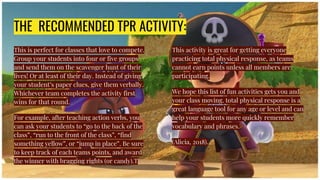
THE RECOMMENDED TPR ACTIVITY:
This is perfect for classes that love to compete.
Group your students into four or five groups
and send them on the scavenger hunt of their
lives! Or at least of their day. Instead of giving
your student’s paper clues, give them verbally.
Whichever team completes the activity first
wins for that round.
For example, after teaching action verbs, you
can ask your students to “go to the back of the
class”, “run to the front of the class”, “find
something yellow”, or “jump in place”. Be sure
to keep track of each teams points, and award
the winner with bragging rights (or candy).T
This activity is great for getting everyone
practicing total physical response, as teams
cannot earn points unless all members are
participating.
We hope this list of fun activities gets you and
your class moving. total physical response is a
great language tool for any age or level and can
help your students more quickly remember
vocabulary and phrases.
(Alicia, 2018).
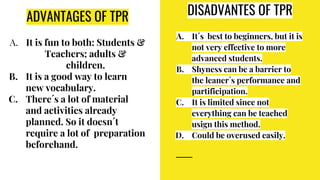
ADVANTAGES OF TPR
A. It is fun to both: Students &
Teachers; adults &
children.
B. It is a good way to learn
new vocabulary.
C. There´s a lot of material
and activities already
planned. So it doesn´t
require a lot of preparation
beforehand.
A. It´s best to beginners, but it is
not very effective to more
advanced students.
B. Shyness can be a barrier to
the leaner´s performance and
partificipation.
C. It is limited since not
everything can be teached
usign this method.
D. Could be overused easily.
DISADVANTES OF TPR
REFERENCES:
Brown, H. D. (2008). Principles of language learning and teaching. White Plains, NY: Pearson Longman.
Dumitru, C., García-Navarro . C., Martín-Cabañas E., Martín-Luengo R. M., (2016, October 12). Total
Physical Response[Slideshare slides]. Retrieved March 8, 2019, from
https://www.slideshare.net/CristinaDumitru9/431-total-physical-response-tpr-definitivo
Ignorantdavinci [pseudonym] (2009, Dicember 23). Total Physical Response [Slideshare slides]. Retrieved
March 8, 2019, from https://es.slideshare.net/ignorantdavinci/total-physical-response
Richards, J. C., & Rodgers, T. S. (2014). Approaches and methods in language teaching. New York, NY:
Cambridge University Press.
Alicia. (2018, February 21). 9 Total Physical Response Activities for Language Learning. Retrieved March 8,
2019, from https://bilingua.io/9-total-physical-response-activities-for-language-learning

Total Physical Response (TPR)

  • 1.
  • 2.
    What is TPR? TotalPhysical Response is a method developed by James Asher in the 1960s. It was created with the goal of helping students learn a second language. TPR helps students learn by associating a physical action with new vocabulary. Some benefits of TPR: ● It helps students remember new phrases or words ● It can be used in both large and small classes ● It doesn’t require much preparation (bye bye worksheets!) ● It gets students excited about learning and involved in the lesson ● It is effective for all age groups and abilities
  • 3.
  • 4.
    Theory of language -TPR classroom drill seem to be built on assumptions that owe much to structure or grammar-based views of language. - Language is composed by abstractions and non-abstractions. Cognitive model Lexical model
  • 5.
    Theory of language -Abstractions should be delayed when students have internalized a detailed cognitive map of the target language. - Non-abstractions are represented by concrete nouns and imperative verbs.
  • 6.
    - Once thatstudents have internalized the code, abstractions can be introduced and explained in the target language. (Language can be internalized as wholes or chunks) Theory of language
  • 7.
    Theory of learning -Itis seen as a behavioral view, based on the stimulus-response and reinforcement model There are three influential learning hypothesis: It exists a specific innate bio-program for language learning Brain lateralization defines different learning functions in the left- and right- brain hemispheres The lower the stress, the greater the learning
  • 8.
    Theory of learning “Thenatural method” First and second language are seen to be learned as parallel process. They should reflect the naturalistic processes of first language learning, and this should be done by first internalize a cognitive map of the target language through listening exercises.
  • 9.
    Theory of learning Thereare studies that demonstrate that the brain is divided into hemispheres according to function, with language activities centralized in the right hemispheres. And when the right one has taken place in the process of learning, the left will be triggered to produce language and to initiate another.
  • 10.
  • 11.
    Objective ● Oral proficiency. ●Basic speaking skills. ● Learners capable of an uninhibited communication.
  • 12.
    The Syllabus ● Useof a sentence-based syllabus. ● Grammar and lexical criteria primary in selecting teaching. ● Grammatical features and vocabulary items are selected according to the situations in which they can be used in the classroom. ● If is not learn rapidly then they are not ready for the item. ● Movements are a powerful mediator for understanding.
  • 13.
    Types of learningand teaching activities ● Imperative drills. ● Role plays and slide presentations. ● Reading and writing activities.
  • 14.
    Learner Roles ● Itis a listener and performer. ● They have influence over the content ● Expected to recognize and respond to novel combinations of previously taught and to produce by their own
  • 15.
    Teacher roles ● Activeand direct role. ● Provides opportunities for learning.
  • 16.
    The Role ofInstructional Materials ● For beginners may not be required the use of materials, the teacher’s voice, actions and gestures are the basis. ● Later teacher may use common classroom objects such as books, pens, furniture, etc. ● It can be include pictures, slides, word charts.
  • 17.
  • 18.
    Nature of theTPR procedure TPR procedure is totally based in kinesthetic activities, this is why, usually, TPR is more suited to children and people with a strong kinesthetic preferences, Also; it is a good method to grab Special Students´attention; as ADHD Dx students REVIEW, NEW COMMANDS, ROLE REVERSAL READING & WRITING. STUDENTS BECOME ACTORS. VERBAL RESPONSE IS NOT NECESSARY. TPR FOCUSES ON THE MEANING & COMPREHENSION THE MOST COMMON TECHNIQUES ARE:
  • 19.
  • 20.
    AS EVERYTHING SEENIN TPR HAS TO BE ASSOCIATED WITH A PHYSICAL ACTIVITIES, FLASHCARDS ARE A GOOD MATERIAL TO USE.
  • 21.
    ● THE TEACHERGIVES A SUMMARY OF THE LAST LESSON. ● TEACHER REPEATS THE VOCABULARY LEARNED THE PREVIOUS SESSION. R E V I E W Testing the sutdents asking to do some commands is a good way of reviewing the learned vocabulary, and assesing the student´s comprehension.
  • 22.
    ASKING NEW COMMANDS.THETEACHER GIVES THE STUDENTS NEW COMMANDS, BUGT WHAT IS A COMMAND? ------ A REQUEST, USUALLY USING THE IMPERATIVE FORM. (LIKE THE PICTURE) REPEAT THE COMMANDS ENOUGH TO FULLY UNDERSTANDS THEM. VARY THE SEQUENCE AND ORDER OF THE GIVEN COMMANDS, LIKE CHANGING THE LYRICS OF A SONG ONCE IN AWHILE.
  • 23.
    ROLE REVERSAL THE STUDENTSUSE THE IMPERATIVE TO EXPRESS COMMANDS AND SHOW COMPREHENSION OF LANGUAGE THIS TECHNIQUE IMPROVES THE ORAL PRODUCTION. USING THE WRITTEN LANGUAGE THE LEARNERS READ & WRITE IN THE TARGET LANGUAGE, -- COULD BE DONE WHEN READING THE LYRICS OF A SONG, AND SIMUSTANEOUSLY DOING THE REQUESTED COMMANDS.
  • 24.
  • 26.
    THE RECOMMENDED TPRACTIVITY: This is perfect for classes that love to compete. Group your students into four or five groups and send them on the scavenger hunt of their lives! Or at least of their day. Instead of giving your student’s paper clues, give them verbally. Whichever team completes the activity first wins for that round. For example, after teaching action verbs, you can ask your students to “go to the back of the class”, “run to the front of the class”, “find something yellow”, or “jump in place”. Be sure to keep track of each teams points, and award the winner with bragging rights (or candy).T This activity is great for getting everyone practicing total physical response, as teams cannot earn points unless all members are participating. We hope this list of fun activities gets you and your class moving. total physical response is a great language tool for any age or level and can help your students more quickly remember vocabulary and phrases. (Alicia, 2018).
  • 27.
    ADVANTAGES OF TPR A.It is fun to both: Students & Teachers; adults & children. B. It is a good way to learn new vocabulary. C. There´s a lot of material and activities already planned. So it doesn´t require a lot of preparation beforehand. A. It´s best to beginners, but it is not very effective to more advanced students. B. Shyness can be a barrier to the leaner´s performance and partificipation. C. It is limited since not everything can be teached usign this method. D. Could be overused easily. DISADVANTES OF TPR
  • 28.
    REFERENCES: Brown, H. D.(2008). Principles of language learning and teaching. White Plains, NY: Pearson Longman. Dumitru, C., García-Navarro . C., Martín-Cabañas E., Martín-Luengo R. M., (2016, October 12). Total Physical Response[Slideshare slides]. Retrieved March 8, 2019, from https://www.slideshare.net/CristinaDumitru9/431-total-physical-response-tpr-definitivo Ignorantdavinci [pseudonym] (2009, Dicember 23). Total Physical Response [Slideshare slides]. Retrieved March 8, 2019, from https://es.slideshare.net/ignorantdavinci/total-physical-response Richards, J. C., & Rodgers, T. S. (2014). Approaches and methods in language teaching. New York, NY: Cambridge University Press. Alicia. (2018, February 21). 9 Total Physical Response Activities for Language Learning. Retrieved March 8, 2019, from https://bilingua.io/9-total-physical-response-activities-for-language-learning