Language Learning Strategies M.Sajid us Salam M.Phil Linguistics The Islamia University Bahawalpur [email_address] TESOL Methodology
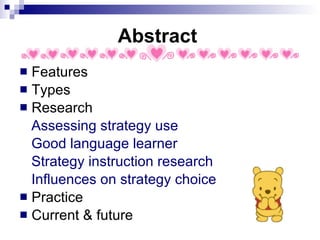
Abstract Features Types Research Assessing strategy use Good language learner Strategy instruction research Influences on strategy choice Practice Current & future
Features of LLS Goal-directed A strategy chain (consisting of  subgoals )   Autonomy (Controlling learning process) Self-efficacy
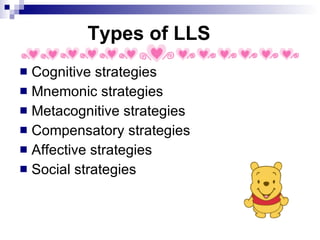
Types of LLS Cognitive strategies Mnemonic strategies Metacognitive strategies Compensatory strategies Affective strategies Social strategies
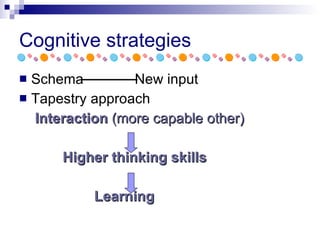
Cognitive strategies Schema  New input Tapestry approach Interaction  (more capable other) Higher thinking skills  Learning
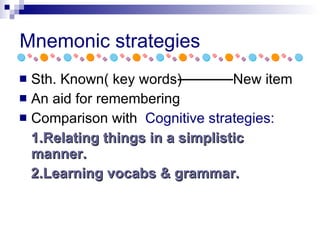
Sth. Known( key words)  New item  An aid for remembering Comparison with  Cognitive strategies: 1.Relating things in a simplistic manner. 2.Learning vocabs & grammar.  Mnemonic strategies
Metacognitive strategies Self-directed language learning. Planning  Monitoring  Evaluating Choosing strategies based on  learning styles . Encouraging students to be an  active participant .
Compensatory strategies Making up for missing knowledge. Controversy: 1.  Cohen: “ It’s for language use!” 2.  Little & Oxford: “ Incidental learning is helpful.”
Affective strategies Identifying learners’ feelings. Methods:  diary, emotional checklist…. Advantages:  reducing anxiety, praising  one’s performance….
Social strategies Facilitating learning with others. Communicative language learning. O’Malley & Chamot: “ Cognitive S & Metacognitive S  downplay the social strategy.”
Research Assessing strategy use The good language learner Strategy instruction research  Influences on strategy choice
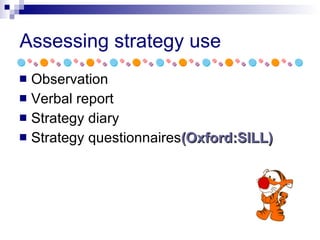
Assessing strategy use Observation Verbal report Strategy diary Strategy questionnaires (Oxford: SILL )
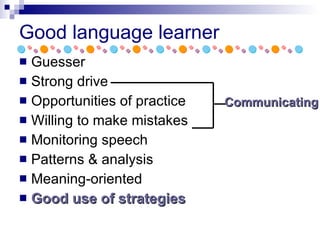
Good language learner Guesser Strong drive Opportunities of practice Willing to make mistakes Monitoring speech Patterns & analysis Meaning-oriented Good use of strategies Communicating
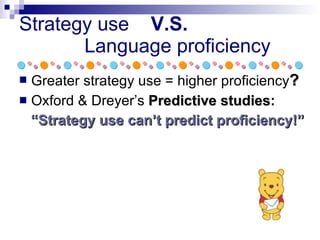
Strategy use  V.S.     Language proficiency Greater strategy use = higher proficiency ? Oxford & Dreyer’s  Predictive studies : “ Strategy use can’t predict proficiency!”
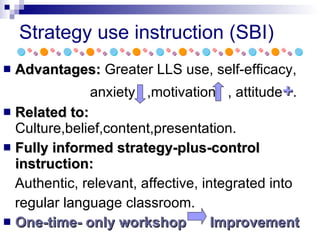
Strategy use instruction (SBI) Advantages:  Greater LLS use, self-efficacy, anxiety  ,motivation  , attitude + .  Related to:  Culture,belief,content,presentation. Fully informed strategy-plus-control instruction: Authentic, relevant, affective, integrated into  regular language classroom. One-time- only workshop  Improvement
Factors affect strategy choice Motivation Environment Learning style & personalities Gender Culture & nation Career orientation Age Language task
Practice & Conclusion Assessing strategy use Attuning instruction to learners’ needs Formats for instruction  Conducting instruction Evaluation of instruction Strategy use instruction
Discussion What language learning strategies you use when learning English? Please explain. Did your teacher coach strategy use in learning English? How? How do you as a teacher weave strategy instruction into English lessons?  What’s your opinion about strategy instruction in the EFL environment in Taiwan? Feasible or not? Why? What are the differences of teaching strategy bet. younger and older learners?

Language Learning Strategies 119955650040400 3

  • 1.
    Language Learning StrategiesM.Sajid us Salam M.Phil Linguistics The Islamia University Bahawalpur [email_address] TESOL Methodology
  • 2.
    Abstract Features TypesResearch Assessing strategy use Good language learner Strategy instruction research Influences on strategy choice Practice Current & future
  • 3.
    Features of LLSGoal-directed A strategy chain (consisting of subgoals ) Autonomy (Controlling learning process) Self-efficacy
  • 4.
    Types of LLSCognitive strategies Mnemonic strategies Metacognitive strategies Compensatory strategies Affective strategies Social strategies
  • 5.
    Cognitive strategies Schema New input Tapestry approach Interaction (more capable other) Higher thinking skills Learning
  • 6.
    Sth. Known( keywords) New item An aid for remembering Comparison with Cognitive strategies: 1.Relating things in a simplistic manner. 2.Learning vocabs & grammar. Mnemonic strategies
  • 7.
    Metacognitive strategies Self-directedlanguage learning. Planning Monitoring Evaluating Choosing strategies based on learning styles . Encouraging students to be an active participant .
  • 8.
    Compensatory strategies Makingup for missing knowledge. Controversy: 1. Cohen: “ It’s for language use!” 2. Little & Oxford: “ Incidental learning is helpful.”
  • 9.
    Affective strategies Identifyinglearners’ feelings. Methods: diary, emotional checklist…. Advantages: reducing anxiety, praising one’s performance….
  • 10.
    Social strategies Facilitatinglearning with others. Communicative language learning. O’Malley & Chamot: “ Cognitive S & Metacognitive S downplay the social strategy.”
  • 11.
    Research Assessing strategyuse The good language learner Strategy instruction research Influences on strategy choice
  • 12.
    Assessing strategy useObservation Verbal report Strategy diary Strategy questionnaires (Oxford: SILL )
  • 13.
    Good language learnerGuesser Strong drive Opportunities of practice Willing to make mistakes Monitoring speech Patterns & analysis Meaning-oriented Good use of strategies Communicating
  • 14.
    Strategy use V.S. Language proficiency Greater strategy use = higher proficiency ? Oxford & Dreyer’s Predictive studies : “ Strategy use can’t predict proficiency!”
  • 15.
    Strategy use instruction(SBI) Advantages: Greater LLS use, self-efficacy, anxiety ,motivation , attitude + . Related to: Culture,belief,content,presentation. Fully informed strategy-plus-control instruction: Authentic, relevant, affective, integrated into regular language classroom. One-time- only workshop Improvement
  • 16.
    Factors affect strategychoice Motivation Environment Learning style & personalities Gender Culture & nation Career orientation Age Language task
  • 17.
    Practice & ConclusionAssessing strategy use Attuning instruction to learners’ needs Formats for instruction Conducting instruction Evaluation of instruction Strategy use instruction
  • 18.
    Discussion What languagelearning strategies you use when learning English? Please explain. Did your teacher coach strategy use in learning English? How? How do you as a teacher weave strategy instruction into English lessons? What’s your opinion about strategy instruction in the EFL environment in Taiwan? Feasible or not? Why? What are the differences of teaching strategy bet. younger and older learners?