





FACTORS AFFECTING 
LANGUAGE LEARNING 
STRATEGIES 
Nur Fatihah binti Abdul Rahman 
A151131 
B. Ed TESL 
Universiti Kebangsaan Malaysia.
1) HIGH LEVEL PROFICIENCY 
 Associated with an increased use of both direct and indirect strategies 
(Chang, 1990; Green and Oxford, 1995; Park, 1997; Chen, 2002) 
 O’Malley et al. (1985b) studied the range, type and frequency of LLSs used 
by beginning and intermediate high school L2 learners. 
 Their results revealed that: 
1. Both groups used more cognitive than metacognitive strategies. 
2. Intermediate students used more metacognitive strategies than the beginners. 
3. Translation strategy was used more by beginners. 
4. Contextualization was used more by the intermediate level students. 
 Chen (1990), too, in a study on the relationship between communication 
strategies and the proficiency level of L2 learners found that; low-proficiency 
students employed more communication strategies than high-proficiency 
ones.
 Park (1997) examined the relationship between the use of LLSs and the 
proficiency level of 332 Korean students learning English as a foreign language. 
 The results of his study showed a linear correlation between LLS use and 
language proficiency. 
 Overall, the results indicated that: 
1. High-proficiency learners mainly employed linguistic-based communication 
strategies (such as using synonyms) more frequently than low-proficiency. 
 The results of the Test of English as a Foreign Language (TOEFL) showed: 
1. Significant correlations between strategy use and proficiency level. 
2. Cognitive and metacognitive strategies showed very high correlations with the 
proficiency level of the participants and were used by high-proficiency learners. 
3. Compensation strategies, however, were shown to be favoured by both high 
and low-proficiency students, with low-proficiency students out performing the 
high-proficiency ones in their use of such strategies (Chen, 2002).
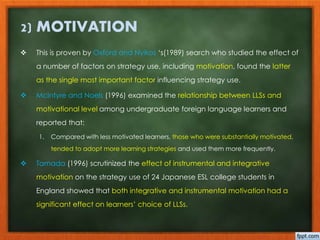
2) MOTIVATION 
 This is proven by Oxford and Nyikos ‘s(1989) search who studied the effect of 
a number of factors on strategy use, including motivation, found the latter 
as the single most important factor influencing strategy use. 
 McIntyre and Noels (1996) examined the relationship between LLSs and 
motivational level among undergraduate foreign language learners and 
reported that: 
1. Compared with less motivated learners, those who were substantially motivated, 
tended to adopt more learning strategies and used them more frequently. 
 Tamada (1996) scrutinized the effect of instrumental and integrative 
motivation on the strategy use of 24 Japanese ESL college students in 
England showed that both integrative and instrumental motivation had a 
significant effect on learners’ choice of LLSs.
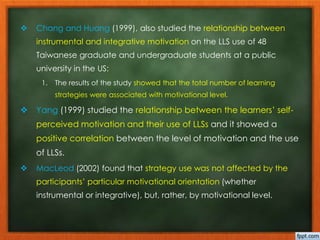
 Chang and Huang (1999), also studied the relationship between 
instrumental and integrative motivation on the LLS use of 48 
Taiwanese graduate and undergraduate students at a public 
university in the US: 
1. The results of the study showed that the total number of learning 
strategies were associated with motivational level. 
 Yang (1999) studied the relationship between the learners’ self-perceived 
motivation and their use of LLSs and it showed a 
positive correlation between the level of motivation and the use 
of LLSs. 
 MacLeod (2002) found that strategy use was not affected by the 
participants’ particular motivational orientation (whether 
instrumental or integrative), but, rather, by motivational level.
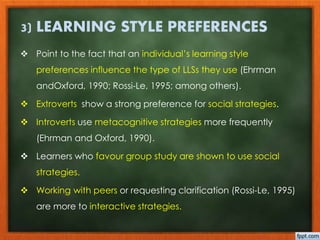
3) LEARNING STYLE PREFERENCES 
 Point to the fact that an individual’s learning style 
preferences influence the type of LLSs they use (Ehrman 
andOxford, 1990; Rossi-Le, 1995; among others). 
 Extroverts show a strong preference for social strategies. 
 Introverts use metacognitive strategies more frequently 
(Ehrman and Oxford, 1990). 
 Learners who favour group study are shown to use social 
strategies. 
 Working with peers or requesting clarification (Rossi-Le, 1995) 
are more to interactive strategies.
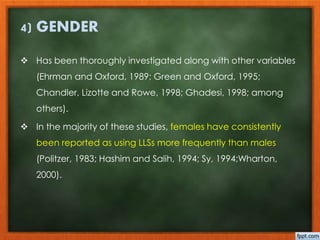
4) GENDER 
 Has been thoroughly investigated along with other variables 
(Ehrman and Oxford, 1989; Green and Oxford, 1995; 
Chandler, Lizotte and Rowe, 1998; Ghadesi, 1998; among 
others). 
 In the majority of these studies, females have consistently 
been reported as using LLSs more frequently than males 
(Politzer, 1983; Hashim and Salih, 1994; Sy, 1994;Wharton, 
2000).
5) YEARS OF LANGUAGE LEARNING 
 Ramirez (1986) showed that the years of language learning 
affected the use of nine (out of 50) strategies indicated in the 
inventory. 
 Ok (2003) investigated the effect of school years on LLS use but 
found no evidence that learners’ LLS use in all six categories 
increased during a certain school year. 
 Third-year students had higher mean scores than first-year students 
in two strategy groups, namely, compensation and memory. 
 In contrast, the mean scores of first-year students were higher in the 
other four strategy groups, i.e., metacognitive, cognitive, affective 
and social strategies.
THE END. 
THANK YOU

5 Factors Affecting Language Learning Strategies (LLS)

  • 1.
    FACTORS AFFECTING LANGUAGELEARNING STRATEGIES Nur Fatihah binti Abdul Rahman A151131 B. Ed TESL Universiti Kebangsaan Malaysia.
  • 2.
    1) HIGH LEVELPROFICIENCY  Associated with an increased use of both direct and indirect strategies (Chang, 1990; Green and Oxford, 1995; Park, 1997; Chen, 2002)  O’Malley et al. (1985b) studied the range, type and frequency of LLSs used by beginning and intermediate high school L2 learners.  Their results revealed that: 1. Both groups used more cognitive than metacognitive strategies. 2. Intermediate students used more metacognitive strategies than the beginners. 3. Translation strategy was used more by beginners. 4. Contextualization was used more by the intermediate level students.  Chen (1990), too, in a study on the relationship between communication strategies and the proficiency level of L2 learners found that; low-proficiency students employed more communication strategies than high-proficiency ones.
  • 3.
     Park (1997)examined the relationship between the use of LLSs and the proficiency level of 332 Korean students learning English as a foreign language.  The results of his study showed a linear correlation between LLS use and language proficiency.  Overall, the results indicated that: 1. High-proficiency learners mainly employed linguistic-based communication strategies (such as using synonyms) more frequently than low-proficiency.  The results of the Test of English as a Foreign Language (TOEFL) showed: 1. Significant correlations between strategy use and proficiency level. 2. Cognitive and metacognitive strategies showed very high correlations with the proficiency level of the participants and were used by high-proficiency learners. 3. Compensation strategies, however, were shown to be favoured by both high and low-proficiency students, with low-proficiency students out performing the high-proficiency ones in their use of such strategies (Chen, 2002).
  • 4.
    2) MOTIVATION This is proven by Oxford and Nyikos ‘s(1989) search who studied the effect of a number of factors on strategy use, including motivation, found the latter as the single most important factor influencing strategy use.  McIntyre and Noels (1996) examined the relationship between LLSs and motivational level among undergraduate foreign language learners and reported that: 1. Compared with less motivated learners, those who were substantially motivated, tended to adopt more learning strategies and used them more frequently.  Tamada (1996) scrutinized the effect of instrumental and integrative motivation on the strategy use of 24 Japanese ESL college students in England showed that both integrative and instrumental motivation had a significant effect on learners’ choice of LLSs.
  • 5.
     Chang andHuang (1999), also studied the relationship between instrumental and integrative motivation on the LLS use of 48 Taiwanese graduate and undergraduate students at a public university in the US: 1. The results of the study showed that the total number of learning strategies were associated with motivational level.  Yang (1999) studied the relationship between the learners’ self-perceived motivation and their use of LLSs and it showed a positive correlation between the level of motivation and the use of LLSs.  MacLeod (2002) found that strategy use was not affected by the participants’ particular motivational orientation (whether instrumental or integrative), but, rather, by motivational level.
  • 6.
    3) LEARNING STYLEPREFERENCES  Point to the fact that an individual’s learning style preferences influence the type of LLSs they use (Ehrman andOxford, 1990; Rossi-Le, 1995; among others).  Extroverts show a strong preference for social strategies.  Introverts use metacognitive strategies more frequently (Ehrman and Oxford, 1990).  Learners who favour group study are shown to use social strategies.  Working with peers or requesting clarification (Rossi-Le, 1995) are more to interactive strategies.
  • 7.
    4) GENDER Has been thoroughly investigated along with other variables (Ehrman and Oxford, 1989; Green and Oxford, 1995; Chandler, Lizotte and Rowe, 1998; Ghadesi, 1998; among others).  In the majority of these studies, females have consistently been reported as using LLSs more frequently than males (Politzer, 1983; Hashim and Salih, 1994; Sy, 1994;Wharton, 2000).
  • 8.
    5) YEARS OFLANGUAGE LEARNING  Ramirez (1986) showed that the years of language learning affected the use of nine (out of 50) strategies indicated in the inventory.  Ok (2003) investigated the effect of school years on LLS use but found no evidence that learners’ LLS use in all six categories increased during a certain school year.  Third-year students had higher mean scores than first-year students in two strategy groups, namely, compensation and memory.  In contrast, the mean scores of first-year students were higher in the other four strategy groups, i.e., metacognitive, cognitive, affective and social strategies.
  • 9.