Schooling in America
Group Colorful Joy: Monica Clifford, Katelyn
Greb,Paige Bursler, Kasey Helms, and Tashiana Joyner
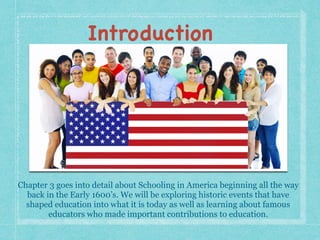
Chapter 3 goes into detail about Schooling in America beginning all the way
back in the Early 1600’s. We will be exploring historic events that have
shaped education into what it is today as well as learning about famous
educators who made important contributions to education.
Introduction
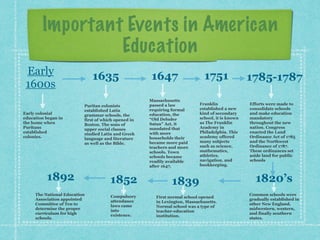
Important Events in American
Education
Early
1600s
Early colonial
education began in
the home when
Puritans
established
colonies.
1635 1647
Puritan colonists
established Latin
grammar schools, the
first of which opened in
Boston. The sons of
upper social classes
studied Latin and Greek
language and literature
as well as the Bible.
1751 1785-1787
1820’s183918521892
Massachusetts
passed a law
requiring formal
education, the
“Old Deluder
Satan” Act, it
mandated that
with more
households their
became more paid
teachers and more
schools. Town
schools became
readily available
after 1647.
Franklin
established a new
kind of secondary
school, it is known
as The Franklin
Academy in
Philadelphia. This
academy offered
many subjects
such as science,
mathematics,
athletics,
navigation, and
bookkeeping.
Efforts were made to
consolidate schools
and make education
mandatory
throughout the new
nation. Congress
enacted the Land
Ordinance Act of 1785
and the Northwest
Ordinance of 1787.
These ordinances set
aside land for public
schools
Common schools were
gradually established in
other New England,
midwestern, western,
and finally southern
states.
First normal school opened
in Lexington, Massachusetts.
Normal school was a type of
teacher-education
institution.
Compulsory
attendance
laws came
into
existence.
The National Education
Association appointed
Committee of Ten to
determine the proper
curriculum for high
schools.
1900s-2001
1909
1954
1950
1965
1972
1975 1983
2001
First junior high
school opens in
Columbus, Ohio.
Brown vs Board of
Education of Topeka,
Kansas. The U.S.
Supreme Court
outlawed segregation in
public education
Development
of middle
schools.
Elementary
and
Secondary
Education
Act.
Title IX, part of the Education Amendments of 1972, a law
that prohibits discrimination on the basis of sex in any
federally funded education program or activity.
Education for All
Handicapped Children
Act, later changed to the
Individuals with
Disabilities Education
Act.
A Nation at Risk was a report
made in the form of an open
letter to the American people
about the deep concern about
the educational system in
America
No Child
Left
Behind
Act.
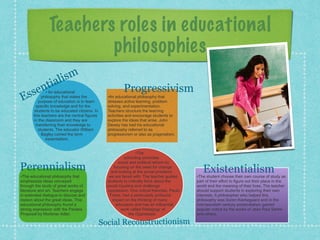
•The educational philosophy that
emphasizes ideas conveyed
through the study of great works of
literature and art. Teachers engage
in extended dialogue to discuss and
reason about the great ideas. This
educational philosophy found a
strong expression with the Paideia
Proposal by Mortimer Adler.
Teachers roles in educational
philosophies
• An educational
philosophy that states the
purpose of education is to learn
specific knowledge and for the
students to be educated citizens. In
this teachers are the central figures
in the classroom and they are
transferring their knowledge to
students. The educator William
Bagley coined the term
essentialism.
Essentialism
•An educational philosophy that
stresses active learning, problem
solving, and experimentation.
Teachers structure the learning
activities and encourage students to
explore the ideas that arise. John
Dewey has had his educational
philosophy referred to as
progressivism or also as pragmatism.
Progressivism
Perennialism
•The
schooling promotes
social and political reform by
focusing on the need for change
and looking at the social problems
we are faced with. The teacher guides
students to critically think about the
social injustice and challenge
oppression. One critical theorists, Paulo
Freire, had a particularly profound
impact on the thinking of many
educators and has an influential
work called Pedagogy of
the Oppressed.
Social Reconstructionism
•The student choose their own course of study as
part of their effort to figure out their place in the
world and the meaning of their lives. The teacher
should support students in exploring their own
interests. A philosopher who helped this
philosophy was Soren Kierkegaard and in the
mid-twentieth century existentialism gained
popular notice by the works of Jean Paul Sartre
and others.
Existentialism
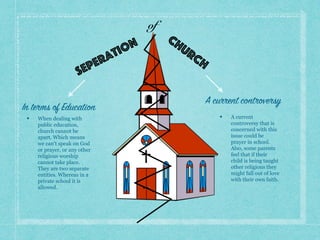
Seperation
of
Church
• When dealing with
public education,
church cannot be
apart. Which means
we can’t speak on God
or prayer, or any other
religious worship
cannot take place.
They are two separate
entities. Whereas in a
private school it is
allowed.
In terms of Education
A current controversy
• A current
controversy that is
concerned with this
issue could be
prayer in school.
Also, some parents
feel that if their
child is being taught
other religions they
might fall out of love
with their own faith.
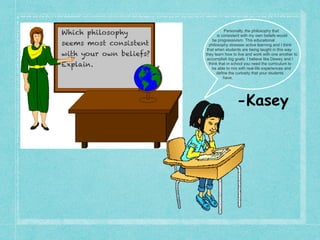
Personally, the philosophy that
is consistent with my own beliefs would
be progressivism. This educational
philosophy stresses active learning and I think
that when students are being taught in this way
they learn how to live and work with one another to
accomplish big goals. I believe like Dewey and I
think that in school you need the curriculum to
be able to mix with real-life experiences and
define the curiosity that your students
have.
Which philosophy
seems most consistent
with your own beliefs?
Explain.
-Kasey
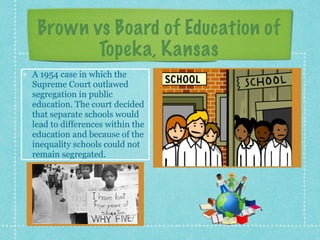
Brown vs Board of Education of
Topeka, Kansas
A 1954 case in which the
Supreme Court outlawed
segregation in public
education. The court decided
that separate schools would
lead to differences within the
education and because of the
inequality schools could not
remain segregated.
Common Schools
• A Common School is
defined by our
textbook as a public
elementary school
that is supported by
taxes.
• Manns’ motivation for
supporting the common
school movement was due to
the new democracy which
required a n educated
citizenry for its survival.
(Koch, 63)
In what ways do you
think schools serve
as an arena for
social control?
I think schools serve as an arena
for social control because the
more wealthy will get a better
education than the less wealthy,
this even was shown in the
Colonial Period that we just read
about.
-Katelyn
Bilingual Education Acts of
1968 and 1974
This act provided supplemental funding for school districts
to establish programs for large numbers of children with
limited English-language ability.
The 1647 Old Deluder Satan Act
The purpose of the act was
to require formal education.
It stated that every town
depending of the amount of
houses, had to pay the
teacher or provide a
grammar school to help
prepare the youths for
university.
The law became successful
and begin spreading to
other colonies. The Latin
grammar school is now
considered one of the
indications of the American
high school
What is this Act?
What was the
impact on
public
education?
Elementary and Secondary
education Act of 1965
This ensured that federal
assistance would be sent to the
poorest schools and communities
in the nation. Its immediate
impact was to provide one billion
dollars to improve the education
of students from families living
in poverty.
Social capital is the connections among
individuals that give them access to
cultural and civic events and institutions.
Parents with social capital make sure
their children have the best education. It
generally comes with wealth, privilege,
and their social status.
Social Capital
Education
&
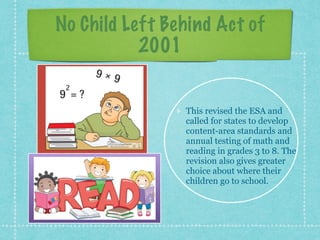
No Child Left Behind Act of
2001
This revised the ESA and
called for states to develop
content-area standards and
annual testing of math and
reading in grades 3 to 8. The
revision also gives greater
choice about where their
children go to school.
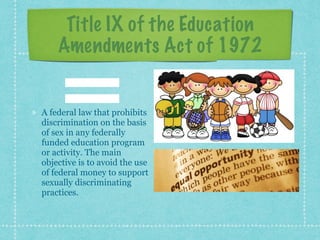
Title IX of the Education
Amendments Act of 1972
A federal law that prohibits
discrimination on the basis
of sex in any federally
funded education program
or activity. The main
objective is to avoid the use
of federal money to support
sexually discriminating
practices.
Individuals with Disabilities
Education Act
The federal law that guarantees that all children
with disabilities receive free, appropriate public
education, just like all the other children.
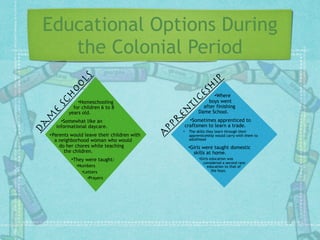
Educational Options During
the Colonial Period
•Homeschooling
for children 6 to 8
years old.
•Somewhat like an
informational daycare.
•Parents would leave their children with
a neighborhood woman who would
do her chores while teaching
the children.
•They were taught:
•Numbers
•Letters
•Prayers
Da
m
e
Schools
•Where
boys went
after finishing
Dame School.
•Sometimes apprenticed to
craftsmen to learn a trade.
• The skills they learn through their
apprenticeship would carry with them to
adulthood
•Girls were taught domestic
skills at home.
•Girls education was
considered a second rate
education to that of
the boys.
Appren
ticeship
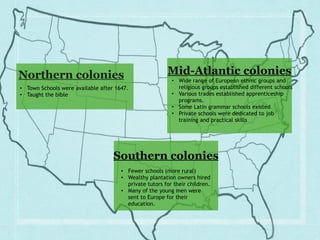
Northern colonies Mid-Atlantic colonies
• Town Schools were available after 1647.
• Taught the bible
• Wide range of European ethnic groups and
religious groups established different schools
• Various trades established apprenticeship
programs.
• Some Latin grammar schools existed
• Private schools were dedicated to job
training and practical skills
Southern colonies
• Fewer schools (more rural)
• Wealthy plantation owners hired
private tutors for their children.
• Many of the young men were
sent to Europe for their
education.
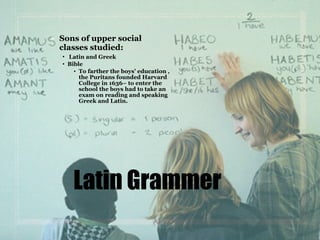
Sons of upper social
classes studied:
• Latin and Greek
• Bible
• To farther the boys’ education ,
the Puritans founded Harvard
College in 1636– to enter the
school the boys had to take an
exam on reading and speaking
Greek and Latin.
Latin Grammer
Schools for formal education
• This came about in 1647 when Massachusetts passed a law requiring formal education.
• Old Deluder Satan Act
• Every town of 50 households must appoint and pay a teacher of reading and writing.
• Every own of 100 households must provide a grammar school to prepare youths for a
University.
New
Town
Schools
Junior high school
vs
Middle school
• The difference between junior high schools and middle
schools is junior high concentrated “on the emotional and
intellectual needs of students in grades 7, 8, and 9” (Koch,
66) and middle school’s concentrated “on interdisciplinary
learning and team teaching” (Koch, 67) for grades 5-8.
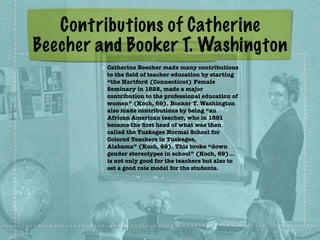
Contributions of Catherine
Beecher and Booker T. Washington
Catherine Beecher made many contributions
to the field of teacher education by starting
“the Hartford (Connecticut) Female
Seminary in 1828, made a major
contribution to the professional education of
women” (Koch, 69). Booker T. Washington
also made contributions by being “an
African American teacher, who in 1881
became the first head of what was then
called the Tuskegee Normal School for
Colored Teachers in Tuskegee,
Alabama” (Koch, 69). This broke “down
gender stereotypes in school” (Koch, 69)…
is not only good for the teachers but also to
set a good role model for the students.
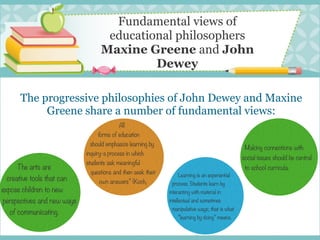
Fundamental views of
educational philosophers
Maxine Greene and John
Dewey
The progressive philosophies of John Dewey and Maxine
Greene share a number of fundamental views:
The arts are
creative tools that can
expose children to new
perspectives and new ways
of communicating.
Learning is an experiential
process. Students learn by
interacting with material in
intellectual and sometimes
manipulative ways; that is what
“learning by doing” means.
All
forms of education
should emphasize learning by
inquiry-a process in which
students ask meaningful
questions and then seek their
own answers” (Koch,
Making connections with
social issues should be central
to school curricula.
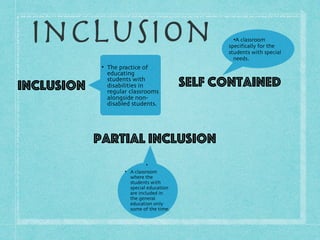
Inclusion
•Partial Inclusion
• The practice of
educating
students with
disabilities in
regular classrooms
alongside non-
disabled students.
• A classroom
where the
students with
special education
are included in
the general
education only
some of the time.
Self Contained
•A classroom
specifically for the
students with special
needs.
Inclusion
After learning about education in the
Colonies, historic events, historic
educational people, we now have an
overview of Schooling in America and
what made Education the way it is
today. All of the past events to this day
influence Education and will continue
to.
Conclusion
Sources
http://www.clipartpanda.com/categories/black-church-clip-art
http://ol.tfsd.org
http://www.nytimes.com/2014/08/24/books/review/the-
teacher-wars-by-dana-goldstein.html?_r=0
http://www.freepptbackgrounds.net/education
Koch, Janice. "Chapter 3." So You Want to Be a Teacher?:
Teaching and Learning in the 21st Century. Boston: Houghton
Mifflin, 2009. N. pag. Print
www.clipartbest.com

Chapter 3 powerpoint

  • 1.
    Schooling in America GroupColorful Joy: Monica Clifford, Katelyn Greb,Paige Bursler, Kasey Helms, and Tashiana Joyner
  • 2.
    Chapter 3 goesinto detail about Schooling in America beginning all the way back in the Early 1600’s. We will be exploring historic events that have shaped education into what it is today as well as learning about famous educators who made important contributions to education. Introduction
  • 3.
    Important Events inAmerican Education Early 1600s Early colonial education began in the home when Puritans established colonies. 1635 1647 Puritan colonists established Latin grammar schools, the first of which opened in Boston. The sons of upper social classes studied Latin and Greek language and literature as well as the Bible. 1751 1785-1787 1820’s183918521892 Massachusetts passed a law requiring formal education, the “Old Deluder Satan” Act, it mandated that with more households their became more paid teachers and more schools. Town schools became readily available after 1647. Franklin established a new kind of secondary school, it is known as The Franklin Academy in Philadelphia. This academy offered many subjects such as science, mathematics, athletics, navigation, and bookkeeping. Efforts were made to consolidate schools and make education mandatory throughout the new nation. Congress enacted the Land Ordinance Act of 1785 and the Northwest Ordinance of 1787. These ordinances set aside land for public schools Common schools were gradually established in other New England, midwestern, western, and finally southern states. First normal school opened in Lexington, Massachusetts. Normal school was a type of teacher-education institution. Compulsory attendance laws came into existence. The National Education Association appointed Committee of Ten to determine the proper curriculum for high schools.
  • 4.
    1900s-2001 1909 1954 1950 1965 1972 1975 1983 2001 First juniorhigh school opens in Columbus, Ohio. Brown vs Board of Education of Topeka, Kansas. The U.S. Supreme Court outlawed segregation in public education Development of middle schools. Elementary and Secondary Education Act. Title IX, part of the Education Amendments of 1972, a law that prohibits discrimination on the basis of sex in any federally funded education program or activity. Education for All Handicapped Children Act, later changed to the Individuals with Disabilities Education Act. A Nation at Risk was a report made in the form of an open letter to the American people about the deep concern about the educational system in America No Child Left Behind Act.
  • 5.
    •The educational philosophythat emphasizes ideas conveyed through the study of great works of literature and art. Teachers engage in extended dialogue to discuss and reason about the great ideas. This educational philosophy found a strong expression with the Paideia Proposal by Mortimer Adler. Teachers roles in educational philosophies • An educational philosophy that states the purpose of education is to learn specific knowledge and for the students to be educated citizens. In this teachers are the central figures in the classroom and they are transferring their knowledge to students. The educator William Bagley coined the term essentialism. Essentialism •An educational philosophy that stresses active learning, problem solving, and experimentation. Teachers structure the learning activities and encourage students to explore the ideas that arise. John Dewey has had his educational philosophy referred to as progressivism or also as pragmatism. Progressivism Perennialism •The schooling promotes social and political reform by focusing on the need for change and looking at the social problems we are faced with. The teacher guides students to critically think about the social injustice and challenge oppression. One critical theorists, Paulo Freire, had a particularly profound impact on the thinking of many educators and has an influential work called Pedagogy of the Oppressed. Social Reconstructionism •The student choose their own course of study as part of their effort to figure out their place in the world and the meaning of their lives. The teacher should support students in exploring their own interests. A philosopher who helped this philosophy was Soren Kierkegaard and in the mid-twentieth century existentialism gained popular notice by the works of Jean Paul Sartre and others. Existentialism
  • 6.
    Seperation of Church • When dealingwith public education, church cannot be apart. Which means we can’t speak on God or prayer, or any other religious worship cannot take place. They are two separate entities. Whereas in a private school it is allowed. In terms of Education A current controversy • A current controversy that is concerned with this issue could be prayer in school. Also, some parents feel that if their child is being taught other religions they might fall out of love with their own faith.
  • 7.
    Personally, the philosophythat is consistent with my own beliefs would be progressivism. This educational philosophy stresses active learning and I think that when students are being taught in this way they learn how to live and work with one another to accomplish big goals. I believe like Dewey and I think that in school you need the curriculum to be able to mix with real-life experiences and define the curiosity that your students have. Which philosophy seems most consistent with your own beliefs? Explain. -Kasey
  • 8.
    Brown vs Boardof Education of Topeka, Kansas A 1954 case in which the Supreme Court outlawed segregation in public education. The court decided that separate schools would lead to differences within the education and because of the inequality schools could not remain segregated.
  • 9.
    Common Schools • ACommon School is defined by our textbook as a public elementary school that is supported by taxes. • Manns’ motivation for supporting the common school movement was due to the new democracy which required a n educated citizenry for its survival. (Koch, 63) In what ways do you think schools serve as an arena for social control? I think schools serve as an arena for social control because the more wealthy will get a better education than the less wealthy, this even was shown in the Colonial Period that we just read about. -Katelyn
  • 10.
    Bilingual Education Actsof 1968 and 1974 This act provided supplemental funding for school districts to establish programs for large numbers of children with limited English-language ability.
  • 11.
    The 1647 OldDeluder Satan Act The purpose of the act was to require formal education. It stated that every town depending of the amount of houses, had to pay the teacher or provide a grammar school to help prepare the youths for university. The law became successful and begin spreading to other colonies. The Latin grammar school is now considered one of the indications of the American high school What is this Act? What was the impact on public education?
  • 12.
    Elementary and Secondary educationAct of 1965 This ensured that federal assistance would be sent to the poorest schools and communities in the nation. Its immediate impact was to provide one billion dollars to improve the education of students from families living in poverty.
  • 13.
    Social capital isthe connections among individuals that give them access to cultural and civic events and institutions. Parents with social capital make sure their children have the best education. It generally comes with wealth, privilege, and their social status. Social Capital Education &
  • 14.
    No Child LeftBehind Act of 2001 This revised the ESA and called for states to develop content-area standards and annual testing of math and reading in grades 3 to 8. The revision also gives greater choice about where their children go to school.
  • 15.
    Title IX ofthe Education Amendments Act of 1972 A federal law that prohibits discrimination on the basis of sex in any federally funded education program or activity. The main objective is to avoid the use of federal money to support sexually discriminating practices.
  • 16.
    Individuals with Disabilities EducationAct The federal law that guarantees that all children with disabilities receive free, appropriate public education, just like all the other children.
  • 17.
    Educational Options During theColonial Period •Homeschooling for children 6 to 8 years old. •Somewhat like an informational daycare. •Parents would leave their children with a neighborhood woman who would do her chores while teaching the children. •They were taught: •Numbers •Letters •Prayers Da m e Schools •Where boys went after finishing Dame School. •Sometimes apprenticed to craftsmen to learn a trade. • The skills they learn through their apprenticeship would carry with them to adulthood •Girls were taught domestic skills at home. •Girls education was considered a second rate education to that of the boys. Appren ticeship
  • 18.
    Northern colonies Mid-Atlanticcolonies • Town Schools were available after 1647. • Taught the bible • Wide range of European ethnic groups and religious groups established different schools • Various trades established apprenticeship programs. • Some Latin grammar schools existed • Private schools were dedicated to job training and practical skills Southern colonies • Fewer schools (more rural) • Wealthy plantation owners hired private tutors for their children. • Many of the young men were sent to Europe for their education.
  • 19.
    Sons of uppersocial classes studied: • Latin and Greek • Bible • To farther the boys’ education , the Puritans founded Harvard College in 1636– to enter the school the boys had to take an exam on reading and speaking Greek and Latin. Latin Grammer
  • 20.
    Schools for formaleducation • This came about in 1647 when Massachusetts passed a law requiring formal education. • Old Deluder Satan Act • Every town of 50 households must appoint and pay a teacher of reading and writing. • Every own of 100 households must provide a grammar school to prepare youths for a University. New Town Schools
  • 21.
    Junior high school vs Middleschool • The difference between junior high schools and middle schools is junior high concentrated “on the emotional and intellectual needs of students in grades 7, 8, and 9” (Koch, 66) and middle school’s concentrated “on interdisciplinary learning and team teaching” (Koch, 67) for grades 5-8.
  • 22.
    Contributions of Catherine Beecherand Booker T. Washington Catherine Beecher made many contributions to the field of teacher education by starting “the Hartford (Connecticut) Female Seminary in 1828, made a major contribution to the professional education of women” (Koch, 69). Booker T. Washington also made contributions by being “an African American teacher, who in 1881 became the first head of what was then called the Tuskegee Normal School for Colored Teachers in Tuskegee, Alabama” (Koch, 69). This broke “down gender stereotypes in school” (Koch, 69)… is not only good for the teachers but also to set a good role model for the students.
  • 23.
    Fundamental views of educationalphilosophers Maxine Greene and John Dewey The progressive philosophies of John Dewey and Maxine Greene share a number of fundamental views: The arts are creative tools that can expose children to new perspectives and new ways of communicating. Learning is an experiential process. Students learn by interacting with material in intellectual and sometimes manipulative ways; that is what “learning by doing” means. All forms of education should emphasize learning by inquiry-a process in which students ask meaningful questions and then seek their own answers” (Koch, Making connections with social issues should be central to school curricula.
  • 24.
    Inclusion •Partial Inclusion • Thepractice of educating students with disabilities in regular classrooms alongside non- disabled students. • A classroom where the students with special education are included in the general education only some of the time. Self Contained •A classroom specifically for the students with special needs. Inclusion
  • 25.
    After learning abouteducation in the Colonies, historic events, historic educational people, we now have an overview of Schooling in America and what made Education the way it is today. All of the past events to this day influence Education and will continue to. Conclusion
  • 26.