LECTURE 3
MATERIAL EVALUATION
DEFINITION OF MATERIALS
EVALUATION
• Materials evaluation refers to the
systematic procedures of appraisal
carried out by the teachers or
students to measure the value of the
materials in relation with the quality of
learning the language.
MATERIALS EVALUATION
• It looks into the potential of the materials
for future use in language learning, the
possibility of the materials to work in a
specific context.
• It helps teachers to determine whether the
materials in question will work in the future
designated context, still works in the
current context or succeeded in the past
use.
MATERIALS EVALUATION
• looks into the materials strengths and
weaknesses, how it can succeed, who can
possibly make it successful, how practical
it is to use it and the such.
• Findings help teachers to decide if
materials are worth adopting, suitable to
maintain or need to be replaced.
MATERIALS EVALUATION
• Too many literature written for evaluation
with diverse criteria to be considered and
various approaches to address the need
• Authors include Tucker (1975) with his
‘internal & external value’ to the most
recent Byrd (2001) who gives priority to
the ‘fit between textbook and the
curriculum, students & teachers’
THE NEED FOR MATERIAL
EVALUATION
• Material evaluation is needed for some
obvious reasons:
1.Too many t/b /materials available in the market –
all claim to be the best in the field, and the only
way to verify the claim is to evaluate them
2.An educated / informed choice need to be made
for the benefit of all parties – teachers must
make informed decision in choosing materials to
ensure that it serves the purpose of enhancing
the learning experience
c1
THE NEED FOR MATERIAL
EVALUATION
3. Learners are more sophisticated &
knowledgeable – the materials given to
them must meet their expectation & suit
their level
4. Ensure only high standard of
materials/books are used – only choose
materials of high quality so that in helps
in achieving high standard of teaching &
learning
THE PURPOSES OF
MATERIAL EVALUATION
1. To adopt new textbook – before decision
can be made of which book to be used, a
number of potential books need to be
evaluated
2. To identify strengths & weaknesses in
books already in use – before decision to
replace it being made, evaluation needs
to be conducted
THE PURPOSES OF
MATERIAL EVALUATION
3. To compare - when there are more than
a book that needs to be considered to be
selected and when existing materials are
challenged by newly produced materials
4. To helps teachers to gain good insights
into the nature of the materials
5. Sensitizing & familiarize teacher trainees
with a range of published materials
Theoretical assumptions of
Evaluation
• Predictive evaluation
– aimed at deciding what materials to use
– Consider materials available to them
– Determine which best suited their purposes
• Retrospective evaluation
– Examine materials that have been used
– To make decision if it is worth to be
continuously used
Predictive evaluation
• Can depend on literature of past researches
(scientific journals)
• Can carry out own evaluation - need to consult
books/ literature for evaluation - use published/
adapted/designed checklist
• Examples of criteria:
• Correspond to learners’ needs
• Facilitate learning process
• Support for learning
(Cunningsworth, 1995 cited in Tsiplakides, 2011)
Retrospective evaluation
• Employ ‘impressionistics evaluation’
• Involved teacher assessing the materials
during the language program
• Collect information & conduct empirical
evaluation – requires overall assessment
on worthiness/suitability of the materials
against the teaching situation
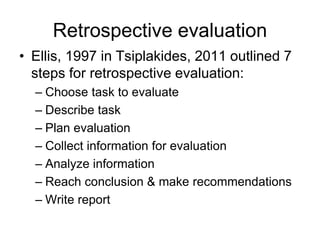
Retrospective evaluation
• Ellis, 1997 in Tsiplakides, 2011 outlined 7
steps for retrospective evaluation:
– Choose task to evaluate
– Describe task
– Plan evaluation
– Collect information for evaluation
– Analyze information
– Reach conclusion & make recommendations
– Write report

Lecture 3 Materials Development and Adaptation

  • 1.
  • 2.
    DEFINITION OF MATERIALS EVALUATION •Materials evaluation refers to the systematic procedures of appraisal carried out by the teachers or students to measure the value of the materials in relation with the quality of learning the language.
  • 3.
    MATERIALS EVALUATION • Itlooks into the potential of the materials for future use in language learning, the possibility of the materials to work in a specific context. • It helps teachers to determine whether the materials in question will work in the future designated context, still works in the current context or succeeded in the past use.
  • 4.
    MATERIALS EVALUATION • looksinto the materials strengths and weaknesses, how it can succeed, who can possibly make it successful, how practical it is to use it and the such. • Findings help teachers to decide if materials are worth adopting, suitable to maintain or need to be replaced.
  • 5.
    MATERIALS EVALUATION • Toomany literature written for evaluation with diverse criteria to be considered and various approaches to address the need • Authors include Tucker (1975) with his ‘internal & external value’ to the most recent Byrd (2001) who gives priority to the ‘fit between textbook and the curriculum, students & teachers’
  • 6.
    THE NEED FORMATERIAL EVALUATION • Material evaluation is needed for some obvious reasons: 1.Too many t/b /materials available in the market – all claim to be the best in the field, and the only way to verify the claim is to evaluate them 2.An educated / informed choice need to be made for the benefit of all parties – teachers must make informed decision in choosing materials to ensure that it serves the purpose of enhancing the learning experience c1
  • 7.
    THE NEED FORMATERIAL EVALUATION 3. Learners are more sophisticated & knowledgeable – the materials given to them must meet their expectation & suit their level 4. Ensure only high standard of materials/books are used – only choose materials of high quality so that in helps in achieving high standard of teaching & learning
  • 8.
    THE PURPOSES OF MATERIALEVALUATION 1. To adopt new textbook – before decision can be made of which book to be used, a number of potential books need to be evaluated 2. To identify strengths & weaknesses in books already in use – before decision to replace it being made, evaluation needs to be conducted
  • 9.
    THE PURPOSES OF MATERIALEVALUATION 3. To compare - when there are more than a book that needs to be considered to be selected and when existing materials are challenged by newly produced materials 4. To helps teachers to gain good insights into the nature of the materials 5. Sensitizing & familiarize teacher trainees with a range of published materials
  • 10.
    Theoretical assumptions of Evaluation •Predictive evaluation – aimed at deciding what materials to use – Consider materials available to them – Determine which best suited their purposes • Retrospective evaluation – Examine materials that have been used – To make decision if it is worth to be continuously used
  • 11.
    Predictive evaluation • Candepend on literature of past researches (scientific journals) • Can carry out own evaluation - need to consult books/ literature for evaluation - use published/ adapted/designed checklist • Examples of criteria: • Correspond to learners’ needs • Facilitate learning process • Support for learning (Cunningsworth, 1995 cited in Tsiplakides, 2011)
  • 12.
    Retrospective evaluation • Employ‘impressionistics evaluation’ • Involved teacher assessing the materials during the language program • Collect information & conduct empirical evaluation – requires overall assessment on worthiness/suitability of the materials against the teaching situation
  • 13.
    Retrospective evaluation • Ellis,1997 in Tsiplakides, 2011 outlined 7 steps for retrospective evaluation: – Choose task to evaluate – Describe task – Plan evaluation – Collect information for evaluation – Analyze information – Reach conclusion & make recommendations – Write report