Downloaded 62 times
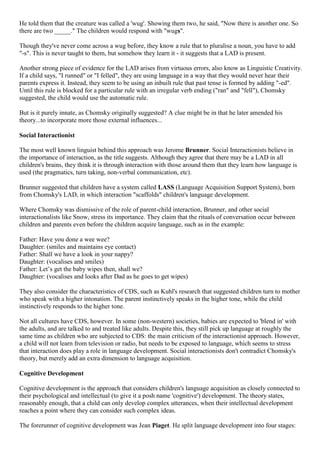
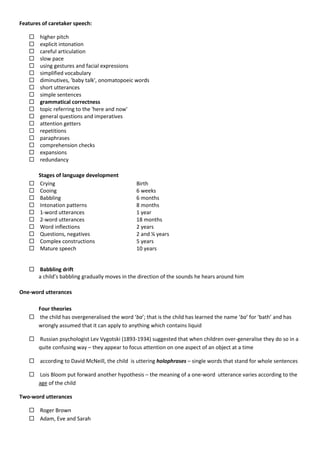
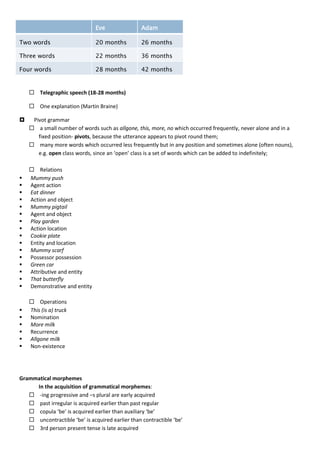
![Recurrence = something happens more than once or more than one of something.
Negation = when something isn't there or doesn't happen.
From these, we can take the following and describe them:
1. take bikky = action + affected
2. mummy give = agent + action
3. clock ticking = agent + action (or entity + attribute, if "ticking" is an adjective, rather than noun).
4. big hand = attribute + entity
5. me little = entity + attribute
6. eat crips[crisps] = action + affected
Back to the Top
Theories of Early Language Use
As with most aspects of language, there are various theorists who have ideas about what's going on with
children's early utterances.
Jean Aitchinson (1987) suggested that there are three stages to vocabulary usage:
1. Labelling - learning the word.
2. Packaging - learning about its meanings.
3. Networking - seeing how it connects to other words.
However, as other theorists have pointed out, children never really go through a stage where they are just
'labelling' things to learn the words. There is usually a reason behind the words, perhaps a request for
something or a desire to attract attention.
Other theorists suggest that children's language has three functions:
Children use language for practical purposes - to get what they want.
Children use it for social purposes - to talk for the sake of interaction and the sake of talking.
Children use it for learning purposes - to extend their understanding of the word around them and
build up their own ideas. The classic "why?".
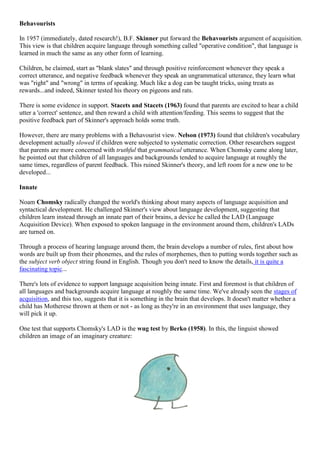
For example, a child might utter ―juice‖. Depending on the context, it could mean, ―I want some juice,‖
―I‘ve spilled some juice,‖ or even, ―I‘ve had enough juice.‖
Michael Halliday subdivided these broad categories further:
Practical
Instumental - "I want".
Regulatory - "Do what I tell you to do".
Social
Interactional - "Me and you".
Personal - "Here I come" or opinions like "That's funny".
Learning
Heuristic - "Tell me why".
Imaginative - "Let's pretend".
Referential - "Let me tell you about this".](https://image.slidesharecdn.com/l1acquisition-130727043622-phpapp02/85/L1-acquisition-4-320.jpg)
![to express concepts or predications. If you make a careful observation of some Chinese
children at such an age, you will hear them often say [ba] (爸), [ma] (妈) , [man]
( 猫) (饱), [qi](起), [do] (打) [teng ](疼) and many other monosyllabic words. The
words used during the holophrastic stage usually convey the following ideas:
(a) children's own action or desire for action.
(b) others' action,
(c) addressing somebody (usually parents), naming or calling things.
1. 3. Two-word Stage
On the basis of one-word sentences children gradually begin to produce two-word
utterances at the time when they are close to the age of two. Some children may
produce two-word utterances some months earlier. At first they just reduplicate what
they have acquired at the holophrastic stage, or just string two of their earlier
holophrastic utterances, with each word having its own meaning to make actual two-
word sentences which are not random combinations of words, but show definite
syntactic and semantic relations and the intonation contour of the two words extending
over the whole utterance rather than being separated by a pause between the two words.
For example, English children at such an age are often beard saying: mammy there,
daddy here, doggie gone, hat table, me go, it ball, toy table- water hot, cat jump and so
on. And the Chinese children at the same age would often say,[ma lai] (妈来), [bo
zou], (爸走), [he" shui](喝水), [chi fan](吃蛋), [kan ying ](看(电)影). [chi
gt.o](吃果), [mao chudng](帽床), [hei mao](黑猫), [bdi mao](白猫).[da moo](大
猫 ). [moo jido](猫叫). [got, yfio](狗咬), [du e](肚饿). [dan xiang](蛋香) and
so on.
During the two-word utterance stage children do not use syntactic or morphological
markers, that is. no inflections for number, person or tense and so on, but the syntactic
and semantic relations in the two-word sentences are clear. The two-word sentences
children of almost all languages produce have very similar or almost ihe same patterns;
noun + noun : mammy book, hat tahle. [mao chuang](帽床 ), noun-f-verb : ceil jump,
doggie gone, [gou yao] (狗咬 ), noun + adj: water hot, candy sweet ,[dan xiang](蛋
香 ) . noun+ adv; daddy here, mummy there [ba near](爸哪儿), adj. +noun: good](https://image.slidesharecdn.com/l1acquisition-130727043622-phpapp02/85/L1-acquisition-18-320.jpg)
![doggie, new hat, [bai mao] (白猫), verb + noun :love Jane- [he shui](喝水) [sa niao]
撒尿 pron +verb: me go, me want ,[ta da](他打), Each pattern of the two-word
sentences shows clear grammatical relations between the two words.
The two-word stage is very crucial for language acquisition, for the structures of two-
word sentences reflect the basic sentence structures and the basic syntactic rules of a
language, including choice of appropriate words.
1. 4. Telegraphic Stage
The two-word sentence stage is followed by the telegraphic stage. There docs not
seem to be any three (or four)- word stage in the process of children's acquisition of
language. When a child is about two years and a half, he starts stringing more than two
words together to make longer utterances. These utterances may he composed of two,
three, four, five or even more words.
The term "telegraphic'' derives from the observation that the child speech throughout
this period lacks inflections marking tense, aspect, number, mood, the, and function
words, such as prepositions (in, at, on), determiners (this, that, the, a. an), auxiliaries
(will, shall- da- does) and conjunctions (and- but. or). for such speech is rather like the
language used in telegrams, in which function words are usually missing and only
content words carrying the main message are used. As the child proceeds during the
telegraphic period from the two-word stage to later stages characterized by the
production of longer utterances, his speech, in terms of word order, etc, will
approximate more and more to that of adults' speech. If the language he is acquiring has
inflections and function words, ru-will also gradually come to vise these words
appropriately that by the time when he is about four or five years old, his speech, though
still defective compared with that of adults, is no longer describable as telegraphic.
The utterances that are longer than two words appear to be sentence-like. There are
many such examples:
Mammy love me.
What that?
John play piano
No heat me.
Daddy no go.
All the sentence-like utterances produced at the telegraphic jttape are not simply
randomly strung-together words, but have hierarchical constituent structures similar TO
ihe syntactic structure"' found in the sentences produced by adults. At the end of this](https://image.slidesharecdn.com/l1acquisition-130727043622-phpapp02/85/L1-acquisition-19-320.jpg)
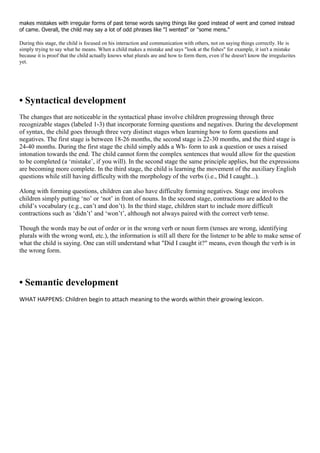
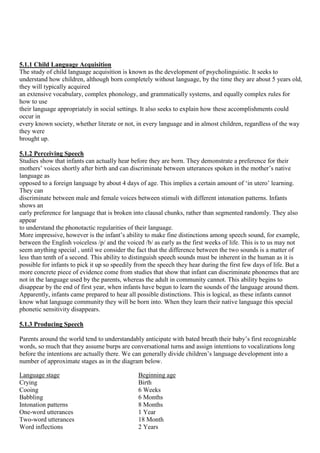
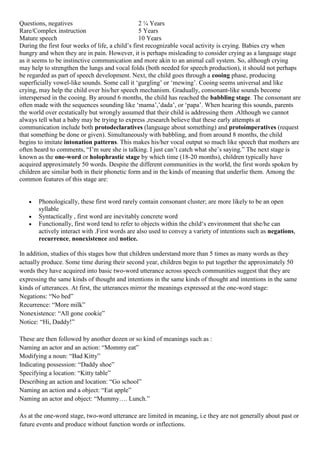
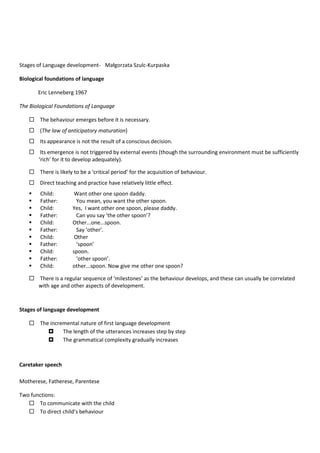
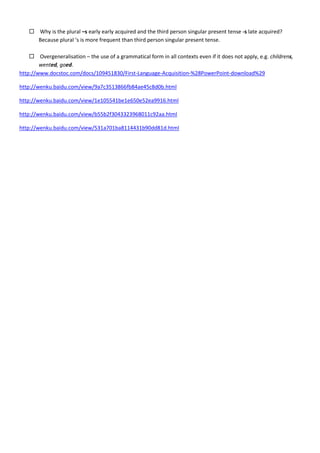


Children acquire language in predictable stages regardless of location or language. There are pre-linguistic, one-word, two-word, and telegraphic stages where children's utterances become more complex as their vocabulary and grammar develop. Theories suggest children's early language serves practical, social, and learning purposes rather than just labeling objects. Children master grammar structures like pluralization before structures like past tense as they progress toward fluent language use by age 5.


![Theories Of Language Acquisition[1]](https://cdn.slidesharecdn.com/ss_thumbnails/theories-of-language-acquisition1-1225480010904742-8-thumbnail.jpg?width=640&height=640&fit=bounds)


