*
    DEVELOPMENTAL PSYCHOLOGY
    GROUP 5
*
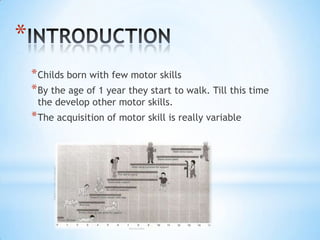
    * Childs born with few motor skills
    * By the age of 1 year they start to walk. Till this time
     the develop other motor skills.
    * The acquisition of motor skill is really variable
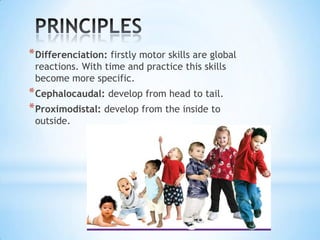
* Differenciation: firstly motor skills are global
 reactions. With time and practice this skills
 become more specific.
* Cephalocaudal: develop from head to tail.
* Proximodistal: develop from the inside to
 outside.
*
*
    * Bertenthal and Clifton (1998) note that control
     over one’s motor behaviour ranks among the
     infant’s greatest achievements. Psychologists who
     study the acquisition of motor skills find it useful
     to distinguish between gross motor development,
     that is, motor skills which help children to get
     around in their environment such as crawling and
     walking, and fine motor development, which
     refers to smaller movement sequences like
     reaching and grasping.
*

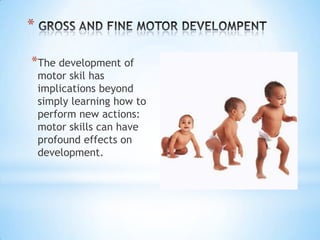
*The development of
    motor skil has
    implications beyond
    simply learning how to
    perform new actions:
    motor skills can have
    profound effects on
    development.
*

*For example;
 children who can
 move about the
 environment
 develop an
 understanding of
 locations such as
 ‘here’ and
 ‘there’.
*

* Because infant memory is initially highly
    dependent on context – that is, similarity
    between the situation where information is
    encoded and where it is recalled – infants who
    have experience moving about the environment
    and who learn to spatially encode information
    become less dependent on context for
    successfull recall.
*

    *These examples show
     that motor development
     has implications beyond
     the immediately
     apparent benefits of
     crawling or walking
*

*Piaget (1952) argued that the development of
    reaching and grasping was a key aspect of
    cognitive development because it forms an
    important link between biological adaptation
    and intellectual adaptation.
*

* Reaching and grasping are voluntary actions under
    the infant’s control, and as such, they open up
    exciting new possibilities in the infant’s ability to
    explore their environment. The infant who
    reaches for and grasps an object so as to explore
    it pushes his development forwards as he engages
    in processes such as adapting his grip to the size
    and shape of the object.
*

* Piaget argued that these
    early processes of
    assimilation and
    accommodation to
    objects drive cognitive
    development in the
    sensory motor period.
*
* The infant's reaching does not depend simply on the
 guidance of the hand and arm by the visual system but is
 controlled by proprioception, the sensation of movement
 and location based on simulation arising from bodily sources
 such as muscle contractions.

* By about 9 months of age, infants can adjust their reaching
 to take into account moving object.

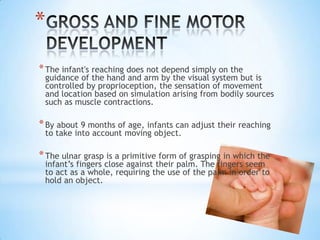
* The ulnar grasp is a primitive form of grasping in which the
 infant’s fingers close against their palm. The fingers seem
 to act as a whole, requiring the use of the palm in order to
 hold an object.
* When infants can sit upright on their
 own, infants acquire the ability
 transfer objects from hand to hand.
 By around the end of the first year,
 infants gave graduate to using the
 pincer grasp wherein they use their
 index finger and their thumb in a
 opposable manner, resulting in a more
 coordinated and finely tuned grip. For
 example to take a knob on a stereo
 system.
*

* Gallahue suggests that, beyond infancy, three
    fundamental sets of motor skills emerge in the child's
    repertoire.


* These are locomotor movements, which include walking,
    running, jumping, hopping, skipping and climbing;
    manipulative movements including throwing, catching and
    kicking; and stability movements including bending,
    stretching, rolling, balancing and walking on one’s hands.
*
*
* Gesell & Thompson (1929) and McGraw (1935) 
    believe that motor behaviours emerged according
    to a preprogrammed genetic timetable.

* Gesell desmostrated it doing an experiment with
    twins, and the conclusion was that maturation and
    not experience is the prime factor in determining
    when children acquire skills.
*
* J.B.Watson,Thelen (1995), Zelazo & Kolb (1972), and
    Hopkins & Westra (1988) think that transactions with the
    environment must play a crucial role in the timing of motor
    skill acquisition.


* The acquisition of motor skills also varies across cultures.

* For instance, Hopkins and Westra found that mothers in the
    West Indies have babies which walk considerably earlier
    than the average North American infant. This example
    shows, environments can have important effects on when
    skills are acquired.
                            http://www.youtube.com/watch?v=90zFK
                            uITTFo
*
* How many fundamental sets of motor skill are
    there?
    a) Two
    b) Three
    c) Four
    d) Five
* How Gesell demonstrated that maduration is the
 prime factor in determining when children
 acquire skills?


 a) Experimenting with pregnant women.
 b) Experimenting with babies.
 c) Experimenting with West Indian mothers.
 d) Experimenting with twins.
* What of this parts of the body developes
 before?
a) The foot
b) The brain
c) The arms
d) The legs
Motor development

Motor development

  • 1.
    * DEVELOPMENTAL PSYCHOLOGY GROUP 5
  • 2.
    * * Childs born with few motor skills * By the age of 1 year they start to walk. Till this time the develop other motor skills. * The acquisition of motor skill is really variable
  • 3.
    * Differenciation: firstlymotor skills are global reactions. With time and practice this skills become more specific. * Cephalocaudal: develop from head to tail. * Proximodistal: develop from the inside to outside.
  • 4.
  • 5.
    * * Bertenthal and Clifton (1998) note that control over one’s motor behaviour ranks among the infant’s greatest achievements. Psychologists who study the acquisition of motor skills find it useful to distinguish between gross motor development, that is, motor skills which help children to get around in their environment such as crawling and walking, and fine motor development, which refers to smaller movement sequences like reaching and grasping.
  • 6.
    * *The development of motor skil has implications beyond simply learning how to perform new actions: motor skills can have profound effects on development.
  • 7.
    * *For example; childrenwho can move about the environment develop an understanding of locations such as ‘here’ and ‘there’.
  • 8.
    * * Because infantmemory is initially highly dependent on context – that is, similarity between the situation where information is encoded and where it is recalled – infants who have experience moving about the environment and who learn to spatially encode information become less dependent on context for successfull recall.
  • 9.
    * *These examples show that motor development has implications beyond the immediately apparent benefits of crawling or walking
  • 10.
    * *Piaget (1952) arguedthat the development of reaching and grasping was a key aspect of cognitive development because it forms an important link between biological adaptation and intellectual adaptation.
  • 11.
    * * Reaching andgrasping are voluntary actions under the infant’s control, and as such, they open up exciting new possibilities in the infant’s ability to explore their environment. The infant who reaches for and grasps an object so as to explore it pushes his development forwards as he engages in processes such as adapting his grip to the size and shape of the object.
  • 12.
    * * Piaget arguedthat these early processes of assimilation and accommodation to objects drive cognitive development in the sensory motor period.
  • 13.
    * * The infant'sreaching does not depend simply on the guidance of the hand and arm by the visual system but is controlled by proprioception, the sensation of movement and location based on simulation arising from bodily sources such as muscle contractions. * By about 9 months of age, infants can adjust their reaching to take into account moving object. * The ulnar grasp is a primitive form of grasping in which the infant’s fingers close against their palm. The fingers seem to act as a whole, requiring the use of the palm in order to hold an object.
  • 14.
    * When infantscan sit upright on their own, infants acquire the ability transfer objects from hand to hand. By around the end of the first year, infants gave graduate to using the pincer grasp wherein they use their index finger and their thumb in a opposable manner, resulting in a more coordinated and finely tuned grip. For example to take a knob on a stereo system.
  • 15.
    * * Gallahue suggeststhat, beyond infancy, three fundamental sets of motor skills emerge in the child's repertoire. * These are locomotor movements, which include walking, running, jumping, hopping, skipping and climbing; manipulative movements including throwing, catching and kicking; and stability movements including bending, stretching, rolling, balancing and walking on one’s hands.
  • 16.
  • 17.
    * * Gesell &Thompson (1929) and McGraw (1935)  believe that motor behaviours emerged according to a preprogrammed genetic timetable. * Gesell desmostrated it doing an experiment with twins, and the conclusion was that maturation and not experience is the prime factor in determining when children acquire skills.
  • 18.
    * * J.B.Watson,Thelen (1995),Zelazo & Kolb (1972), and Hopkins & Westra (1988) think that transactions with the environment must play a crucial role in the timing of motor skill acquisition. * The acquisition of motor skills also varies across cultures. * For instance, Hopkins and Westra found that mothers in the West Indies have babies which walk considerably earlier than the average North American infant. This example shows, environments can have important effects on when skills are acquired. http://www.youtube.com/watch?v=90zFK uITTFo
  • 19.
    * * How manyfundamental sets of motor skill are there? a) Two b) Three c) Four d) Five
  • 20.
    * How Geselldemonstrated that maduration is the prime factor in determining when children acquire skills? a) Experimenting with pregnant women. b) Experimenting with babies. c) Experimenting with West Indian mothers. d) Experimenting with twins.
  • 21.
    * What ofthis parts of the body developes before? a) The foot b) The brain c) The arms d) The legs