LANDMINES DETECTION USING GROUND PENETRATING RADAR (GPR) By:- Kuldeep Singh Rao  Final year , EICE  A Seminar  On
Outline   The problem of landmines  Current detection methods Ground penetrating radar Block diagram of GPR Working of GPR Drawbacks Conclusion
The Problem :  Land mines and UXO There are nearly 50 million unexploded  land mines in 60 countries around the  world. These land mines kill and maim  approximately 26,000 people annually. Large portions of land go unused due to fear of mines.
United Nations relief operations are made  more difficult and dangerous due to mining of roads. Modern mines can be constructed with plastics and composites. The low metal content of mines makes detection extremely difficult.
Current Detection Methods: Metal detectors--- capable of finding even low-metal content mines in mineralized soils. Nuclear magnetic resonance, fast neutron activation and thermal neutron activation. Thermal imaging and electro-optical sensors detect evidence of buried objects.
Biological sensors such as dogs, pigs, bees and birds. Chemical sensors such as thermal fluorescence--- detect airborne and waterborne presence of explosive vapors.
GPR :  Ground penetrating radar The impulse GPR system has been developed in the International Research Center for Telecommunications-transmission and Radar (IRCTR). Ground Penetrating Radar (GPR) is an ultra wide band radar which provides centimeter resolution to locate even small targets. There are two distinct types of GPR, time-domain and frequency domain.
Time domain or impulse GPR transmits discrete pulses of nanosecond duration and digitizes the returns at GHz sample rates. Frequency domain GPR systems transmit single frequencies and the amplitude and phase of the return signal is measured. The resulting data is converted to the time domain. These techniques allow GPR to locate even non metallic mines.
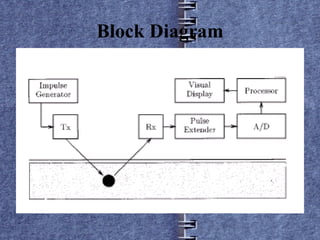
Block Diagram
Basic Components  Impulse GPR system comprises of Impulse generator Transmitter Receiver Pulse extender A/D converter Processor Visual display.
WORKING: The impulse generator produces 0.8ns monocycle pulses. The generator spectrum covers a wide frequency band from 500MHz till 2GHz on 3dB level. Pulses are transmitted by the Tx antenna into the ground. After striking the mine, pulses return and are received by the Rx antenna.
Pulse extender amplifies the ground reflection signal up to the maximum level acquired by A/D converter. A/D converter converts the signal into digital signal. Processor filters the signal and shows the presence or absence of surrogate mine in the soil. Visual display helps to see the range of targets. It displays the exact position of landmine.
GPR images the dielectric properties of the soils, and any discontinuities appear as an error signal. Thus false alarms are easily generated from the background itself . To overcome the problem Automatic target recognition (ATR) algorithms are employed by impulse-based GPR systems typically calculate and remove background. DRAWBACKS
It tries to detect the hyperbolic signatures that are characteristic in size and shape of landmine targets in GEO-CENTERS 400. The sensor such as GPR is larger and heavier. GPR is more power hungry.
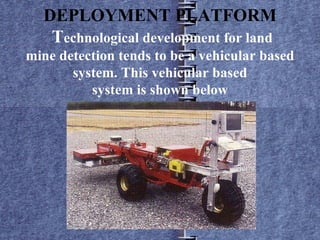
DEPLOYMENT PLATFORM  T echnological development for land mine detection tends to be a vehicular based system. This vehicular based system is shown below
CONCLUSION Impulse GPR system is used for detecting anti-tank and antipersonnel mines. Through iterative design, build test cycles, and blind and scored testing at Army mine lanes, steady progress is being made.
Queries  ?
THANK YOU

Landmines Detection

  • 1.
    LANDMINES DETECTION USINGGROUND PENETRATING RADAR (GPR) By:- Kuldeep Singh Rao Final year , EICE A Seminar On
  • 2.
    Outline The problem of landmines Current detection methods Ground penetrating radar Block diagram of GPR Working of GPR Drawbacks Conclusion
  • 3.
    The Problem : Land mines and UXO There are nearly 50 million unexploded land mines in 60 countries around the world. These land mines kill and maim approximately 26,000 people annually. Large portions of land go unused due to fear of mines.
  • 4.
    United Nations reliefoperations are made more difficult and dangerous due to mining of roads. Modern mines can be constructed with plastics and composites. The low metal content of mines makes detection extremely difficult.
  • 5.
    Current Detection Methods:Metal detectors--- capable of finding even low-metal content mines in mineralized soils. Nuclear magnetic resonance, fast neutron activation and thermal neutron activation. Thermal imaging and electro-optical sensors detect evidence of buried objects.
  • 6.
    Biological sensors suchas dogs, pigs, bees and birds. Chemical sensors such as thermal fluorescence--- detect airborne and waterborne presence of explosive vapors.
  • 7.
    GPR : Ground penetrating radar The impulse GPR system has been developed in the International Research Center for Telecommunications-transmission and Radar (IRCTR). Ground Penetrating Radar (GPR) is an ultra wide band radar which provides centimeter resolution to locate even small targets. There are two distinct types of GPR, time-domain and frequency domain.
  • 8.
    Time domain orimpulse GPR transmits discrete pulses of nanosecond duration and digitizes the returns at GHz sample rates. Frequency domain GPR systems transmit single frequencies and the amplitude and phase of the return signal is measured. The resulting data is converted to the time domain. These techniques allow GPR to locate even non metallic mines.
  • 9.
  • 10.
    Basic Components Impulse GPR system comprises of Impulse generator Transmitter Receiver Pulse extender A/D converter Processor Visual display.
  • 11.
    WORKING: The impulsegenerator produces 0.8ns monocycle pulses. The generator spectrum covers a wide frequency band from 500MHz till 2GHz on 3dB level. Pulses are transmitted by the Tx antenna into the ground. After striking the mine, pulses return and are received by the Rx antenna.
  • 12.
    Pulse extender amplifiesthe ground reflection signal up to the maximum level acquired by A/D converter. A/D converter converts the signal into digital signal. Processor filters the signal and shows the presence or absence of surrogate mine in the soil. Visual display helps to see the range of targets. It displays the exact position of landmine.
  • 13.
    GPR images thedielectric properties of the soils, and any discontinuities appear as an error signal. Thus false alarms are easily generated from the background itself . To overcome the problem Automatic target recognition (ATR) algorithms are employed by impulse-based GPR systems typically calculate and remove background. DRAWBACKS
  • 14.
    It tries todetect the hyperbolic signatures that are characteristic in size and shape of landmine targets in GEO-CENTERS 400. The sensor such as GPR is larger and heavier. GPR is more power hungry.
  • 15.
    DEPLOYMENT PLATFORM T echnological development for land mine detection tends to be a vehicular based system. This vehicular based system is shown below
  • 16.
    CONCLUSION Impulse GPRsystem is used for detecting anti-tank and antipersonnel mines. Through iterative design, build test cycles, and blind and scored testing at Army mine lanes, steady progress is being made.
  • 17.
  • 18.