A SEMINAR TOPIC ON
LANDMINE DETECTION USING
IMPULSE GROUND PENETRATING RADAR
Contents
> Introduction
> Block diagram
> Implementation
> Applications
> Advantages
> Limitations
> Future scope
> Conclusion
Introduction
> Around every 22 minutes one person some where in the world is killed or injured
by a land mine.
> Nearly 50 million unexploded land mines in 60 countries around the world.
> Large portions of land go unused due to fear of mines.
> Modern mines can be constructed with plastics and composites.
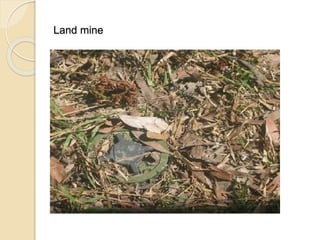
Land mine
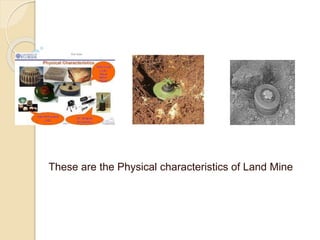
These are the Physical characteristics of Land Mine
Technology used to Detect the land mines:
> Metal detectors
> Nuclear magnetic resonance
> Thermal imaging and electro optical sensors
> Biological sensors
> Chemical sensors
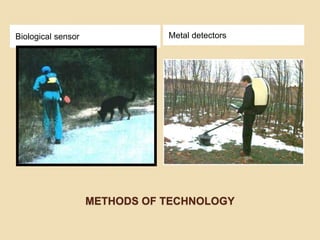
METHODS OF TECHNOLOGY
Biological sensor Metal detectors
Block Diagram
Hardware description
> Impulse generator(GPR)
> Antenna system
> Pulse extender
> A/D converter
> Processor
> Visual display
Ground Penetrating Radar:
> The impulse GPR system has been developed in the International Research
Centre for Telecommunications Transmission and Radar(IRCTR).
> This ultra wide band radar provide centimetere resolution to locate even small
targets.
> Two distinct types of GPR Time domain , Frequency domain.
> Time domain or Impulse GPR transmits discrete pulses of nano sec duration and
digitize the return at GHZ sample rate.
> Frequency domain GPR system transmit single frequency & amplitude &phase of
the return signal is measured.
Antenna System:
> The GPR system performance strongly depends on the antenna system.
> The antenna system consist of transmitter and receiver
> The transmit antenna should :
> Radiate Ultra-Wideband
> Radiate Electro-magnetic energy
Pulse extender:
> It will amplify the ground reflection signal upto the maximum level acquired A/D
converter.
> It amplify the samples of digital signals which are converted from analog signal.
A/D Converter:
> The transmitter sends out a series of EM pulses then listens with the receiver
connected to high speed samples which in-turn feeds to A/D converter.
> This information is converted from nano sec to milli sec.
> It provides 12 bit accuracy and 66dB linear dynamic range.
Processor:
> The processor filters the signals
> This signals shows presence or absence of surrogate mine in the soil.
> Processor selects the mine detecting signal and passes to the visual display.
Visual display:
> It helps to see the range of targets.
> It displays the position of land mine.
Implementation:
> The impulse generator produces 0.8ns monocycle pulse.
> The generator spectrum covers a wide frequency band from 500MHZ on
3dB level.
> After striking the mine, pulses return and are received by the receiver
antenna.
[Cont..]
Applications
GPR has many applications in number of fields:
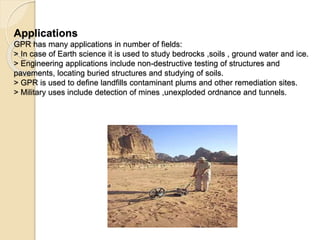
> In case of Earth science it is used to study bedrocks ,soils , ground water and ice.
> Engineering applications include non-destructive testing of structures and
pavements, locating buried structures and studying of soils.
> GPR is used to define landfills contaminant plums and other remediation sites.
> Military uses include detection of mines ,unexploded ordnance and tunnels.
Advantages:
> GPR has accurate measurements.
> GPR locates even a small targets.
> It has been well founded by the defense.
> GPR operates by detecting the dielectric soils when allows it to locate even no
metallic mines.
> GPR has been tested in different environmental conditions.
Limitations:
> GPR is more power hungry
> Thus false alarms are easily generated from the background itself.
> The sensors such as GPR are larger and heavier.
Future scope:
> Army mine fields is to measure detection probabilities under realistic conditions.
> Plans to speed up the scan rate with advanced arrays are under the way.
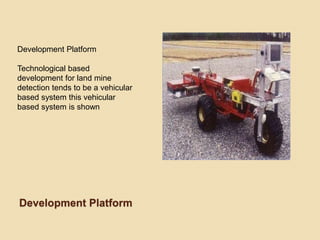
Development Platform
Technological based
development for land mine
detection tends to be a vehicular
based system this vehicular
based system is shown
Conclusion
Impulse GPR system is used for detecting anti-tank and antipersonnel mines.
Through iterative design, build test cycles, and scored testing at Army mine lanes,
steady progress is being made.
THANK YOU

landminedetectionusingimpulsegroundpenetratingradar-130402084311-phpapp02 (1)

  • 1.
    A SEMINAR TOPICON LANDMINE DETECTION USING IMPULSE GROUND PENETRATING RADAR
  • 2.
    Contents > Introduction > Blockdiagram > Implementation > Applications > Advantages > Limitations > Future scope > Conclusion
  • 3.
    Introduction > Around every22 minutes one person some where in the world is killed or injured by a land mine. > Nearly 50 million unexploded land mines in 60 countries around the world. > Large portions of land go unused due to fear of mines. > Modern mines can be constructed with plastics and composites.
  • 4.
  • 5.
    These are thePhysical characteristics of Land Mine
  • 6.
    Technology used toDetect the land mines: > Metal detectors > Nuclear magnetic resonance > Thermal imaging and electro optical sensors > Biological sensors > Chemical sensors
  • 7.
    METHODS OF TECHNOLOGY Biologicalsensor Metal detectors
  • 8.
  • 9.
    Hardware description > Impulsegenerator(GPR) > Antenna system > Pulse extender > A/D converter > Processor > Visual display
  • 10.
    Ground Penetrating Radar: >The impulse GPR system has been developed in the International Research Centre for Telecommunications Transmission and Radar(IRCTR). > This ultra wide band radar provide centimetere resolution to locate even small targets. > Two distinct types of GPR Time domain , Frequency domain. > Time domain or Impulse GPR transmits discrete pulses of nano sec duration and digitize the return at GHZ sample rate. > Frequency domain GPR system transmit single frequency & amplitude &phase of the return signal is measured.
  • 11.
    Antenna System: > TheGPR system performance strongly depends on the antenna system. > The antenna system consist of transmitter and receiver > The transmit antenna should : > Radiate Ultra-Wideband > Radiate Electro-magnetic energy
  • 12.
    Pulse extender: > Itwill amplify the ground reflection signal upto the maximum level acquired A/D converter. > It amplify the samples of digital signals which are converted from analog signal.
  • 13.
    A/D Converter: > Thetransmitter sends out a series of EM pulses then listens with the receiver connected to high speed samples which in-turn feeds to A/D converter. > This information is converted from nano sec to milli sec. > It provides 12 bit accuracy and 66dB linear dynamic range.
  • 14.
    Processor: > The processorfilters the signals > This signals shows presence or absence of surrogate mine in the soil. > Processor selects the mine detecting signal and passes to the visual display.
  • 15.
    Visual display: > Ithelps to see the range of targets. > It displays the position of land mine.
  • 16.
    Implementation: > The impulsegenerator produces 0.8ns monocycle pulse. > The generator spectrum covers a wide frequency band from 500MHZ on 3dB level. > After striking the mine, pulses return and are received by the receiver antenna. [Cont..]
  • 17.
    Applications GPR has manyapplications in number of fields: > In case of Earth science it is used to study bedrocks ,soils , ground water and ice. > Engineering applications include non-destructive testing of structures and pavements, locating buried structures and studying of soils. > GPR is used to define landfills contaminant plums and other remediation sites. > Military uses include detection of mines ,unexploded ordnance and tunnels.
  • 18.
    Advantages: > GPR hasaccurate measurements. > GPR locates even a small targets. > It has been well founded by the defense. > GPR operates by detecting the dielectric soils when allows it to locate even no metallic mines. > GPR has been tested in different environmental conditions.
  • 19.
    Limitations: > GPR ismore power hungry > Thus false alarms are easily generated from the background itself. > The sensors such as GPR are larger and heavier.
  • 20.
    Future scope: > Armymine fields is to measure detection probabilities under realistic conditions. > Plans to speed up the scan rate with advanced arrays are under the way.
  • 21.
    Development Platform Development Platform Technologicalbased development for land mine detection tends to be a vehicular based system this vehicular based system is shown
  • 22.
    Conclusion Impulse GPR systemis used for detecting anti-tank and antipersonnel mines. Through iterative design, build test cycles, and scored testing at Army mine lanes, steady progress is being made.
  • 23.