By
Ravikiran S. Anande
Assistant Professor
rvanande21@gmail.com
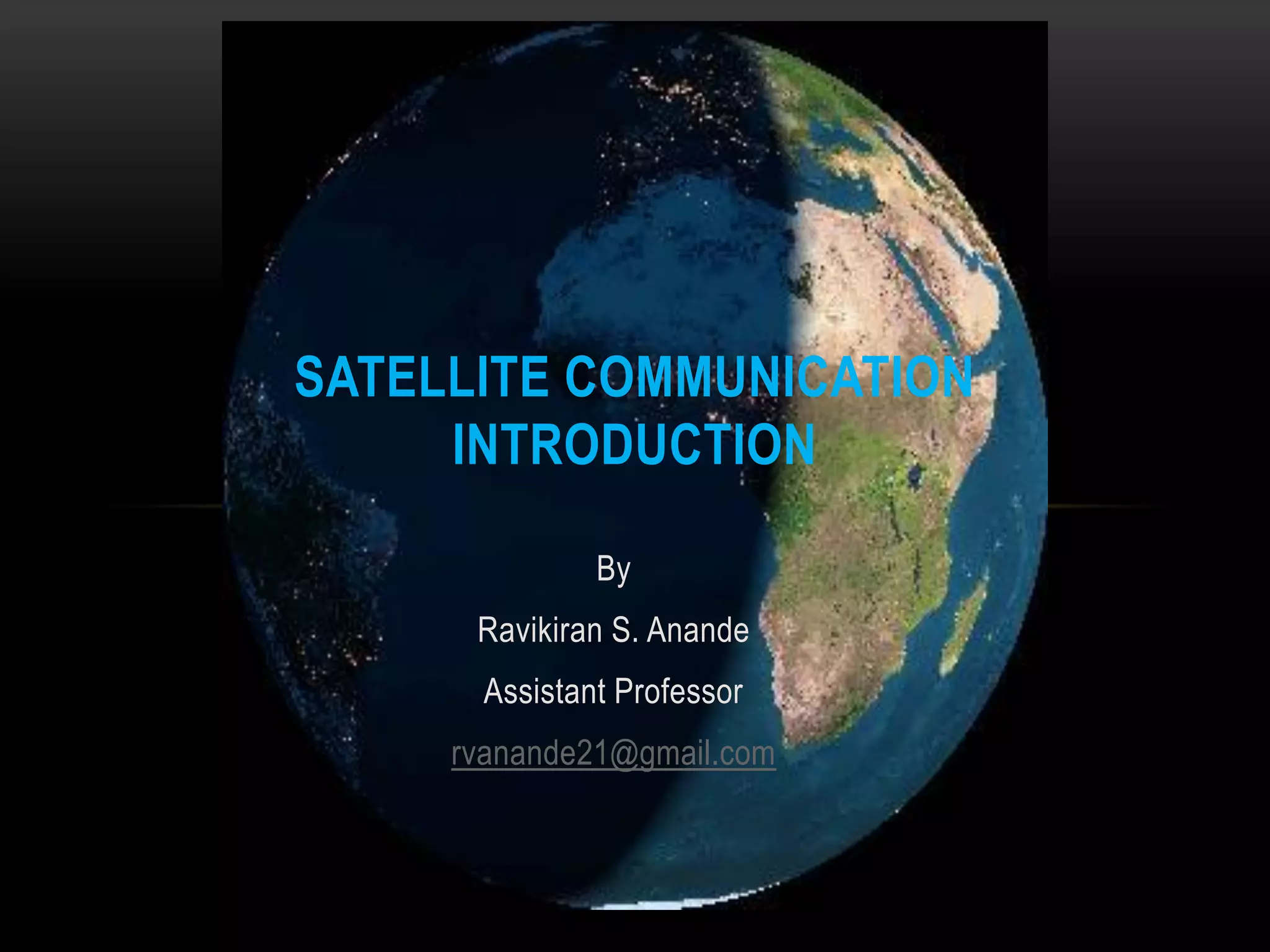
SATELLITE COMMUNICATION
INTRODUCTION
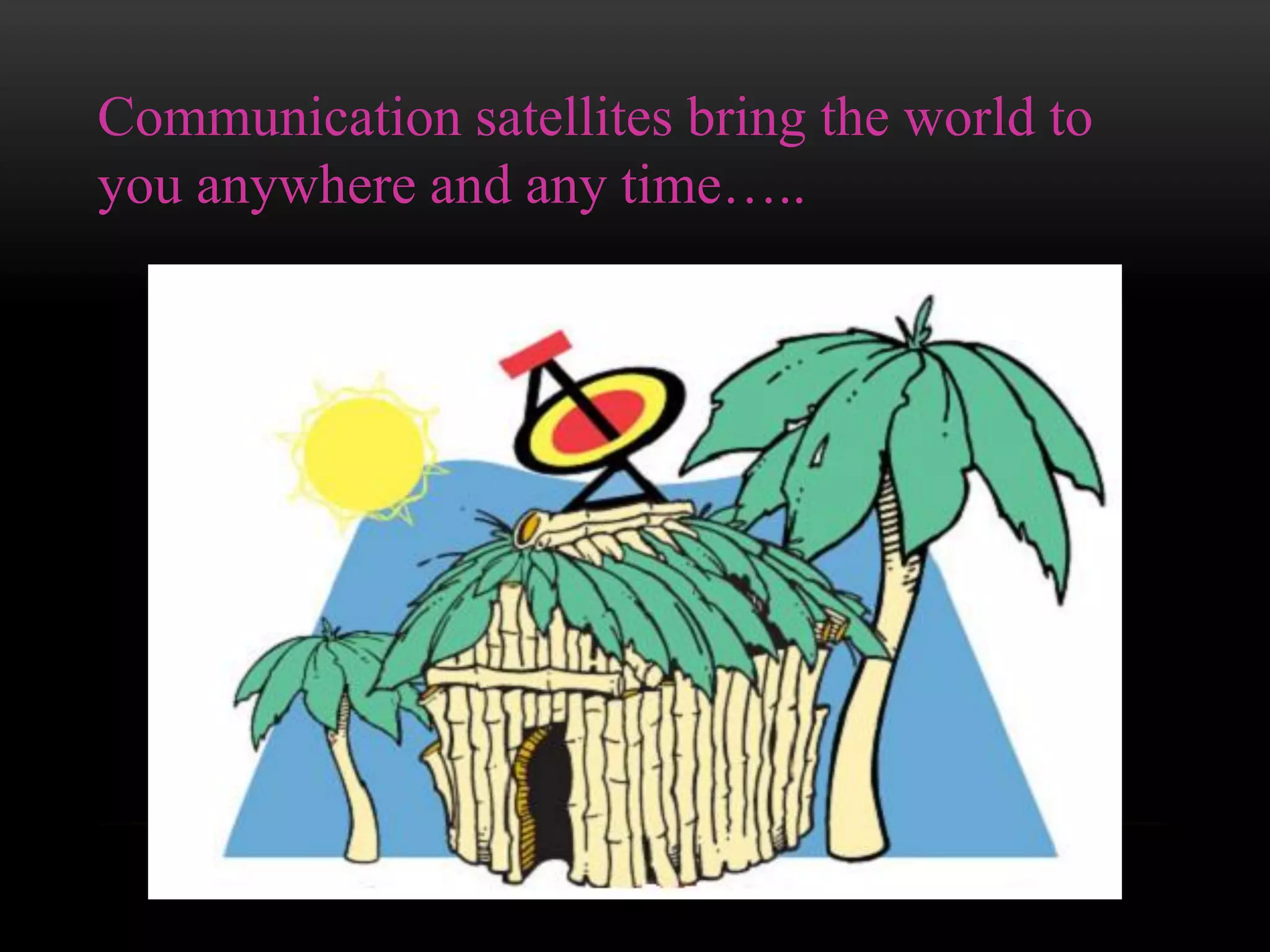
Communication satellites bring the world to
you anywhere and any time…..
BACKGROUND:
• Telecommunication system made it possible to communicate
with anyone at any time.
• Before the telegraph & telephone, all communication was face-
to-face, or in writing.
• If you wanted to talk someone, you had to travel to meet with
that person.
• If you wanted to send information, it had to written down on
papers & carried to destination.
• Telegraph cables laid across the oceans as early as the mid-
1800s.
• Telegraph system used copper wire to carry signals over earth’s
surface & across oceans , made possible intercontinental links.
• But cables capable of carrying voice signals did not begin
service until 1953.
• In 1945, HF radio was only available method for
transcontinental distances.
• HF is commonly called as Short Wave (SW).
• Operates in 3 to 30 MHz
• Not reliable.
• Because Sunspots & ionospheric disturbances disrupt HF radio
links.
ORIGIN OF SATELLIE COMMUNICATION:
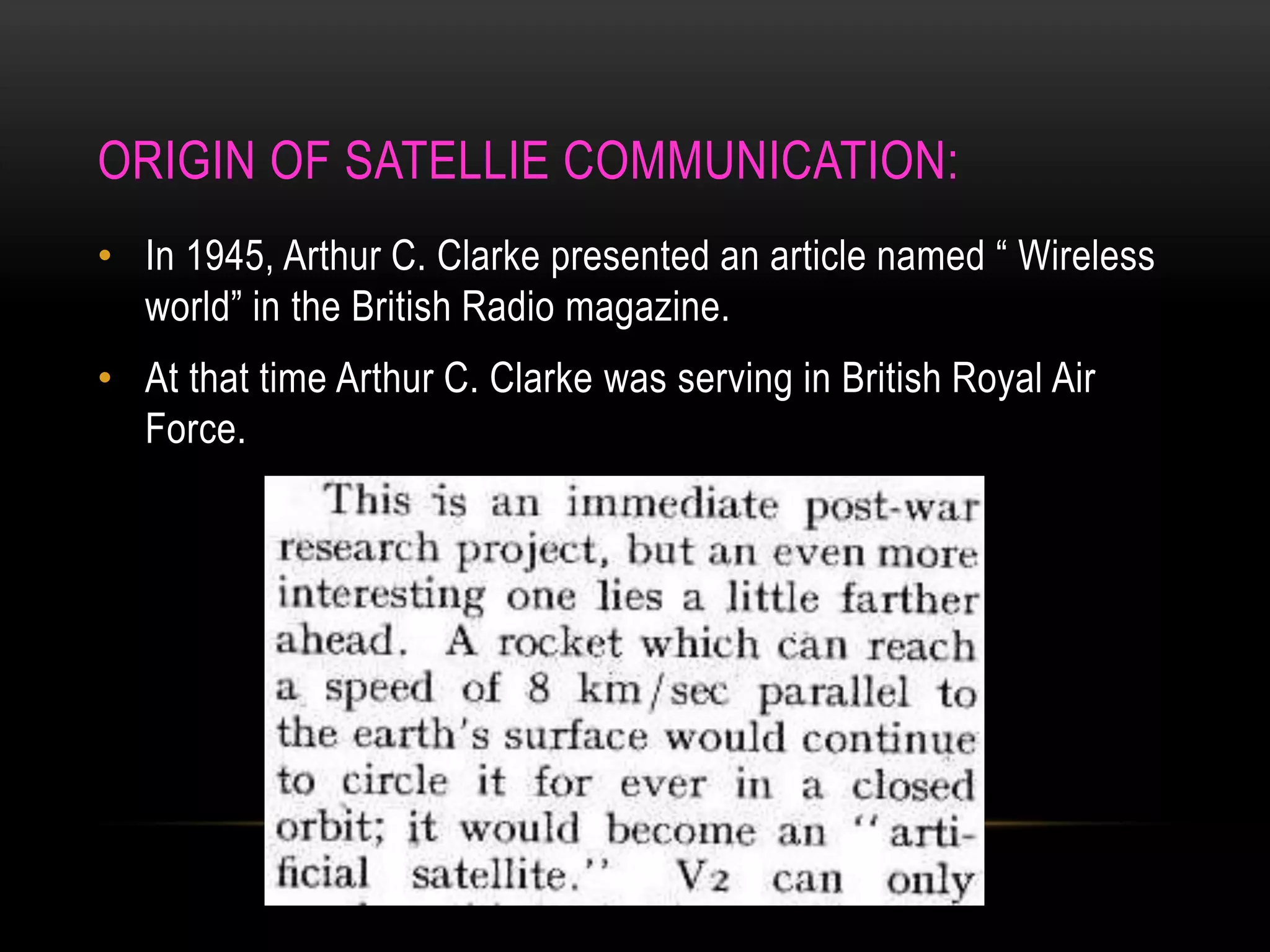
• In 1945, Arthur C. Clarke presented an article named “ Wireless
world” in the British Radio magazine.
• At that time Arthur C. Clarke was serving in British Royal Air
Force.
• Clarke suggested that a radio relay satellite in an equatorial
orbit with a period of 24 h would remain stationary with respect
to earth’s surface and make possible long distance radio links.
• Clarke wrote, there were no rockets powerful enough to launch
them.
HISTORY OF SATELLITE COMMUNICATION:
• Satellite communication began in October 1957 with the launch
by Russia of a small satellite called Sputnik I.
• It’s a first artificial earth satellite and it sparked the space race
between United States and Russia.
• Sputnik I carried only a beacon transmitter, did not have
communication capability.
• The first satellite successfully launched by USA was Explorer I
on January 1958.
• The first voice heard from space was that of US president
Eisenhower, who recorded Christmas message that was
transmitted back to earth from SCORE satellite in December
1958.
• The world's first commercial communications satellite was Early
Bird (INTELSAT I).
• Launched on April 6, 1965 and placed in commercial service
after moving into geosynchronous orbit 22,300 miles above the
equator.
• The satellite weighed a mere 36 kg & incorporated two 6/4 GHz
transponders, each with 25 MHz bandwidth.
• Early Bird didn't have a battery - and worked only when its solar
panels were exposed to the sun.
1960’S –FIRST SATELLITE COMMUNICATIONS:
• 1960 First passive communication satellite (Large balloons,
Echo I and II).
• 1962: First active communication satellite (Telstar I , MEO).
• 1963: First satellite into geostationary (GEO) orbit (Syncom1,
communication failed).
• 1964: International Telecomm. Satellite Organization
(INTELSAT) created.
• 1965 First successful communications GEO (Early Bird /
INTELSAT 1).
1970’S –GEO APPLICATIONS DEVELOPMENT, DBS:
• 1972 First domestic satellite system operational (Canada).
• 1975 First successful direct broadcast experiment (USA-India).
• 1979 International Mobile Satellite Organization (Inmarsat)
established.
1980’S –GEO APPLICATIONS EXPANDED, MOBILE:
• 1981 First reusable launch vehicle flight.
• 1982 International maritime communications made operational.
• 1984 First direct-to-home broadcast system operational (Japan).
• 1987 Successful trials of land-mobile communications
(Inmarsat).
• 1989-90 Global mobile communication service extended to land
mobile and aeronautical use (Inmarsat)
1990+’S NGSO APPLICATIONS DEVELOPMENT AND
GEO EXPANSION
• Proposals of non-geostationary (NGSO) systems for mobile
communications.
• Continuing growth of VSATs around the world.
• Spectrum allocation for non-GEO systems.
• Continuing growth of DBS. DirectTV created.
• Launch of first batch of LEO for hand-held terminals (Iridium).
• Voice-service portables and paging-service pocket size mobile
terminals launched (Inmarsat).
• And continues………………
WHAT IS SATELLITE ?
• In astronomical terms, a satellite is a celestial body that orbits
around a planet.
• Example: The moon is a satellite of Earth.
• In Aerospace terms, a satellite is a space vehicle launched by
humans and orbits around Earth or another celestial body.
• Communications Satellite: It is a microwave repeater in the
sky that consists of a diverse combination of one or more
components including transmitter, receiver, amplifier,
regenerator, filter onboard computer, multiplexer, demultiplexer,
antenna, waveguide etc.
• A satellite radio repeater is also called transponder. This is
usually a combination of transmitter and receiver.
HOW SATELLITE WORKS ?
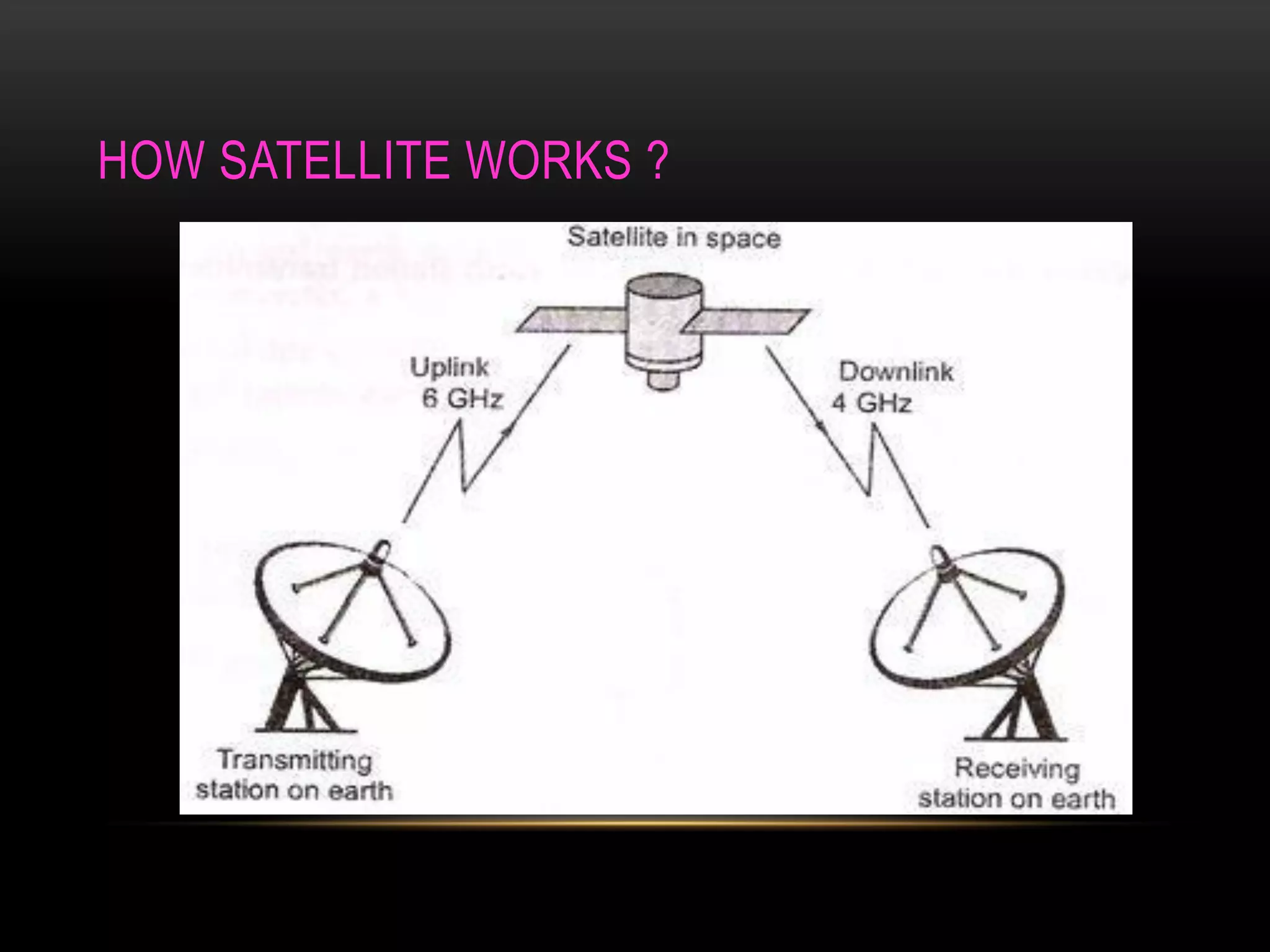
• Two Stations on Earth want to communicate through radio
broadcast but are too far away to use conventional means.
• The two stations can use a satellite as a relay station for their
communication.
• One Earth station transmits the signals to the satellite at Up link
frequency.
• Up link frequency is the frequency at which Earth station is
communicating with a satellite.
• The satellite transponder process the signal and sends it to the
second Earth station at another frequency called downlink
frequency.
ADVANTAGES OF SATELLITE COMMUNICATION:
• Global Availability-
Communications satellites cover large geographical area.
Customers in rural and remote regions around the world
who cannot obtain high speed Internet access from a
terrestrial provider are increasingly relying on satellite
communications.
• Cost Effectiveness-
Cost of satellite capacity does not increase with the
number of users/receive sites, or with the distance between
communication points.
I
• Superior Reliability-
Satellite communications can operate independently from
terrestrial infrastructure. When terrestrial outages occur
from man-made and natural events, satellite connections
remain operational.
• Immediacy and Scalability-
Additional receive sites, or nodes on a network, can readily
be added, sometimes within hours. All it takes is ground-
based equipment.
• Superior Performance-
Satellite is unmatched for broadcast applications like
television.
DISADVANTAGES OF SATELLITE COMMUNICATION-
• Huge initial cost-
Satellites are large and expensive, thus there is a large
capital cost in building and launching a satellite.
• Propagation delay-
• Impossibility to repair and maintain-
• Noise and interference-
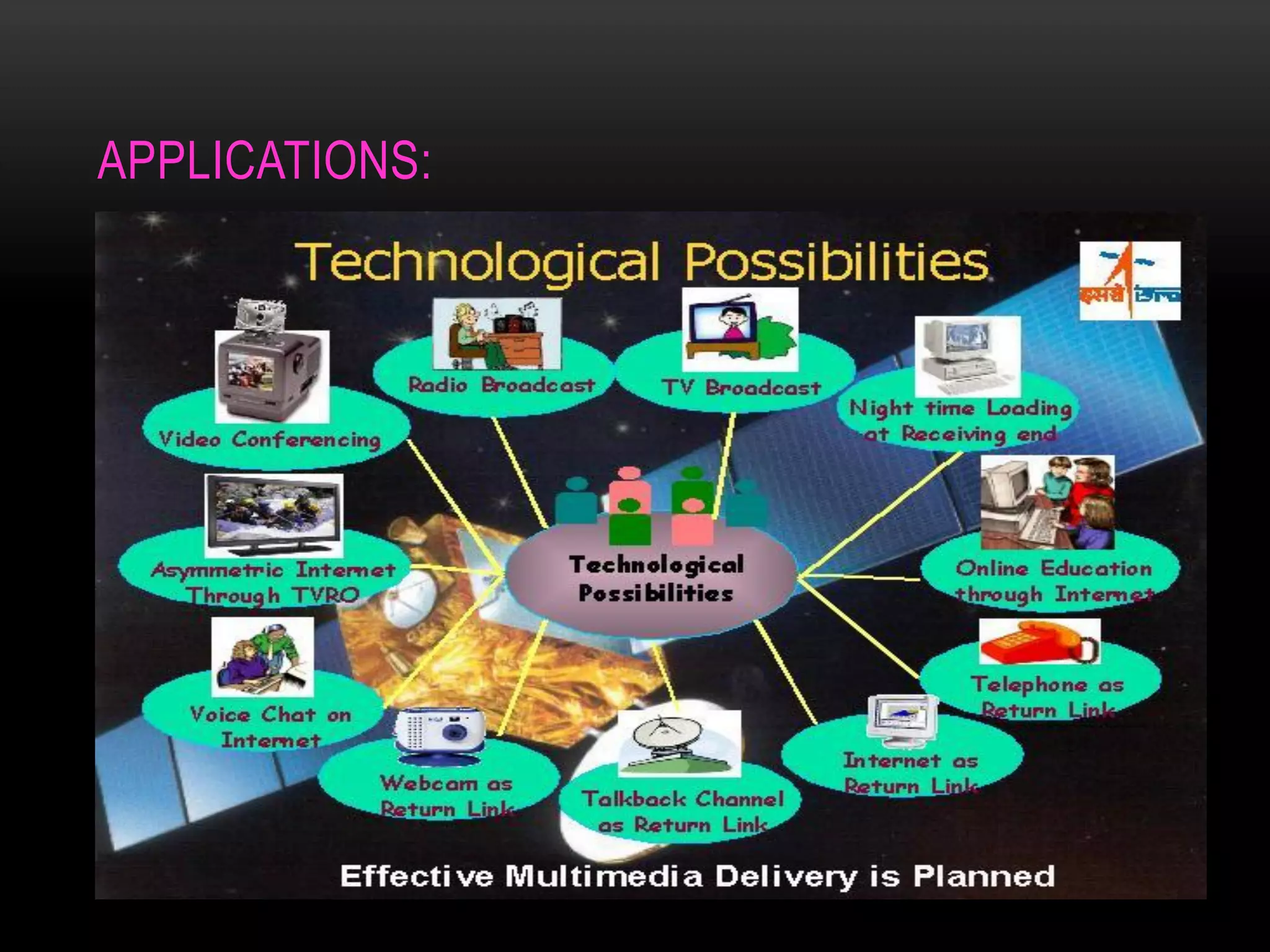
APPLICATIONS:
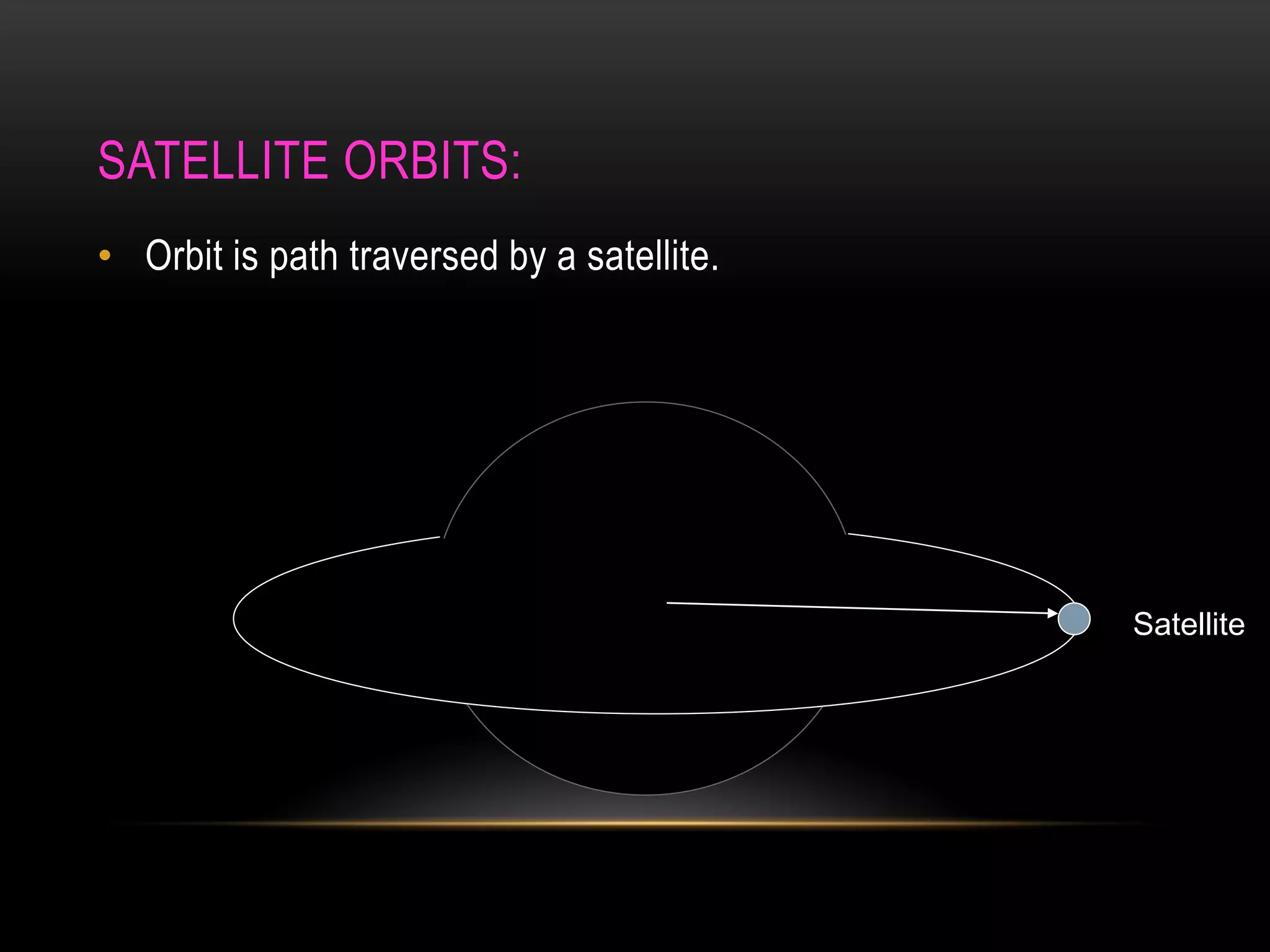
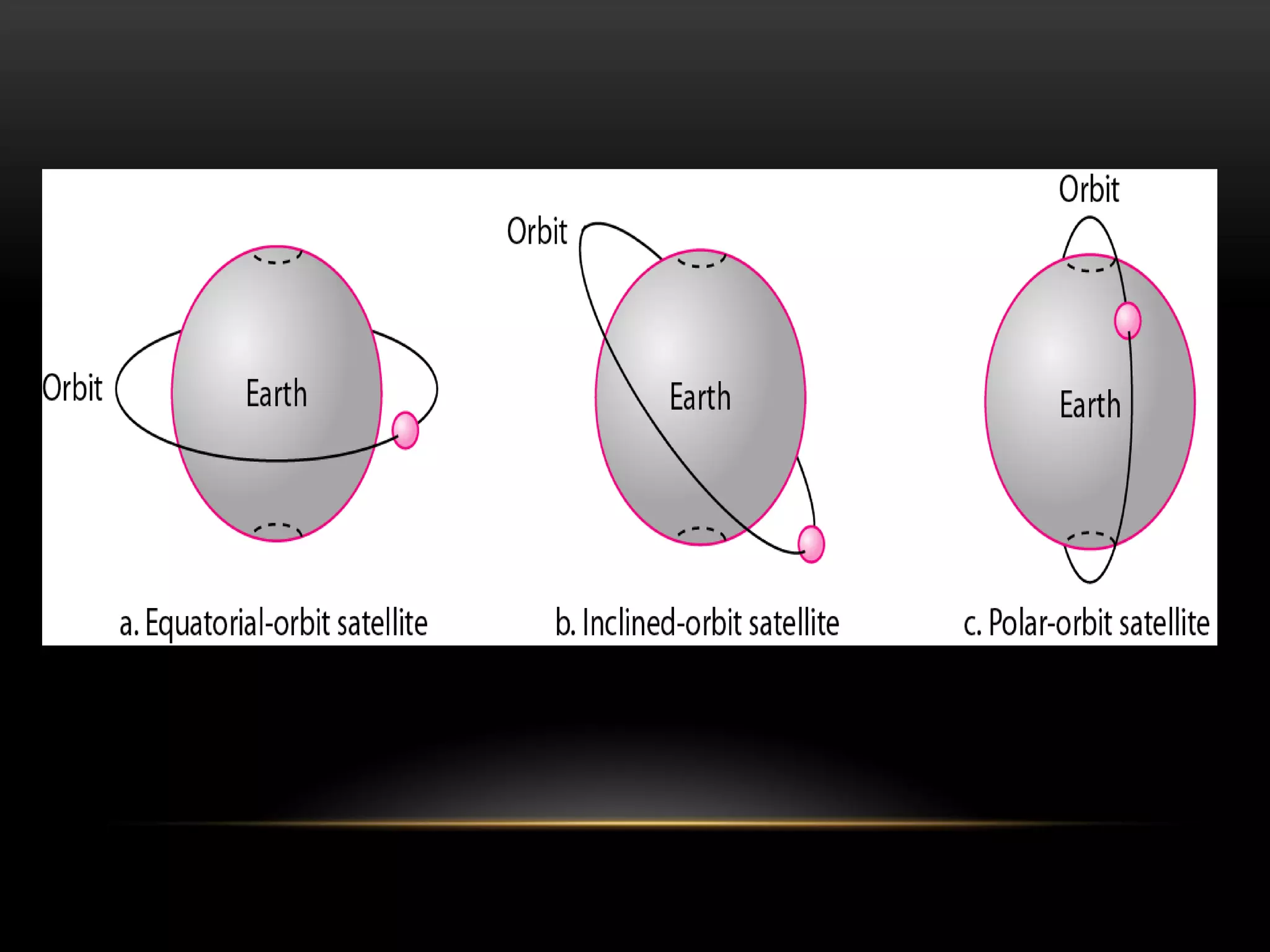
SATELLITE ORBITS:
• Orbit is path traversed by a satellite.
Satellite
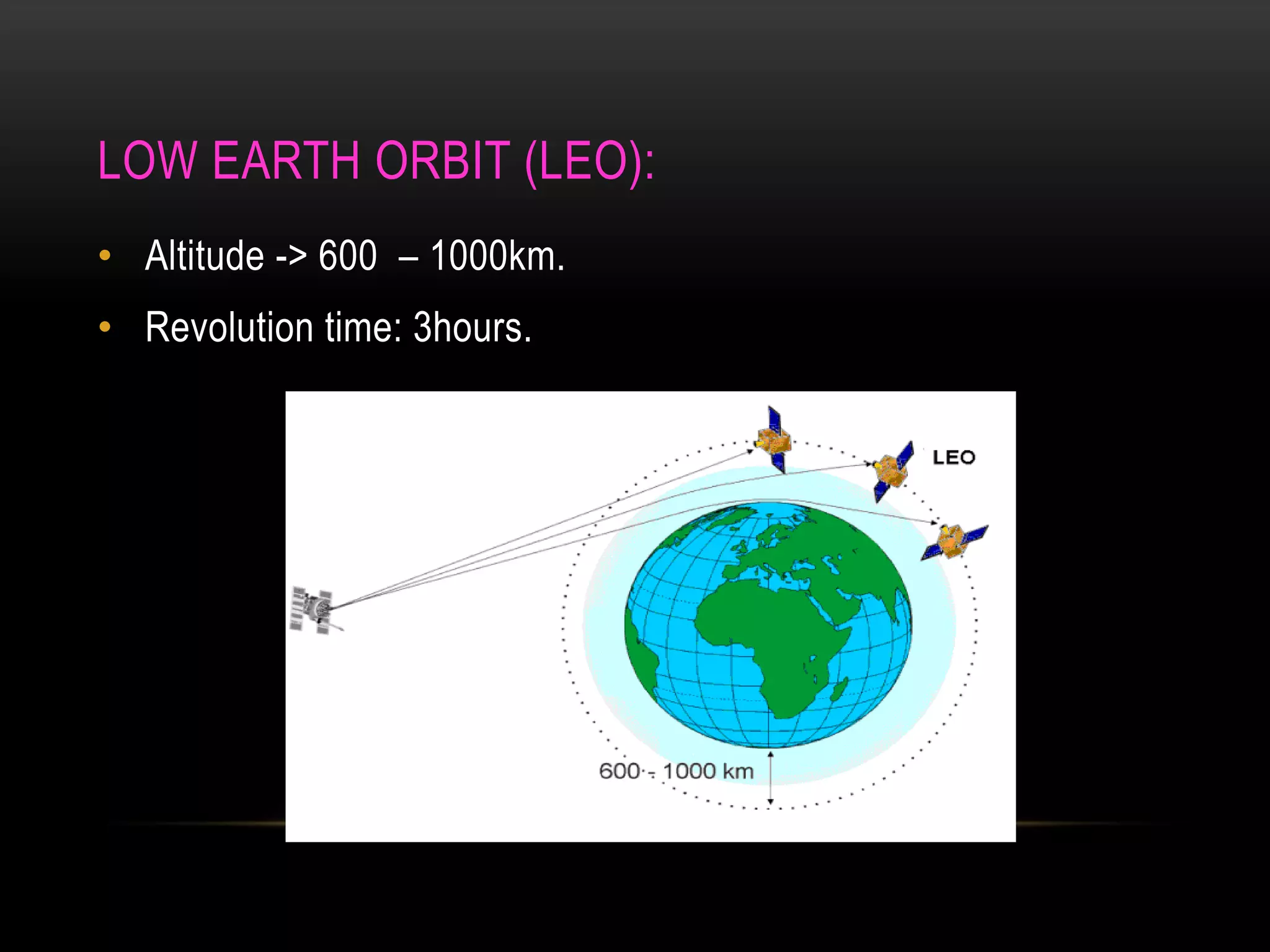
LOW EARTH ORBIT (LEO):
• Altitude -> 600 – 1000km.
• Revolution time: 3hours.
• Advantages-
1. Reduces transmission delay
2. Low transmission power required.
• Disadvantages-
1. Smaller coverage area.
2. A network of at least 6 LEO satellites is required to cover a
region continuously.
3. Shorter life span(5-8yrs) than GEO’s
• Subdivisions- Little, Big and Mega LEO’s.
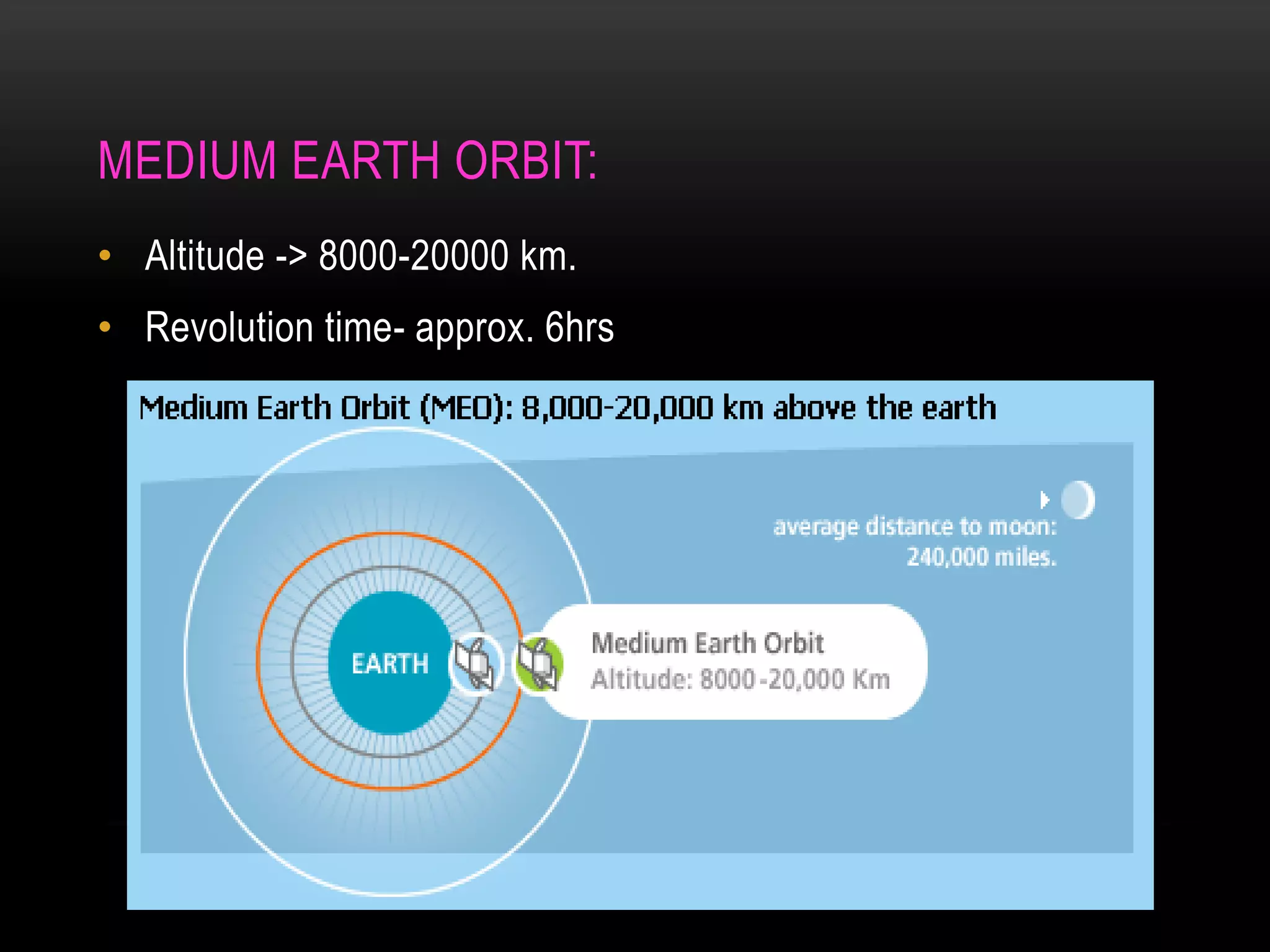
MEDIUM EARTH ORBIT:
• Altitude -> 8000-20000 km.
• Revolution time- approx. 6hrs
• These orbits are primarily reserved for communications
satellites that cover the North and South Pole.
• Unlike the circular orbit of the geostationary satellites, MEOs are
placed in an elliptical (oval-shaped) orbit.
• Approximately a dozen medium Earth orbiting satellites are
necessary to provide continuous global coverage 24 hours a
day.
• Advantages-
1. Slightly longer propagation delays (~40 msec).
2. Slightly higher transmission power required.
• Disadvantages-
1. Coverage spot greater than a LEO, but still less than a GEO.
2. Multiple MEO satellites are still needed to cover a region
continuously.
3. Handovers and satellite tracking are still needed, hence,
high complexity.
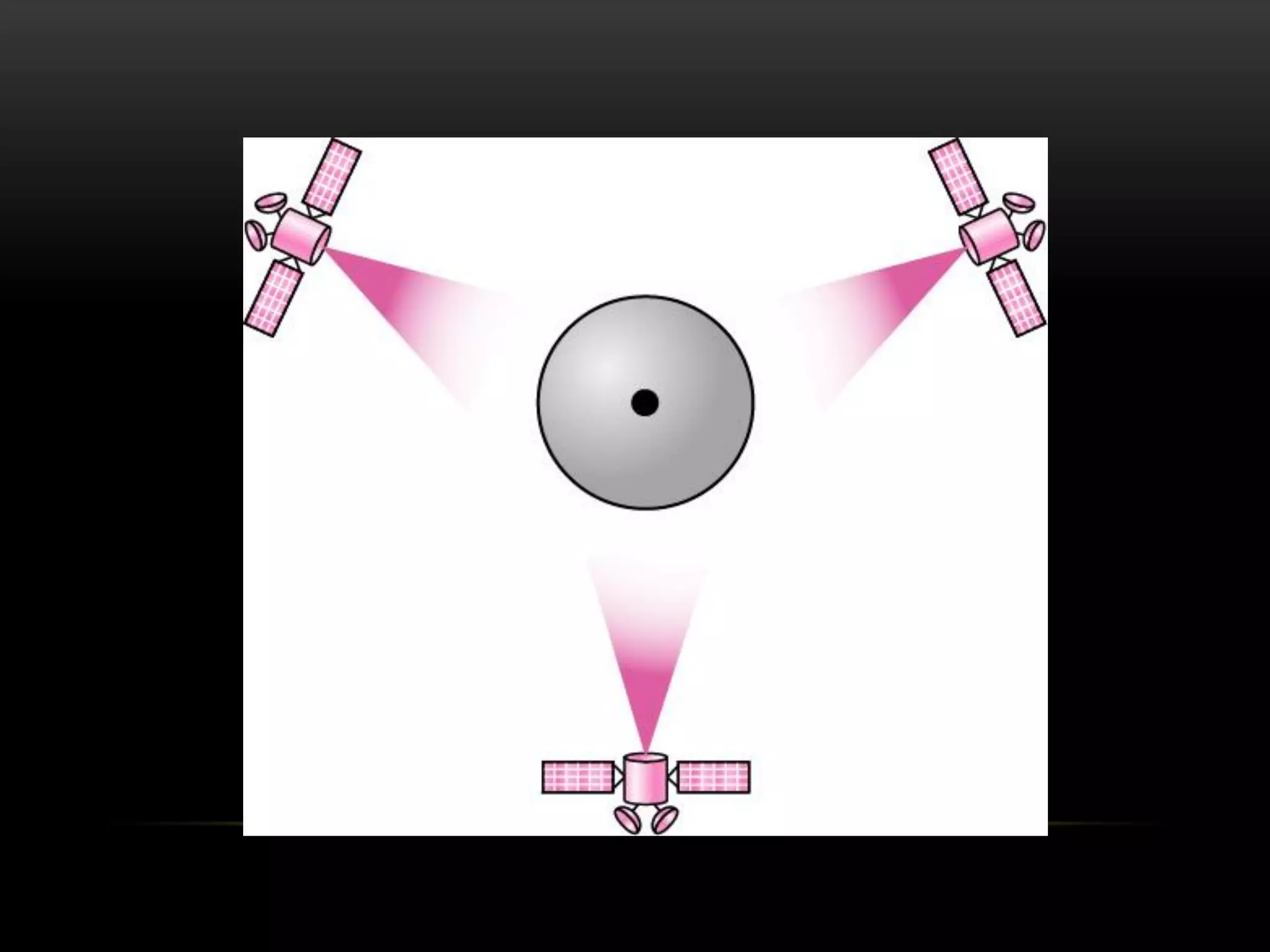
GEOSTATIONARY EARTH ORBIT(GEO):
• Altitude-> 35786 km above earth surface.
• Revolution period- Same as period of earth.
• Satellite in GEO appears to be stationary over a fixed point on
the ground.
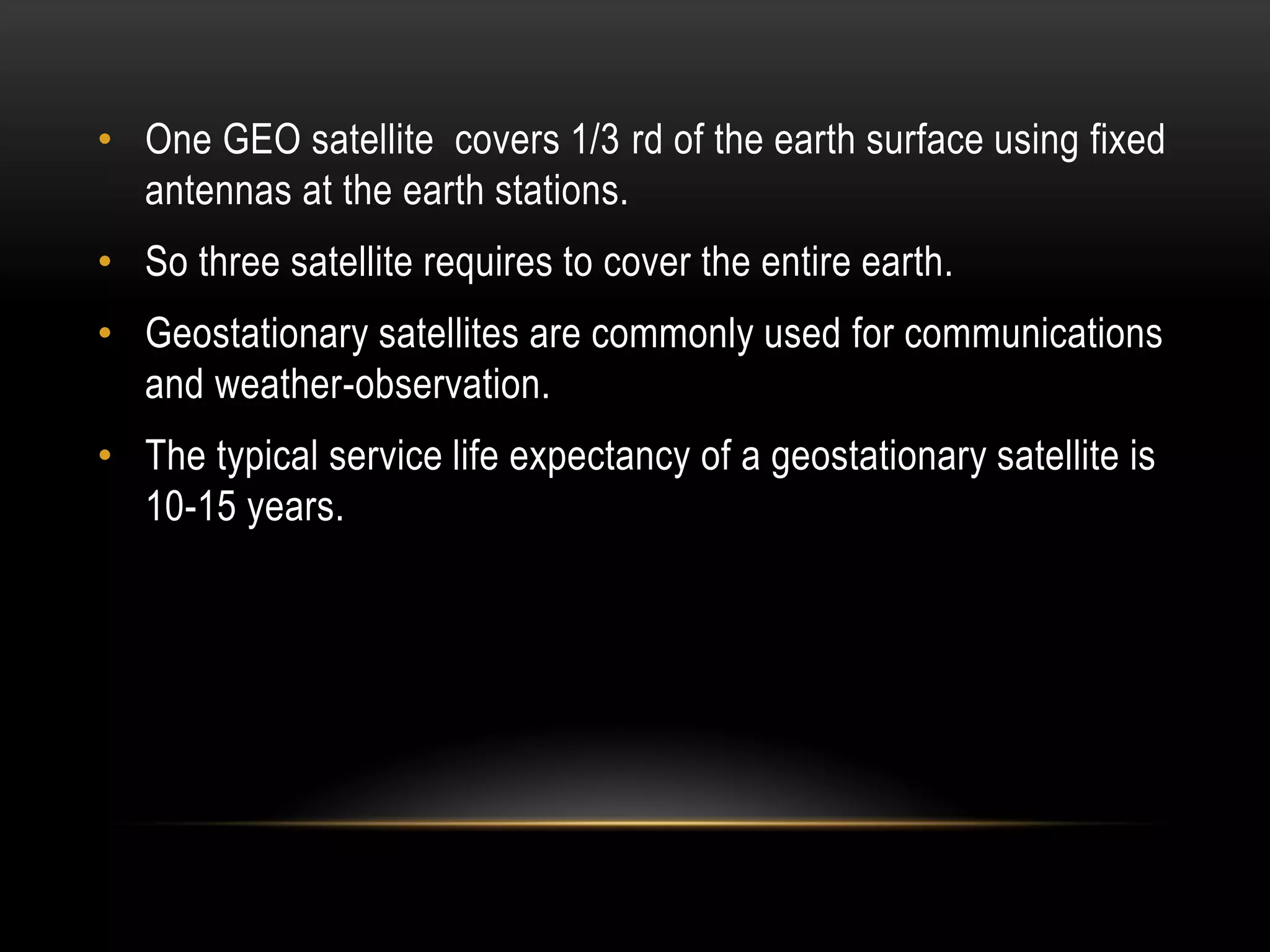
• One GEO satellite covers 1/3 rd of the earth surface using fixed
antennas at the earth stations.
• So three satellite requires to cover the entire earth.
• Geostationary satellites are commonly used for communications
and weather-observation.
• The typical service life expectancy of a geostationary satellite is
10-15 years.
• Advantages-
1. Large coverage area.
2. GEO satellites have a 24 hour view of a particular area.
• Disadvantages-
1. Propagation delay is more.
2. As the distance is more, signal at receiver is very weak
3. GEO satellites, centered above the equator, have difficulty
broadcasting signals to near polar regions.
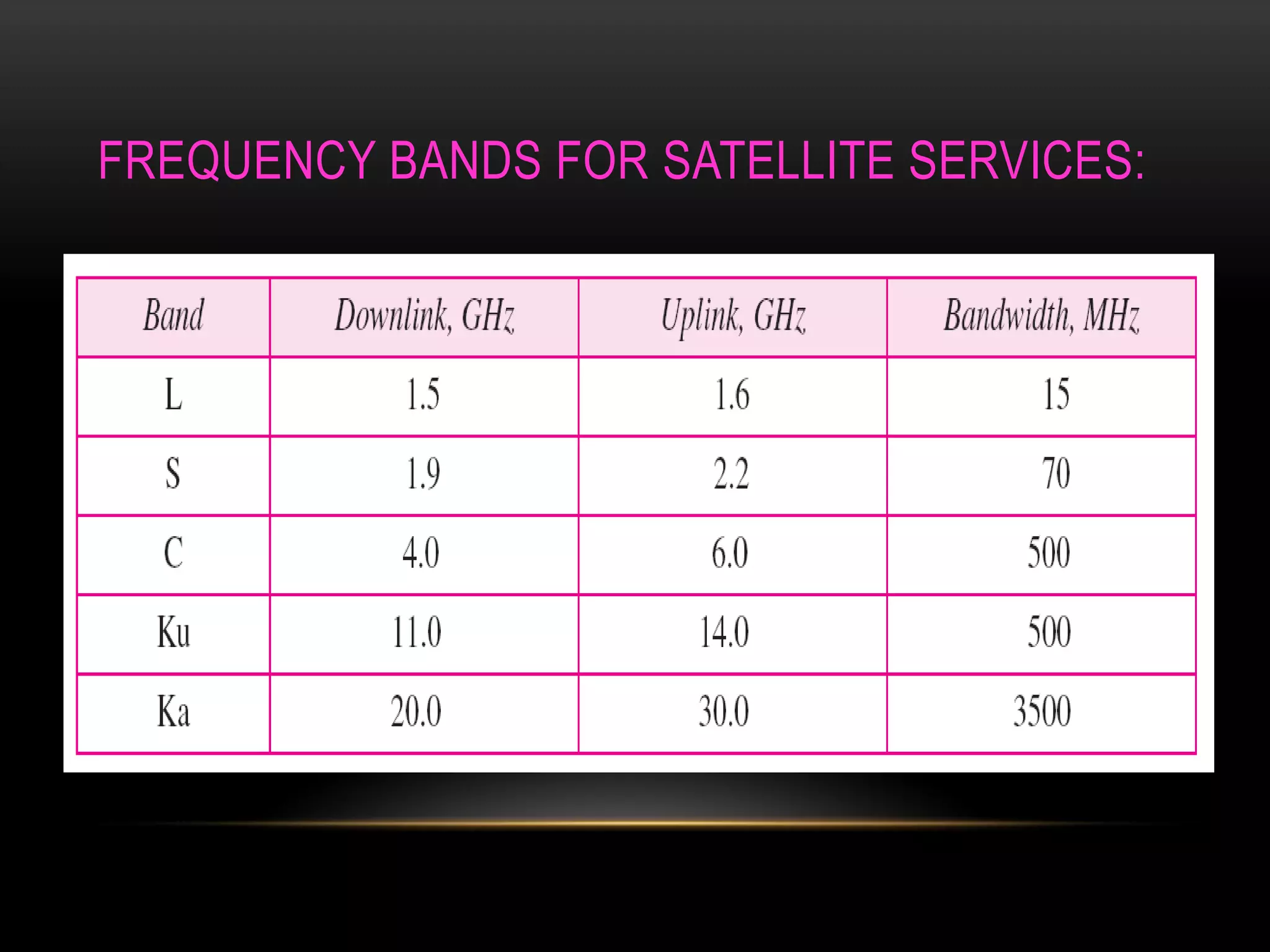
FREQUENCY BANDS FOR SATELLITE SERVICES:
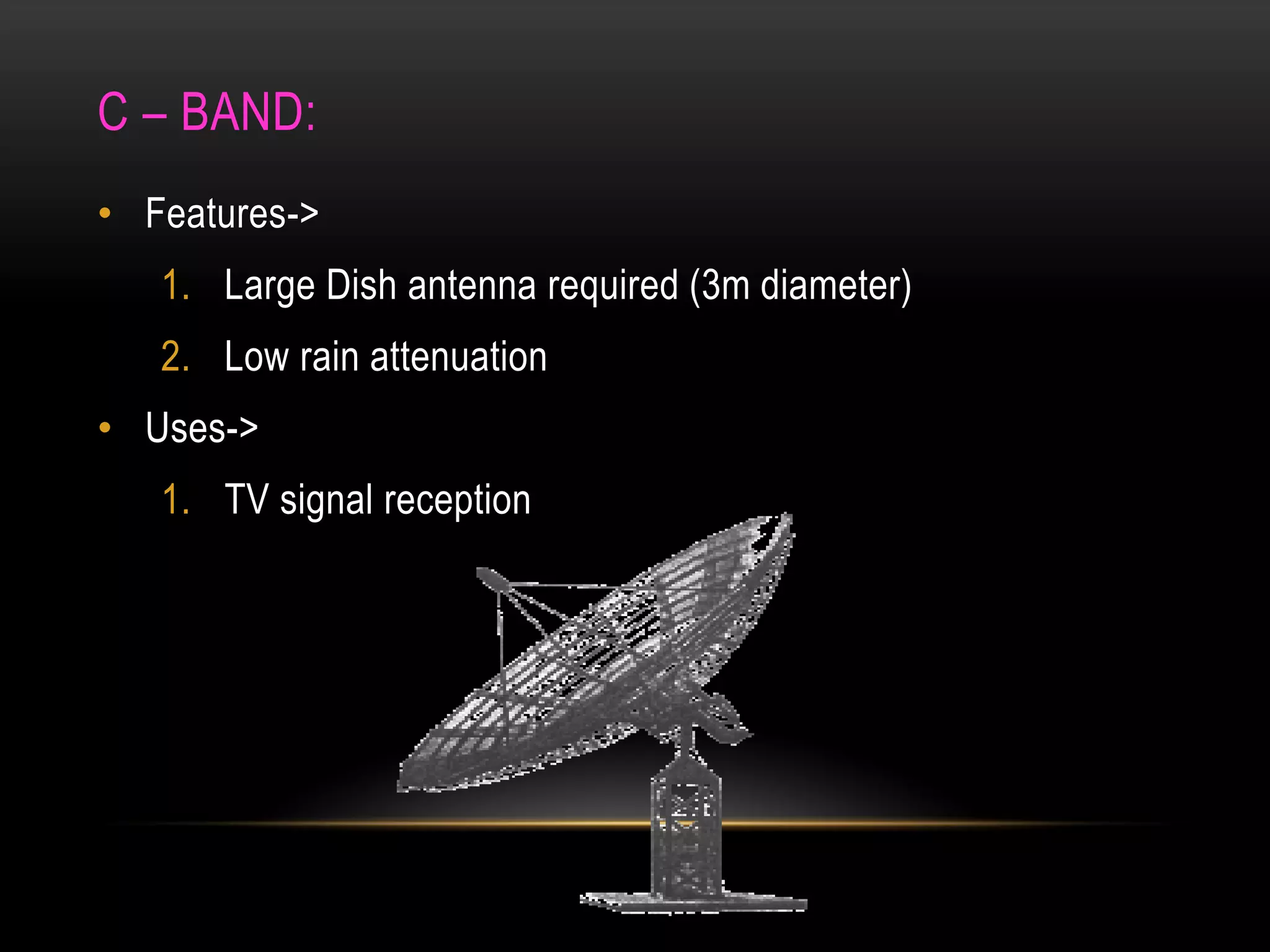
C – BAND:
• Features->
1. Large Dish antenna required (3m diameter)
2. Low rain attenuation
• Uses->
1. TV signal reception
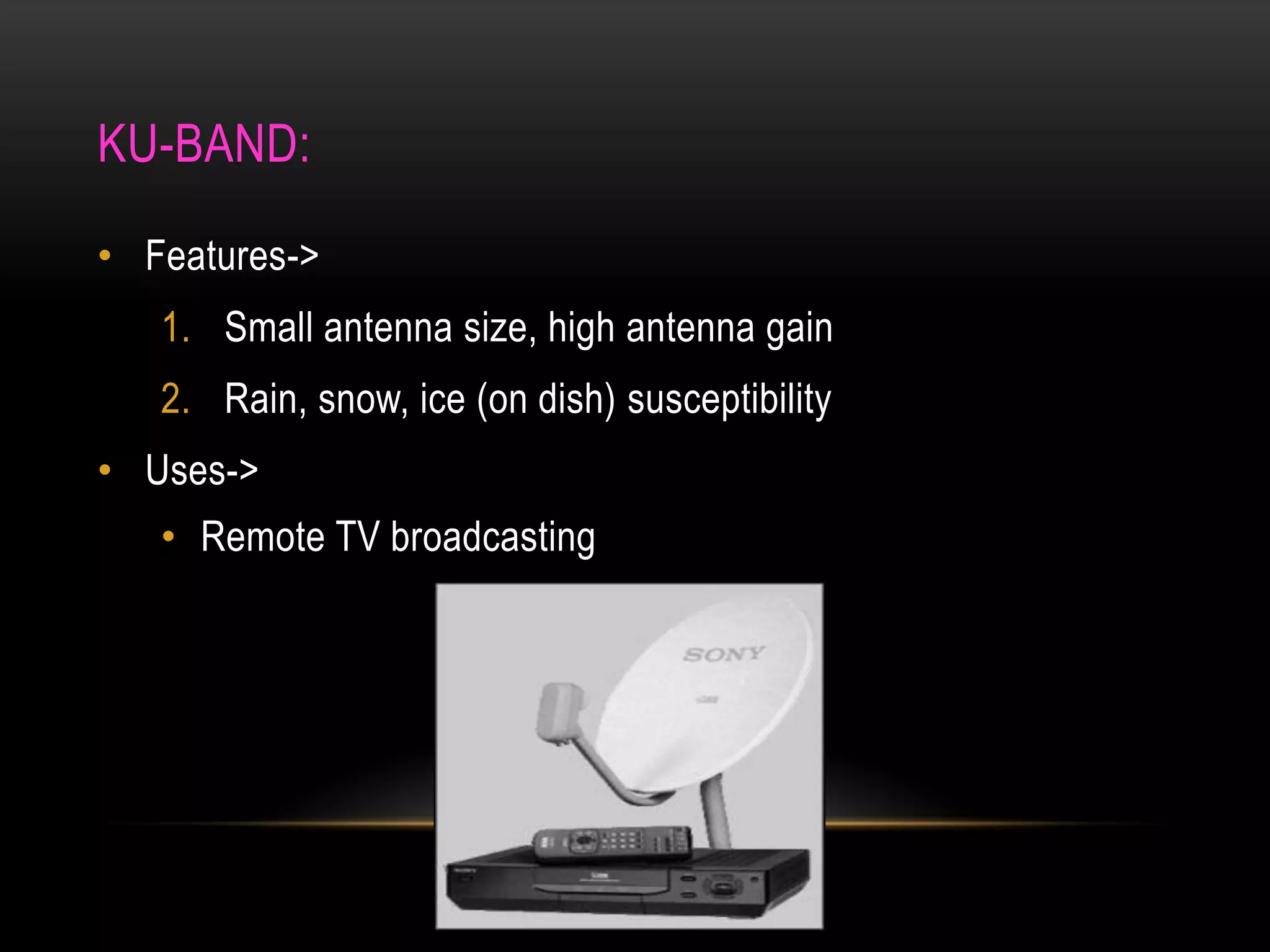
KU-BAND:
• Features->
1. Small antenna size, high antenna gain
2. Rain, snow, ice (on dish) susceptibility
• Uses->
• Remote TV broadcasting

Introduction to satellite communication

  • 1.
    By Ravikiran S. Anande AssistantProfessor rvanande21@gmail.com SATELLITE COMMUNICATION INTRODUCTION
  • 2.
    Communication satellites bringthe world to you anywhere and any time…..
  • 3.
    BACKGROUND: • Telecommunication systemmade it possible to communicate with anyone at any time. • Before the telegraph & telephone, all communication was face- to-face, or in writing. • If you wanted to talk someone, you had to travel to meet with that person. • If you wanted to send information, it had to written down on papers & carried to destination.
  • 4.
    • Telegraph cableslaid across the oceans as early as the mid- 1800s. • Telegraph system used copper wire to carry signals over earth’s surface & across oceans , made possible intercontinental links. • But cables capable of carrying voice signals did not begin service until 1953.
  • 5.
    • In 1945,HF radio was only available method for transcontinental distances. • HF is commonly called as Short Wave (SW). • Operates in 3 to 30 MHz • Not reliable. • Because Sunspots & ionospheric disturbances disrupt HF radio links.
  • 6.
    ORIGIN OF SATELLIECOMMUNICATION: • In 1945, Arthur C. Clarke presented an article named “ Wireless world” in the British Radio magazine. • At that time Arthur C. Clarke was serving in British Royal Air Force.
  • 7.
    • Clarke suggestedthat a radio relay satellite in an equatorial orbit with a period of 24 h would remain stationary with respect to earth’s surface and make possible long distance radio links. • Clarke wrote, there were no rockets powerful enough to launch them.
  • 8.
    HISTORY OF SATELLITECOMMUNICATION: • Satellite communication began in October 1957 with the launch by Russia of a small satellite called Sputnik I. • It’s a first artificial earth satellite and it sparked the space race between United States and Russia. • Sputnik I carried only a beacon transmitter, did not have communication capability. • The first satellite successfully launched by USA was Explorer I on January 1958. • The first voice heard from space was that of US president Eisenhower, who recorded Christmas message that was transmitted back to earth from SCORE satellite in December 1958.
  • 9.
    • The world'sfirst commercial communications satellite was Early Bird (INTELSAT I). • Launched on April 6, 1965 and placed in commercial service after moving into geosynchronous orbit 22,300 miles above the equator. • The satellite weighed a mere 36 kg & incorporated two 6/4 GHz transponders, each with 25 MHz bandwidth. • Early Bird didn't have a battery - and worked only when its solar panels were exposed to the sun.
  • 10.
    1960’S –FIRST SATELLITECOMMUNICATIONS: • 1960 First passive communication satellite (Large balloons, Echo I and II). • 1962: First active communication satellite (Telstar I , MEO). • 1963: First satellite into geostationary (GEO) orbit (Syncom1, communication failed). • 1964: International Telecomm. Satellite Organization (INTELSAT) created. • 1965 First successful communications GEO (Early Bird / INTELSAT 1).
  • 11.
    1970’S –GEO APPLICATIONSDEVELOPMENT, DBS: • 1972 First domestic satellite system operational (Canada). • 1975 First successful direct broadcast experiment (USA-India). • 1975 First successful direct broadcast experiment (USA-India). • 1979 International Mobile Satellite Organization (Inmarsat) established.
  • 12.
    1980’S –GEO APPLICATIONSEXPANDED, MOBILE: • 1981 First reusable launch vehicle flight. • 1982 International maritime communications made operational. • 1984 First direct-to-home broadcast system operational (Japan). • 1987 Successful trials of land-mobile communications (Inmarsat). • 1989-90 Global mobile communication service extended to land mobile and aeronautical use (Inmarsat)
  • 13.
    1990+’S NGSO APPLICATIONSDEVELOPMENT AND GEO EXPANSION • Proposals of non-geostationary (NGSO) systems for mobile communications. • Continuing growth of VSATs around the world. • Spectrum allocation for non-GEO systems. • Continuing growth of DBS. DirectTV created. • Launch of first batch of LEO for hand-held terminals (Iridium). • Voice-service portables and paging-service pocket size mobile terminals launched (Inmarsat). • And continues………………
  • 14.
    WHAT IS SATELLITE? • In astronomical terms, a satellite is a celestial body that orbits around a planet. • Example: The moon is a satellite of Earth. • In Aerospace terms, a satellite is a space vehicle launched by humans and orbits around Earth or another celestial body. • Communications Satellite: It is a microwave repeater in the sky that consists of a diverse combination of one or more components including transmitter, receiver, amplifier, regenerator, filter onboard computer, multiplexer, demultiplexer, antenna, waveguide etc. • A satellite radio repeater is also called transponder. This is usually a combination of transmitter and receiver.
  • 15.
  • 17.
    • Two Stationson Earth want to communicate through radio broadcast but are too far away to use conventional means. • The two stations can use a satellite as a relay station for their communication. • One Earth station transmits the signals to the satellite at Up link frequency. • Up link frequency is the frequency at which Earth station is communicating with a satellite. • The satellite transponder process the signal and sends it to the second Earth station at another frequency called downlink frequency.
  • 18.
    ADVANTAGES OF SATELLITECOMMUNICATION: • Global Availability- Communications satellites cover large geographical area. Customers in rural and remote regions around the world who cannot obtain high speed Internet access from a terrestrial provider are increasingly relying on satellite communications. • Cost Effectiveness- Cost of satellite capacity does not increase with the number of users/receive sites, or with the distance between communication points.
  • 19.
    I • Superior Reliability- Satellitecommunications can operate independently from terrestrial infrastructure. When terrestrial outages occur from man-made and natural events, satellite connections remain operational. • Immediacy and Scalability- Additional receive sites, or nodes on a network, can readily be added, sometimes within hours. All it takes is ground- based equipment. • Superior Performance- Satellite is unmatched for broadcast applications like television.
  • 20.
    DISADVANTAGES OF SATELLITECOMMUNICATION- • Huge initial cost- Satellites are large and expensive, thus there is a large capital cost in building and launching a satellite. • Propagation delay- • Impossibility to repair and maintain- • Noise and interference-
  • 21.
  • 22.
    SATELLITE ORBITS: • Orbitis path traversed by a satellite. Satellite
  • 24.
    LOW EARTH ORBIT(LEO): • Altitude -> 600 – 1000km. • Revolution time: 3hours.
  • 25.
    • Advantages- 1. Reducestransmission delay 2. Low transmission power required. • Disadvantages- 1. Smaller coverage area. 2. A network of at least 6 LEO satellites is required to cover a region continuously. 3. Shorter life span(5-8yrs) than GEO’s • Subdivisions- Little, Big and Mega LEO’s.
  • 26.
    MEDIUM EARTH ORBIT: •Altitude -> 8000-20000 km. • Revolution time- approx. 6hrs
  • 27.
    • These orbitsare primarily reserved for communications satellites that cover the North and South Pole. • Unlike the circular orbit of the geostationary satellites, MEOs are placed in an elliptical (oval-shaped) orbit. • Approximately a dozen medium Earth orbiting satellites are necessary to provide continuous global coverage 24 hours a day.
  • 28.
    • Advantages- 1. Slightlylonger propagation delays (~40 msec). 2. Slightly higher transmission power required. • Disadvantages- 1. Coverage spot greater than a LEO, but still less than a GEO. 2. Multiple MEO satellites are still needed to cover a region continuously. 3. Handovers and satellite tracking are still needed, hence, high complexity.
  • 29.
    GEOSTATIONARY EARTH ORBIT(GEO): •Altitude-> 35786 km above earth surface. • Revolution period- Same as period of earth. • Satellite in GEO appears to be stationary over a fixed point on the ground.
  • 31.
    • One GEOsatellite covers 1/3 rd of the earth surface using fixed antennas at the earth stations. • So three satellite requires to cover the entire earth. • Geostationary satellites are commonly used for communications and weather-observation. • The typical service life expectancy of a geostationary satellite is 10-15 years.
  • 32.
    • Advantages- 1. Largecoverage area. 2. GEO satellites have a 24 hour view of a particular area. • Disadvantages- 1. Propagation delay is more. 2. As the distance is more, signal at receiver is very weak 3. GEO satellites, centered above the equator, have difficulty broadcasting signals to near polar regions.
  • 33.
    FREQUENCY BANDS FORSATELLITE SERVICES:
  • 34.
    C – BAND: •Features-> 1. Large Dish antenna required (3m diameter) 2. Low rain attenuation • Uses-> 1. TV signal reception
  • 35.
    KU-BAND: • Features-> 1. Smallantenna size, high antenna gain 2. Rain, snow, ice (on dish) susceptibility • Uses-> • Remote TV broadcasting