GURU NANAK INSTITUTE OF TECHNOLOGY
(Approved by A.I.C.T.E, New Delhi, Affiliated to JNTU, Hyderabad)
Campus: Ibrahimpatnam, R. R. District, Hyderabad-501506. Ph.08414-202123
DEPARTMENT OF ELECTRICAL AND ELECTRONICS
ENGINEERING
A TECHNICAL SEMINAR REPORT ON
LANDMINE DETECTION USING IMPULSE GROUND
PENETRATING RADAR
BY
D.Nagesh (14831A0211)
CONTENTS
 Introduction
 Block diagram
 Implementation
 Applications
 Advantages
 Limitations
 Future scope
 Conclusion
INTRODUCTION
 Around every 22 minutes one person some where
in the world is killed or injured by a land mine.
 There are nearly 50 million unexploded land mines
in 60 countries around the world.
 Large portions of land go unused due to fear of
mines.
 Modern mines can be constructed with plastics and
composites.
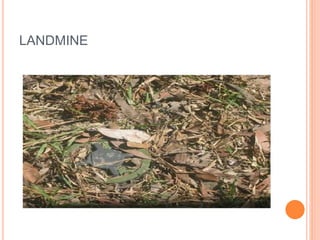
LANDMINE
TECHNOLOGY USED TO DETECT THE
LANDMINE:
 Metal detectors
 Nuclear magnetic resonance
 Thermal imaging and electro optical sensors
 Biological sensors
 Chemical sensors
 Ground penetrating radar
BLOCK DIAGRAM
HARDWARE DESCRIPTION
 Impulse generator(GPR)
 Antenna system
 Pulse extender
 A/D converter
 Processor
 Visual display
GROUND PENETRATING RADAR
WHAT IS GPR?
 The impulse GPR system has been developed in the
International Research Centre for Telecommunications
Transmission and Radar(IRCTR).
 This ultra wide band radar provide centimeter resolution
to locate even small targets.
 Two distinct types of GPR are present namely Time
domain, Frequency domain.
 Time domain or Impulse GPR transmits discrete pulses
of nano sec duration and digitize the return at GHZ
sample rate.
 Frequency domain GPR system transmit single
frequency & amplitude & phase of the return signal is
measured.
BASIC PRINCIPLE OF GPR
ANTENNA SYSTEM
 The GPR system performance strongly depends on
the antenna system.
 The antenna system consist of transmitter and
receiver.
 The transmit antenna should :
Radiate Ultra-Wideband
Radiate Electro-magnetic energy
PULSE EXTENDER
 It will amplify the ground reflection signal up to the
maximum level acquired A/D converter.
 It amplify the samples of digital signals which are
converted from analog signal.
A/D CONVERTER
 The transmitter sends out a series of EM pulses
then listens with the receiver connected to high
speed samples which in-turn feeds to A/D
converter.
 This information is converted from nanosecond to
millisecond.
 It provides 12 bit accuracy and 66dB linear dynamic
range.
PROCESSOR
 The processor filters the signals.
 This signals shows presence or absence of
surrogate mine in the soil.
 Processor selects the mine detecting signal and
passes to the visual display.
VISUAL DISPLAY
 It helps to see the range of targets.
 It displays the position of land mine.
IMPLEMENTATION
 The impulse generator produces 0.8ns monocycle
pulse.
 GPR uses a high frequency radio signal that is
transmitted by the antenna and travels downward
until it hits an object that has different electrical
properties from the surrounding medium then its get
scattered from the object and receive by the
receiver antenna and stored on digital media.
 The computer measures the time taken for a pulse to
travel from the target which indicates its depth and
location. The reflected signals are interpreted by the
system and displayed on the unit's LCD panel in the
form of image.
 If the wave hits a buried object, then part of the
waves energy is reflected back to the surface, while
part of its energy continues to travel downward. The
wave that is reflected back to the surface is captured
by a receive antenna, and recorded on a digital
storage device for later interpretation.
 The GPR method measures the travel time of
electromagnetic impulses in subsurface materials.
 Antenna is able to detect and measure the depth of
reflecting discontinuities in subsurface.
APPLICATIONS
 GPR has many applications in number of fields:
 In case of Earth science it is used to study bedrocks ,soils ,
ground water and ice.
 Engineering applications include non-destructive testing of
structures and pavements, locating buried structures and
studying of soils.
 Military uses include detection of mines ,unexploded ordnance
and tunnels.
ADVANTAGES
 GPR has accurate measurements.
 GPR locates even a small targets.
 It has been well founded by the defense.
 GPR operates by detecting the dielectric soils when
allows it to locate even no metallic mines.
 GPR has been tested in different environmental
conditions.
FUTURE SCOPE
 US army handheld standoff mine detection system that is a
self propelled cart with GPR system. As technological
development for land mine detection tends to be a vehicular
based system. This vehicular based system is shown in figure.
 Plans to speed up the scan rate with advanced arrays are
under the way.
CONCLUSION
 Impulse GPR system is used for detecting anti-tank
and antipersonnel mines.
 Through iterative design, build test cycles, and
scored testing at Army mine lanes, steady progress
is being made.
Land mine ppt

Land mine ppt

  • 1.
    GURU NANAK INSTITUTEOF TECHNOLOGY (Approved by A.I.C.T.E, New Delhi, Affiliated to JNTU, Hyderabad) Campus: Ibrahimpatnam, R. R. District, Hyderabad-501506. Ph.08414-202123 DEPARTMENT OF ELECTRICAL AND ELECTRONICS ENGINEERING A TECHNICAL SEMINAR REPORT ON LANDMINE DETECTION USING IMPULSE GROUND PENETRATING RADAR BY D.Nagesh (14831A0211)
  • 2.
    CONTENTS  Introduction  Blockdiagram  Implementation  Applications  Advantages  Limitations  Future scope  Conclusion
  • 3.
    INTRODUCTION  Around every22 minutes one person some where in the world is killed or injured by a land mine.  There are nearly 50 million unexploded land mines in 60 countries around the world.  Large portions of land go unused due to fear of mines.  Modern mines can be constructed with plastics and composites.
  • 4.
  • 5.
    TECHNOLOGY USED TODETECT THE LANDMINE:  Metal detectors  Nuclear magnetic resonance  Thermal imaging and electro optical sensors  Biological sensors  Chemical sensors  Ground penetrating radar
  • 6.
  • 7.
    HARDWARE DESCRIPTION  Impulsegenerator(GPR)  Antenna system  Pulse extender  A/D converter  Processor  Visual display
  • 8.
  • 9.
    WHAT IS GPR? The impulse GPR system has been developed in the International Research Centre for Telecommunications Transmission and Radar(IRCTR).  This ultra wide band radar provide centimeter resolution to locate even small targets.  Two distinct types of GPR are present namely Time domain, Frequency domain.  Time domain or Impulse GPR transmits discrete pulses of nano sec duration and digitize the return at GHZ sample rate.  Frequency domain GPR system transmit single frequency & amplitude & phase of the return signal is measured.
  • 10.
  • 11.
    ANTENNA SYSTEM  TheGPR system performance strongly depends on the antenna system.  The antenna system consist of transmitter and receiver.  The transmit antenna should : Radiate Ultra-Wideband Radiate Electro-magnetic energy
  • 12.
    PULSE EXTENDER  Itwill amplify the ground reflection signal up to the maximum level acquired A/D converter.  It amplify the samples of digital signals which are converted from analog signal.
  • 13.
    A/D CONVERTER  Thetransmitter sends out a series of EM pulses then listens with the receiver connected to high speed samples which in-turn feeds to A/D converter.  This information is converted from nanosecond to millisecond.  It provides 12 bit accuracy and 66dB linear dynamic range.
  • 14.
    PROCESSOR  The processorfilters the signals.  This signals shows presence or absence of surrogate mine in the soil.  Processor selects the mine detecting signal and passes to the visual display.
  • 15.
    VISUAL DISPLAY  Ithelps to see the range of targets.  It displays the position of land mine.
  • 16.
    IMPLEMENTATION  The impulsegenerator produces 0.8ns monocycle pulse.  GPR uses a high frequency radio signal that is transmitted by the antenna and travels downward until it hits an object that has different electrical properties from the surrounding medium then its get scattered from the object and receive by the receiver antenna and stored on digital media.  The computer measures the time taken for a pulse to travel from the target which indicates its depth and location. The reflected signals are interpreted by the system and displayed on the unit's LCD panel in the form of image.
  • 17.
     If thewave hits a buried object, then part of the waves energy is reflected back to the surface, while part of its energy continues to travel downward. The wave that is reflected back to the surface is captured by a receive antenna, and recorded on a digital storage device for later interpretation.  The GPR method measures the travel time of electromagnetic impulses in subsurface materials.  Antenna is able to detect and measure the depth of reflecting discontinuities in subsurface.
  • 18.
    APPLICATIONS  GPR hasmany applications in number of fields:  In case of Earth science it is used to study bedrocks ,soils , ground water and ice.  Engineering applications include non-destructive testing of structures and pavements, locating buried structures and studying of soils.  Military uses include detection of mines ,unexploded ordnance and tunnels.
  • 19.
    ADVANTAGES  GPR hasaccurate measurements.  GPR locates even a small targets.  It has been well founded by the defense.  GPR operates by detecting the dielectric soils when allows it to locate even no metallic mines.  GPR has been tested in different environmental conditions.
  • 20.
    FUTURE SCOPE  USarmy handheld standoff mine detection system that is a self propelled cart with GPR system. As technological development for land mine detection tends to be a vehicular based system. This vehicular based system is shown in figure.  Plans to speed up the scan rate with advanced arrays are under the way.
  • 21.
    CONCLUSION  Impulse GPRsystem is used for detecting anti-tank and antipersonnel mines.  Through iterative design, build test cycles, and scored testing at Army mine lanes, steady progress is being made.