Mansoura University
Faculty of Computers and Information
Information Systems Department
By
Ahmed Ismail
B.SC. Of Information Systems
Faculty of computers and Information
Mansoura University
Landmines Detection By Using Mobile Robots
" ‫اآللى‬ ‫االنسان‬ ‫باستخدام‬ ‫اآلرضية‬ ‫اآللغام‬ ‫عن‬ ‫"الكشف‬
Assoc. Prof. Hazem ElBakry
Department of Information Systems,
Faculty of Computers and Information
Mansoura University
Assoc. Prof. Mohamed Elmogy
Department of Information Technology,
Faculty of Computers and Information,
Mansoura University
Under Supervision of
Outline
1. Objectives & Contributions
2. Introduction
3. Related Work
4. Proposed System
5. Experimental and Results
6. Conclusion
7. Future Work
Outline
1. Motivations & Objectives & Contributions
2. Introduction
3. Related Work
4. Proposed System
5. Experimental and Results
6. Conclusion
7. Future Work
Motivations
We developed our low cost demining robot for the
following purposes:
1-Every landmines detection technique has error rates.
2-The landmines still there, due to the limited
performance of available techniques.
3-In the last years, many demining researches used
GPR is very expensive ,very heavy ,and power hungry.
Objectives
 Designing a low-cost mobile robot.
 Proposing a method to detect landmines by integrating
more than one technique.
 Using effective motion planning algorithm .
 Ensuring the demining operators safety.
 Designing an autonomous low cost light mobile robot .
 Effective motion planning in mines detection and saves time.
 Using Multisensor fusion in demining.
 Developing affective object avoidance algorithm.
 We implemented a system uses effective technique to defuse
the mines where they are.
Contributions
Outline
1. Objectives & Contributions
2. Introduction
3. Related Work
4. Proposed System
5. Experimental and Results
6. Conclusion
7. Future Work
Introduction
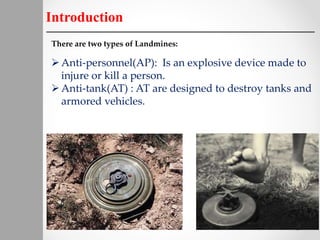
There are two types of Landmines:
Anti-personnel(AP): Is an explosive device made to
injure or kill a person.
Anti-tank(AT) : AT are designed to destroy tanks and
armored vehicles.
Introduction(cont.)
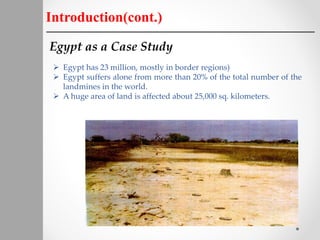
Egypt as a Case Study
 Egypt has 23 million, mostly in border regions)
 Egypt suffers alone from more than 20% of the total number of the
landmines in the world.
 A huge area of land is affected about 25,000 sq. kilometers.
Introduction(cont.)
Technologies are used for landmine detection are:
 Humanitarian demining
1. Metal detector
2. Dogs 5-Bactria
3. Rats 6-Plants
4. Honey bees
 Mechanical clearance
 Advanced electromagnetic methods
1. Ground penetrating radar
2. Nuclear detection
3. Acoustic detection
4. Biological sensors
5. Chemical sensors such as thermal fluorescence
Introduction(cont.)
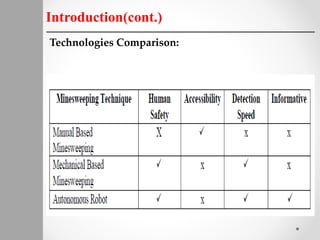
Technologies Comparison:
Outline
1. Objectives & Contributions
2. Introduction
3. Related Work
4. Proposed System
5. Experimental and Results
6. Conclusion
7. Future Work
Related Work
 Akhtar [2012] Used GPR to captures an image in real-
time.
• Fed into a processing unit where smaller segments of
it, analyzed after being processed for noise reduction.
• Then recognized and classified landmines with
success rate 90%
• This scheme has some drawbacks:
• The sensor such as GPR is larger and heavier.
• GPR is more power hungry.
• GPR can suffer falls alarm rates as high as metal detectors.
Related Work (cont.)
 Ghribi et al. [2013] developed a cheap
wheeled robot that could detect only metal
mines.
 The robot mounted on a metal detector to
detect mines.
 The system used to color paint to mark the
position of detected mines. This scheme has
some drawbacks:
 high false alarms due to metal objects in the
soil.
Related Work (cont.)
Garcia et al [2002] proposed awaking robot for
detecting and locating antipersonnel landmines,
consisted of: ahead with detector, locator with GPS.
• The robot was controlled remotely
• There is some drawback in their scheme, such as
High cost
The robot can be triggered
False alarms
Outline
1. Objectives & Contributions
2. Introduction
3. Related Work
4. Proposed System
5. Experimental and Results
6. Conclusion
7. Future Work
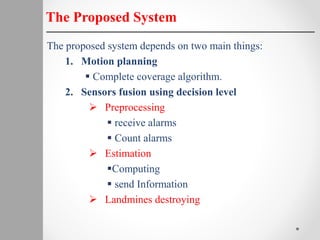
The proposed system depends on two main things:
1. Motion planning
 Complete coverage algorithm.
2. Sensors fusion using decision level
 Preprocessing
 receive alarms
 Count alarms
 Estimation
Computing
 send Information
 Landmines destroying
The Proposed System
The Proposed System(cont.)
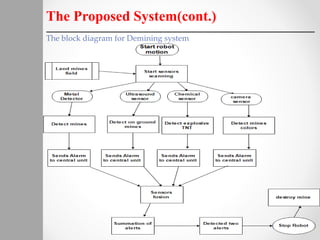
The block diagram for Demining system
The Proposed System(cont.)
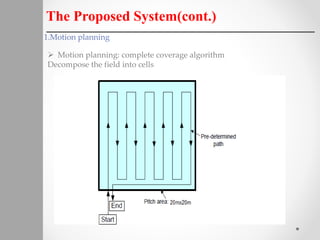
1.Motion planning
 Motion planning: complete coverage algorithm
Decompose the field into cells
The Proposed System(cont.)
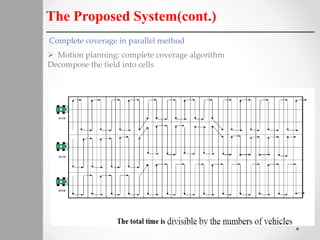
Complete coverage in parallel method
 Motion planning: complete coverage algorithm
Decompose the field into cells
The Proposed System(cont.)
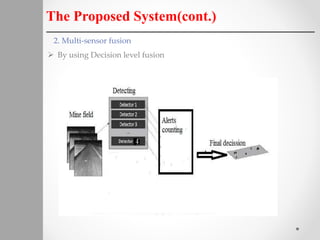
2. Multi-sensor fusion
 By using Decision level fusion
The Proposed System(cont.)
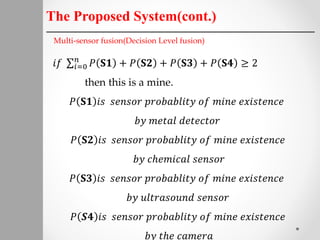
Multi-sensor fusion(Decision Level fusion)
𝑖𝑓 𝑖=0
𝑛
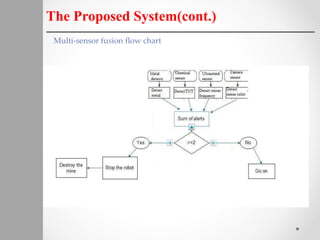
𝑃 𝐒𝟏 + 𝑃 𝐒𝟐 + 𝑃 𝐒𝟑 + 𝑃 𝐒𝟒 ≥ 2
then this is a mine.
𝑃 𝐒𝟏 𝑖𝑠 𝑠𝑒𝑛𝑠𝑜𝑟 𝑝𝑟𝑜𝑏𝑎𝑏𝑙𝑖𝑡𝑦 𝑜𝑓 𝑚𝑖𝑛𝑒 𝑒𝑥𝑖𝑠𝑡𝑒𝑛𝑐𝑒
𝑏𝑦 𝑚𝑒𝑡𝑎𝑙 𝑑𝑒𝑡𝑒𝑐𝑡𝑜𝑟
𝑃 𝐒𝟐 𝑖𝑠 𝑠𝑒𝑛𝑠𝑜𝑟 𝑝𝑟𝑜𝑏𝑎𝑏𝑙𝑖𝑡𝑦 𝑜𝑓 𝑚𝑖𝑛𝑒 𝑒𝑥𝑖𝑠𝑡𝑒𝑛𝑐𝑒
𝑏𝑦 𝑐ℎ𝑒𝑚𝑖𝑐𝑎𝑙 𝑠𝑒𝑛𝑠𝑜𝑟
𝑃 𝐒𝟑 𝑖𝑠 𝑠𝑒𝑛𝑠𝑜𝑟 𝑝𝑟𝑜𝑏𝑎𝑏𝑙𝑖𝑡𝑦 𝑜𝑓 𝑚𝑖𝑛𝑒 𝑒𝑥𝑖𝑠𝑡𝑒𝑛𝑐𝑒
𝑏𝑦 𝑢𝑙𝑡𝑟𝑎𝑠𝑜𝑢𝑛𝑑 𝑠𝑒𝑛𝑠𝑜𝑟
𝑃 𝑺𝟒 𝑖𝑠 𝑠𝑒𝑛𝑠𝑜𝑟 𝑝𝑟𝑜𝑏𝑎𝑏𝑙𝑖𝑡𝑦 𝑜𝑓 𝑚𝑖𝑛𝑒 𝑒𝑥𝑖𝑠𝑡𝑒𝑛𝑐𝑒
𝑏𝑦 𝑡ℎ𝑒 𝑐𝑎𝑚𝑒𝑟𝑎
The Proposed System(cont.)
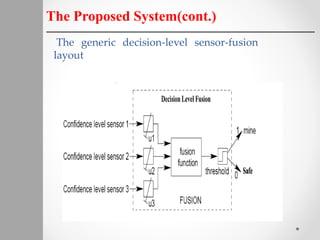
The generic decision-level sensor-fusion
layout
The Proposed System(cont.)
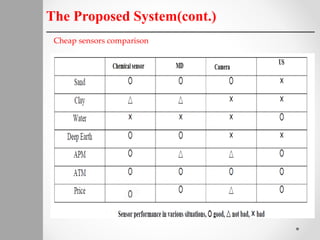
Cheap sensors comparison
The Proposed System(cont.)
Multi-sensor fusion flow chart
The Proposed System(cont.)
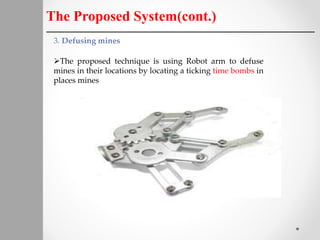
3. Defusing mines
The proposed technique is using Robot arm to defuse
mines in their locations by locating a ticking time bombs in
places mines
Outline
1. Objectives & Contributions
2. Introduction
3. Related Work
4. Proposed System
5. Experimental and Results
6. Conclusion
7. Future Work
Experimental results
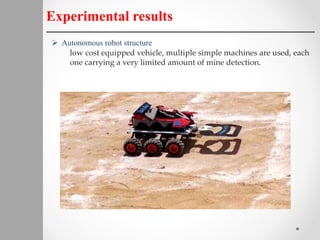
 Autonomous robot structure
low cost equipped vehicle, multiple simple machines are used, each
one carrying a very limited amount of mine detection.
Experimental results
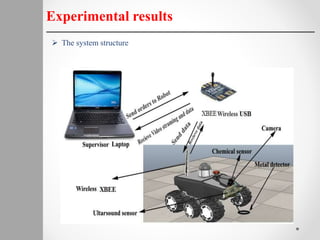
 The system structure
Experimental results
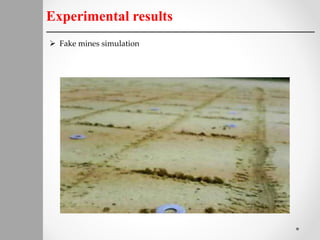
 Fake mines simulation
Experimental results
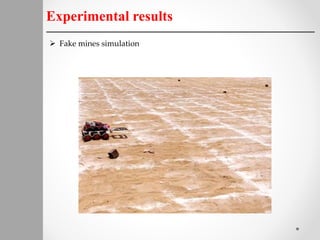
 Fake mines simulation
Experimental results
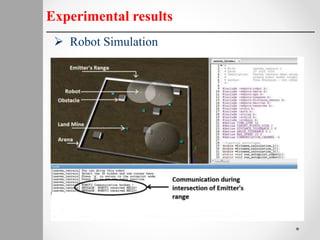
 Robot Simulation
Experimental results
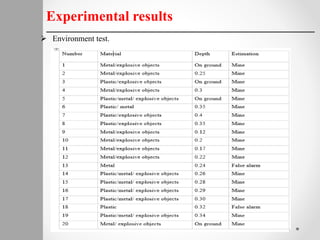
 Environment test.
Experimental results
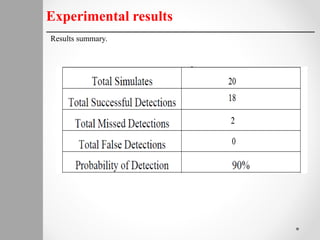
Results summary.
Outline
1. Objectives & Contributions
2. 3D Object Recognition
3. Related Work
4. Proposed System
5. Experimental and Results
6. Conclusion
7. Future Work
Conclusion
Conclusion(cont.)
• The robot uses a coverage algorithm technique
where explicitly passes over all points in the
minefield at least once.
• The algorithm guarantees complete coverage of
unknown areas for ensuring the detected mines
existence.
• The experimental results proved that using
multisensor system using decision level
fusion when robot move in coverage based
motion decreased the false alarms.
Conclusion(cont.)
• Our Result proved that using more than one
low-cost sensors is better than using the best
sensor alone.
• Demining can be done with very low cost
with only $140.
• The overall demining process has no risks to
a human operator with using very small and
light sensors.
Conclusion(cont.)
• The more obstacles are in the field; the
longer time the overall process takes.
• So Using fails to clean the field from
obstacles before demining is a critical step.
• using many robots with the same design,
which work together in parallel way solved
the time problem
Conclusion(cont.)
• The robot can detect landmines with high
detection rates.
• The use of multi-sensor fusion solved the
problem of high rates of false alarms of
demining sensors.
• Destroying the mines where they are, is
better than forming maps of found mines
and then defusing them.
Outline
1. Objectives & Contributions
2. Introduction
3. Related Work
4. Proposed System
5. Experimental and Results
6. Conclusion
7. Future Work
using one expensive metal detector sensor that will be better
to increase detection distance underground more than 60 cm.
Test the robot in real mines field
I suggest for the new researchers in demining try to use
nanotechnology or Either that will increase the efficiency of
landmines detection.
Using crawler robot will be better than wheels robots in
demining process.
Testing the robot in real environments.
Future Work
 A. Ismail, M. Elmogy, H. ElBakry, " Landmines Detection
Using Autonomous Robots: A Survey", International Journal
of Emerging Trends & Technology in Computer Science
(IJETTCS), Volume 3, Issue 4, 4, July-August 2014.
 A. Ismail, M. Elmogy, H. ElBakry, "Landmines Detection
Using Low-Cost Multisensory Mobile Robot", Journal of
Convergence Information Technology, Volume 3, Issue 4,
2015.
Publications
References
• Y.Baudoin, and I.Doroftei," TriDem-A Wheeled Mobile Robot for
Humanitarian Mine Clearance", Citeseer, 2012
• A.Muhammad, S. Abbas, T.Manzoor,A. Munawar,S. Abbas,M.
Hayat,A. Abbas,and M.Awais," Marwa: A rough terrain landmine
detection robot for low budgets",cyphynets.lums.edu.pk,2012.
• A.Alshbatat," Behavior-Based Approach for the Detection of Land
Mines Utilizing off the Shelf Low Cost Autonomous Robot",IAES
International Journal of Robotics and Automation (IJRA),2,83-
92,2013
• G.Tesfamariam, "Signal Processing Techniques for Landmine
Detection Using Impulse Ground Penetrating Radar
(ImGPR)", TU Darmstadt, 2013
Landmines Detection by Robots  presentation

Landmines Detection by Robots presentation

  • 2.
    Mansoura University Faculty ofComputers and Information Information Systems Department By Ahmed Ismail B.SC. Of Information Systems Faculty of computers and Information Mansoura University Landmines Detection By Using Mobile Robots " ‫اآللى‬ ‫االنسان‬ ‫باستخدام‬ ‫اآلرضية‬ ‫اآللغام‬ ‫عن‬ ‫"الكشف‬ Assoc. Prof. Hazem ElBakry Department of Information Systems, Faculty of Computers and Information Mansoura University Assoc. Prof. Mohamed Elmogy Department of Information Technology, Faculty of Computers and Information, Mansoura University Under Supervision of
  • 3.
    Outline 1. Objectives &Contributions 2. Introduction 3. Related Work 4. Proposed System 5. Experimental and Results 6. Conclusion 7. Future Work
  • 4.
    Outline 1. Motivations &Objectives & Contributions 2. Introduction 3. Related Work 4. Proposed System 5. Experimental and Results 6. Conclusion 7. Future Work
  • 5.
    Motivations We developed ourlow cost demining robot for the following purposes: 1-Every landmines detection technique has error rates. 2-The landmines still there, due to the limited performance of available techniques. 3-In the last years, many demining researches used GPR is very expensive ,very heavy ,and power hungry.
  • 6.
    Objectives  Designing alow-cost mobile robot.  Proposing a method to detect landmines by integrating more than one technique.  Using effective motion planning algorithm .  Ensuring the demining operators safety.
  • 7.
     Designing anautonomous low cost light mobile robot .  Effective motion planning in mines detection and saves time.  Using Multisensor fusion in demining.  Developing affective object avoidance algorithm.  We implemented a system uses effective technique to defuse the mines where they are. Contributions
  • 8.
    Outline 1. Objectives &Contributions 2. Introduction 3. Related Work 4. Proposed System 5. Experimental and Results 6. Conclusion 7. Future Work
  • 9.
    Introduction There are twotypes of Landmines: Anti-personnel(AP): Is an explosive device made to injure or kill a person. Anti-tank(AT) : AT are designed to destroy tanks and armored vehicles.
  • 10.
    Introduction(cont.) Egypt as aCase Study  Egypt has 23 million, mostly in border regions)  Egypt suffers alone from more than 20% of the total number of the landmines in the world.  A huge area of land is affected about 25,000 sq. kilometers.
  • 11.
    Introduction(cont.) Technologies are usedfor landmine detection are:  Humanitarian demining 1. Metal detector 2. Dogs 5-Bactria 3. Rats 6-Plants 4. Honey bees  Mechanical clearance  Advanced electromagnetic methods 1. Ground penetrating radar 2. Nuclear detection 3. Acoustic detection 4. Biological sensors 5. Chemical sensors such as thermal fluorescence
  • 12.
  • 13.
    Outline 1. Objectives &Contributions 2. Introduction 3. Related Work 4. Proposed System 5. Experimental and Results 6. Conclusion 7. Future Work
  • 14.
    Related Work  Akhtar[2012] Used GPR to captures an image in real- time. • Fed into a processing unit where smaller segments of it, analyzed after being processed for noise reduction. • Then recognized and classified landmines with success rate 90% • This scheme has some drawbacks: • The sensor such as GPR is larger and heavier. • GPR is more power hungry. • GPR can suffer falls alarm rates as high as metal detectors.
  • 15.
    Related Work (cont.) Ghribi et al. [2013] developed a cheap wheeled robot that could detect only metal mines.  The robot mounted on a metal detector to detect mines.  The system used to color paint to mark the position of detected mines. This scheme has some drawbacks:  high false alarms due to metal objects in the soil.
  • 16.
    Related Work (cont.) Garciaet al [2002] proposed awaking robot for detecting and locating antipersonnel landmines, consisted of: ahead with detector, locator with GPS. • The robot was controlled remotely • There is some drawback in their scheme, such as High cost The robot can be triggered False alarms
  • 17.
    Outline 1. Objectives &Contributions 2. Introduction 3. Related Work 4. Proposed System 5. Experimental and Results 6. Conclusion 7. Future Work
  • 18.
    The proposed systemdepends on two main things: 1. Motion planning  Complete coverage algorithm. 2. Sensors fusion using decision level  Preprocessing  receive alarms  Count alarms  Estimation Computing  send Information  Landmines destroying The Proposed System
  • 19.
    The Proposed System(cont.) Theblock diagram for Demining system
  • 20.
    The Proposed System(cont.) 1.Motionplanning  Motion planning: complete coverage algorithm Decompose the field into cells
  • 21.
    The Proposed System(cont.) Completecoverage in parallel method  Motion planning: complete coverage algorithm Decompose the field into cells
  • 22.
    The Proposed System(cont.) 2.Multi-sensor fusion  By using Decision level fusion
  • 23.
    The Proposed System(cont.) Multi-sensorfusion(Decision Level fusion) 𝑖𝑓 𝑖=0 𝑛 𝑃 𝐒𝟏 + 𝑃 𝐒𝟐 + 𝑃 𝐒𝟑 + 𝑃 𝐒𝟒 ≥ 2 then this is a mine. 𝑃 𝐒𝟏 𝑖𝑠 𝑠𝑒𝑛𝑠𝑜𝑟 𝑝𝑟𝑜𝑏𝑎𝑏𝑙𝑖𝑡𝑦 𝑜𝑓 𝑚𝑖𝑛𝑒 𝑒𝑥𝑖𝑠𝑡𝑒𝑛𝑐𝑒 𝑏𝑦 𝑚𝑒𝑡𝑎𝑙 𝑑𝑒𝑡𝑒𝑐𝑡𝑜𝑟 𝑃 𝐒𝟐 𝑖𝑠 𝑠𝑒𝑛𝑠𝑜𝑟 𝑝𝑟𝑜𝑏𝑎𝑏𝑙𝑖𝑡𝑦 𝑜𝑓 𝑚𝑖𝑛𝑒 𝑒𝑥𝑖𝑠𝑡𝑒𝑛𝑐𝑒 𝑏𝑦 𝑐ℎ𝑒𝑚𝑖𝑐𝑎𝑙 𝑠𝑒𝑛𝑠𝑜𝑟 𝑃 𝐒𝟑 𝑖𝑠 𝑠𝑒𝑛𝑠𝑜𝑟 𝑝𝑟𝑜𝑏𝑎𝑏𝑙𝑖𝑡𝑦 𝑜𝑓 𝑚𝑖𝑛𝑒 𝑒𝑥𝑖𝑠𝑡𝑒𝑛𝑐𝑒 𝑏𝑦 𝑢𝑙𝑡𝑟𝑎𝑠𝑜𝑢𝑛𝑑 𝑠𝑒𝑛𝑠𝑜𝑟 𝑃 𝑺𝟒 𝑖𝑠 𝑠𝑒𝑛𝑠𝑜𝑟 𝑝𝑟𝑜𝑏𝑎𝑏𝑙𝑖𝑡𝑦 𝑜𝑓 𝑚𝑖𝑛𝑒 𝑒𝑥𝑖𝑠𝑡𝑒𝑛𝑐𝑒 𝑏𝑦 𝑡ℎ𝑒 𝑐𝑎𝑚𝑒𝑟𝑎
  • 24.
    The Proposed System(cont.) Thegeneric decision-level sensor-fusion layout
  • 25.
  • 26.
  • 27.
    The Proposed System(cont.) 3.Defusing mines The proposed technique is using Robot arm to defuse mines in their locations by locating a ticking time bombs in places mines
  • 28.
    Outline 1. Objectives &Contributions 2. Introduction 3. Related Work 4. Proposed System 5. Experimental and Results 6. Conclusion 7. Future Work
  • 29.
    Experimental results  Autonomousrobot structure low cost equipped vehicle, multiple simple machines are used, each one carrying a very limited amount of mine detection.
  • 30.
  • 31.
  • 32.
  • 33.
  • 34.
  • 35.
  • 36.
    Outline 1. Objectives &Contributions 2. 3D Object Recognition 3. Related Work 4. Proposed System 5. Experimental and Results 6. Conclusion 7. Future Work
  • 37.
  • 38.
    Conclusion(cont.) • The robotuses a coverage algorithm technique where explicitly passes over all points in the minefield at least once. • The algorithm guarantees complete coverage of unknown areas for ensuring the detected mines existence. • The experimental results proved that using multisensor system using decision level fusion when robot move in coverage based motion decreased the false alarms.
  • 39.
    Conclusion(cont.) • Our Resultproved that using more than one low-cost sensors is better than using the best sensor alone. • Demining can be done with very low cost with only $140. • The overall demining process has no risks to a human operator with using very small and light sensors.
  • 40.
    Conclusion(cont.) • The moreobstacles are in the field; the longer time the overall process takes. • So Using fails to clean the field from obstacles before demining is a critical step. • using many robots with the same design, which work together in parallel way solved the time problem
  • 41.
    Conclusion(cont.) • The robotcan detect landmines with high detection rates. • The use of multi-sensor fusion solved the problem of high rates of false alarms of demining sensors. • Destroying the mines where they are, is better than forming maps of found mines and then defusing them.
  • 42.
    Outline 1. Objectives &Contributions 2. Introduction 3. Related Work 4. Proposed System 5. Experimental and Results 6. Conclusion 7. Future Work
  • 43.
    using one expensivemetal detector sensor that will be better to increase detection distance underground more than 60 cm. Test the robot in real mines field I suggest for the new researchers in demining try to use nanotechnology or Either that will increase the efficiency of landmines detection. Using crawler robot will be better than wheels robots in demining process. Testing the robot in real environments. Future Work
  • 44.
     A. Ismail,M. Elmogy, H. ElBakry, " Landmines Detection Using Autonomous Robots: A Survey", International Journal of Emerging Trends & Technology in Computer Science (IJETTCS), Volume 3, Issue 4, 4, July-August 2014.  A. Ismail, M. Elmogy, H. ElBakry, "Landmines Detection Using Low-Cost Multisensory Mobile Robot", Journal of Convergence Information Technology, Volume 3, Issue 4, 2015. Publications
  • 45.
    References • Y.Baudoin, andI.Doroftei," TriDem-A Wheeled Mobile Robot for Humanitarian Mine Clearance", Citeseer, 2012 • A.Muhammad, S. Abbas, T.Manzoor,A. Munawar,S. Abbas,M. Hayat,A. Abbas,and M.Awais," Marwa: A rough terrain landmine detection robot for low budgets",cyphynets.lums.edu.pk,2012. • A.Alshbatat," Behavior-Based Approach for the Detection of Land Mines Utilizing off the Shelf Low Cost Autonomous Robot",IAES International Journal of Robotics and Automation (IJRA),2,83- 92,2013 • G.Tesfamariam, "Signal Processing Techniques for Landmine Detection Using Impulse Ground Penetrating Radar (ImGPR)", TU Darmstadt, 2013

Editor's Notes

  • #3 Depth map: (range image) is an image that contains information relating to the distance of surfaces of scene objects from a viewpoint Range images: namely depth image, point cloud, and mesh. Depth image: is a gray scale image that describes the distance of objects in an image. Depth image acquired by two camera named stereo vision. Right and lift camera. Point cloud: set of point in 3D space. Point cloud acquired by sensor data such as Microsoft Kinect. Mesh: is a geometry representation that describe object in set of edges and vertices that together form polygons in 3D space.