Ground Penetrating Radar
Basic for Civil Engineering
2014. 04. 17
GPR Basic for Master’s Course
Jiyoung Rhee
Engineer Researcher
What is RADAR?
3/45
RADAR?
4/45
RADAR? No! Laser
5/45
RADAR
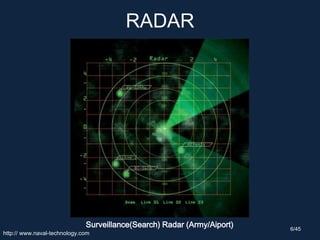
Surveillance(Search) Radar (Army/Aiport)
http:// www.naval-technology.com
6/45
RADAR
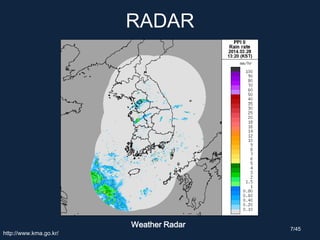
Weather Radar
http://www.kma.go.kr/
7/45
RADAR
3 Dimensional Radar(TRMM PR)
[Hurricane Sandy, Oct. 28, 2012 at 1725 UTC (1:25 PM EDT)]http://trmm.gsfc.nasa.gov/ 8/45
RADAR
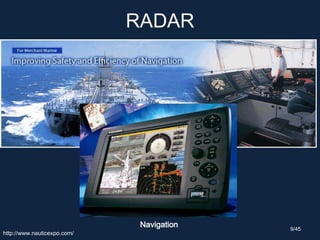
Navigation
http://www.nauticexpo.com/
9/45
RADAR
• Radio Detecting And Ranging
• An object-detection system that
uses radio waves to determine the
range, altitude, direction, or speed of
objects.
http://en.wikipedia.org/
10/45
RADAR
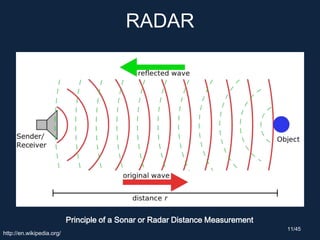
http://en.wikipedia.org/
Principle of a Sonar or Radar Distance Measurement
11/45
G P R ?
12/45
Ground
Penetrating
Radar
13/45
Ground Penetrating Radar
• A geophysical method that
uses radar pulses to image the
subsurface.
• This nondestructive method detects
the reflected signals from subsurface
structures.
http://en.wikipedia.org/
14/45
Ground Penetrating Radar
• GPR can be used in a variety of
media, including rock, soil, ice, fresh
water, pavements and structures.
• It can detect objects, changes in
material, and voids and cracks.
http://en.wikipedia.org/
15/45
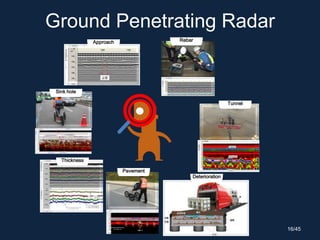
Ground Penetrating Radar
Deterioration
Approach
Thickness
Pavement
Sink hole
Rebar
Tunnel
16/45
Definitions!
17/45
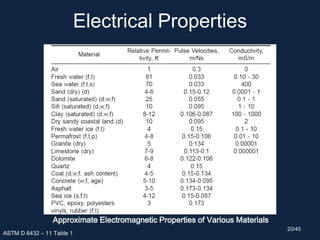
Dielectric Constant
• Dielectric Permittivity is the property that
describes the ability of a material to store
electric energy by separating opposite
polarity charges in space. (units :
farads/metre(F/m))
• Relative dielectric permittivity (dielectric
constant) is the ratio of the permittivity of a
material to that of free space, 8.854×10⁻¹²
F/m. (No unit!)
ASTM D 6432 – 11 3.2.9
18/45
Electrical Conductivity
• The ability of a material to support an
electrical current (material property that
describes the movement of electrons or
ions) due to an applied electrical field.
(units : Siemens/metre (S/m)).
ASTM D 6432 – 11 3.2.5
19/45
Electrical Properties
Approximate Electromagnetic Properties of Various Materials
ASTM D 6432 – 11 Table 1
20/45
Survey & Analysis
21/45
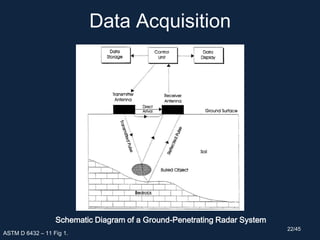
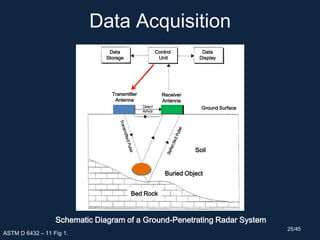
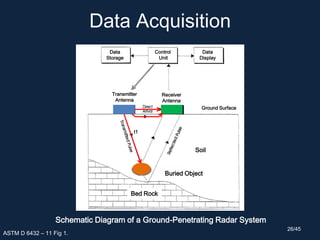
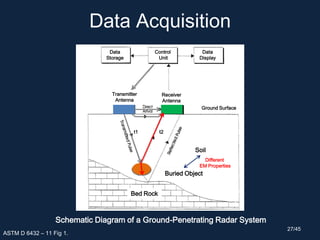
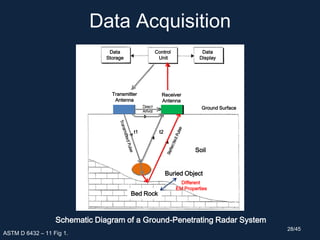
Data Acquisition
ASTM D 6432 – 11 Fig 1.
Schematic Diagram of a Ground-Penetrating Radar System
22/45
Data Acquisition
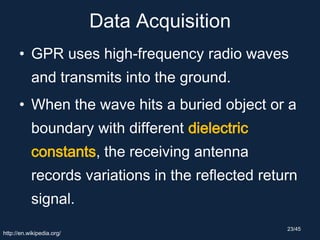
• GPR uses high-frequency radio waves
and transmits into the ground.
• When the wave hits a buried object or a
boundary with different dielectric
constants, the receiving antenna
records variations in the reflected return
signal.
http://en.wikipedia.org/
23/45
Data Acquisition
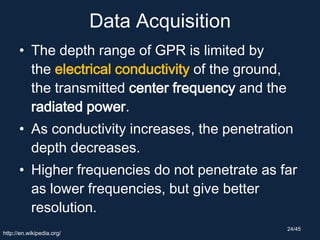
• The depth range of GPR is limited by
the electrical conductivity of the ground,
the transmitted center frequency and the
radiated power.
• As conductivity increases, the penetration
depth decreases.
• Higher frequencies do not penetrate as far
as lower frequencies, but give better
resolution.
http://en.wikipedia.org/
24/45
Data Acquisition
ASTM D 6432 – 11 Fig 1.
Schematic Diagram of a Ground-Penetrating Radar System
Soil
Buried Object
Bed Rock
Transmitter
Antenna
Receiver
Antenna
Control
Unit
Data
Display
Data
Storage
Ground Surface
25/45
Data Acquisition
ASTM D 6432 – 11 Fig 1.
Schematic Diagram of a Ground-Penetrating Radar System
Soil
Buried Object
Bed Rock
Transmitter
Antenna
Receiver
Antenna
Control
Unit
Data
Display
Data
Storage
Ground Surface
t1
26/45
Data Acquisition
ASTM D 6432 – 11 Fig 1.
Schematic Diagram of a Ground-Penetrating Radar System
Soil
Buried Object
Bed Rock
Transmitter
Antenna
Receiver
Antenna
Control
Unit
Data
Display
Data
Storage
Ground Surface
Different
EM Properties
t1 t2
27/45
Data Acquisition
ASTM D 6432 – 11 Fig 1.
Schematic Diagram of a Ground-Penetrating Radar System
Soil
Buried Object
Bed Rock
Transmitter
Antenna
Receiver
Antenna
Control
Unit
Data
Display
Data
Storage
Ground Surface
Different
EM Properties
t1 t2
28/45
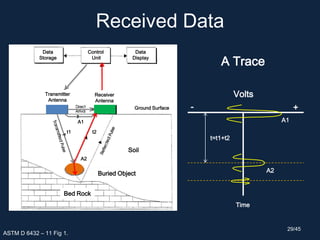
Received Data
ASTM D 6432 – 11 Fig 1.
Soil
Buried Object
Bed Rock
Transmitter
Antenna
Receiver
Antenna
Control
Unit
Data
Display
Data
Storage
Ground Surface
t1 t2
A1
A2
A Trace
+-
Time
A1
A2
Volts
t=t1+t2
29/45
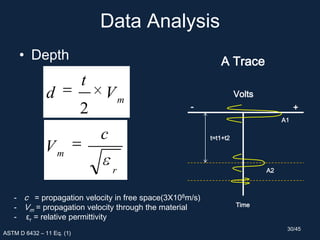
Data Analysis
• Depth
ASTM D 6432 – 11 Eq. (1)
m
V
t
d
2
r
m
c
V
- c = propagation velocity in free space(3X10⁸m/s)
- Vm = propagation velocity through the material
- εr = relative permittivity
A Trace
+-
Time
A1
A2
Volts
t=t1+t2
30/45
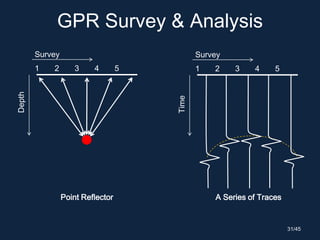
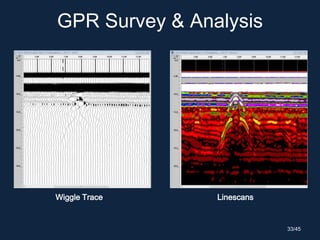
GPR Survey & Analysis
A Series of Traces
Depth
1 2 3 4 5
Survey
Time
1 2 3 4 5
Survey
31/45
Point Reflector
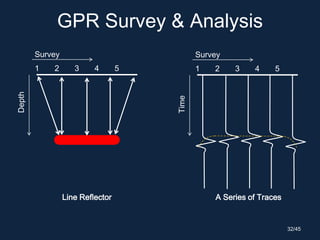
GPR Survey & Analysis
A Series of Traces
Depth
1 2 3 4 5
Survey
Time
1 2 3 4 5
Survey
32/45
Line Reflector
GPR Survey & Analysis
Wiggle Trace Linescans
33/45
Investigation
34/45
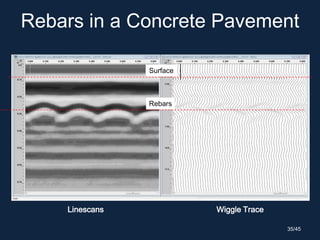
Rebars in a Concrete Pavement
Linescans Wiggle Trace
Surface
Rebars
35/45
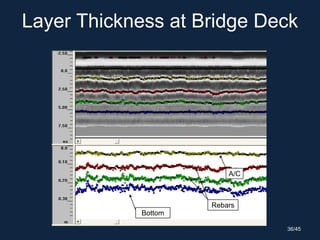
Layer Thickness at Bridge Deck
A/C
Rebars
Bottom
36/45
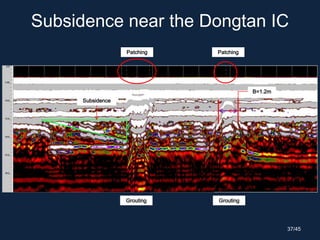
Subsidence near the Dongtan IC
Patching
Subsidence
B=1.2m
Grouting
Patching
Grouting
37/45
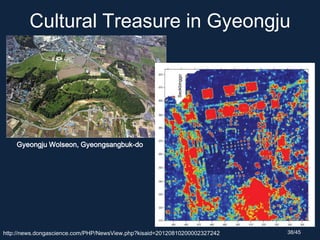
Cultural Treasure in Gyeongju
http://news.dongascience.com/PHP/NewsView.php?kisaid=20120810200002327242
Gyeongju Wolseon, Gyeongsangbuk-do
Seokbinggo
38/45
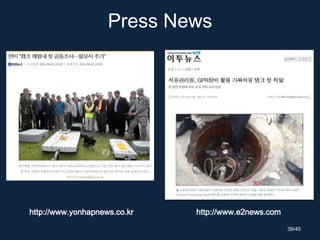
Press News
http://www.yonhapnews.co.kr http://www.e2news.com
39/45
Press News
http://www.joins.com http://www.segye.com
40/45
Now & the Future?
41/45
Now : Research
2012 GPR Conference 42/45
Now : Equipment
2012 GPR Conference
43/45
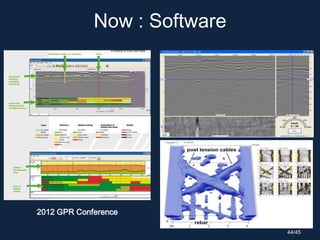
Now : Software
2012 GPR Conference
44/45
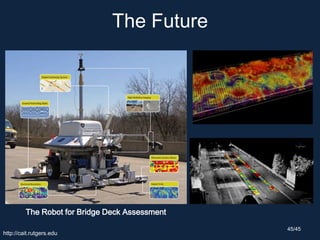
The Future
http://cait.rutgers.edu
The Robot for Bridge Deck Assessment
45/45
Question?
Jiyoung Rhee
Mobile : 031-371-2761
Mailto : need@ex.co.kr
http://www.slideshare.net/ssuser6b53da

Ground Penetrating Radar : Basic and Applications for Civil Engineering