EN8591
MUNICIPAL SOLID WASTE
MANAGEMENT
Unit IV
Processing of Wastes
Objectives of waste processing – Physical Processing
techniques and Equipment; Resource recovery from solid
waste composting and biomethanation; Thermal processing
options – case studies under Indian conditions.
Processing of Wastes
A process by which the physical property of the wastes is
altered to make it best suited for technology adopted for its
treatment is called as processing of wastes.
Processing Techniques & Equipments
Purpose of Processing
The purposes of processing are:
(a) Improving efficiency of SWM system
(b) Recovering material for reuse
( c ) Recovering conversion products & energy
Various Techniques & Equipments
(a) Mechanical Volume & Size reduction
(b) Component Separation
- Air Separation
- Magnetic Separation
- Screening
( c ) Drying & Dewatering
(A) Mechanical Volume & Size
Reduction
 Mechanical volume and size reduction is an important factor in
the development and operation of any SWM system.
 The main purpose is to reduce the volume and size of waste, as
compared to the original form, and produce waste of uniform size.
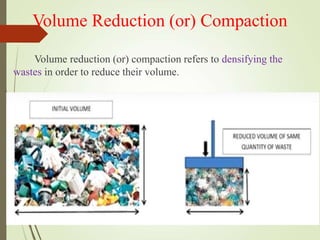
Volume Reduction (or) Compaction
Volume reduction (or) compaction refers to densifying the
wastes in order to reduce their volume.
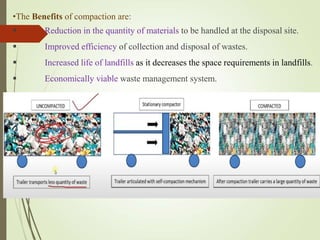
•The Benefits of compaction are:
 Reduction in the quantity of materials to be handled at the disposal site.
 Improved efficiency of collection and disposal of wastes.
 Increased life of landfills as it decreases the space requirements in landfills.
 Economically viable waste management system.
Disadvantages associated with compaction include,
 Poor quality of recyclable materials sorted out of compaction vehicle;
 Difficulty in segregation or sorting (since the various recyclable materials
are mixed and compressed in lumps);
 Bio-degradable materials (e.g., leftover food, fruits and vegetables) destroy
the value of paper and plastic material.
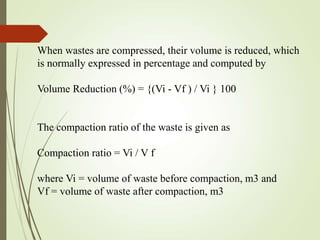
When wastes are compressed, their volume is reduced, which
is normally expressed in percentage and computed by
Volume Reduction (%) = {(Vi - Vf ) / Vi } 100
The compaction ratio of the waste is given as
Compaction ratio = Vi / V f
where Vi = volume of waste before compaction, m3 and
Vf = volume of waste after compaction, m3
Equipments for
Volume reduction (or) Compaction
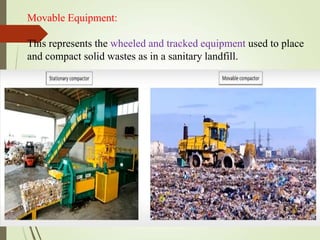
Stationary Equipment:
 This represents the equipment in which wastes are brought to, and loaded
into, either manually (or) mechanically.
 According to their application, stationary compactors can be described as
light duty (e.g., those used for residential areas), commercial or light
industrial, heavy industrial and transfer station compactors. Usually, large
stationary compactors are necessary, when wastes are to be compressed
into:
 steel containers that can be subsequently moved manually or mechanically.
 chambers where the compressed blocks are banded or tied by some means
before being removed.
 chambers where they are compressed into a block and then released and
hauled away untied.
 transport vehicles directly.
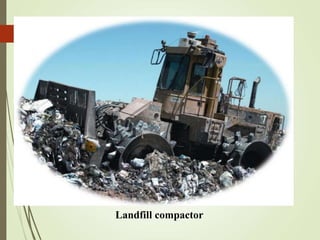
Movable Equipment:
This represents the wheeled and tracked equipment used to place
and compact solid wastes as in a sanitary landfill.
Landfill compactor
Low Pressure ( < 7 kg / cm2 ) Compactors
These compactors are used at apartments, commercial establishments.
Example:
Baling equipment – For waste papers & card boards.
Stationary compactors – For transfer station
In low pressure compaction, wastes are compacted in large containers.
High Pressure ( > 7Kg / cm2 )Compactors
Compact systems with a capacity up to 351.5 Kg / cm2 came under this
category.
Here, specialized compaction equipment are used to compress solid wastes in
to blocks (or) bales of various sizes.
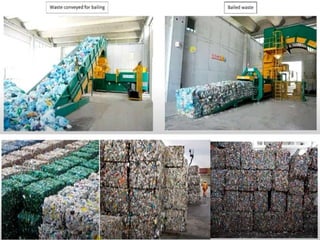
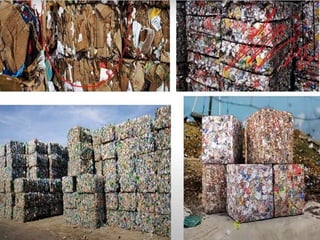
BALING EQUIPMENT
 Operating under high pressure they produce relatively small
compact bales/blocks of solid waste or recyclable materials.
 Used for recyclable materials for their shipment to buyers or
manufacturers.
 Most common waste that are baled are paper, cardboard,
plastic, PETE bottles, aluminium cans etc.
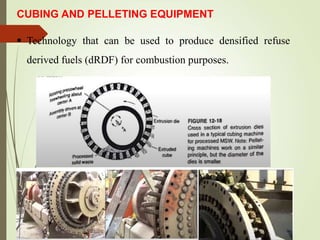
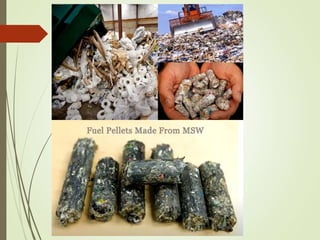
CUBING AND PELLETING EQUIPMENT
 Technology that can be used to produce densified refuse
derived fuels (dRDF) for combustion purposes.
Size Reduction (or) Shredding
• This is required to convert the large sized wastes into smaller
pieces.
• Size reduction helps in obtaining the final product in a
reasonable size in comparison to the original form.
Equipments for Size Reduction (or) Shredding
Hammer Mill:
 These are used most often in large commercial operations for reducing
the size of wastes.
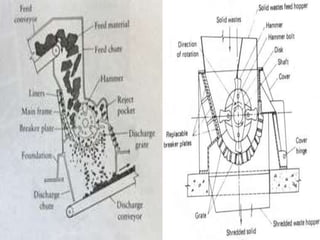
 Hammer mill is an impact device consisting of a number of hammers,
fastened flexibly to an inner disk, which rotates at a very high speed.
 Solid wastes as they enter the mill, are hit by sufficient force, which
crush (or) tear them with a velocity so that they do not adhere to the
hammers.
 Wastes are further reduced in size by being struck between breaker
plates & cutting bars fixed around the periphery of the inner chamber.
 This process of cutting and striking action continues, until the required
size of material is achieved and after that it falls out of the bottom of the
mill.
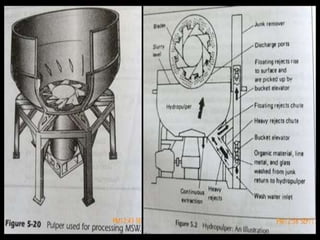
Hydro-pulper:
 An alternate method of size reduction involves the use of a
hydropulper as shown below:
Solid wastes and recycled water are added to the hydro-
pulper.
The high speed cutting blades, mounted on a rotor in the
bottom of the unit, convert pulpable and friable materials in
to slurry with a solid content varying from 2.5 to 3.5%
The rejected material passes down a chute that is connected
to a bucket elevator, while the solid slurry passes out through
the bottom of the pulper tank and is pumped to the next
processing operation.
(B) Component Separation
Component separation is a necessary operation in which the waste
components are identified and either manually (or) mechanically to
aid further processing. This is required for:
 recovery of valuable materials for recycling.
 preparation of solid wastes by removing certain components prior
to incineration, energy recovery, composting and biogas
production.
Air Separation
• This technique has been in use for a number of years in
industrial operations for segregating various components from
dry mixtures.
• Air separation is primarily used to separate lighter materials
from the heavier ones.
• The lighter materials may include plastics, paper products and
other organic materials.
Equipments used for Air Separation
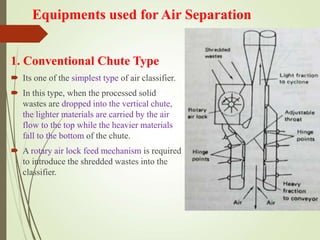
1. Conventional Chute Type
 Its one of the simplest type of air classifier.
 In this type, when the processed solid
wastes are dropped into the vertical chute,
the lighter materials are carried by the air
flow to the top while the heavier materials
fall to the bottom of the chute.
 A rotary air lock feed mechanism is required
to introduce the shredded wastes into the
classifier.
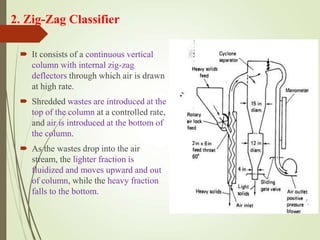
2. Zig-Zag Classifier
 It consists of a continuous vertical
column with internal zig-zag
deflectors through which air is drawn
at high rate.
 Shredded wastes are introduced at the
top of the column at a controlled rate,
and air is introduced at the bottom of
the column.
 As the wastes drop into the air
stream, the lighter fraction is
fluidized and moves upward and out
of column, while the heavy fraction
falls to the bottom.
Magnetic Separation
 The most common method of recovering ferrous scrap from
shredded solid wastes involves the use of magnetic recovery
system.
 Ferrous materials are usually recovered either after shredding
(or) before air separation.
 Magnetic separator is used to remove the ferrous material from
the incinerator residue.
 Magnetic recovery systems have also been used at landfill
disposal sites.
Equipments used for Magnetic Separation
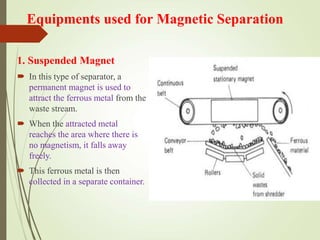
1. Suspended Magnet
 In this type of separator, a
permanent magnet is used to
attract the ferrous metal from the
waste stream.
 When the attracted metal
reaches the area where there is
no magnetism, it falls away
freely.
 This ferrous metal is then
collected in a separate container.
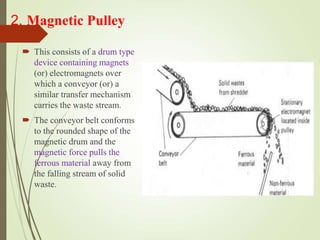
2. Magnetic Pulley
 This consists of a drum type
device containing magnets
(or) electromagnets over
which a conveyor (or) a
similar transfer mechanism
carries the waste stream.
 The conveyor belt conforms
to the rounded shape of the
magnetic drum and the
magnetic force pulls the
ferrous material away from
the falling stream of solid
waste.
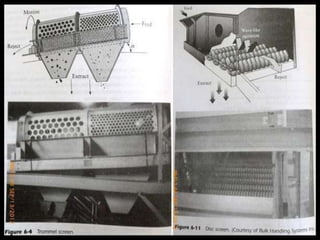
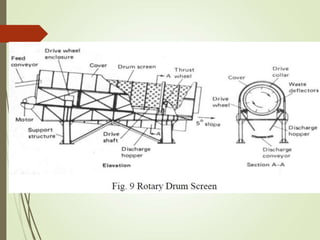
Screening
• Screening is the most common form of separating solid wastes,
depending on their size by the use of one (or) more screening
surfaces.
• Screening has a number of applications in solid waste resource
& energy recovery systems.
• Screens can be used before (or) after shredding and after air
separation of wastes in various applications dealing with both
light & heavy fraction materials.
(C) Drying & Dewatering
 Drying and dewatering operations are used primarily for
incineration systems with (or) without energy recovery
systems.
 These are also used for drying of sludges in wastewater
treatment plants, prior to their incineration (or) transport to
land disposal.
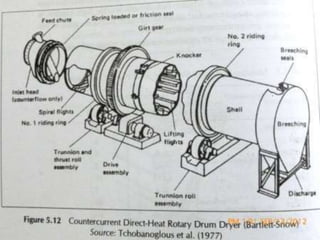
Drying
• The following methods are used to apply the heat required for
drying the wastes.
• Convection Drying: In this method, hot air is in direct contact with
the wet solid waste stream.
• Conduction Drying: In this method, the wet solid waste stream is
in contact with a heated surface.
• Radiation Drying: In this method, heat is transmitted directly to
the wet solid waste stream by radiation from the heated body.
Dewatering
• Dewatering is more applicable to the problem of sludge disposal from wastewater
treatment plants but may also be applicable in some cases to municipal/industrial
waste problems.
• When drying beds, lagoons (or) spreading on land are not feasible,
• Other mechanical means of dewatering are used.
• The objective is to reduce the liquid volume in the solid waste stream.
• Once dewatered, the sludge can be mixed with other solid waste, and the resulting
mixture can be:
(i) incinerated to reduce volume
(ii) used for the production of recoverable by-products
(iii) used for production of compost
(iv) buried in a landfill

Processing of solid waste

  • 1.
  • 2.
    Unit IV Processing ofWastes Objectives of waste processing – Physical Processing techniques and Equipment; Resource recovery from solid waste composting and biomethanation; Thermal processing options – case studies under Indian conditions.
  • 4.
    Processing of Wastes Aprocess by which the physical property of the wastes is altered to make it best suited for technology adopted for its treatment is called as processing of wastes.
  • 5.
    Processing Techniques &Equipments Purpose of Processing The purposes of processing are: (a) Improving efficiency of SWM system (b) Recovering material for reuse ( c ) Recovering conversion products & energy
  • 6.
    Various Techniques &Equipments (a) Mechanical Volume & Size reduction (b) Component Separation - Air Separation - Magnetic Separation - Screening ( c ) Drying & Dewatering
  • 7.
    (A) Mechanical Volume& Size Reduction  Mechanical volume and size reduction is an important factor in the development and operation of any SWM system.  The main purpose is to reduce the volume and size of waste, as compared to the original form, and produce waste of uniform size.
  • 8.
    Volume Reduction (or)Compaction Volume reduction (or) compaction refers to densifying the wastes in order to reduce their volume.
  • 9.
    •The Benefits ofcompaction are:  Reduction in the quantity of materials to be handled at the disposal site.  Improved efficiency of collection and disposal of wastes.  Increased life of landfills as it decreases the space requirements in landfills.  Economically viable waste management system.
  • 10.
    Disadvantages associated withcompaction include,  Poor quality of recyclable materials sorted out of compaction vehicle;  Difficulty in segregation or sorting (since the various recyclable materials are mixed and compressed in lumps);  Bio-degradable materials (e.g., leftover food, fruits and vegetables) destroy the value of paper and plastic material.
  • 11.
    When wastes arecompressed, their volume is reduced, which is normally expressed in percentage and computed by Volume Reduction (%) = {(Vi - Vf ) / Vi } 100 The compaction ratio of the waste is given as Compaction ratio = Vi / V f where Vi = volume of waste before compaction, m3 and Vf = volume of waste after compaction, m3
  • 12.
    Equipments for Volume reduction(or) Compaction Stationary Equipment:  This represents the equipment in which wastes are brought to, and loaded into, either manually (or) mechanically.  According to their application, stationary compactors can be described as light duty (e.g., those used for residential areas), commercial or light industrial, heavy industrial and transfer station compactors. Usually, large stationary compactors are necessary, when wastes are to be compressed into:  steel containers that can be subsequently moved manually or mechanically.  chambers where the compressed blocks are banded or tied by some means before being removed.  chambers where they are compressed into a block and then released and hauled away untied.  transport vehicles directly.
  • 13.
    Movable Equipment: This representsthe wheeled and tracked equipment used to place and compact solid wastes as in a sanitary landfill.
  • 14.
  • 15.
    Low Pressure (< 7 kg / cm2 ) Compactors These compactors are used at apartments, commercial establishments. Example: Baling equipment – For waste papers & card boards. Stationary compactors – For transfer station In low pressure compaction, wastes are compacted in large containers. High Pressure ( > 7Kg / cm2 )Compactors Compact systems with a capacity up to 351.5 Kg / cm2 came under this category. Here, specialized compaction equipment are used to compress solid wastes in to blocks (or) bales of various sizes.
  • 16.
    BALING EQUIPMENT  Operatingunder high pressure they produce relatively small compact bales/blocks of solid waste or recyclable materials.  Used for recyclable materials for their shipment to buyers or manufacturers.  Most common waste that are baled are paper, cardboard, plastic, PETE bottles, aluminium cans etc.
  • 19.
    CUBING AND PELLETINGEQUIPMENT  Technology that can be used to produce densified refuse derived fuels (dRDF) for combustion purposes.
  • 21.
    Size Reduction (or)Shredding • This is required to convert the large sized wastes into smaller pieces. • Size reduction helps in obtaining the final product in a reasonable size in comparison to the original form.
  • 22.
    Equipments for SizeReduction (or) Shredding Hammer Mill:  These are used most often in large commercial operations for reducing the size of wastes.  Hammer mill is an impact device consisting of a number of hammers, fastened flexibly to an inner disk, which rotates at a very high speed.  Solid wastes as they enter the mill, are hit by sufficient force, which crush (or) tear them with a velocity so that they do not adhere to the hammers.  Wastes are further reduced in size by being struck between breaker plates & cutting bars fixed around the periphery of the inner chamber.  This process of cutting and striking action continues, until the required size of material is achieved and after that it falls out of the bottom of the mill.
  • 24.
    Hydro-pulper:  An alternatemethod of size reduction involves the use of a hydropulper as shown below: Solid wastes and recycled water are added to the hydro- pulper. The high speed cutting blades, mounted on a rotor in the bottom of the unit, convert pulpable and friable materials in to slurry with a solid content varying from 2.5 to 3.5% The rejected material passes down a chute that is connected to a bucket elevator, while the solid slurry passes out through the bottom of the pulper tank and is pumped to the next processing operation.
  • 26.
    (B) Component Separation Componentseparation is a necessary operation in which the waste components are identified and either manually (or) mechanically to aid further processing. This is required for:  recovery of valuable materials for recycling.  preparation of solid wastes by removing certain components prior to incineration, energy recovery, composting and biogas production.
  • 27.
    Air Separation • Thistechnique has been in use for a number of years in industrial operations for segregating various components from dry mixtures. • Air separation is primarily used to separate lighter materials from the heavier ones. • The lighter materials may include plastics, paper products and other organic materials.
  • 28.
    Equipments used forAir Separation 1. Conventional Chute Type  Its one of the simplest type of air classifier.  In this type, when the processed solid wastes are dropped into the vertical chute, the lighter materials are carried by the air flow to the top while the heavier materials fall to the bottom of the chute.  A rotary air lock feed mechanism is required to introduce the shredded wastes into the classifier.
  • 29.
    2. Zig-Zag Classifier It consists of a continuous vertical column with internal zig-zag deflectors through which air is drawn at high rate.  Shredded wastes are introduced at the top of the column at a controlled rate, and air is introduced at the bottom of the column.  As the wastes drop into the air stream, the lighter fraction is fluidized and moves upward and out of column, while the heavy fraction falls to the bottom.
  • 30.
    Magnetic Separation  Themost common method of recovering ferrous scrap from shredded solid wastes involves the use of magnetic recovery system.  Ferrous materials are usually recovered either after shredding (or) before air separation.  Magnetic separator is used to remove the ferrous material from the incinerator residue.  Magnetic recovery systems have also been used at landfill disposal sites.
  • 31.
    Equipments used forMagnetic Separation 1. Suspended Magnet  In this type of separator, a permanent magnet is used to attract the ferrous metal from the waste stream.  When the attracted metal reaches the area where there is no magnetism, it falls away freely.  This ferrous metal is then collected in a separate container.
  • 32.
    2. Magnetic Pulley This consists of a drum type device containing magnets (or) electromagnets over which a conveyor (or) a similar transfer mechanism carries the waste stream.  The conveyor belt conforms to the rounded shape of the magnetic drum and the magnetic force pulls the ferrous material away from the falling stream of solid waste.
  • 33.
    Screening • Screening isthe most common form of separating solid wastes, depending on their size by the use of one (or) more screening surfaces. • Screening has a number of applications in solid waste resource & energy recovery systems. • Screens can be used before (or) after shredding and after air separation of wastes in various applications dealing with both light & heavy fraction materials.
  • 36.
    (C) Drying &Dewatering  Drying and dewatering operations are used primarily for incineration systems with (or) without energy recovery systems.  These are also used for drying of sludges in wastewater treatment plants, prior to their incineration (or) transport to land disposal.
  • 37.
    Drying • The followingmethods are used to apply the heat required for drying the wastes. • Convection Drying: In this method, hot air is in direct contact with the wet solid waste stream. • Conduction Drying: In this method, the wet solid waste stream is in contact with a heated surface. • Radiation Drying: In this method, heat is transmitted directly to the wet solid waste stream by radiation from the heated body.
  • 39.
    Dewatering • Dewatering ismore applicable to the problem of sludge disposal from wastewater treatment plants but may also be applicable in some cases to municipal/industrial waste problems. • When drying beds, lagoons (or) spreading on land are not feasible, • Other mechanical means of dewatering are used. • The objective is to reduce the liquid volume in the solid waste stream. • Once dewatered, the sludge can be mixed with other solid waste, and the resulting mixture can be: (i) incinerated to reduce volume (ii) used for the production of recoverable by-products (iii) used for production of compost (iv) buried in a landfill