Solid Waste
Disposal into Land
Submitted to Dr. Shama E. Haque
Department of Civil & Environmental Engineering,
North South University
Solid Waste Disposal
Sayed MD. Sayem
1610196025
3
4
5
Land disposal
• Land disposal can be either in or on the ground—in a
landfill, injection well, or other land-based unit.
• Currently, about 400 million tons of hazardous waste
are land disposed each year in the world (United Nations Environment Programme (UNEP) )
• A wide range of wastes and by-products of industrial
processes is being spread on the land in agriculture,
forestry and land reclamation operations.
Disposal Methods
6
Selecting a disposal method depends almost entirely
on costs, which in turn are likely to reflect local
circumstances.
• Land fill.
• Waste buried in soil.
More about land, landfill,
disposal & recycling
Sadia Tabassum
ID: 1620629025
Landfill is the primary method of solid waste disposal in most
countries. Solid waste is separated into recyclable and non-recyclable
components
8
It is a necessary part of an integrated solid
waste system.
9
10
waste treatment processes have residues that cannot be
further reused or recovered and are eventually landfilled.
11
• Thermal, mechanical and biological pretreatment
techniques are used prior to landfilling.
• The aim is to recover certain components for
energy production.
• Pretreatment techniques can also be used with the
ultimate objective of controlling landfill behavior,
• the biological and physicochemical processes that
take place within a landfill is supported by such
techniques
Landfill can be managed
using
12
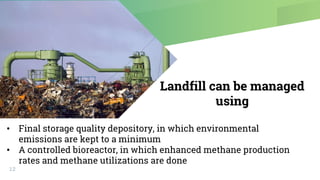
• Final storage quality depository, in which environmental
emissions are kept to a minimum
• A controlled bioreactor, in which enhanced methane production
rates and methane utilizations are done
 Thermal, mechanical and biological
pretreatment methods are combined to
achieve either of the concerned outcomes.13
Other Waste
management options
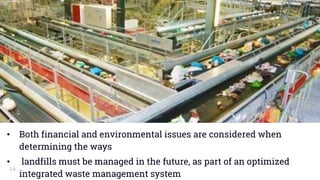
• Both financial and environmental issues are considered when
determining the ways
• landfills must be managed in the future, as part of an optimized
integrated waste management system
14
Classification of Land Disposal
Al Mamun
ID: 1610833025
16
17
The most widely accepted classification
systems used for landfills
are:
 Hazardous Waste (Also known as Secure landfills/Class 1 landfills)
• For solid hazardous waste only.
• May be found in different physical states such as gaseous, liquids, or solids.
 Designated Waste (Also known as Monofills/Class 2 landfills)
• Consists of non-hazardous waste associated with manufacturing and other
industrial activities.
• Ability to use the waste stored there in the future when a recycling process
for that material is developed.
 Municipal Solid Waste (Also known as Sanitary landfills/Class 3 landfills)
• Uses a synthetic(plastic) liner to isolate the trash from the environment.
• Landfill that uses a clay liner to isolate the trash from the environment.
18
Hazardous Waste
19
Designated Waste
20
Municipal Solid Waste
Types of Landfill
21
• Conventional landfill for commingled MSW
• Landfills for mild solid waste
• Monofills for designated or specialized waste
• Landfills designed to maximize gas production
• Landfill as integrated treatment units
• Landfill in wetland areas
Planning , Design and Operation of
Sanitary Land Disposal
Name: Sheikh Moinul Hassan Mahmud
ID# 1611060025
22
23
Selecting Criteria for Land Disposal Area
• Low population density.
• Low alternate land use value.
• Low GW contamination potential.
• Having clay content in the sub soil.
Site Investigation Criteria
24
• Sub soil investigation.
• Groundwater/Hydrological investigation.
• Topographical investigation.
• Hydrological investigation.
• Geological investigation.
• Seismic investigation.
Leachate Collection
System(Design Step)
25
• Finalization of layout pipe network.
• Estimation of pipe diameter & spacing.
• Estimating the size of sums & pumps.
• Design of wells/side slops.
• Design of holding tank.
26
Alternatives for leachate
management
• Discharge to lined drains.
• Discharge to waste water
treatment system.
• Recirculation.
• Evaporation of leachate.
• Treatment of leachate.
27
Site preparation & construction
step
• Clear site
• Remove & stockpile top soil.
• Construct beams.
• Install drainage improvement.
• Excavate fill areas.
• Install utilities.
28
Land Disposal Equipment
Selection
• Amount & type of waste to be handled.
• Amount & type of soil cover to be handled.
• Distance cover material to be transported.
• Weather condition.
• Compaction requirements.
• Land Disposal method utilized.
Land Disposal
Completion
Name: S.M. Eftikhar Chowdhury
ID:1610077025
30
What is Land Disposal Completion?
A technical note providing guidance measuring the
completion of licensed land disposal sites.
31
32
33
Criteria of Land Disposal
Completion
• Characterization of the land disposal environment
system
• Issues parameters and scenario analysis
• Transport pathway and pollutant migration
• Environmental compatibility and completion criteria
• Monitoring and taking care
34
Characterization of the land Disposal
Environment System
• Waste amount
• Quality
• Issues
• Containment
• System
• Site characteristics
35
Issues Parameters and Scenario
Analysis
• Identification of relevant issues parameters
• Scenario based issues estimates.
36
Transport Pathway and Pollutant
Migration
• Layout of the environment system
• Evaluation of pollutant concentration
• Determination of the factors
37
Environmental Compatibility and
Completion Criteria
• Estimated concentrations and quality
criteria
• Reverse calculation of tolerable issues
38
Monitoring and Taking Care
• Monitoring and model confirmation
• Residual risks Appropriate after use
Stages Of Decomposition In A Typical Land Disposal
Subro Prokash Dey Rahul
ID: 1610418025
40
Decomposition
41
Phases of decomposition in a typical landfill
Phase 1 Aerobic Phase :
• Waste absorb the moisture, compact naturally and settle
slowly.
• Breaking down component organic waste.
• Anaerobic phase take place.
• Oxygen supply depended factor.
42
• This stages land disposal becomes highly acidic.
• Microbe colonies reduce the particulates large to small
monomers.
• Byproducts are carbon dioxide and hydrogen.
• Increase colonization increase fatty acids.
• Contact of oxygen again.
Phase 2 Anaerobic, Non-Methanogenic:
43
Phase 3 Anaerobic, Methanogenic Unsteady
• Continuation of microbe colonies to grow that eats away
at the polymer chain.
• Creates increasingly larger molecular spaces.
• Acetogenesis occurs.
• Fatty acid converts into acetic acid, carbon dioxide &
hydrogen.
• Rates of CO2 decay & hydrogen production eventually
stops.
44
Phase 4 Anaerobic, Methanogenic steady
• Final stage of decomposition on a open dump.
• Polymer eating of colonies of microbes continue.
• Methane gas are produced.
• About half of the gas will be CO2 & the other half will be
methane.
• Acetates are converted into methane & carbon dioxide
& hydrogen consumes.
Groundwater Monitoring
Corrective action
Nazmul Hasan Babu
ID:1610229025
46
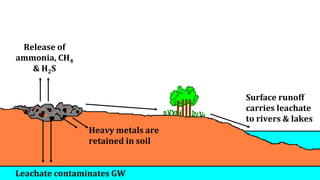
Release of
ammonia, CH4
& H2S
Leachate contaminates GW
Surface runoff
carries leachate
to rivers & lakes
Heavy metals are
retained in soil
47
Groundwater Monitoring
Nearly all Land disposal site of solid waste are required to monitor the underlying
groundwater for contamination during their active life and after their life also.
Drill wells to the aquifer to determine contamination level.
The required number of wells, spacing, and depth of wells is determined on a site-
specific basis based on the
• aquifer thickness,
• groundwater flow rate and direction,
• and the other geologic and hydrogeological characteristics of the site.
48
Groundwater Monitoring
• Routine sampling and analysis of groundwater.
• Compare of sampling results to site background and see where groundwater protection
standards exceed or not.
• Daily reporting of groundwater monitoring activities.
Corrective action
• Corrective action is required whenever one or more groundwater protection standard is
exceeded at statistically significant levels.
• Containment of the land disposal mass, including an impermeable cap.
• Control the leachate from land disposal.
• Reduction of saturation of the land disposal mass
• Invent new technology to clear contaminated ground water.
Landspreading of Solid Waste
Hia Quraishy
50
Introduction:
• A process where contaminated soils or waste are spread
over a treatment area and tilled with native soil.
• Nutrients and/or water may be added to enhance
biodegradation. .
• Organic wastes having ecological benefits and
harmlessness can be candidate for land spreading.
• Land spreading is prohibited near forests and meadows,
frequently cultivated land, terrains that are steeply
sloped, wherever there’s risk of heavy rain and flooding,
or where soil is snow-covered or frozen.
51
Legal considerations :
• Land spreading requires the preliminary study of the
waste composition and the soil ability to receive the
waste.
• If local or regional authority determines land
spreading was done only to avoid waste
management laws or regulations, it is considered as
fake recycling.
52
• Byproducts of many mining and industrial processes
contain from 45 to 80 percent organic matter that’s capable
of stimulating biological soil activity.
• Byproducts are also rich in calcium, which can prevent soils
from becoming acidic.
• Soil’s naturally occurring microbial population metabolizes,
transforms, and assimilates waste constituents, rendering
the waste benign and nonhazardous.
53
• Land spreading can be a viable option to traditional
methods of disposing solid waste within amenable
scenarios and eco-environments.
• Farmers get benefitted as they’re availed of a rich source
of free or low-cost organic matter and fertilizing
elements to replenish their croplands.
• Expert consultation is a crucial element in determining
whether and how to land spread wastes.
54
Reference :
https://tribune.com.pk/story/2026123/6-environmental-health-problems-open-waste-dumping/
Integrated solid waste management (Chapter 11)
https://www.researchgate.net/figure/Landfill-operation-stage-The-area-and-trench-method-Wroblewski-et-al-
2009_fig1_334067628
https://www.researchgate.net/publication/47336265_Landfill_sustainability_and_aftercare_completion_criteria
https://www.researchgate.net/publication/304148141_Landfill_planning_and_design_considerations
http://www.bvsde.paho.org/bvsair/e/repindex/repi49-50/lesson8/lesson8.htm
https://graduatedegrees.online.njit.edu/blog/sanitary-landfill-design-for-civil-engineers/
https://www.theworldcounts.com/counters/waste_pollution_facts/hazardous_waste_statistics

Solid Waste Disposal into Land

  • 1.
    Solid Waste Disposal intoLand Submitted to Dr. Shama E. Haque Department of Civil & Environmental Engineering, North South University
  • 2.
    Solid Waste Disposal SayedMD. Sayem 1610196025
  • 3.
  • 4.
  • 5.
    5 Land disposal • Landdisposal can be either in or on the ground—in a landfill, injection well, or other land-based unit. • Currently, about 400 million tons of hazardous waste are land disposed each year in the world (United Nations Environment Programme (UNEP) ) • A wide range of wastes and by-products of industrial processes is being spread on the land in agriculture, forestry and land reclamation operations.
  • 6.
    Disposal Methods 6 Selecting adisposal method depends almost entirely on costs, which in turn are likely to reflect local circumstances. • Land fill. • Waste buried in soil.
  • 7.
    More about land,landfill, disposal & recycling Sadia Tabassum ID: 1620629025
  • 8.
    Landfill is theprimary method of solid waste disposal in most countries. Solid waste is separated into recyclable and non-recyclable components 8
  • 9.
    It is anecessary part of an integrated solid waste system. 9
  • 10.
    10 waste treatment processeshave residues that cannot be further reused or recovered and are eventually landfilled.
  • 11.
    11 • Thermal, mechanicaland biological pretreatment techniques are used prior to landfilling. • The aim is to recover certain components for energy production. • Pretreatment techniques can also be used with the ultimate objective of controlling landfill behavior, • the biological and physicochemical processes that take place within a landfill is supported by such techniques
  • 12.
    Landfill can bemanaged using 12 • Final storage quality depository, in which environmental emissions are kept to a minimum • A controlled bioreactor, in which enhanced methane production rates and methane utilizations are done
  • 13.
     Thermal, mechanicaland biological pretreatment methods are combined to achieve either of the concerned outcomes.13 Other Waste management options
  • 14.
    • Both financialand environmental issues are considered when determining the ways • landfills must be managed in the future, as part of an optimized integrated waste management system 14
  • 15.
    Classification of LandDisposal Al Mamun ID: 1610833025
  • 16.
  • 17.
    17 The most widelyaccepted classification systems used for landfills are:  Hazardous Waste (Also known as Secure landfills/Class 1 landfills) • For solid hazardous waste only. • May be found in different physical states such as gaseous, liquids, or solids.  Designated Waste (Also known as Monofills/Class 2 landfills) • Consists of non-hazardous waste associated with manufacturing and other industrial activities. • Ability to use the waste stored there in the future when a recycling process for that material is developed.  Municipal Solid Waste (Also known as Sanitary landfills/Class 3 landfills) • Uses a synthetic(plastic) liner to isolate the trash from the environment. • Landfill that uses a clay liner to isolate the trash from the environment.
  • 18.
  • 19.
  • 20.
  • 21.
    Types of Landfill 21 •Conventional landfill for commingled MSW • Landfills for mild solid waste • Monofills for designated or specialized waste • Landfills designed to maximize gas production • Landfill as integrated treatment units • Landfill in wetland areas
  • 22.
    Planning , Designand Operation of Sanitary Land Disposal Name: Sheikh Moinul Hassan Mahmud ID# 1611060025 22
  • 23.
    23 Selecting Criteria forLand Disposal Area • Low population density. • Low alternate land use value. • Low GW contamination potential. • Having clay content in the sub soil.
  • 24.
    Site Investigation Criteria 24 •Sub soil investigation. • Groundwater/Hydrological investigation. • Topographical investigation. • Hydrological investigation. • Geological investigation. • Seismic investigation.
  • 25.
    Leachate Collection System(Design Step) 25 •Finalization of layout pipe network. • Estimation of pipe diameter & spacing. • Estimating the size of sums & pumps. • Design of wells/side slops. • Design of holding tank.
  • 26.
    26 Alternatives for leachate management •Discharge to lined drains. • Discharge to waste water treatment system. • Recirculation. • Evaporation of leachate. • Treatment of leachate.
  • 27.
    27 Site preparation &construction step • Clear site • Remove & stockpile top soil. • Construct beams. • Install drainage improvement. • Excavate fill areas. • Install utilities.
  • 28.
    28 Land Disposal Equipment Selection •Amount & type of waste to be handled. • Amount & type of soil cover to be handled. • Distance cover material to be transported. • Weather condition. • Compaction requirements. • Land Disposal method utilized.
  • 29.
    Land Disposal Completion Name: S.M.Eftikhar Chowdhury ID:1610077025
  • 30.
    30 What is LandDisposal Completion? A technical note providing guidance measuring the completion of licensed land disposal sites.
  • 31.
  • 32.
  • 33.
    33 Criteria of LandDisposal Completion • Characterization of the land disposal environment system • Issues parameters and scenario analysis • Transport pathway and pollutant migration • Environmental compatibility and completion criteria • Monitoring and taking care
  • 34.
    34 Characterization of theland Disposal Environment System • Waste amount • Quality • Issues • Containment • System • Site characteristics
  • 35.
    35 Issues Parameters andScenario Analysis • Identification of relevant issues parameters • Scenario based issues estimates.
  • 36.
    36 Transport Pathway andPollutant Migration • Layout of the environment system • Evaluation of pollutant concentration • Determination of the factors
  • 37.
    37 Environmental Compatibility and CompletionCriteria • Estimated concentrations and quality criteria • Reverse calculation of tolerable issues
  • 38.
    38 Monitoring and TakingCare • Monitoring and model confirmation • Residual risks Appropriate after use
  • 39.
    Stages Of DecompositionIn A Typical Land Disposal Subro Prokash Dey Rahul ID: 1610418025
  • 40.
  • 41.
    41 Phases of decompositionin a typical landfill Phase 1 Aerobic Phase : • Waste absorb the moisture, compact naturally and settle slowly. • Breaking down component organic waste. • Anaerobic phase take place. • Oxygen supply depended factor.
  • 42.
    42 • This stagesland disposal becomes highly acidic. • Microbe colonies reduce the particulates large to small monomers. • Byproducts are carbon dioxide and hydrogen. • Increase colonization increase fatty acids. • Contact of oxygen again. Phase 2 Anaerobic, Non-Methanogenic:
  • 43.
    43 Phase 3 Anaerobic,Methanogenic Unsteady • Continuation of microbe colonies to grow that eats away at the polymer chain. • Creates increasingly larger molecular spaces. • Acetogenesis occurs. • Fatty acid converts into acetic acid, carbon dioxide & hydrogen. • Rates of CO2 decay & hydrogen production eventually stops.
  • 44.
    44 Phase 4 Anaerobic,Methanogenic steady • Final stage of decomposition on a open dump. • Polymer eating of colonies of microbes continue. • Methane gas are produced. • About half of the gas will be CO2 & the other half will be methane. • Acetates are converted into methane & carbon dioxide & hydrogen consumes.
  • 45.
  • 46.
    46 Release of ammonia, CH4 &H2S Leachate contaminates GW Surface runoff carries leachate to rivers & lakes Heavy metals are retained in soil
  • 47.
    47 Groundwater Monitoring Nearly allLand disposal site of solid waste are required to monitor the underlying groundwater for contamination during their active life and after their life also. Drill wells to the aquifer to determine contamination level. The required number of wells, spacing, and depth of wells is determined on a site- specific basis based on the • aquifer thickness, • groundwater flow rate and direction, • and the other geologic and hydrogeological characteristics of the site.
  • 48.
    48 Groundwater Monitoring • Routinesampling and analysis of groundwater. • Compare of sampling results to site background and see where groundwater protection standards exceed or not. • Daily reporting of groundwater monitoring activities. Corrective action • Corrective action is required whenever one or more groundwater protection standard is exceeded at statistically significant levels. • Containment of the land disposal mass, including an impermeable cap. • Control the leachate from land disposal. • Reduction of saturation of the land disposal mass • Invent new technology to clear contaminated ground water.
  • 49.
    Landspreading of SolidWaste Hia Quraishy
  • 50.
    50 Introduction: • A processwhere contaminated soils or waste are spread over a treatment area and tilled with native soil. • Nutrients and/or water may be added to enhance biodegradation. . • Organic wastes having ecological benefits and harmlessness can be candidate for land spreading. • Land spreading is prohibited near forests and meadows, frequently cultivated land, terrains that are steeply sloped, wherever there’s risk of heavy rain and flooding, or where soil is snow-covered or frozen.
  • 51.
    51 Legal considerations : •Land spreading requires the preliminary study of the waste composition and the soil ability to receive the waste. • If local or regional authority determines land spreading was done only to avoid waste management laws or regulations, it is considered as fake recycling.
  • 52.
    52 • Byproducts ofmany mining and industrial processes contain from 45 to 80 percent organic matter that’s capable of stimulating biological soil activity. • Byproducts are also rich in calcium, which can prevent soils from becoming acidic. • Soil’s naturally occurring microbial population metabolizes, transforms, and assimilates waste constituents, rendering the waste benign and nonhazardous.
  • 53.
    53 • Land spreadingcan be a viable option to traditional methods of disposing solid waste within amenable scenarios and eco-environments. • Farmers get benefitted as they’re availed of a rich source of free or low-cost organic matter and fertilizing elements to replenish their croplands. • Expert consultation is a crucial element in determining whether and how to land spread wastes.
  • 54.
    54 Reference : https://tribune.com.pk/story/2026123/6-environmental-health-problems-open-waste-dumping/ Integrated solidwaste management (Chapter 11) https://www.researchgate.net/figure/Landfill-operation-stage-The-area-and-trench-method-Wroblewski-et-al- 2009_fig1_334067628 https://www.researchgate.net/publication/47336265_Landfill_sustainability_and_aftercare_completion_criteria https://www.researchgate.net/publication/304148141_Landfill_planning_and_design_considerations http://www.bvsde.paho.org/bvsair/e/repindex/repi49-50/lesson8/lesson8.htm https://graduatedegrees.online.njit.edu/blog/sanitary-landfill-design-for-civil-engineers/ https://www.theworldcounts.com/counters/waste_pollution_facts/hazardous_waste_statistics