International Journal For Research & Development in Technology 
Volume: 2, Issue: 1, JULY-2014 ISSN (Online):- 2349-3585 
13 
Copyright 2014- IJRDT www.ijrdt.org 
LAN Based Intelligent Traffic Light System with Emergency Service Identification Meenu Bhati1 , Mamta Devi Sharma2 
1 2 ECE Department, GCT Jaipur Abstract- In this paper we implemented a traffic lights control system using LAN technology which has the capability of mimicking human intelligence for controlling traffic lights. It aims to do analysis, design, develop and deploy monitoring and information system jointly with the help of state of the art traffic equipment, to enable the safe and efficient and effective movement of traffic for all road users. In this work we implemented the first based on LAN networking. The aim of this paper is to design and implement the network based car traffic control system. This system mainly comprises of signalized junctions and central computer (sever) that is connected to every traffic signal junction (clients). Its main task is to adjust, in real times, signal timings in response to variation in traffic demand and system capacity. Real time data from traffic controls are collected and transported to a central computer (server) for analysis. The results of this work are reduction in normal recurring, significantly enhanced operational tools congestion to effectively manage traffic incidents, reduced pollution, faster response to reports of faults, improved public transport service, reduction in emergency response times and safer travel and less congestion during road works. Keywords: LAN, Signalized junctions, Traffic signal junction, Response times and Congestion. I.INTRODUCTION In the developing IT world, everything is so improving time by time. Transportation is very important for every country. Advances in transport technology have brought benefits, but growing vehicle fleets and escalating furl use have also created problems. If transportation is clear, traffic jam and air pollution will be less. Moreover, by controlling car traffic, car accidents case will be reduced in every country. Traffic congestion is one of the main roles in every country. This leads to economic losses, argument the population and has a great impact of the quality of life. One common approach to try to handle traffic congestion is to build infrastructure, such as roads and bridges by pass lane, fly over etc. But in the past year, it is becoming increasingly more difficult to build more infrastructures to at least diminish traffic jams. Not only the height cost, but also the lack of space and the environmental damage of building new road have to be considered. A different approach is needed, based on the applying intelligent in order to manage traffic flow in a more effective and efficient manner. This lead to a relatively new research area called Intelligent Transportation System (ITS) which is basically concerned with the application of information and communication technologies (ICT) to the planning and operation of transportation system. Traffic observation, control and real time management is one of the major components within future intelligent transportation systems (ITS). This involves, for instances design and construction of LAN based car traffic control system. It is widely accepted by the transportation community that ITS makes exiting transportation facilities efficient, minimizing the need to build more infrastructure. Intelligent Transportation Systems (ITS), advanced electronics, communications, and computer systems that increase the efficiency and safety of urban and highway transportation. 
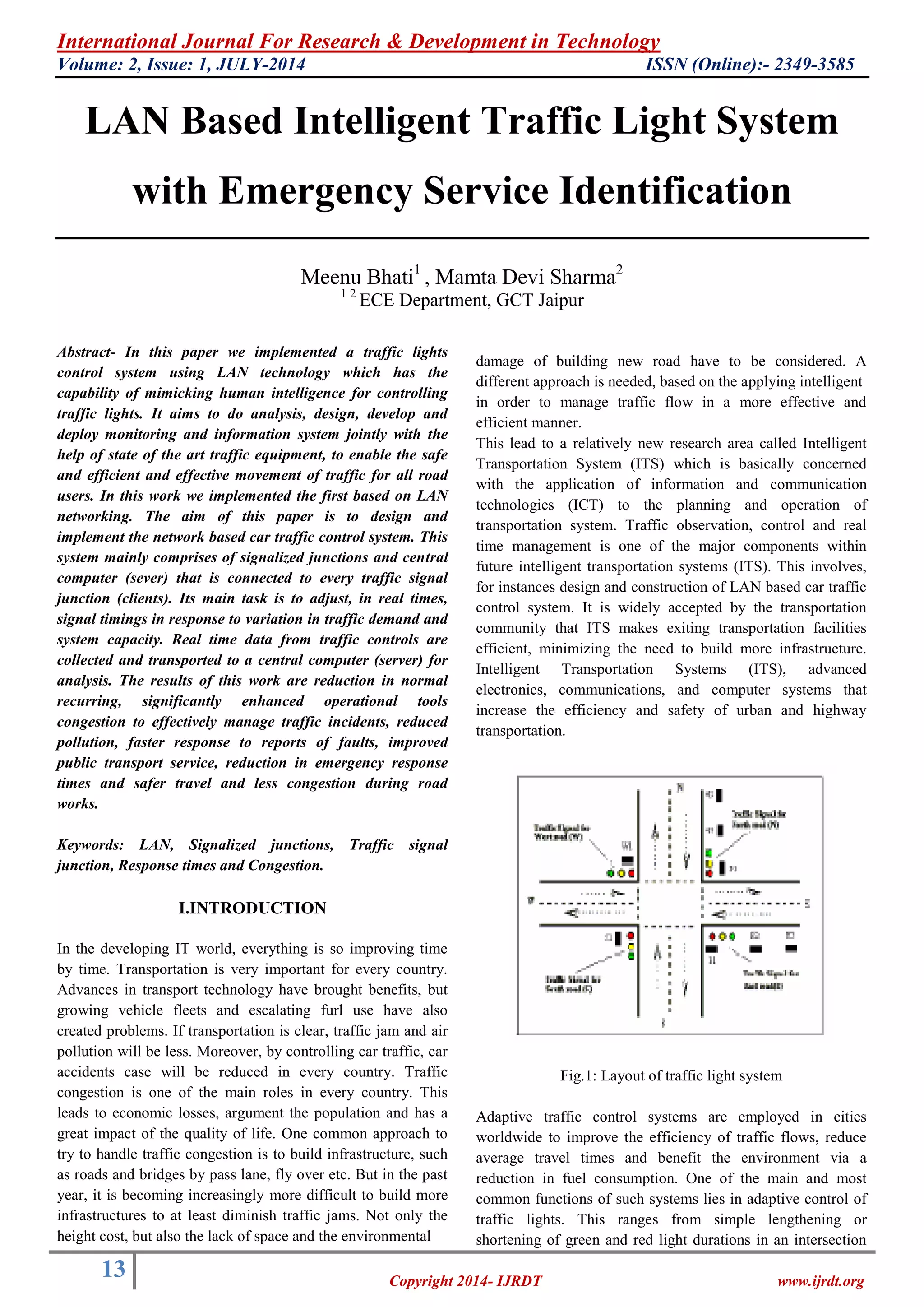
Fig.1: Layout of traffic light system 
Adaptive traffic control systems are employed in cities worldwide to improve the efficiency of traffic flows, reduce average travel times and benefit the environment via a reduction in fuel consumption. One of the main and most common functions of such systems lies in adaptive control of traffic lights. This ranges from simple lengthening or shortening of green and red light durations in an intersection
International Journal For Research & Development in Technology 
Paper Title:- LAN Based Intelligent Traffic Light System with Emergency ISSN(O):- 2349-3585 
Service Identification (Vol.2, Issue-1) 
14 
Copyright 2014- IJRDT www.ijrdt.org 
according to the actual presence of cars in the respective lanes, to coordination of green light phases among neighboring intersections on main thoroughfares. This adaptability is made possible with the use of sensors (typically in the form of magnetic loop detectors embedded under the road pavement) that feed data to roadside traffic light controllers, and a communications infrastructure that connects among the intersections and a traffic management centre, as well as, in some cases (typically in large cities), a hierarchy of regional computers (RC) that perform the control decisions for respective portions of the system. Traditionally, the communications layer of traffic control systems has been based on wired connections, either private or leased from public telecommunications operators. While for many years such leased lines (operating at 300bps) have served their purpose well, they have several shortcomings, such as a significant operating cost, inflexibility, and difficulty of installation in new sites. In certain cases, alternative solutions, operating over public infrastructure, have been deployed for specific sites where private or leased lines were not a viable option; these ranged from ADSL, regular dialup, or cellular (GPRS). However, using public network for traffic control could suffer from inconsistent delay jitters and reliability issues. 
Have you ever observed that in the midst of traffic, whenever siren sound of an ambulance or fire brigade is heard, the first reaction from the public as well as the traffic police will be to look towards the approaching ambulance in amusement to find how far are it from them and how the vehicle is approaching. In this melee, the traffic becomes chaotic making it more difficult for the ambulance or the fire brigade to move forward. It takes some time for the moving traffic to come to a halt and give way to the ambulance. Even in such a situation, there would be some two-wheeler or vehicle driver wanting to go ahead of every one without bothering! The worst part is when the constable managing the traffic themselves becomes the onlooker to the scene. They will be just watching as to how the ambulance driver is able to negotiate and move ahead of the surging traffic jam! Often the ambulances get stuck at the traffic signals where all other vehicles try to squeeze in to all the available space so as to move ahead as soon as the signal turns green. Unlike western countries, Indian cities cannot think of having separate lanes for emergency purpose because the roads are not broad enough. Its time for the traffic experts, police and the transport authorities to evolve a clear cut guideline as to what is the correct procedure to be followed by the traffic constable, public and the drivers of ambulance/fire brigade as the case may be. In absence of any specific guidelines the drivers of ambulance tend to steer the vehicle from whichever side they find it convenient. Other vehicles while giving way move here and there creating more chaos than facilitate. 
The need of the hour is to understand the gravity of such an emergent situation by every body. People should immediately act on hearing the siren instead of looking here and there in bewilderment. All vehicles must immediately be brought to the left side leaving the right side absolutely free for the un- obstructive passage of ambulance. The role of traffic constable should be well defined to bring all the vehicular traffic to a halt on to the left side on hearing any siren sound from approaching vehicle. They should ensure that no body (including VIP vehicle) is allowed to go ahead overtaking others until the ambulance passes. 
„Golden hour‟ is the key to one‟s life and instead of becoming a mere onlooker, let us be pro-active at the first sound of siren on road from an ambulance, fire brigade or even a police van/jeep (provided the last one is not carrying family of police personal to a school, mall or a film show!). 
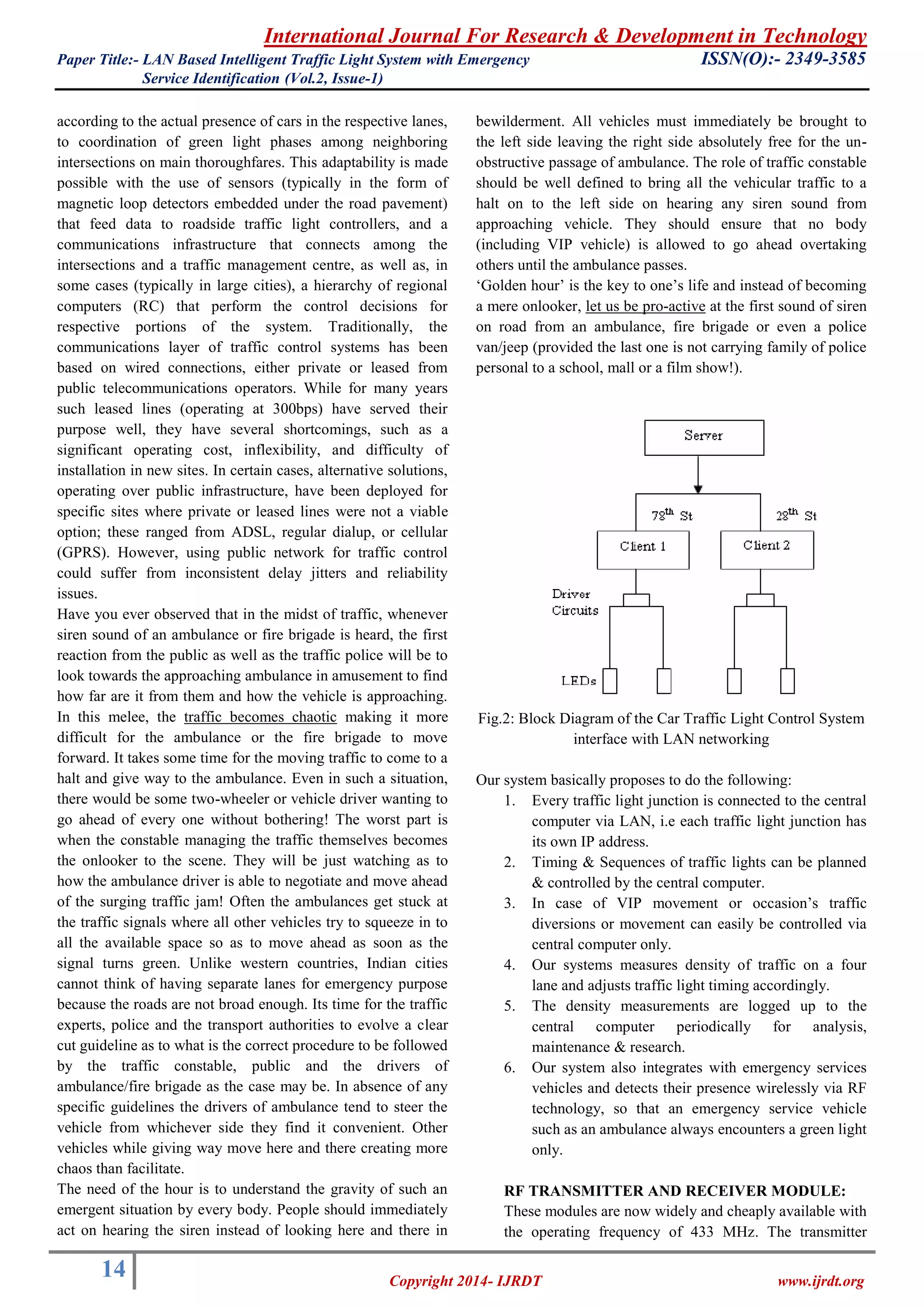
Fig.2: Block Diagram of the Car Traffic Light Control System interface with LAN networking Our system basically proposes to do the following: 
1. Every traffic light junction is connected to the central computer via LAN, i.e each traffic light junction has its own IP address. 
2. Timing & Sequences of traffic lights can be planned & controlled by the central computer. 
3. In case of VIP movement or occasion‟s traffic diversions or movement can easily be controlled via central computer only. 
4. Our systems measures density of traffic on a four lane and adjusts traffic light timing accordingly. 
5. The density measurements are logged up to the central computer periodically for analysis, maintenance & research. 
6. Our system also integrates with emergency services vehicles and detects their presence wirelessly via RF technology, so that an emergency service vehicle such as an ambulance always encounters a green light only. 
RF TRANSMITTER AND RECEIVER MODULE: 
These modules are now widely and cheaply available with the operating frequency of 433 MHz. The transmitter
International Journal For Research & Development in Technology 
Paper Title:- LAN Based Intelligent Traffic Light System with Emergency ISSN(O):- 2349-3585 
Service Identification (Vol.2, Issue-1) 
15 
Copyright 2014- IJRDT www.ijrdt.org 
module accepts serial data. The encoder IC takes in parallel data at the TX side packages it into serial format and then transmits it with the help of a RF transmitter module. At the RX end, the decoder IC receives the signal via the RF receiver module, decodes the serial data and reproduces the original data in the parallel format. Features 
Range in open space (Standard Conditions): 100 Meters 
RX Receiver Frequency: 433 MHz 
Low Power Consumption 
Easy For Application 
RX Operating Voltage: 5V 
TX Frequency Range: 433.92 MHz 
TX Supply Voltage: 3V ~ 6V 
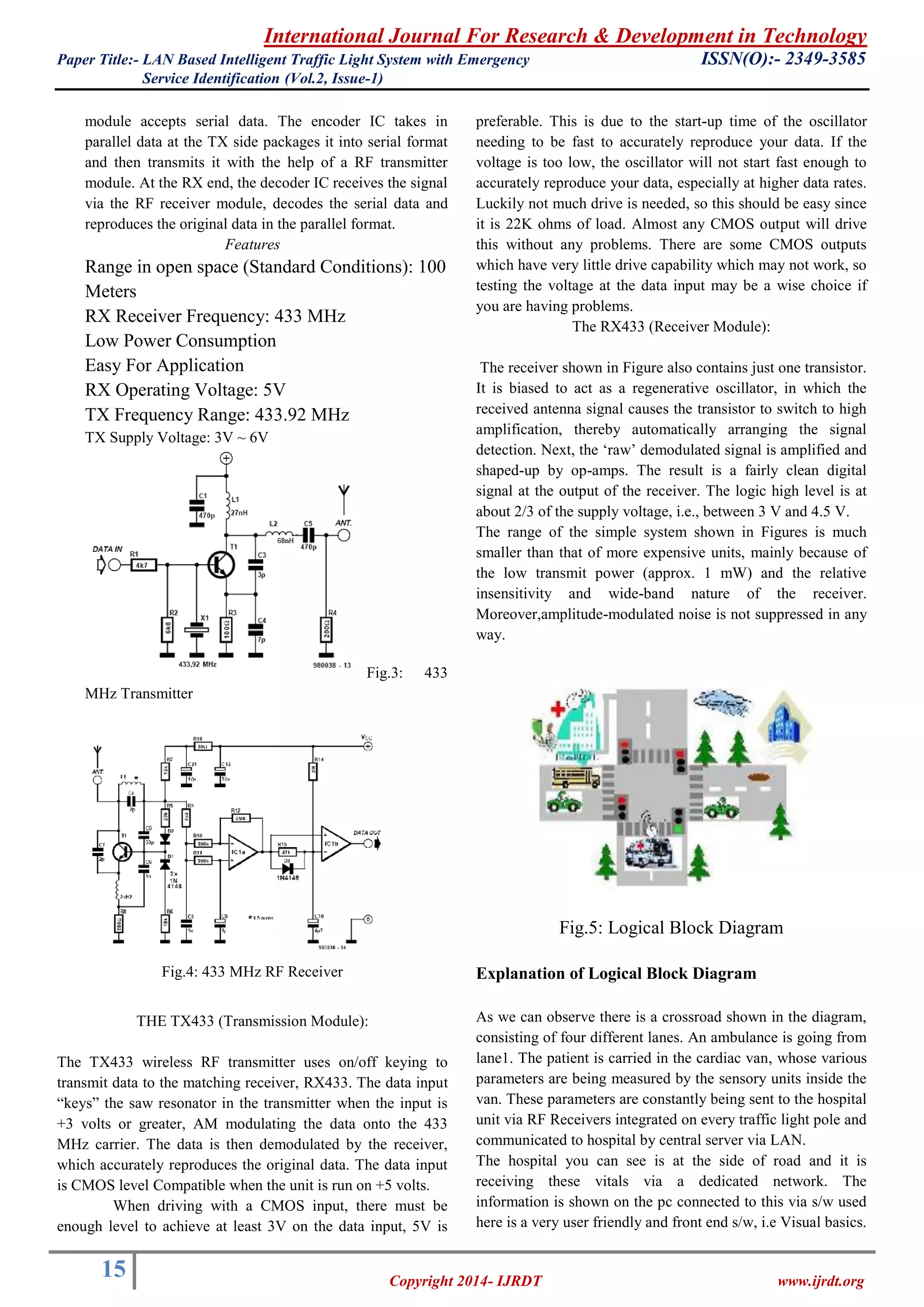
Fig.3: 433 MHz Transmitter 
Fig.4: 433 MHz RF Receiver THE TX433 (Transmission Module): The TX433 wireless RF transmitter uses on/off keying to transmit data to the matching receiver, RX433. The data input “keys” the saw resonator in the transmitter when the input is +3 volts or greater, AM modulating the data onto the 433 MHz carrier. The data is then demodulated by the receiver, which accurately reproduces the original data. The data input is CMOS level Compatible when the unit is run on +5 volts. 
When driving with a CMOS input, there must be enough level to achieve at least 3V on the data input, 5V is preferable. This is due to the start-up time of the oscillator needing to be fast to accurately reproduce your data. If the voltage is too low, the oscillator will not start fast enough to accurately reproduce your data, especially at higher data rates. Luckily not much drive is needed, so this should be easy since it is 22K ohms of load. Almost any CMOS output will drive this without any problems. There are some CMOS outputs which have very little drive capability which may not work, so testing the voltage at the data input may be a wise choice if you are having problems. The RX433 (Receiver Module): The receiver shown in Figure also contains just one transistor. It is biased to act as a regenerative oscillator, in which the received antenna signal causes the transistor to switch to high amplification, thereby automatically arranging the signal detection. Next, the „raw‟ demodulated signal is amplified and shaped-up by op-amps. The result is a fairly clean digital signal at the output of the receiver. The logic high level is at about 2/3 of the supply voltage, i.e., between 3 V and 4.5 V. The range of the simple system shown in Figures is much smaller than that of more expensive units, mainly because of the low transmit power (approx. 1 mW) and the relative insensitivity and wide-band nature of the receiver. Moreover,amplitude-modulated noise is not suppressed in any way. 
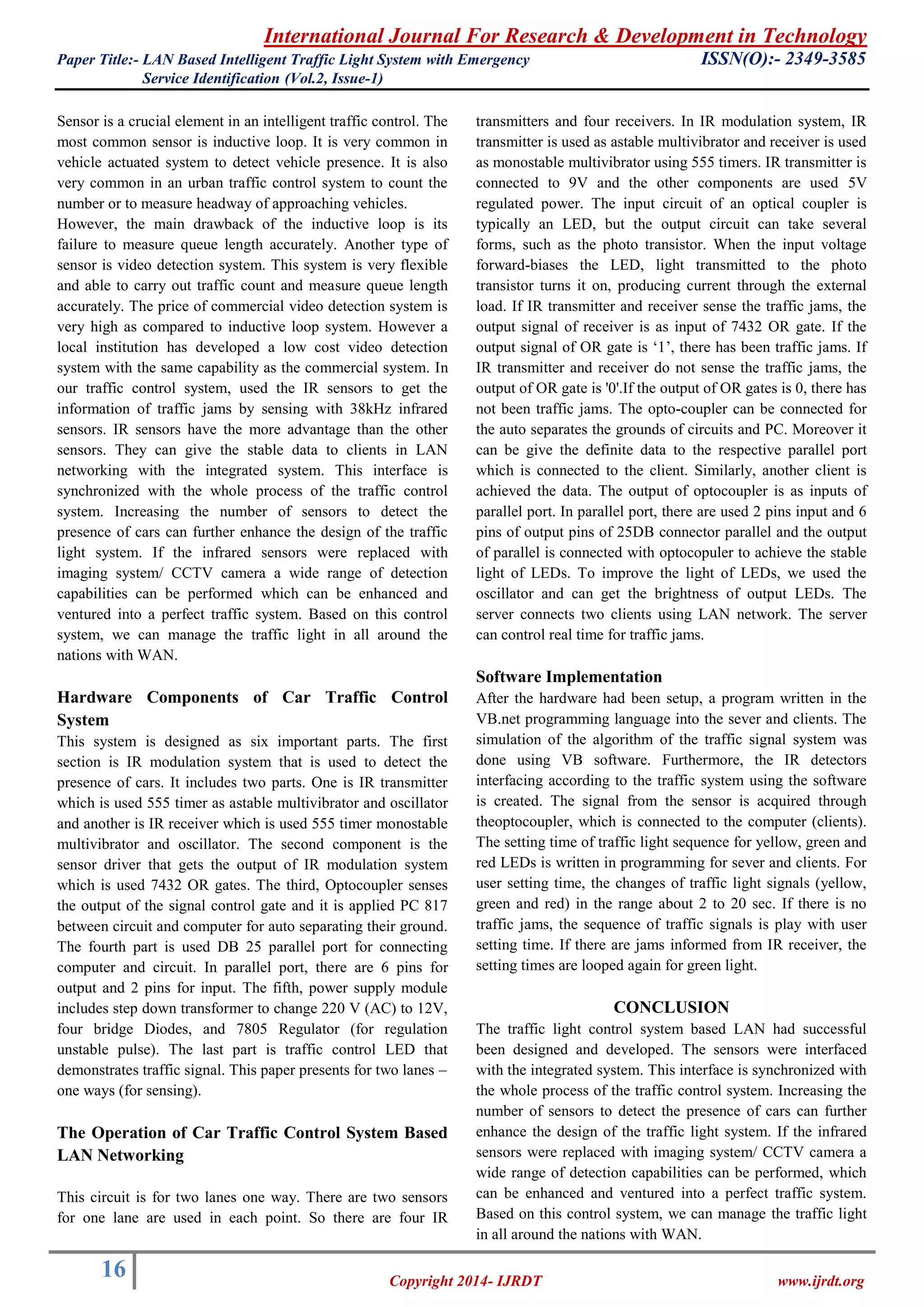
Fig.5: Logical Block Diagram Explanation of Logical Block Diagram As we can observe there is a crossroad shown in the diagram, consisting of four different lanes. An ambulance is going from lane1. The patient is carried in the cardiac van, whose various parameters are being measured by the sensory units inside the van. These parameters are constantly being sent to the hospital unit via RF Receivers integrated on every traffic light pole and communicated to hospital by central server via LAN. 
The hospital you can see is at the side of road and it is receiving these vitals via a dedicated network. The information is shown on the pc connected to this via s/w used here is a very user friendly and front end s/w, i.e Visual basics.
International Journal For Research & Development in Technology 
Paper Title:- LAN Based Intelligent Traffic Light System with Emergency ISSN(O):- 2349-3585 
Service Identification (Vol.2, Issue-1) 
16 
Copyright 2014- IJRDT www.ijrdt.org 
Sensor is a crucial element in an intelligent traffic control. The most common sensor is inductive loop. It is very common in vehicle actuated system to detect vehicle presence. It is also very common in an urban traffic control system to count the number or to measure headway of approaching vehicles. However, the main drawback of the inductive loop is its failure to measure queue length accurately. Another type of sensor is video detection system. This system is very flexible and able to carry out traffic count and measure queue length accurately. The price of commercial video detection system is very high as compared to inductive loop system. However a local institution has developed a low cost video detection system with the same capability as the commercial system. In our traffic control system, used the IR sensors to get the information of traffic jams by sensing with 38kHz infrared sensors. IR sensors have the more advantage than the other sensors. They can give the stable data to clients in LAN networking with the integrated system. This interface is synchronized with the whole process of the traffic control system. Increasing the number of sensors to detect the presence of cars can further enhance the design of the traffic light system. If the infrared sensors were replaced with imaging system/ CCTV camera a wide range of detection capabilities can be performed which can be enhanced and ventured into a perfect traffic system. Based on this control system, we can manage the traffic light in all around the nations with WAN. Hardware Components of Car Traffic Control System This system is designed as six important parts. The first section is IR modulation system that is used to detect the presence of cars. It includes two parts. One is IR transmitter which is used 555 timer as astable multivibrator and oscillator and another is IR receiver which is used 555 timer monostable multivibrator and oscillator. The second component is the sensor driver that gets the output of IR modulation system which is used 7432 OR gates. The third, Optocoupler senses the output of the signal control gate and it is applied PC 817 between circuit and computer for auto separating their ground. The fourth part is used DB 25 parallel port for connecting computer and circuit. In parallel port, there are 6 pins for output and 2 pins for input. The fifth, power supply module includes step down transformer to change 220 V (AC) to 12V, four bridge Diodes, and 7805 Regulator (for regulation unstable pulse). The last part is traffic control LED that demonstrates traffic signal. This paper presents for two lanes – one ways (for sensing). The Operation of Car Traffic Control System Based LAN Networking 
This circuit is for two lanes one way. There are two sensors for one lane are used in each point. So there are four IR transmitters and four receivers. In IR modulation system, IR transmitter is used as astable multivibrator and receiver is used as monostable multivibrator using 555 timers. IR transmitter is connected to 9V and the other components are used 5V regulated power. The input circuit of an optical coupler is typically an LED, but the output circuit can take several forms, such as the photo transistor. When the input voltage forward-biases the LED, light transmitted to the photo transistor turns it on, producing current through the external load. If IR transmitter and receiver sense the traffic jams, the output signal of receiver is as input of 7432 OR gate. If the output signal of OR gate is „1‟, there has been traffic jams. If IR transmitter and receiver do not sense the traffic jams, the output of OR gate is '0'.If the output of OR gates is 0, there has not been traffic jams. The opto-coupler can be connected for the auto separates the grounds of circuits and PC. Moreover it can be give the definite data to the respective parallel port which is connected to the client. Similarly, another client is achieved the data. The output of optocoupler is as inputs of parallel port. In parallel port, there are used 2 pins input and 6 pins of output pins of 25DB connector parallel and the output of parallel is connected with optocopuler to achieve the stable light of LEDs. To improve the light of LEDs, we used the oscillator and can get the brightness of output LEDs. The server connects two clients using LAN network. The server can control real time for traffic jams. Software Implementation After the hardware had been setup, a program written in the VB.net programming language into the sever and clients. The simulation of the algorithm of the traffic signal system was done using VB software. Furthermore, the IR detectors interfacing according to the traffic system using the software is created. The signal from the sensor is acquired through theoptocoupler, which is connected to the computer (clients). The setting time of traffic light sequence for yellow, green and red LEDs is written in programming for sever and clients. For user setting time, the changes of traffic light signals (yellow, green and red) in the range about 2 to 20 sec. If there is no traffic jams, the sequence of traffic signals is play with user setting time. If there are jams informed from IR receiver, the setting times are looped again for green light. CONCLUSION 
The traffic light control system based LAN had successful been designed and developed. The sensors were interfaced with the integrated system. This interface is synchronized with the whole process of the traffic control system. Increasing the number of sensors to detect the presence of cars can further enhance the design of the traffic light system. If the infrared sensors were replaced with imaging system/ CCTV camera a wide range of detection capabilities can be performed, which can be enhanced and ventured into a perfect traffic system. Based on this control system, we can manage the traffic light in all around the nations with WAN.
International Journal For Research & Development in Technology 
Paper Title:- LAN Based Intelligent Traffic Light System with Emergency ISSN(O):- 2349-3585 
Service Identification (Vol.2, Issue-1) 
17 
Copyright 2014- IJRDT www.ijrdt.org 
The intelligent traffic management system proposed in this work is a distributed automation systems based on Internet and Web technologies. The system uses the Ethernet as a communication backbone between individual nodes located at different traffic intersections and a central traffic management unit. Each node consists of an embedded web server interfaced with the traffic signals and used to monitors and control its operation. The proposed system offers a low cost solution to the needs of tomorrow‟s traffic management. As future work, we will be looking into techniques for optimizing the method of generating the dynamic web pages. 
ACKNOWLEDGMENT 
I owe my deepest gratitude to my Husband and Parents for their moral support, encouragement, help and prayers which enabled me to complete this project. I am heartedly thankful to my loving kids Ms. Saima Khan and Master Mishaal Khan and all my well-wishers for their tremendous co-operation and encouragement. Finally, I would like to extend my gratitude to the Almighty God and to all those persons who directly or indirectly helped me in the process and contributed towards this work. REFERENCES [1] Igor Klimchynski, “Extensible Embedded Web Server Architecture for Internet-Based Data Acquisition and Control,” IEEE Sensors Journal, Vol. 6, No. 3, June 2006. [2] Jen-Hao Teng; Chin-Yuan Tseng; Yu-Hung Chen, “Integration of networked embedded systems into power equipment remote control and monitoring,” 2004 IEEE Region 10 Conference, TENCON 2004. Volume C, Issue 3, 21-24 Nov. 2004, pp. 566 – 569. [3] Lakshmi Sangeetha, A. and Balaji Ganesh, A., “An embedded based digital controller for thermal process,” Sensors & Transducers Journal, Vol. 87, Issue 1, January 2008, pp. 46–51. [4] Li-Wei Wu, Jwu-Sheng Hu, “Embedded System Design for Robots - Design Concept, System Architecture, and Implementation,” IEEE Robotics & Automation Magazine, Volume 15, Issue 2, June 2008, pp. 108 – 121. [5] R. E. Filman, „„Embedded Internet systems come home,‟‟ IEEE Internet Comput., vol. 5, no. 1, 2001, pp. 52–53. [6] Jianwei Dong; Shi Zhang; Xiaonan Jia, “A Portable Intelligent ECG Monitor Based on Wireless Internet and Embedded System Technology”, 2008 International Conference on BioMedical 
Engineering and Informatics. (BMEI 2008). Volume 2, Issue , 27-30 May 2008 pp. 553 – 556. 
[7] Zhang, X.-h. Xu, W.-b., “A New CGI Queueing Model Designed in Embedded Web Server,” Lecture Notes in Computer Science, 2004, No. 3605, pp. 306-311. [8] Microchip PIC18F97J60 Family DataSheet,http://ww1.microchip.com/downloads/en/DeviceDoc/39762d.pdf Proceedings of the World Congress on Engineering and Computer Science 2009 Vol I WCECS 2009, October 20-22, 2009, San Francisco, USA ISBN: [9] Solomon, S., 1999, Sensors Handbook. McGraw –Hill New York. [10] Papacostas, C.S and Prevedouros, P.D., 1993.Transportation Engineering and Planning.2nd Edn. Prentice Hall, Englewood Clifts, New Jersey. [11] Bolton, W., 1996.Mechatronics: Electronic Control Systems in Mechanical Engineering .Addison Wesely Longman Limited, 1996. 
[12] Intelligent Transportation Systems, U.S. Department of Transportation.” http://www.its.dot.gov. [13] Dalaff, C.; Ruhé, M.; Reulke, R.; Schischmanow, A.; Schlotzhauer, G.: OIS - An optical information system for road traffic measurement and management, Joint Workshop of ISPRS Working Groups IV/3, IV/6 and IV/7, 8. -9.September 2003, University Stuttgart, Germany. [14] Mieth P, Lorkowski S, Schäfer RP: Comparison and assessment of large urban road networks - A case study, In: Proceedings, European Transport Conference, ETC, 2004.10.04 - 2004.10.06, Strasbourg. Authors Profile: 
Meenu Bhati is pursued Diploma in (EC) Electronics & Communication from Govt. Polytechnic College, CHURU. B.Tech. in Electronics and communication Engineering. From Govt. ECB Bikaner under Rajasthan University and M.Tech. in CSP (COMMUNICATION & SIGNAL PROCESSING) from JNU JAIPUR. Her interested research area in Microstrip Antennas. Filters, the planar
International Journal For Research & Development in Technology 
Paper Title:- LAN Based Intelligent Traffic Light System with Emergency ISSN(O):- 2349-3585 
Service Identification (Vol.2, Issue-1) 
18 
Copyright 2014- IJRDT www.ijrdt.org 
circuits, antenna elements and electromagnetic bandgap structures and MATLAB. 
Mamta Sharma is pursued in B.E. in Electronics and communication Engineering. from Global College of Technology, Jaipur and M.Tech in Digital Communication System from RTU.Her interested research area is Microstrip Antennas, Filters, the planar circuits, antenna elements and electromagnetic bandgap structures and MATLAB.

Lan based intelligent traffic light system with emergency service identification

  • 1.
    International Journal ForResearch & Development in Technology Volume: 2, Issue: 1, JULY-2014 ISSN (Online):- 2349-3585 13 Copyright 2014- IJRDT www.ijrdt.org LAN Based Intelligent Traffic Light System with Emergency Service Identification Meenu Bhati1 , Mamta Devi Sharma2 1 2 ECE Department, GCT Jaipur Abstract- In this paper we implemented a traffic lights control system using LAN technology which has the capability of mimicking human intelligence for controlling traffic lights. It aims to do analysis, design, develop and deploy monitoring and information system jointly with the help of state of the art traffic equipment, to enable the safe and efficient and effective movement of traffic for all road users. In this work we implemented the first based on LAN networking. The aim of this paper is to design and implement the network based car traffic control system. This system mainly comprises of signalized junctions and central computer (sever) that is connected to every traffic signal junction (clients). Its main task is to adjust, in real times, signal timings in response to variation in traffic demand and system capacity. Real time data from traffic controls are collected and transported to a central computer (server) for analysis. The results of this work are reduction in normal recurring, significantly enhanced operational tools congestion to effectively manage traffic incidents, reduced pollution, faster response to reports of faults, improved public transport service, reduction in emergency response times and safer travel and less congestion during road works. Keywords: LAN, Signalized junctions, Traffic signal junction, Response times and Congestion. I.INTRODUCTION In the developing IT world, everything is so improving time by time. Transportation is very important for every country. Advances in transport technology have brought benefits, but growing vehicle fleets and escalating furl use have also created problems. If transportation is clear, traffic jam and air pollution will be less. Moreover, by controlling car traffic, car accidents case will be reduced in every country. Traffic congestion is one of the main roles in every country. This leads to economic losses, argument the population and has a great impact of the quality of life. One common approach to try to handle traffic congestion is to build infrastructure, such as roads and bridges by pass lane, fly over etc. But in the past year, it is becoming increasingly more difficult to build more infrastructures to at least diminish traffic jams. Not only the height cost, but also the lack of space and the environmental damage of building new road have to be considered. A different approach is needed, based on the applying intelligent in order to manage traffic flow in a more effective and efficient manner. This lead to a relatively new research area called Intelligent Transportation System (ITS) which is basically concerned with the application of information and communication technologies (ICT) to the planning and operation of transportation system. Traffic observation, control and real time management is one of the major components within future intelligent transportation systems (ITS). This involves, for instances design and construction of LAN based car traffic control system. It is widely accepted by the transportation community that ITS makes exiting transportation facilities efficient, minimizing the need to build more infrastructure. Intelligent Transportation Systems (ITS), advanced electronics, communications, and computer systems that increase the efficiency and safety of urban and highway transportation. Fig.1: Layout of traffic light system Adaptive traffic control systems are employed in cities worldwide to improve the efficiency of traffic flows, reduce average travel times and benefit the environment via a reduction in fuel consumption. One of the main and most common functions of such systems lies in adaptive control of traffic lights. This ranges from simple lengthening or shortening of green and red light durations in an intersection
  • 2.
    International Journal ForResearch & Development in Technology Paper Title:- LAN Based Intelligent Traffic Light System with Emergency ISSN(O):- 2349-3585 Service Identification (Vol.2, Issue-1) 14 Copyright 2014- IJRDT www.ijrdt.org according to the actual presence of cars in the respective lanes, to coordination of green light phases among neighboring intersections on main thoroughfares. This adaptability is made possible with the use of sensors (typically in the form of magnetic loop detectors embedded under the road pavement) that feed data to roadside traffic light controllers, and a communications infrastructure that connects among the intersections and a traffic management centre, as well as, in some cases (typically in large cities), a hierarchy of regional computers (RC) that perform the control decisions for respective portions of the system. Traditionally, the communications layer of traffic control systems has been based on wired connections, either private or leased from public telecommunications operators. While for many years such leased lines (operating at 300bps) have served their purpose well, they have several shortcomings, such as a significant operating cost, inflexibility, and difficulty of installation in new sites. In certain cases, alternative solutions, operating over public infrastructure, have been deployed for specific sites where private or leased lines were not a viable option; these ranged from ADSL, regular dialup, or cellular (GPRS). However, using public network for traffic control could suffer from inconsistent delay jitters and reliability issues. Have you ever observed that in the midst of traffic, whenever siren sound of an ambulance or fire brigade is heard, the first reaction from the public as well as the traffic police will be to look towards the approaching ambulance in amusement to find how far are it from them and how the vehicle is approaching. In this melee, the traffic becomes chaotic making it more difficult for the ambulance or the fire brigade to move forward. It takes some time for the moving traffic to come to a halt and give way to the ambulance. Even in such a situation, there would be some two-wheeler or vehicle driver wanting to go ahead of every one without bothering! The worst part is when the constable managing the traffic themselves becomes the onlooker to the scene. They will be just watching as to how the ambulance driver is able to negotiate and move ahead of the surging traffic jam! Often the ambulances get stuck at the traffic signals where all other vehicles try to squeeze in to all the available space so as to move ahead as soon as the signal turns green. Unlike western countries, Indian cities cannot think of having separate lanes for emergency purpose because the roads are not broad enough. Its time for the traffic experts, police and the transport authorities to evolve a clear cut guideline as to what is the correct procedure to be followed by the traffic constable, public and the drivers of ambulance/fire brigade as the case may be. In absence of any specific guidelines the drivers of ambulance tend to steer the vehicle from whichever side they find it convenient. Other vehicles while giving way move here and there creating more chaos than facilitate. The need of the hour is to understand the gravity of such an emergent situation by every body. People should immediately act on hearing the siren instead of looking here and there in bewilderment. All vehicles must immediately be brought to the left side leaving the right side absolutely free for the un- obstructive passage of ambulance. The role of traffic constable should be well defined to bring all the vehicular traffic to a halt on to the left side on hearing any siren sound from approaching vehicle. They should ensure that no body (including VIP vehicle) is allowed to go ahead overtaking others until the ambulance passes. „Golden hour‟ is the key to one‟s life and instead of becoming a mere onlooker, let us be pro-active at the first sound of siren on road from an ambulance, fire brigade or even a police van/jeep (provided the last one is not carrying family of police personal to a school, mall or a film show!). Fig.2: Block Diagram of the Car Traffic Light Control System interface with LAN networking Our system basically proposes to do the following: 1. Every traffic light junction is connected to the central computer via LAN, i.e each traffic light junction has its own IP address. 2. Timing & Sequences of traffic lights can be planned & controlled by the central computer. 3. In case of VIP movement or occasion‟s traffic diversions or movement can easily be controlled via central computer only. 4. Our systems measures density of traffic on a four lane and adjusts traffic light timing accordingly. 5. The density measurements are logged up to the central computer periodically for analysis, maintenance & research. 6. Our system also integrates with emergency services vehicles and detects their presence wirelessly via RF technology, so that an emergency service vehicle such as an ambulance always encounters a green light only. RF TRANSMITTER AND RECEIVER MODULE: These modules are now widely and cheaply available with the operating frequency of 433 MHz. The transmitter
  • 3.
    International Journal ForResearch & Development in Technology Paper Title:- LAN Based Intelligent Traffic Light System with Emergency ISSN(O):- 2349-3585 Service Identification (Vol.2, Issue-1) 15 Copyright 2014- IJRDT www.ijrdt.org module accepts serial data. The encoder IC takes in parallel data at the TX side packages it into serial format and then transmits it with the help of a RF transmitter module. At the RX end, the decoder IC receives the signal via the RF receiver module, decodes the serial data and reproduces the original data in the parallel format. Features Range in open space (Standard Conditions): 100 Meters RX Receiver Frequency: 433 MHz Low Power Consumption Easy For Application RX Operating Voltage: 5V TX Frequency Range: 433.92 MHz TX Supply Voltage: 3V ~ 6V Fig.3: 433 MHz Transmitter Fig.4: 433 MHz RF Receiver THE TX433 (Transmission Module): The TX433 wireless RF transmitter uses on/off keying to transmit data to the matching receiver, RX433. The data input “keys” the saw resonator in the transmitter when the input is +3 volts or greater, AM modulating the data onto the 433 MHz carrier. The data is then demodulated by the receiver, which accurately reproduces the original data. The data input is CMOS level Compatible when the unit is run on +5 volts. When driving with a CMOS input, there must be enough level to achieve at least 3V on the data input, 5V is preferable. This is due to the start-up time of the oscillator needing to be fast to accurately reproduce your data. If the voltage is too low, the oscillator will not start fast enough to accurately reproduce your data, especially at higher data rates. Luckily not much drive is needed, so this should be easy since it is 22K ohms of load. Almost any CMOS output will drive this without any problems. There are some CMOS outputs which have very little drive capability which may not work, so testing the voltage at the data input may be a wise choice if you are having problems. The RX433 (Receiver Module): The receiver shown in Figure also contains just one transistor. It is biased to act as a regenerative oscillator, in which the received antenna signal causes the transistor to switch to high amplification, thereby automatically arranging the signal detection. Next, the „raw‟ demodulated signal is amplified and shaped-up by op-amps. The result is a fairly clean digital signal at the output of the receiver. The logic high level is at about 2/3 of the supply voltage, i.e., between 3 V and 4.5 V. The range of the simple system shown in Figures is much smaller than that of more expensive units, mainly because of the low transmit power (approx. 1 mW) and the relative insensitivity and wide-band nature of the receiver. Moreover,amplitude-modulated noise is not suppressed in any way. Fig.5: Logical Block Diagram Explanation of Logical Block Diagram As we can observe there is a crossroad shown in the diagram, consisting of four different lanes. An ambulance is going from lane1. The patient is carried in the cardiac van, whose various parameters are being measured by the sensory units inside the van. These parameters are constantly being sent to the hospital unit via RF Receivers integrated on every traffic light pole and communicated to hospital by central server via LAN. The hospital you can see is at the side of road and it is receiving these vitals via a dedicated network. The information is shown on the pc connected to this via s/w used here is a very user friendly and front end s/w, i.e Visual basics.
  • 4.
    International Journal ForResearch & Development in Technology Paper Title:- LAN Based Intelligent Traffic Light System with Emergency ISSN(O):- 2349-3585 Service Identification (Vol.2, Issue-1) 16 Copyright 2014- IJRDT www.ijrdt.org Sensor is a crucial element in an intelligent traffic control. The most common sensor is inductive loop. It is very common in vehicle actuated system to detect vehicle presence. It is also very common in an urban traffic control system to count the number or to measure headway of approaching vehicles. However, the main drawback of the inductive loop is its failure to measure queue length accurately. Another type of sensor is video detection system. This system is very flexible and able to carry out traffic count and measure queue length accurately. The price of commercial video detection system is very high as compared to inductive loop system. However a local institution has developed a low cost video detection system with the same capability as the commercial system. In our traffic control system, used the IR sensors to get the information of traffic jams by sensing with 38kHz infrared sensors. IR sensors have the more advantage than the other sensors. They can give the stable data to clients in LAN networking with the integrated system. This interface is synchronized with the whole process of the traffic control system. Increasing the number of sensors to detect the presence of cars can further enhance the design of the traffic light system. If the infrared sensors were replaced with imaging system/ CCTV camera a wide range of detection capabilities can be performed which can be enhanced and ventured into a perfect traffic system. Based on this control system, we can manage the traffic light in all around the nations with WAN. Hardware Components of Car Traffic Control System This system is designed as six important parts. The first section is IR modulation system that is used to detect the presence of cars. It includes two parts. One is IR transmitter which is used 555 timer as astable multivibrator and oscillator and another is IR receiver which is used 555 timer monostable multivibrator and oscillator. The second component is the sensor driver that gets the output of IR modulation system which is used 7432 OR gates. The third, Optocoupler senses the output of the signal control gate and it is applied PC 817 between circuit and computer for auto separating their ground. The fourth part is used DB 25 parallel port for connecting computer and circuit. In parallel port, there are 6 pins for output and 2 pins for input. The fifth, power supply module includes step down transformer to change 220 V (AC) to 12V, four bridge Diodes, and 7805 Regulator (for regulation unstable pulse). The last part is traffic control LED that demonstrates traffic signal. This paper presents for two lanes – one ways (for sensing). The Operation of Car Traffic Control System Based LAN Networking This circuit is for two lanes one way. There are two sensors for one lane are used in each point. So there are four IR transmitters and four receivers. In IR modulation system, IR transmitter is used as astable multivibrator and receiver is used as monostable multivibrator using 555 timers. IR transmitter is connected to 9V and the other components are used 5V regulated power. The input circuit of an optical coupler is typically an LED, but the output circuit can take several forms, such as the photo transistor. When the input voltage forward-biases the LED, light transmitted to the photo transistor turns it on, producing current through the external load. If IR transmitter and receiver sense the traffic jams, the output signal of receiver is as input of 7432 OR gate. If the output signal of OR gate is „1‟, there has been traffic jams. If IR transmitter and receiver do not sense the traffic jams, the output of OR gate is '0'.If the output of OR gates is 0, there has not been traffic jams. The opto-coupler can be connected for the auto separates the grounds of circuits and PC. Moreover it can be give the definite data to the respective parallel port which is connected to the client. Similarly, another client is achieved the data. The output of optocoupler is as inputs of parallel port. In parallel port, there are used 2 pins input and 6 pins of output pins of 25DB connector parallel and the output of parallel is connected with optocopuler to achieve the stable light of LEDs. To improve the light of LEDs, we used the oscillator and can get the brightness of output LEDs. The server connects two clients using LAN network. The server can control real time for traffic jams. Software Implementation After the hardware had been setup, a program written in the VB.net programming language into the sever and clients. The simulation of the algorithm of the traffic signal system was done using VB software. Furthermore, the IR detectors interfacing according to the traffic system using the software is created. The signal from the sensor is acquired through theoptocoupler, which is connected to the computer (clients). The setting time of traffic light sequence for yellow, green and red LEDs is written in programming for sever and clients. For user setting time, the changes of traffic light signals (yellow, green and red) in the range about 2 to 20 sec. If there is no traffic jams, the sequence of traffic signals is play with user setting time. If there are jams informed from IR receiver, the setting times are looped again for green light. CONCLUSION The traffic light control system based LAN had successful been designed and developed. The sensors were interfaced with the integrated system. This interface is synchronized with the whole process of the traffic control system. Increasing the number of sensors to detect the presence of cars can further enhance the design of the traffic light system. If the infrared sensors were replaced with imaging system/ CCTV camera a wide range of detection capabilities can be performed, which can be enhanced and ventured into a perfect traffic system. Based on this control system, we can manage the traffic light in all around the nations with WAN.
  • 5.
    International Journal ForResearch & Development in Technology Paper Title:- LAN Based Intelligent Traffic Light System with Emergency ISSN(O):- 2349-3585 Service Identification (Vol.2, Issue-1) 17 Copyright 2014- IJRDT www.ijrdt.org The intelligent traffic management system proposed in this work is a distributed automation systems based on Internet and Web technologies. The system uses the Ethernet as a communication backbone between individual nodes located at different traffic intersections and a central traffic management unit. Each node consists of an embedded web server interfaced with the traffic signals and used to monitors and control its operation. The proposed system offers a low cost solution to the needs of tomorrow‟s traffic management. As future work, we will be looking into techniques for optimizing the method of generating the dynamic web pages. ACKNOWLEDGMENT I owe my deepest gratitude to my Husband and Parents for their moral support, encouragement, help and prayers which enabled me to complete this project. I am heartedly thankful to my loving kids Ms. Saima Khan and Master Mishaal Khan and all my well-wishers for their tremendous co-operation and encouragement. Finally, I would like to extend my gratitude to the Almighty God and to all those persons who directly or indirectly helped me in the process and contributed towards this work. REFERENCES [1] Igor Klimchynski, “Extensible Embedded Web Server Architecture for Internet-Based Data Acquisition and Control,” IEEE Sensors Journal, Vol. 6, No. 3, June 2006. [2] Jen-Hao Teng; Chin-Yuan Tseng; Yu-Hung Chen, “Integration of networked embedded systems into power equipment remote control and monitoring,” 2004 IEEE Region 10 Conference, TENCON 2004. Volume C, Issue 3, 21-24 Nov. 2004, pp. 566 – 569. [3] Lakshmi Sangeetha, A. and Balaji Ganesh, A., “An embedded based digital controller for thermal process,” Sensors & Transducers Journal, Vol. 87, Issue 1, January 2008, pp. 46–51. [4] Li-Wei Wu, Jwu-Sheng Hu, “Embedded System Design for Robots - Design Concept, System Architecture, and Implementation,” IEEE Robotics & Automation Magazine, Volume 15, Issue 2, June 2008, pp. 108 – 121. [5] R. E. Filman, „„Embedded Internet systems come home,‟‟ IEEE Internet Comput., vol. 5, no. 1, 2001, pp. 52–53. [6] Jianwei Dong; Shi Zhang; Xiaonan Jia, “A Portable Intelligent ECG Monitor Based on Wireless Internet and Embedded System Technology”, 2008 International Conference on BioMedical Engineering and Informatics. (BMEI 2008). Volume 2, Issue , 27-30 May 2008 pp. 553 – 556. [7] Zhang, X.-h. Xu, W.-b., “A New CGI Queueing Model Designed in Embedded Web Server,” Lecture Notes in Computer Science, 2004, No. 3605, pp. 306-311. [8] Microchip PIC18F97J60 Family DataSheet,http://ww1.microchip.com/downloads/en/DeviceDoc/39762d.pdf Proceedings of the World Congress on Engineering and Computer Science 2009 Vol I WCECS 2009, October 20-22, 2009, San Francisco, USA ISBN: [9] Solomon, S., 1999, Sensors Handbook. McGraw –Hill New York. [10] Papacostas, C.S and Prevedouros, P.D., 1993.Transportation Engineering and Planning.2nd Edn. Prentice Hall, Englewood Clifts, New Jersey. [11] Bolton, W., 1996.Mechatronics: Electronic Control Systems in Mechanical Engineering .Addison Wesely Longman Limited, 1996. [12] Intelligent Transportation Systems, U.S. Department of Transportation.” http://www.its.dot.gov. [13] Dalaff, C.; Ruhé, M.; Reulke, R.; Schischmanow, A.; Schlotzhauer, G.: OIS - An optical information system for road traffic measurement and management, Joint Workshop of ISPRS Working Groups IV/3, IV/6 and IV/7, 8. -9.September 2003, University Stuttgart, Germany. [14] Mieth P, Lorkowski S, Schäfer RP: Comparison and assessment of large urban road networks - A case study, In: Proceedings, European Transport Conference, ETC, 2004.10.04 - 2004.10.06, Strasbourg. Authors Profile: Meenu Bhati is pursued Diploma in (EC) Electronics & Communication from Govt. Polytechnic College, CHURU. B.Tech. in Electronics and communication Engineering. From Govt. ECB Bikaner under Rajasthan University and M.Tech. in CSP (COMMUNICATION & SIGNAL PROCESSING) from JNU JAIPUR. Her interested research area in Microstrip Antennas. Filters, the planar
  • 6.
    International Journal ForResearch & Development in Technology Paper Title:- LAN Based Intelligent Traffic Light System with Emergency ISSN(O):- 2349-3585 Service Identification (Vol.2, Issue-1) 18 Copyright 2014- IJRDT www.ijrdt.org circuits, antenna elements and electromagnetic bandgap structures and MATLAB. Mamta Sharma is pursued in B.E. in Electronics and communication Engineering. from Global College of Technology, Jaipur and M.Tech in Digital Communication System from RTU.Her interested research area is Microstrip Antennas, Filters, the planar circuits, antenna elements and electromagnetic bandgap structures and MATLAB.