Improving User Topic Interest
Profiles by Behavior Factorization
Presented by,
R Abhiram
USN: 1PE12IS079
Batch of 2016
Guided by,
Prof. Kakoli Bora
Department of ISE
PESIT-BSC
Zhe Zhao, Zhiyuan Cheng, Lichan Hong, Ed H. Chi
(Employees at Google)
Presented at International World Wide Web Conference Committee
(IW3C2), May 2015
1
Outline
○ A model to improve
recommendation of posts
on social networking sites
○ Uses “behavior
factorization” to achieve
this which is based on
matrix factorization
○ Predict topics of interest
for both consumption as
well as publishing
2
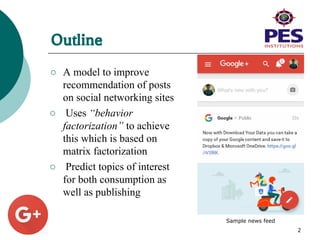
Sample news feed
Related Work
3
○ Building User Profiles
● Matrix Factorization
○ Collaborative Filtering techniques
● Google Knowledge Graph
○ Personalized User Profiles
○ Contextual Personalization
4
○ Each data point is represented as a tuple: (u, b, E) where:
● a user u (with an anonymized id) used
● behavior b to engage with
● a post containing E set of entities.
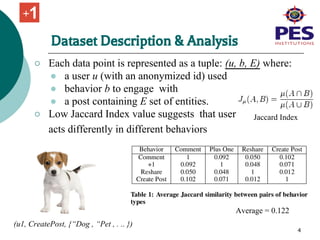
○ Low Jaccard Index value suggests that user
acts differently in different behaviors
(u1, CreatePost, {“Dog , “Pet , . .. })
Jaccard Index
Average = 0.122
Dataset Description & Analysis
Problem Definition
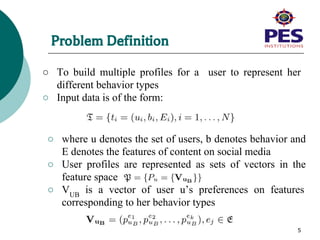
○ To build multiple profiles for a user to represent her
different behavior types
○ Input data is of the form:
5
○ where u denotes the set of users, b denotes behavior and
E denotes the features of content on social media
○ User profiles are represented as sets of vectors in the
feature space
○ VUB
is a vector of user u’s preferences on features
corresponding to her behavior types
Proposed approach
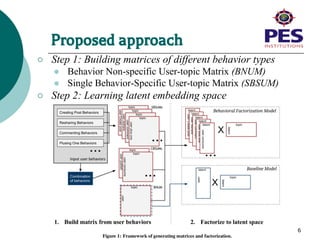
○ Step 1: Building matrices of different behavior types
● Behavior Non-specific User-topic Matrix (BNUM)
● Single Behavior-Specific User-topic Matrix (SBSUM)
○ Step 2: Learning latent embedding space
6
Proposed Approach - contd.
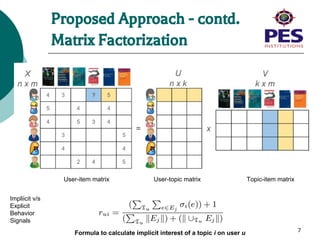
Matrix Factorization
7
Formula to calculate implicit interest of a topic i on user u
User-item matrix User-topic matrix Topic-item matrix
Impliicit v/s
Explicit
Behavior
Signals
Proposed approach - contd.
User Profiles
8
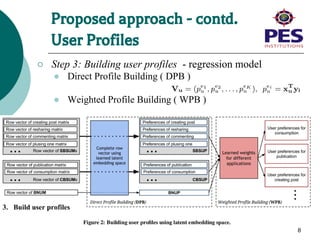
○ Step 3: Building user profiles - regression model
● Direct Profile Building ( DPB )
● Weighted Profile Building ( WPB )
Evaluation
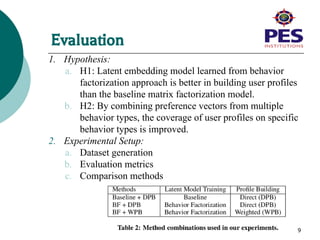
1. Hypothesis:
a. H1: Latent embedding model learned from behavior
factorization approach is better in building user profiles
than the baseline matrix factorization model.
b. H2: By combining preference vectors from multiple
behavior types, the coverage of user profiles on specific
behavior types is improved.
2. Experimental Setup:
a. Dataset generation
b. Evaluation metrics
c. Comparison methods
9
Evaluation - contd.
Results
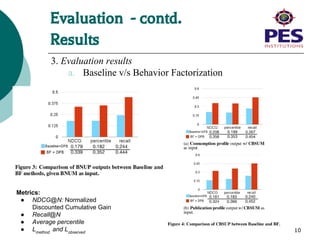
3. Evaluation results
a. Baseline v/s Behavior Factorization
10
Metrics:
● NDCG@N: Normalized
Discounted Cumulative Gain
● Recall@N
● Average percentile
● Lmethod
and Lobserved
Evaluation - contd.
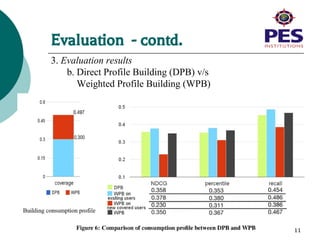
3. Evaluation results
b. Direct Profile Building (DPB) v/s
Weighted Profile Building (WPB)
11
Conclusión
1. Users have significantly different topical interests as
reflected by their different behavior types in G+.
2. Building multiple profiles with separate behavior
types allows us to tailor content recommendation
systems for various behavioral contexts.
3. Behavior Factorization (BF) as a way to build user
topic interest profiles in social media.
4. BF improved our latent embedding model by about
80% in predicting user topic preferences.
5. By using Weighted Profile Building (WPB), coverage
of consumption profile is improved by 60%.
12
References
1. A. Singhal. Google blog: Introducing the knowledge graph:
Things, not strings, May 2012.
2. E. Goffman. The presentation of self in everyday life.
1959.
3. A. E. Marwick et al. I tweet honestly, i tweet passionately:
Twitter users, context collapse, and the imagined audience.
New media & society, 13(1):114–133, 2011.
4. A. P. Singh and G. J. Gordon. Relational learning via
collective matrix factorization. In SIGKDD 2008, pages
650–658.
5. X. Zhao, N. Salehi, S. Naranjit, S. Alwaalan, S. Voida, and
D. Cosley. The many faces of facebook: Experiencing
social media as performance, exhibition, and personal
archive. In SIGCHI 2013, pages 1–10.
13
14
Thank you!

A seminar on User Topic Interest profiles research by Google

  • 1.
    Improving User TopicInterest Profiles by Behavior Factorization Presented by, R Abhiram USN: 1PE12IS079 Batch of 2016 Guided by, Prof. Kakoli Bora Department of ISE PESIT-BSC Zhe Zhao, Zhiyuan Cheng, Lichan Hong, Ed H. Chi (Employees at Google) Presented at International World Wide Web Conference Committee (IW3C2), May 2015 1
  • 2.
    Outline ○ A modelto improve recommendation of posts on social networking sites ○ Uses “behavior factorization” to achieve this which is based on matrix factorization ○ Predict topics of interest for both consumption as well as publishing 2 Sample news feed
  • 3.
    Related Work 3 ○ BuildingUser Profiles ● Matrix Factorization ○ Collaborative Filtering techniques ● Google Knowledge Graph ○ Personalized User Profiles ○ Contextual Personalization
  • 4.
    4 ○ Each datapoint is represented as a tuple: (u, b, E) where: ● a user u (with an anonymized id) used ● behavior b to engage with ● a post containing E set of entities. ○ Low Jaccard Index value suggests that user acts differently in different behaviors (u1, CreatePost, {“Dog , “Pet , . .. }) Jaccard Index Average = 0.122 Dataset Description & Analysis
  • 5.
    Problem Definition ○ Tobuild multiple profiles for a user to represent her different behavior types ○ Input data is of the form: 5 ○ where u denotes the set of users, b denotes behavior and E denotes the features of content on social media ○ User profiles are represented as sets of vectors in the feature space ○ VUB is a vector of user u’s preferences on features corresponding to her behavior types
  • 6.
    Proposed approach ○ Step1: Building matrices of different behavior types ● Behavior Non-specific User-topic Matrix (BNUM) ● Single Behavior-Specific User-topic Matrix (SBSUM) ○ Step 2: Learning latent embedding space 6
  • 7.
    Proposed Approach -contd. Matrix Factorization 7 Formula to calculate implicit interest of a topic i on user u User-item matrix User-topic matrix Topic-item matrix Impliicit v/s Explicit Behavior Signals
  • 8.
    Proposed approach -contd. User Profiles 8 ○ Step 3: Building user profiles - regression model ● Direct Profile Building ( DPB ) ● Weighted Profile Building ( WPB )
  • 9.
    Evaluation 1. Hypothesis: a. H1:Latent embedding model learned from behavior factorization approach is better in building user profiles than the baseline matrix factorization model. b. H2: By combining preference vectors from multiple behavior types, the coverage of user profiles on specific behavior types is improved. 2. Experimental Setup: a. Dataset generation b. Evaluation metrics c. Comparison methods 9
  • 10.
    Evaluation - contd. Results 3.Evaluation results a. Baseline v/s Behavior Factorization 10 Metrics: ● NDCG@N: Normalized Discounted Cumulative Gain ● Recall@N ● Average percentile ● Lmethod and Lobserved
  • 11.
    Evaluation - contd. 3.Evaluation results b. Direct Profile Building (DPB) v/s Weighted Profile Building (WPB) 11
  • 12.
    Conclusión 1. Users havesignificantly different topical interests as reflected by their different behavior types in G+. 2. Building multiple profiles with separate behavior types allows us to tailor content recommendation systems for various behavioral contexts. 3. Behavior Factorization (BF) as a way to build user topic interest profiles in social media. 4. BF improved our latent embedding model by about 80% in predicting user topic preferences. 5. By using Weighted Profile Building (WPB), coverage of consumption profile is improved by 60%. 12
  • 13.
    References 1. A. Singhal.Google blog: Introducing the knowledge graph: Things, not strings, May 2012. 2. E. Goffman. The presentation of self in everyday life. 1959. 3. A. E. Marwick et al. I tweet honestly, i tweet passionately: Twitter users, context collapse, and the imagined audience. New media & society, 13(1):114–133, 2011. 4. A. P. Singh and G. J. Gordon. Relational learning via collective matrix factorization. In SIGKDD 2008, pages 650–658. 5. X. Zhao, N. Salehi, S. Naranjit, S. Alwaalan, S. Voida, and D. Cosley. The many faces of facebook: Experiencing social media as performance, exhibition, and personal archive. In SIGCHI 2013, pages 1–10. 13
  • 14.