Centre Name : ICAI Bhawan, Cuffe Parade,
Mumbai.
Group Leader: Hrishikesh
Name
Yash
Shubbham
Abrar
Samuel Thomas
Hrishikesh
Vijay
1
2
1. In the era of information Tech revolution, advances in computer
technology and internet have led to development and gradual widespread use of
concepts such as e-commerce, e-banking, DMAT accounts, e-governance, e-retail.
2. Countries and trade blocs are vying each other to become the global currency
for trade, currently dollar holds the distinction of being the most widely
accepted currency. Advances in Digital Cash mechanism could create a truly
global currency, and e-currencies like `Bitcoin’ could also be traded offline.
3. Global response Digital cash and e-currencies like `Flooz’,`Beenz’, and David
Chaum created `DigiCash’, is evidence of its potential. Specifically, merchants are
interested in new and exciting payment mechanism, something which would
offer anonymity and global acceptance.
3
Digital cash aims to mimic the functionality of paper cash, by providing such properties
of anonymity and transferability of payment. Digital cash is intended to be
implemented data which can be copied, stored, or given as payment (for example,
attached to an email message, or via a USB stick, Bluetooth, etc).
Just like paper currency and coins, digital cash is intended to represent value because it
is backed by a trusted third party (namely, the government and the banking industry).
A payment message bearing a digital signature which functions as a medium of
exchange or store of value.
 Need to be backed by a trusted third party, usually the government or banks.
4
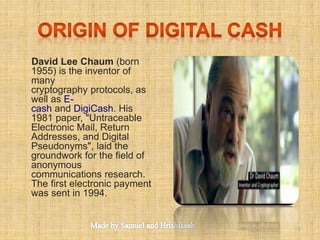
David Lee Chaum (born
1955) is the inventor of
many
cryptography protocols, as
well as E-
cash and DigiCash. His
1981 paper, "Untraceable
Electronic Mail, Return
Addresses, and Digital
Pseudonyms", laid the
groundwork for the field of
anonymous
communications research.
The first electronic payment
was sent in 1994.
5
• Most money is already paid in electronic form; for example, by credit or debit card, and by
direct transfer between accounts, or by on-line services such as PayPal. This kind of electronic
money is not digital cash, because it doesn't have the properties of cash (namely, anonymous
and off-line transferability between holders).
• Buyer can pay electronically by transmitting a unique number (called digital certificate)
similar to a banknote number. Like the serial numbers on real dollar bills, the digital cash
numbers are unique. Each one is issued by a bank and represents a specified sum of real
money. One of the key features of digital cash is that, like real cash, it is anonymous and
reusable. That is, when a digital cash amount is sent from a buyer to a vendor, there is no way
to obtain information about the buyer.
• Unlike credit card payments where the identity of the buyer can be established,
digital cash (just like real cash) is anonymous. Credit cards and e-cash can be used for online
transactions or via POS machines only , Digital cash can be used offline.
• Thus all digital cash is e-cash but all e-cash is not digital cash. Also called electronic
cash.
6
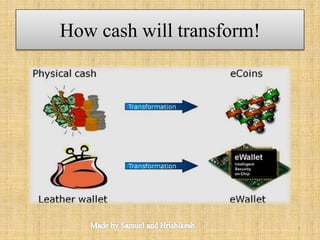
How cash will transform!
7
Anonymous Reusable (Portable)
Offline
Transaction
Secure Peer-to-
Peer
Widely
Accepted
8
Transfer Digital Cash
Linked with other
banks.
9
Traceable Online
Digital Cash
Untraceable
Offline Digital
Cash
Untraceable
Online Digital
Cash
Traceable
Offline Digital
Cash
10
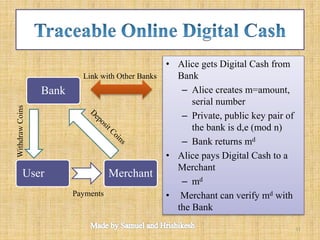
Bank
MerchantUser
• Alice gets Digital Cash from
Bank
– Alice creates m=amount,
serial number
– Private, public key pair of
the bank is d,e (mod n)
– Bank returns md
• Alice pays Digital Cash to a
Merchant
– md
• Merchant can verify md with
the Bank
Link with Other Banks
Payments
WithdrawCoins
11
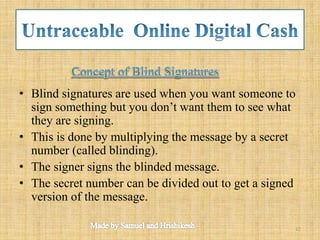
• Blind signatures are used when you want someone to
sign something but you don’t want them to see what
they are signing.
• This is done by multiplying the message by a secret
number (called blinding).
• The signer signs the blinded message.
• The secret number can be divided out to get a signed
version of the message.
12
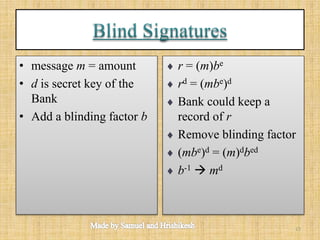
• message m = amount
• d is secret key of the
Bank
• Add a blinding factor b
 r = (m)be
 rd = (mbe)d
 Bank could keep a
record of r
 Remove blinding factor
 (mbe)d = (m)dbed
 b-1  md
13
• Banks public key = 17 (n=77)
• Banks private key = 53
• Alice’s message = 28
• Alice chooses a blinding
factor=6
• Alice asks Bob to sign 28*617
mod 77 = 70
• Bob signs 70 and sends Alice
7053 mod 77=42
• Alice can compute 42.6-1(mod
77) to get 7
– Note that 2853 mod 77 = 7
Blind Signature
14
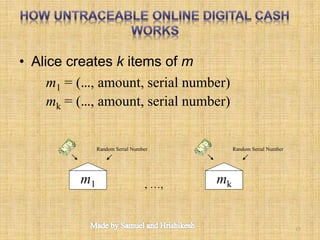
• Alice creates k items of m
Random Serial Number
m1
Random Serial Number
, …, mk
m1 = (…, amount, serial number)
mk = (…, amount, serial number)
15
• Alice creates blinding factors:b1
e,…, bk
e
• Blind the units - m1b1
e, …, mk bk
e
m1b1
e mkbk
e, …,
Bank
• Send to bank for signing
16
• Bank chooses k –1 items to check (at random)
• Customer gives all blinding factors except one
(say unit i)
• Bank checks they are correct
i
17
• Bank signs the remaining one and sends it
back – (mibe
i)d = mi
dbi
Customer
• The customer removes the blind using bi
-1
 mi
d
18
Here is the summary of the pros and cons of the online system:
Pros
• Provides fully anonymous
and untraceable digital cash:
• No double spending
problems (coins are checked
in real time during the
transaction).
• No additional secure
hardware required
Cons
• Communications overhead
between merchant and the
bank.
• Huge database of coin records
-- the bank server needs to
maintain an ever-growing
database for all the used coins’
serial numbers.
• Difficult to scale, need
synchronization between bank
servers.
• Coins are not reusable
19
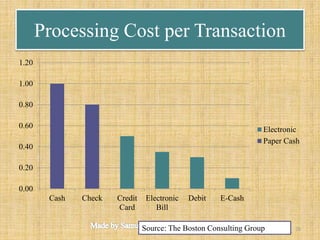
Processing Cost per Transaction
0.00
0.20
0.40
0.60
0.80
1.00
1.20
Cash Check Credit
Card
Electronic
Bill
Debit E-Cash
Electronic
Paper Cash
Source: The Boston Consulting Group 20
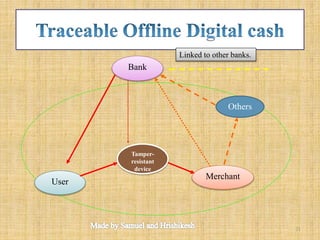
Bank
Merchant
User
Tamper-
resistant
device
Others
Linked to other banks.
21
• Let us denote Alice’s username as I
• We will split I into n parts such that
–Each part on its own does not contain any
information about I
–All n parts can be combined to reveal
username
• How does it work?
–Alice picks a random numbers r
–Alice calculates s = I  r
22
• Alice’s Username = 2510
• Alice picks a random number r = 1500:
• S=2510  1500 = 3090
• The username can now be split into 2 parts
– 1500 and 3090
• On their own they don’t reveal the username,
but when combined using the XOR, the
username is revealed
– 1500  3090 = 2510
23
A Coin
• User ID:
1500 3090
4545 6159
5878 7992
Header Information – 100$
Serial number - 123456
Transaction Item – pairs of user IDs
24
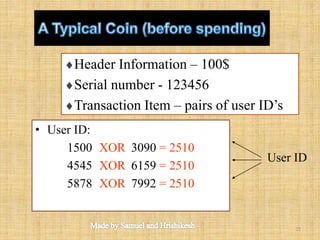
• User ID:
1500 XOR 3090 = 2510
4545 XOR 6159 = 2510
5878 XOR 7992 = 2510
User ID
Header Information – 100$
Serial number - 123456
Transaction Item – pairs of user ID’s
25
• Alice presents a token
to a Merchant
• Merchant asks Alice to
reveal part of each
user ID pair
– Merchant decides if he
wants to know the
right half or the left
half
– Alice blanks out the
other half
26
• User ID:
0 3090
4545 6159
5878 7992
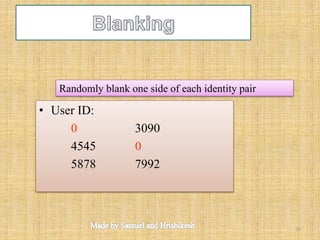
Randomly blank one side of each identity pair
27
• User ID:
0 3090
4545 0
5878 7992
Randomly blank one side of each identity pair
28
• User ID:
0 3090
4545 0
5878 0
Randomly blank one side of each identity pair
29
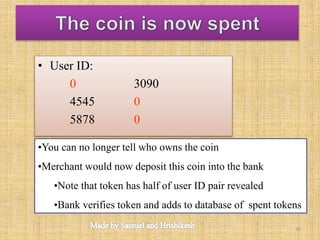
• User ID:
0 3090
4545 0
5878 0
•You can no longer tell who owns the coin
•Merchant would now deposit this coin into the bank
•Note that token has half of user ID pair revealed
•Bank verifies token and adds to database of spent tokens
30
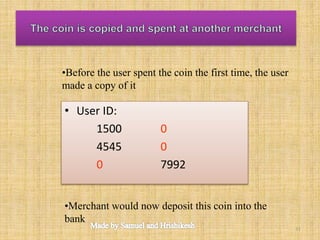
• User ID:
1500 0
4545 0
0 7992
•Before the user spent the coin the first time, the user
made a copy of it
•Merchant would now deposit this coin into the
bank
31
• Original Coin
• User ID:
0 3090
4545 0
5878 0
• Duplicate Coin
• User ID:
1500 0
4545 0
0 7992
This is what is in the bank
32
Pros
• Off-line, portable scheme
• User is fully anonymous unless
double spends
• Bank can detect double
spender (with high probability)
• Banks don’t need to
synchronize database in each
transaction.
• Coins are reusable
Cons
• Might not prevent double
spending immediately
• More expensive to
implement - the extra
security hardware needed in
the system requires an
additional cost
33
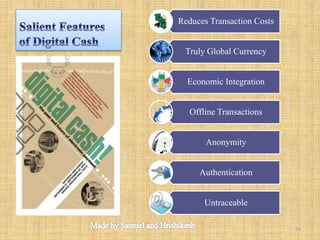
Reduces Transaction Costs
Truly Global Currency
Economic Integration
Offline Transactions
Anonymity
Authentication
Untraceable
34
Forgery
Money laundering
Private minting of cash
Low Financial Inclusion in developing
countries
Susceptible to hacking
High dependency on power
35
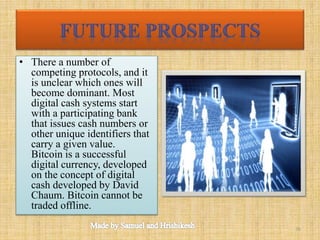
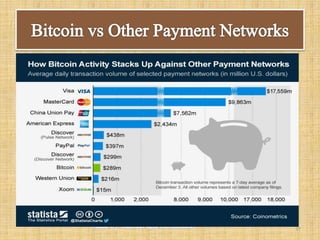
• There a number of
competing protocols, and it
is unclear which ones will
become dominant. Most
digital cash systems start
with a participating bank
that issues cash numbers or
other unique identifiers that
carry a given value.
Bitcoin is a successful
digital currency, developed
on the concept of digital
cash developed by David
Chaum. Bitcoin cannot be
traded offline.
36
37
/
• Peter Wayner, Digital Cash, Academic Press Inc; Pap/Cdr
edition
(1 October 1995)
• https://www.cs.bham.ac.uk/~mdr/teaching/modules06/netsec
/lectures/DigitalCash.html
• David Chaum, Amos Fiat and Moni Naor, "Untraceable
Electronic Cash", in Advances in Cryptology - CRYPTO '88
Proceedings.
• David Chaum, “Blind Signature System”. US Patent
#4759063
• illinois.edu
38
39

Digital Cash

  • 1.
    Centre Name :ICAI Bhawan, Cuffe Parade, Mumbai. Group Leader: Hrishikesh Name Yash Shubbham Abrar Samuel Thomas Hrishikesh Vijay 1
  • 2.
  • 3.
    1. In theera of information Tech revolution, advances in computer technology and internet have led to development and gradual widespread use of concepts such as e-commerce, e-banking, DMAT accounts, e-governance, e-retail. 2. Countries and trade blocs are vying each other to become the global currency for trade, currently dollar holds the distinction of being the most widely accepted currency. Advances in Digital Cash mechanism could create a truly global currency, and e-currencies like `Bitcoin’ could also be traded offline. 3. Global response Digital cash and e-currencies like `Flooz’,`Beenz’, and David Chaum created `DigiCash’, is evidence of its potential. Specifically, merchants are interested in new and exciting payment mechanism, something which would offer anonymity and global acceptance. 3
  • 4.
    Digital cash aimsto mimic the functionality of paper cash, by providing such properties of anonymity and transferability of payment. Digital cash is intended to be implemented data which can be copied, stored, or given as payment (for example, attached to an email message, or via a USB stick, Bluetooth, etc). Just like paper currency and coins, digital cash is intended to represent value because it is backed by a trusted third party (namely, the government and the banking industry). A payment message bearing a digital signature which functions as a medium of exchange or store of value.  Need to be backed by a trusted third party, usually the government or banks. 4
  • 5.
    David Lee Chaum(born 1955) is the inventor of many cryptography protocols, as well as E- cash and DigiCash. His 1981 paper, "Untraceable Electronic Mail, Return Addresses, and Digital Pseudonyms", laid the groundwork for the field of anonymous communications research. The first electronic payment was sent in 1994. 5
  • 6.
    • Most moneyis already paid in electronic form; for example, by credit or debit card, and by direct transfer between accounts, or by on-line services such as PayPal. This kind of electronic money is not digital cash, because it doesn't have the properties of cash (namely, anonymous and off-line transferability between holders). • Buyer can pay electronically by transmitting a unique number (called digital certificate) similar to a banknote number. Like the serial numbers on real dollar bills, the digital cash numbers are unique. Each one is issued by a bank and represents a specified sum of real money. One of the key features of digital cash is that, like real cash, it is anonymous and reusable. That is, when a digital cash amount is sent from a buyer to a vendor, there is no way to obtain information about the buyer. • Unlike credit card payments where the identity of the buyer can be established, digital cash (just like real cash) is anonymous. Credit cards and e-cash can be used for online transactions or via POS machines only , Digital cash can be used offline. • Thus all digital cash is e-cash but all e-cash is not digital cash. Also called electronic cash. 6
  • 7.
    How cash willtransform! 7
  • 8.
  • 9.
    Transfer Digital Cash Linkedwith other banks. 9
  • 10.
    Traceable Online Digital Cash Untraceable OfflineDigital Cash Untraceable Online Digital Cash Traceable Offline Digital Cash 10
  • 11.
    Bank MerchantUser • Alice getsDigital Cash from Bank – Alice creates m=amount, serial number – Private, public key pair of the bank is d,e (mod n) – Bank returns md • Alice pays Digital Cash to a Merchant – md • Merchant can verify md with the Bank Link with Other Banks Payments WithdrawCoins 11
  • 12.
    • Blind signaturesare used when you want someone to sign something but you don’t want them to see what they are signing. • This is done by multiplying the message by a secret number (called blinding). • The signer signs the blinded message. • The secret number can be divided out to get a signed version of the message. 12
  • 13.
    • message m= amount • d is secret key of the Bank • Add a blinding factor b  r = (m)be  rd = (mbe)d  Bank could keep a record of r  Remove blinding factor  (mbe)d = (m)dbed  b-1  md 13
  • 14.
    • Banks publickey = 17 (n=77) • Banks private key = 53 • Alice’s message = 28 • Alice chooses a blinding factor=6 • Alice asks Bob to sign 28*617 mod 77 = 70 • Bob signs 70 and sends Alice 7053 mod 77=42 • Alice can compute 42.6-1(mod 77) to get 7 – Note that 2853 mod 77 = 7 Blind Signature 14
  • 15.
    • Alice createsk items of m Random Serial Number m1 Random Serial Number , …, mk m1 = (…, amount, serial number) mk = (…, amount, serial number) 15
  • 16.
    • Alice createsblinding factors:b1 e,…, bk e • Blind the units - m1b1 e, …, mk bk e m1b1 e mkbk e, …, Bank • Send to bank for signing 16
  • 17.
    • Bank choosesk –1 items to check (at random) • Customer gives all blinding factors except one (say unit i) • Bank checks they are correct i 17
  • 18.
    • Bank signsthe remaining one and sends it back – (mibe i)d = mi dbi Customer • The customer removes the blind using bi -1  mi d 18
  • 19.
    Here is thesummary of the pros and cons of the online system: Pros • Provides fully anonymous and untraceable digital cash: • No double spending problems (coins are checked in real time during the transaction). • No additional secure hardware required Cons • Communications overhead between merchant and the bank. • Huge database of coin records -- the bank server needs to maintain an ever-growing database for all the used coins’ serial numbers. • Difficult to scale, need synchronization between bank servers. • Coins are not reusable 19
  • 20.
    Processing Cost perTransaction 0.00 0.20 0.40 0.60 0.80 1.00 1.20 Cash Check Credit Card Electronic Bill Debit E-Cash Electronic Paper Cash Source: The Boston Consulting Group 20
  • 21.
  • 22.
    • Let usdenote Alice’s username as I • We will split I into n parts such that –Each part on its own does not contain any information about I –All n parts can be combined to reveal username • How does it work? –Alice picks a random numbers r –Alice calculates s = I  r 22
  • 23.
    • Alice’s Username= 2510 • Alice picks a random number r = 1500: • S=2510  1500 = 3090 • The username can now be split into 2 parts – 1500 and 3090 • On their own they don’t reveal the username, but when combined using the XOR, the username is revealed – 1500  3090 = 2510 23
  • 24.
    A Coin • UserID: 1500 3090 4545 6159 5878 7992 Header Information – 100$ Serial number - 123456 Transaction Item – pairs of user IDs 24
  • 25.
    • User ID: 1500XOR 3090 = 2510 4545 XOR 6159 = 2510 5878 XOR 7992 = 2510 User ID Header Information – 100$ Serial number - 123456 Transaction Item – pairs of user ID’s 25
  • 26.
    • Alice presentsa token to a Merchant • Merchant asks Alice to reveal part of each user ID pair – Merchant decides if he wants to know the right half or the left half – Alice blanks out the other half 26
  • 27.
    • User ID: 03090 4545 6159 5878 7992 Randomly blank one side of each identity pair 27
  • 28.
    • User ID: 03090 4545 0 5878 7992 Randomly blank one side of each identity pair 28
  • 29.
    • User ID: 03090 4545 0 5878 0 Randomly blank one side of each identity pair 29
  • 30.
    • User ID: 03090 4545 0 5878 0 •You can no longer tell who owns the coin •Merchant would now deposit this coin into the bank •Note that token has half of user ID pair revealed •Bank verifies token and adds to database of spent tokens 30
  • 31.
    • User ID: 15000 4545 0 0 7992 •Before the user spent the coin the first time, the user made a copy of it •Merchant would now deposit this coin into the bank 31
  • 32.
    • Original Coin •User ID: 0 3090 4545 0 5878 0 • Duplicate Coin • User ID: 1500 0 4545 0 0 7992 This is what is in the bank 32
  • 33.
    Pros • Off-line, portablescheme • User is fully anonymous unless double spends • Bank can detect double spender (with high probability) • Banks don’t need to synchronize database in each transaction. • Coins are reusable Cons • Might not prevent double spending immediately • More expensive to implement - the extra security hardware needed in the system requires an additional cost 33
  • 34.
    Reduces Transaction Costs TrulyGlobal Currency Economic Integration Offline Transactions Anonymity Authentication Untraceable 34
  • 35.
    Forgery Money laundering Private mintingof cash Low Financial Inclusion in developing countries Susceptible to hacking High dependency on power 35
  • 36.
    • There anumber of competing protocols, and it is unclear which ones will become dominant. Most digital cash systems start with a participating bank that issues cash numbers or other unique identifiers that carry a given value. Bitcoin is a successful digital currency, developed on the concept of digital cash developed by David Chaum. Bitcoin cannot be traded offline. 36
  • 37.
  • 38.
    / • Peter Wayner,Digital Cash, Academic Press Inc; Pap/Cdr edition (1 October 1995) • https://www.cs.bham.ac.uk/~mdr/teaching/modules06/netsec /lectures/DigitalCash.html • David Chaum, Amos Fiat and Moni Naor, "Untraceable Electronic Cash", in Advances in Cryptology - CRYPTO '88 Proceedings. • David Chaum, “Blind Signature System”. US Patent #4759063 • illinois.edu 38
  • 39.