MEMRISTOR

            1
Contents
 Introduction
 History
 Theory
 An analogy
 Construction
 Working
 Possible applications
 Conclusion
 References

                              2
WHAT IS MEMRISTOR?
 Fourth fundamental circuit element
 Two terminal device
 Passive device
 Its resistance depends on the amount of
  charge passed through it
 That’s why it is called “memristor”(memory
  resistor)

                                               3
The beginning
                       v


    Resistor                Capacitor
    dv=Rdi                  dq=Cdv


                                              q
i


    Inductor              Memristor
    dΦ =Ldi 2008Chua proposed the existence of memristor in 1971 first
          Leon a team leaddΦ Stanley Williams created the
          In              by =Mdq
          memristor

                       φ
                                                                         4
Theory


 Or


 Or


         5
An analogy
  Memristor             Pipe
  Charge                Water
  Conductance           Cross sectional area
  Potential             Pressure

When water flows                               When water flows in
in one direction                               opposite direction
 the diameter                                   the diameter
increases                                      decreases (resistance
(resistance                                    increases)
decreases)


                                                                   6
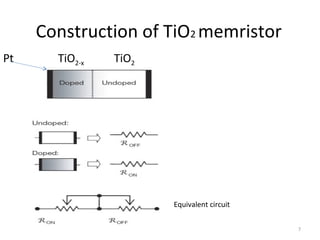
Construction of TiO2 memristor
Pt     TiO2-x   TiO2


                       Equivalent circuit


                                            7
Working


   Tio2-x   Ron


            Roff
   Tio2


                   8
Applications
As a switch
As a non volatile memory
Can perform logic operations
In artificial neural networks


                                 9
As a switch


Off state (high resistance)        On state (low resistance)


          0                                      1
                                                               10
As a memory unit


1 cm3 memristor = 1 terabit


                                      11
Logical operations
• Naturally suited for performing implication
  operation


                                                12
In artificial neural networks


                                                Memristive systems

Synapse=memristor
The Hodgkin-Huxley circuit model of a neuron axon membrane.


                                                                     13
How is it going to change the future?

POSSIBLE INVENTIONS UTILIZING MEMRISTORS                                            TIME

•memory for cameras, cell phones, iPods, iPads, etc.                                1 to 5 years
•universal memory replacing hard drives, RAM, flash, etc. in all computer devices   5 to 10 years
•complex self learning neural networks and hybrid transistor/memristor circuits     5 to 15 years
•memristic logic circuits on par with CPUs and other transistor circuits            15 to 20 years
•advanced artificial thinking brains                                                20 to 30 years?
•artificial conscious brains                                                        ?
•memory and brains capable of living millions of years                              ?
•artificial conscious beings capable of interstellar travel                         ?


                                                                                                      14
Conclusion
 Memristor will change circuit design in the
  21st century as radically as the transistor
  changed it in the 20th.


                                                15
References
 How We Found the Missing Memristor by Stanley Williams, IEEE
  Spectrum December 2008.
 L.O, Chua, Memristor-missing circuit clement, IEEE Tans . Circuit
  Theory, Vol. 18, 1971, pp. 507-519.
 Memristor and Memristive Systems Symposium, University of California,
  Berkeley, November 21,2008.
 Stateful Implication Logic with Memristors by Eero Lehtonen, Mika Laiho
  2009 IEEE/ACM International Symposium on Nanoscale Architectures


                                                                        16
THANK YOU

            17
MEMRISTOR

            18

memristor

  • 1.
  • 2.
    Contents  Introduction  History Theory  An analogy  Construction  Working  Possible applications  Conclusion  References 2
  • 3.
    WHAT IS MEMRISTOR? Fourth fundamental circuit element  Two terminal device  Passive device  Its resistance depends on the amount of charge passed through it  That’s why it is called “memristor”(memory resistor) 3
  • 4.
    The beginning v Resistor Capacitor dv=Rdi dq=Cdv q i Inductor Memristor dΦ =Ldi 2008Chua proposed the existence of memristor in 1971 first Leon a team leaddΦ Stanley Williams created the In by =Mdq memristor φ 4
  • 5.
  • 6.
    An analogy Memristor Pipe Charge Water Conductance Cross sectional area Potential Pressure When water flows When water flows in in one direction opposite direction the diameter the diameter increases decreases (resistance (resistance increases) decreases) 6
  • 7.
    Construction of TiO2memristor Pt TiO2-x TiO2 Equivalent circuit 7
  • 8.
    Working Tio2-x Ron Roff Tio2 8
  • 9.
    Applications As a switch Asa non volatile memory Can perform logic operations In artificial neural networks 9
  • 10.
    As a switch Offstate (high resistance) On state (low resistance) 0 1 10
  • 11.
    As a memoryunit 1 cm3 memristor = 1 terabit 11
  • 12.
    Logical operations • Naturallysuited for performing implication operation 12
  • 13.
    In artificial neuralnetworks Memristive systems Synapse=memristor The Hodgkin-Huxley circuit model of a neuron axon membrane. 13
  • 14.
    How is itgoing to change the future? POSSIBLE INVENTIONS UTILIZING MEMRISTORS TIME •memory for cameras, cell phones, iPods, iPads, etc. 1 to 5 years •universal memory replacing hard drives, RAM, flash, etc. in all computer devices 5 to 10 years •complex self learning neural networks and hybrid transistor/memristor circuits 5 to 15 years •memristic logic circuits on par with CPUs and other transistor circuits 15 to 20 years •advanced artificial thinking brains 20 to 30 years? •artificial conscious brains ? •memory and brains capable of living millions of years ? •artificial conscious beings capable of interstellar travel ? 14
  • 15.
    Conclusion  Memristor willchange circuit design in the 21st century as radically as the transistor changed it in the 20th. 15
  • 16.
    References  How WeFound the Missing Memristor by Stanley Williams, IEEE Spectrum December 2008.  L.O, Chua, Memristor-missing circuit clement, IEEE Tans . Circuit Theory, Vol. 18, 1971, pp. 507-519.  Memristor and Memristive Systems Symposium, University of California, Berkeley, November 21,2008.  Stateful Implication Logic with Memristors by Eero Lehtonen, Mika Laiho 2009 IEEE/ACM International Symposium on Nanoscale Architectures 16
  • 17.
  • 18.