Lamar University
                              College of Education
                            Educational Leadership
                                    Beaumont, TX

   Documenting Student Assessment:
   The Use of Electronic Portfolios and
             Web 2.0 Tools
Kay Abernathy, Ed.D.
Diane Mason, Ph.D.
Sheryl Abshire, Ph.D.
Cindy Cummings, Ed.D
Daryl Ann Borel, M.Ed.
Xinyu Liu, Ph.D.
• Cohort VI - 12 Universities -
  United States and Australia - 3
  year study
• E-portfolios - embracing rich
  media & social software, which
  enact reflection and
  integration.
• Cohort VI investigating
  e-portfolios in systemic way for
  assessment & effectiveness.
Research Procedures: Mixed Methods
            On-going Study
• INCEPR – Cohort 6 focus
  e-portfolios in ETL Graduate
  Program
• Research question, cohort
  guiding questions determine
  programs and eportfolio insight
  and perspective
• Analysis themes and patterns
• Pilot survey, analyzed findings,
  revised & developed second
  survey
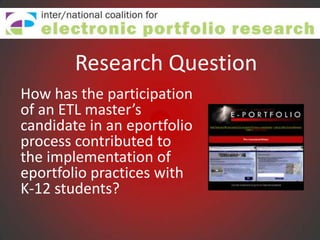
Research Question
How has the participation
of an ETL master’s
candidate in an eportfolio
process contributed to
the implementation of
eportfolio practices with
K-12 students?
Guiding Questions
• Can you adequately assess an eportfolio if the artifacts and
  reflections are in isolation?
• Are the candidates’ critical reflections focused on
  leadership development, the learning process, the
  assessment, and/or the artifact?
• Do candidates understand the concept of artifacts and their
  relationship to e-portfolios?
• How do connectivism and socialization impact the way our
  candidates perceive relationships between artifacts and
  extended learning?
• Are ETL candidates using Web 2.0 tools as part of their
  professional practice?
Survey and Program Findings
• Eportfolio as professional showcase vs. master’s
  program requirement.
• Artifacts indicate each e-portfolios are extension of
  personal and professional knowledge base.
• Reflections, course projects, and personal vitaes are
  separate artifacts focused on ETL coursework and
  professional contributions.
• Little evidence to indicate eportfolio is
  representative of personal learning and connections
  outside of the ETL program and professional
  expectations.
Survey and Program Findings
• ETL faculty should mentor candidates as they define
  artifacts and critically reflect on the value of
  e-portfolios personal and professional use.
• ETL faculty questions whether artifacts are products,
  how separate assessment tools such as a rubric or
  scoring guide affect the artifact contributions and
  processes, and if critical reflection impacts the overall
  eportfolio perceptions.
• ETL faculty envision building candidate leadership in
  eportfolio expertise to impact and transfer concepts
  to K-12 practice.
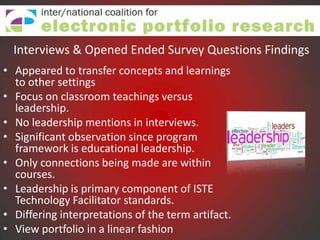
Interviews & Opened Ended Survey Questions Findings
• Appeared to transfer concepts and learnings
  to other settings
• Focus on classroom teachings versus
  leadership.
• No leadership mentions in interviews.
• Significant observation since program
  framework is educational leadership.
• Only connections being made are within
  courses.
• Leadership is primary component of ISTE
  Technology Facilitator standards.
• Differing interpretations of the term artifact.
• View portfolio in a linear fashion
Survey and Program Conclusions
• ETL faculty examining coursework content and eportfolio
  construction processes, procedures, and guidelines
• Readily enable candidates to frequently examine artifacts
  and the relationships between them.
• Candidates encouraged to reflect upon learning and
  relationship to teacher added value in K-12 instructional
  practice and student growth.
• In order to link artifacts through
  commonalities, differences, and
  inter-relationships, candidates should
  be given opportunities to analyze,
  reconsider, and question their beliefs,
  assumptions and experiences and how
  these elements impact their learning.
Survey and Program Conclusions
• The interviews and sample artifacts provided
  necessary examples for the ETL faculty to assess the
  current implementation of e-portfolios as related to
  the ETL coursework.
• Enabled the faculty to critically reflect upon the
  current progress and gave guidance for
  improvements in the program.
• Helped to solidify the beliefs of the
  ETL faculty regarding e-portfolio
  construction and critical reflection.
• Cronbach’s Alpha indicated a need
  to revise some survey items.
Mixed Methods
                On-going Study
• Conducted Conbach’s alpha
• Revised survey
• Field-tested the revised survey with 25 individuals
  representative of the final sample
• Revised survey for clarity based upon data from
  field-test
Revised Survey
• Distributed survey to 289 ETL graduates.
• 16 not valid email addresses
• 2 opt outs – not PK -12 educators
• Possible respondents - 271
• 105 completed survey – 39 % response rate
• Revised topics – Online teaching strategies, Web
  2.0 tools, E-portfolios, Leadership
• 19 questions – today – focus Web 2.0 &
  E-portfolios data
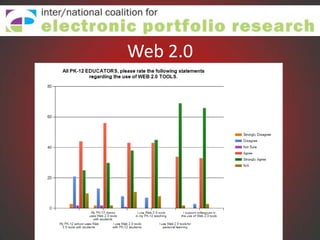
Web 2.0
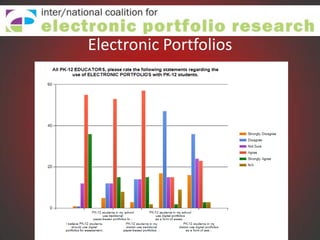
Electronic Portfolios
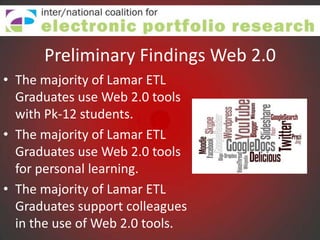
Preliminary Findings Web 2.0
• The majority of Lamar ETL
  Graduates use Web 2.0 tools
  with Pk-12 students.
• The majority of Lamar ETL
  Graduates use Web 2.0 tools
  for personal learning.
• The majority of Lamar ETL
  Graduates support colleagues
  in the use of Web 2.0 tools.
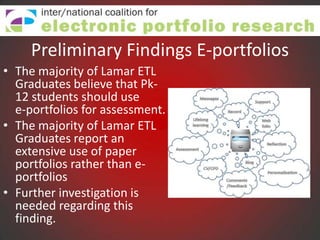
Preliminary Findings E-portfolios
• The majority of Lamar ETL
  Graduates believe that Pk-
  12 students should use
  e-portfolios for assessment.
• The majority of Lamar ETL
  Graduates report an
  extensive use of paper
  portfolios rather than e-
  portfolios
• Further investigation is
  needed regarding this
  finding.
Contact Information

•   Kay Abernathy, Ed.D. - lkabernathy@lamar.edu
•   Diane Mason, Ph.D. - diane.mason@lamar.edu
•   Sheryl Abshire, Ph.D. – sheryl.abshire@lamar.edu
•   Cindy Cummings, Ed.D. -        cdcummings@lamar.edu
•   Daryl Ann Borel, M.Ed. – daborel@lamar.edu
•   Xinyu Liu, Ph.D. - xinyu.liu@lamar.edu
For More Information:
         Lamar University
           Beaumont, TX
http://lamar.edu/ & ttp://stateu.com/lamar/


              Tiny URL
    http://tinyurl.com/7reh5r9

Lamar coehd regional_research_presentation_final_3-23-12

  • 1.
    Lamar University College of Education Educational Leadership Beaumont, TX Documenting Student Assessment: The Use of Electronic Portfolios and Web 2.0 Tools Kay Abernathy, Ed.D. Diane Mason, Ph.D. Sheryl Abshire, Ph.D. Cindy Cummings, Ed.D Daryl Ann Borel, M.Ed. Xinyu Liu, Ph.D.
  • 2.
    • Cohort VI- 12 Universities - United States and Australia - 3 year study • E-portfolios - embracing rich media & social software, which enact reflection and integration. • Cohort VI investigating e-portfolios in systemic way for assessment & effectiveness.
  • 3.
    Research Procedures: MixedMethods On-going Study • INCEPR – Cohort 6 focus e-portfolios in ETL Graduate Program • Research question, cohort guiding questions determine programs and eportfolio insight and perspective • Analysis themes and patterns • Pilot survey, analyzed findings, revised & developed second survey
  • 4.
    Research Question How hasthe participation of an ETL master’s candidate in an eportfolio process contributed to the implementation of eportfolio practices with K-12 students?
  • 5.
    Guiding Questions • Canyou adequately assess an eportfolio if the artifacts and reflections are in isolation? • Are the candidates’ critical reflections focused on leadership development, the learning process, the assessment, and/or the artifact? • Do candidates understand the concept of artifacts and their relationship to e-portfolios? • How do connectivism and socialization impact the way our candidates perceive relationships between artifacts and extended learning? • Are ETL candidates using Web 2.0 tools as part of their professional practice?
  • 6.
    Survey and ProgramFindings • Eportfolio as professional showcase vs. master’s program requirement. • Artifacts indicate each e-portfolios are extension of personal and professional knowledge base. • Reflections, course projects, and personal vitaes are separate artifacts focused on ETL coursework and professional contributions. • Little evidence to indicate eportfolio is representative of personal learning and connections outside of the ETL program and professional expectations.
  • 7.
    Survey and ProgramFindings • ETL faculty should mentor candidates as they define artifacts and critically reflect on the value of e-portfolios personal and professional use. • ETL faculty questions whether artifacts are products, how separate assessment tools such as a rubric or scoring guide affect the artifact contributions and processes, and if critical reflection impacts the overall eportfolio perceptions. • ETL faculty envision building candidate leadership in eportfolio expertise to impact and transfer concepts to K-12 practice.
  • 8.
    Interviews & OpenedEnded Survey Questions Findings • Appeared to transfer concepts and learnings to other settings • Focus on classroom teachings versus leadership. • No leadership mentions in interviews. • Significant observation since program framework is educational leadership. • Only connections being made are within courses. • Leadership is primary component of ISTE Technology Facilitator standards. • Differing interpretations of the term artifact. • View portfolio in a linear fashion
  • 9.
    Survey and ProgramConclusions • ETL faculty examining coursework content and eportfolio construction processes, procedures, and guidelines • Readily enable candidates to frequently examine artifacts and the relationships between them. • Candidates encouraged to reflect upon learning and relationship to teacher added value in K-12 instructional practice and student growth. • In order to link artifacts through commonalities, differences, and inter-relationships, candidates should be given opportunities to analyze, reconsider, and question their beliefs, assumptions and experiences and how these elements impact their learning.
  • 10.
    Survey and ProgramConclusions • The interviews and sample artifacts provided necessary examples for the ETL faculty to assess the current implementation of e-portfolios as related to the ETL coursework. • Enabled the faculty to critically reflect upon the current progress and gave guidance for improvements in the program. • Helped to solidify the beliefs of the ETL faculty regarding e-portfolio construction and critical reflection. • Cronbach’s Alpha indicated a need to revise some survey items.
  • 11.
    Mixed Methods On-going Study • Conducted Conbach’s alpha • Revised survey • Field-tested the revised survey with 25 individuals representative of the final sample • Revised survey for clarity based upon data from field-test
  • 12.
    Revised Survey • Distributedsurvey to 289 ETL graduates. • 16 not valid email addresses • 2 opt outs – not PK -12 educators • Possible respondents - 271 • 105 completed survey – 39 % response rate • Revised topics – Online teaching strategies, Web 2.0 tools, E-portfolios, Leadership • 19 questions – today – focus Web 2.0 & E-portfolios data
  • 13.
  • 14.
  • 15.
    Preliminary Findings Web2.0 • The majority of Lamar ETL Graduates use Web 2.0 tools with Pk-12 students. • The majority of Lamar ETL Graduates use Web 2.0 tools for personal learning. • The majority of Lamar ETL Graduates support colleagues in the use of Web 2.0 tools.
  • 16.
    Preliminary Findings E-portfolios •The majority of Lamar ETL Graduates believe that Pk- 12 students should use e-portfolios for assessment. • The majority of Lamar ETL Graduates report an extensive use of paper portfolios rather than e- portfolios • Further investigation is needed regarding this finding.
  • 17.
    Contact Information • Kay Abernathy, Ed.D. - lkabernathy@lamar.edu • Diane Mason, Ph.D. - diane.mason@lamar.edu • Sheryl Abshire, Ph.D. – sheryl.abshire@lamar.edu • Cindy Cummings, Ed.D. - cdcummings@lamar.edu • Daryl Ann Borel, M.Ed. – daborel@lamar.edu • Xinyu Liu, Ph.D. - xinyu.liu@lamar.edu
  • 18.
    For More Information: Lamar University Beaumont, TX http://lamar.edu/ & ttp://stateu.com/lamar/ Tiny URL http://tinyurl.com/7reh5r9

Editor's Notes