Presenters
Jennifer Butcher, Ph.D.
Diane Mason, Ph.D.
Donna Fong, Ed.D.
Donda Slaydon, Ed.D.
How to Master Qualitative Design
Leadership-U
May 3, 2013
Research Design Selection
• Gain familiarity with core designs.
– Narrative, Ethnography, Grounded Theory, Case
Study, Phenomenological
• Examine research studies.
• Align research question with design.
• Become an expert.
Narrative
• Narrative text used with a specific focus on the stories lived
and told by individuals, and chronologically connected.
– Analysis of narrative
– Narrative analysis
• Example
– Factors that Influence Hispanic Students to Take Advanced
Level Courses - Susan M. Caffery, Ed.D.
Ethnography
• Observation and recording of shared learned
behaviors of a cultural group.
• Example
– An Ethnographic Case Study of the Professional
Development Model in a Successful Elementary
School Within a Suburban Southeast
Texas School District
– – Valerie Petrzelka, Ed.D.
Grounded Theory
• Generate or discover a theory (Creswell, 1968)
• Examples
– Used primarily in Human Research Development.
– Studies of workplace are development.
– Responses to organizational change.
– Conflict management.
– Exploration of leadership values in
teamwork.
– Developing Long-Term Physical Activity
Participation: A Grounded Theory Study With
African American Women (Creswell, 2013)
Phenomenological
• Describes the meaning for several individuals, their
lived experiences of a concept, or phenomenon.
• Example
– A Study of High School Veteran Teachers Who Have
Changed Instructional Paradigms to Embrace
Digital Tools: Framed Within Adult
Learning Theory – Donna Fong, Ed.D.
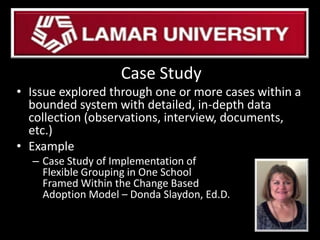
Case Study
• Issue explored through one or more cases within a
bounded system with detailed, in-depth data
collection (observations, interview, documents,
etc.)
• Example
– Case Study of Implementation of
Flexible Grouping in One School
Framed Within the Change Based
Adoption Model – Donda Slaydon, Ed.D.
Researcher Role
• Reduce bias
– Use specificity with terms.
– Set aside personal experiences.
– Examine with a fresh perspective.
• Epoche
– Common in qualitative research.
– Usually a page or so in length.
Data Collection Process
• Yourself, someone else, or team?
• Data Types
– Interviews
• Individual, pairs, or focus group?
– Open-ended survey items
– Artifacts
– Social Media
Coding and Identifying Themes
• Coding is the process of examining the raw
qualitative data.
• Results in assigning codes, labels, or themes to
words, phrases, sentences, or paragraphs.
• Themes are often referred to as
categories. Generally, no more that 5-7.
• Themes are similar codes aggregated
together to form a major idea.
Coding Group Activity
• Coding Qualitative Data
– Examine code list and decide which code sums up
the text discussion.
– Read a passage and provide a code for what is
happening in each line of the text.
• Questions & Answers
Contact Information
Diane Mason, Ph.D.
diane.mason@lamar.edu
Jennifer Butcher, Ph.D.
jbutcher@lamar.edu
Donna Fong, Ed.D.
dfong@lcmcisd.org
Donda Slaydon, Ed.D.
dondaslaydon@sbcglobal.net

Leadership u how-to_master_qualitative_design_5-3-13

  • 1.
    Presenters Jennifer Butcher, Ph.D. DianeMason, Ph.D. Donna Fong, Ed.D. Donda Slaydon, Ed.D. How to Master Qualitative Design Leadership-U May 3, 2013
  • 2.
    Research Design Selection •Gain familiarity with core designs. – Narrative, Ethnography, Grounded Theory, Case Study, Phenomenological • Examine research studies. • Align research question with design. • Become an expert.
  • 3.
    Narrative • Narrative textused with a specific focus on the stories lived and told by individuals, and chronologically connected. – Analysis of narrative – Narrative analysis • Example – Factors that Influence Hispanic Students to Take Advanced Level Courses - Susan M. Caffery, Ed.D.
  • 4.
    Ethnography • Observation andrecording of shared learned behaviors of a cultural group. • Example – An Ethnographic Case Study of the Professional Development Model in a Successful Elementary School Within a Suburban Southeast Texas School District – – Valerie Petrzelka, Ed.D.
  • 5.
    Grounded Theory • Generateor discover a theory (Creswell, 1968) • Examples – Used primarily in Human Research Development. – Studies of workplace are development. – Responses to organizational change. – Conflict management. – Exploration of leadership values in teamwork. – Developing Long-Term Physical Activity Participation: A Grounded Theory Study With African American Women (Creswell, 2013)
  • 6.
    Phenomenological • Describes themeaning for several individuals, their lived experiences of a concept, or phenomenon. • Example – A Study of High School Veteran Teachers Who Have Changed Instructional Paradigms to Embrace Digital Tools: Framed Within Adult Learning Theory – Donna Fong, Ed.D.
  • 7.
    Case Study • Issueexplored through one or more cases within a bounded system with detailed, in-depth data collection (observations, interview, documents, etc.) • Example – Case Study of Implementation of Flexible Grouping in One School Framed Within the Change Based Adoption Model – Donda Slaydon, Ed.D.
  • 8.
    Researcher Role • Reducebias – Use specificity with terms. – Set aside personal experiences. – Examine with a fresh perspective. • Epoche – Common in qualitative research. – Usually a page or so in length.
  • 9.
    Data Collection Process •Yourself, someone else, or team? • Data Types – Interviews • Individual, pairs, or focus group? – Open-ended survey items – Artifacts – Social Media
  • 10.
    Coding and IdentifyingThemes • Coding is the process of examining the raw qualitative data. • Results in assigning codes, labels, or themes to words, phrases, sentences, or paragraphs. • Themes are often referred to as categories. Generally, no more that 5-7. • Themes are similar codes aggregated together to form a major idea.
  • 11.
    Coding Group Activity •Coding Qualitative Data – Examine code list and decide which code sums up the text discussion. – Read a passage and provide a code for what is happening in each line of the text. • Questions & Answers
  • 12.
    Contact Information Diane Mason,Ph.D. diane.mason@lamar.edu Jennifer Butcher, Ph.D. jbutcher@lamar.edu Donna Fong, Ed.D. dfong@lcmcisd.org Donda Slaydon, Ed.D. dondaslaydon@sbcglobal.net

Editor's Notes