The Development, Implementation, and
    Use of Eportfolios in PK-12 Schools
          Lamar University Research Conference
                  College of Education
                 Educational Leadership
                    March 22, 2013
Presenters:
Diane Mason, Ph.D.
Cindy Cummings, Ed.D.
Sheryl Abshire, Ph.D.
Kay Abernathy, Ed.D.
Purpose
To investigate master’s program content
related to construction of electronic
portfolios in an online Educational
Technology Leadership (ETL) master’s
program and potential transference of
concepts to PK-12 instruction.
I/NCEPR Background
• The Inter/National Coalition for Electronic
  Portfolio Research (I/NCEPR) convenes
  research/practitioners to study the impact of
  eportfolios on student learning and educational
  outcomes.
• Each year 10-12 institutions
  selected through an
  application process
  constitute a three-year cohort.
I/NCEPR Cohort VI Participants
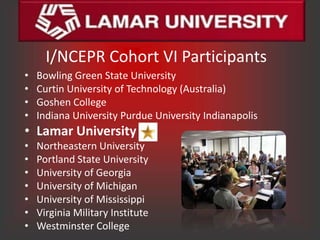
•   Bowling Green State University
•   Curtin University of Technology (Australia)
•   Goshen College
•   Indiana University Purdue University Indianapolis
• Lamar University
•   Northeastern University
•   Portland State University
•   University of Georgia
•   University of Michigan
•   University of Mississippi
•   Virginia Military Institute
•   Westminster College
Introduction
• An eportfolio is a technology-based storage of
  artifacts that demonstrates learning (Barrett,
  2005).
• The design is aligned with a constructivist
  approach (Paulson & Paulson, 1994).
• Three areas of interest for this study included
  the application of Web 2.0 tools for eportfolio
  construction and use, reflection on learning
  and transference, and the use of
  e-portfolios for formative assessment.
Research Question
How has the participation
of an ETL master’s
candidate in an eportfolio
process contributed to the
implementation of
eportfolio practices
with PK-12 students?
Literature Review
• Transference is an individual’s ability to use past
  experiences and new knowledge, shaped by
  interaction, feedback, and reflections of
  understanding, to apply in new learning situations
  (Bransford & Swartz, 1999).
• Transference aligns with the foundational approach
  of constructivism where learners demonstrate and
  apply knowledge learned from one context to
  another (Berryman, 1990).
Literature Review
• Electronic portfolios have a strong support base in
  constructivism where learners interact with artifacts
  to construct meaning and show evidence of learning
  (Avraamidou & Zembal-Saul, 2003; Barrett &
  Wilkerson, 2004).
• Historically, electronic portfolios have been used in
  higher education (Barrett, 2011).
• The use of electronic portfolios in K-12 are referenced
  in the USDOE National Education Technology Plan as a
  learning and assessment tool (U.S. Department of
  Education, 2010).
Eportfolios in PK-12
Questions to consider for implementation of
electronic portfolios in PK-12:
• What is the meaning of eportfolios?
• Why are we developing them?
• How will they be used to show evidence of
  learning?
Eportfolios in PK-12
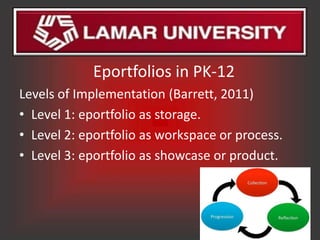
Levels of Implementation (Barrett, 2011)
• Level 1: eportfolio as storage.
• Level 2: eportfolio as workspace or process.
• Level 3: eportfolio as showcase or product.
Eportfolios in PK-12
Other Implementation Considerations
• Selection of Web 2.0 tool aligned with
  eportfolio purpose (Barrett, 2012, January).
• Strategies for reflections that provide insight
  into student learning and growth (Barrett &
  Richer, 2012).
• Assessment opportunities which offer
  formative and summative approaches to
  examine in-depth learning (Barrett, 1999).
Methodology
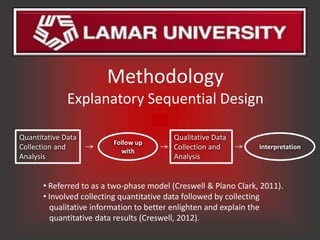
              Explanatory Sequential Design

Quantitative Data                         Qualitative Data
                          Follow up
Collection and                            Collection and          Interpretation
                            with
Analysis                                  Analysis


       • Referred to as a two-phase model (Creswell & Plano Clark, 2011).
       • Involved collecting quantitative data followed by collecting
         qualitative information to better enlighten and explain the
         quantitative data results (Creswell, 2012).
Assumptions
• Assumption 1: The majority of Educational Technology
  Leadership graduates believe PK-12 students should
  use digital portfolios for assessment.
• Assumption 2: The majority of Educational Technology
  Leadership graduates believe PK-12 students in my
  school use traditional paper-based portfolios for
  assessment.
Assumptions
• Assumption 3: The majority of Educational Technology
  Leadership graduates believe PK-12 students in my
  district use traditional paper-based portfolios for
  assessment.
• Assumption 4: The majority of Educational Technology
  Leadership graduates believe PK-12 students in my
  school use digital portfolios as a form of assessment.
Assumptions
• Assumption 5: The majority of Educational Technology
  Leadership graduates believe PK-12 students in my
  district use digital portfolios as a form of assessment.
Design of Instrument
• Developed a pilot survey with a 5 point Likert Scale.
   – Tested internal consistency for Likert-style items
     using Cronbach’s Alpha.
   – Revised survey and conducted another pilot.
   – Solicited feedback from field experts.
• Used SurveyMonkey™ to distribute and obtain
  anonymous survey responses to the Likert items and
  open-ended responses.
Participants
• Distributed survey to 289 ETL graduates.
  – 16 invalid email addresses
  – 2 opted out (not PK -12 educators)
• 271 possible respondents
  – 110 completed survey
  – 41 % response rate
• Data reflects responses to the eportfolio survey
  items.
Delimitations and Limitations
•   Survey data collected only through SurveyMonkey™
•   University email addresses used
•   Participants employed in PK-12 settings
•   Limited 2-week timeframe to collect data
•   Voluntary and anonymous participation
•   Unfamiliarity with online surveys
•   Program completers
•   Potential researcher bias
Quantitative Results
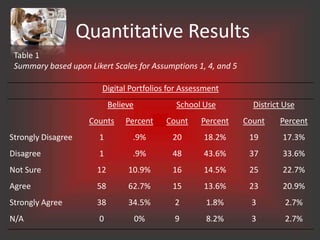
 Table 1
 Summary based upon Likert Scales for Assumptions 1, 4, and 5

                        Digital Portfolios for Assessment
                            Believe          School Use           District Use
                     Counts     Percent    Count    Percent     Count    Percent
Strongly Disagree      1          .9%       20      18.2%        19       17.3%
Disagree               1          .9%       48      43.6%        37       33.6%
Not Sure               12        10.9%      16      14.5%        25       22.7%
Agree                  58        62.7%      15      13.6%        23       20.9%
Strongly Agree         38        34.5%      2        1.8%        3         2.7%
N/A                    0              0%    9        8.2%        3         2.7%
Quantitative Results
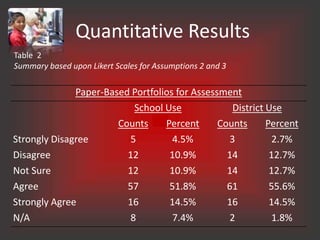
Table 2
Summary based upon Likert Scales for Assumptions 2 and 3

              Paper-Based Portfolios for Assessment
                          School Use              District Use
                       Counts     Percent      Counts      Percent
Strongly Disagree        5          4.5%         3          2.7%
Disagree                 12        10.9%         14         12.7%
Not Sure                 12        10.9%         14         12.7%
Agree                    57        51.8%         61         55.6%
Strongly Agree           16        14.5%         16         14.5%
N/A                      8          7.4%         2          1.8%
Qualitative
        Sub-Research Question
How has the ETL Master’s graduates’ knowledge of
e-portfolio assessment supported the
implementation of digital portfolios with PK-12
students?
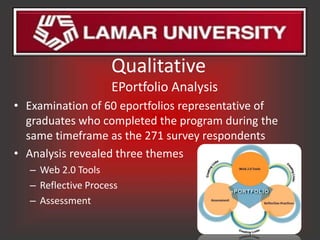
Qualitative
                    EPortfolio Analysis
• Examination of 60 eportfolios representative of
  graduates who completed the program during the
  same timeframe as the 271 survey respondents
• Analysis revealed three themes
  – Web 2.0 Tools
  – Reflective Process
  – Assessment
Web 2.0 Tools
         Evidence from Candidate EPortfolios
• “The program has pushed me to explore new technologies,
  such as, Web 2.0 applications. Because of these
  experiences I directly applied my learning to my own
  classroom” (Eportfolio 1).
• “With Web 2.0, the focus is not on software, but on
  practices such as sharing thoughts and information
  through self-publishing and harnessing the collective
  intelligence of all users to generate information and solve
  problems” (Eportfolio 2).
Reflection
          Evidence from Candidate EPortfolios
• When I understand what they need and what tools we
  have to offer, I can plan effective strategies and activities
  that will facilitate deep, critical learning, leading my
  students to be successful citizens as they continue through
  life” (EPortfolio 3).
• The graduates stated that reflection was often used by
  their PK-12 students to explain their learning through e-
  portfolio development.
Assessment
         Evidence from Candidate EPortfolios
• An e-portfolio would make it possible for students to
  interact outside of the classroom and assist each other
  towards a new form of peer tutoring” (EPortfolio 4).
• “Electronic portfolios…will follow them from year to year.
  Students will be able to communicate beyond borders, and
  learn without limits” (EPortfolio 5).
Qualitative
                 Feedback Analysis
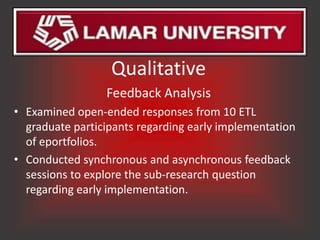
• Examined open-ended responses from 10 ETL
  graduate participants regarding early implementation
  of eportfolios.
• Conducted synchronous and asynchronous feedback
  sessions to explore the sub-research question
  regarding early implementation.
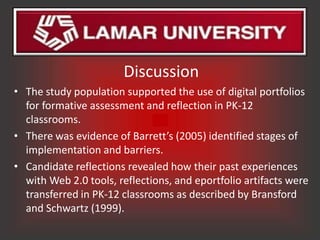
Discussion
• The study population supported the use of digital portfolios
  for formative assessment and reflection in PK-12
  classrooms.
• There was evidence of Barrett’s (2005) identified stages of
  implementation and barriers.
• Candidate reflections revealed how their past experiences
  with Web 2.0 tools, reflections, and eportfolio artifacts were
  transferred in PK-12 classrooms as described by Bransford
  and Schwartz (1999).
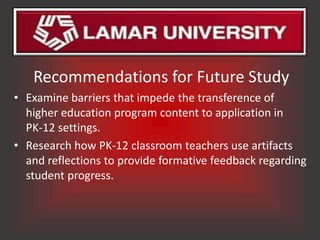
Recommendations for Future Study
• Examine barriers that impede the transference of
  higher education program content to application in
  PK-12 settings.
• Research how PK-12 classroom teachers use artifacts
  and reflections to provide formative feedback regarding
  student progress.
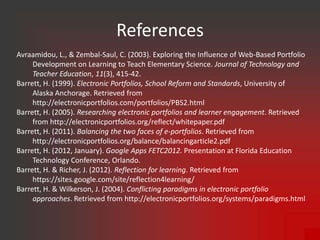
References
Avraamidou, L., & Zembal-Saul, C. (2003). Exploring the Influence of Web-Based Portfolio
     Development on Learning to Teach Elementary Science. Journal of Technology and
     Teacher Education, 11(3), 415-42.
Barrett, H. (1999). Electronic Portfolios, School Reform and Standards, University of
     Alaska Anchorage. Retrieved from
     http://electronicportfolios.com/portfolios/PBS2.html
Barrett, H. (2005). Researching electronic portfolios and learner engagement. Retrieved
     from http://electronicportfolios.org/reflect/whitepaper.pdf
Barrett, H. (2011). Balancing the two faces of e-portfolios. Retrieved from
     http://electronicportfolios.org/balance/balancingarticle2.pdf
Barrett, H. (2012, January). Google Apps FETC2012. Presentation at Florida Education
     Technology Conference, Orlando.
Barrett, H. & Richer, J. (2012). Reflection for learning. Retrieved from
     https://sites.google.com/site/reflection4learning/
Barrett, H. & Wilkerson, J. (2004). Conflicting paradigms in electronic portfolio
     approaches. Retrieved from http://electronicportfolios.org/systems/paradigms.html
References
Berryman, S. E. (1990). Skills, Schools, and Signals. New York, NY: Institute on Education
     and the Economy, Teachers College, Columbia University.
Bransford, J. D., & Schwartz, D. L. (1999). Rethinking transfer: A simple proposal with
     multiple implications. In A. Iran-Nejad & P. D. Pearson (Eds.), Review of Research in
     Education, Vol. 24 (pp. 61-100).Washington, DC: American Educational Research
     Association.
Creswell, J.W. (2012). Educational research: Planning, conducting, and evaluating
     quantitative and qualitative research. Boston, MA: Pearson Education, Inc.
Creswell, J. W. & Plano Clark, V. L. (2011). Designing and conducting mixed methods
     research. Thousand Oaks, California: Sage Publications, Inc.
Paulson, F. & Paulson, P. (1994, April). Assessing Portfolios Using the Constructivist
     Paradigm. Paper presented at the annual meeting of the American Educational
     Research Association (New Orleans, LA).
U.S. Department of Education (2010). National Educational Technology Plan. Retrieved
     from http://www.ed.gov/technology/netp-2010
Contact Information

Diane Mason, Ph.D.          Cynthia Cummings, Ed.D.
diane.mason@lamar.edu       cdcummings@lamar.edu


Sheryl Abshire, Ph.D.           Kay Abernathy, Ed.D.
sheryl.abshire@lamar.edu   lkayabernathy@lamar.edu
Presentation in Slideshare

Lamar resconfdevelopmentimplementationuseeportfoliospk 12 schools-3-22-13

  • 1.
    The Development, Implementation,and Use of Eportfolios in PK-12 Schools Lamar University Research Conference College of Education Educational Leadership March 22, 2013 Presenters: Diane Mason, Ph.D. Cindy Cummings, Ed.D. Sheryl Abshire, Ph.D. Kay Abernathy, Ed.D.
  • 2.
    Purpose To investigate master’sprogram content related to construction of electronic portfolios in an online Educational Technology Leadership (ETL) master’s program and potential transference of concepts to PK-12 instruction.
  • 3.
    I/NCEPR Background • TheInter/National Coalition for Electronic Portfolio Research (I/NCEPR) convenes research/practitioners to study the impact of eportfolios on student learning and educational outcomes. • Each year 10-12 institutions selected through an application process constitute a three-year cohort.
  • 4.
    I/NCEPR Cohort VIParticipants • Bowling Green State University • Curtin University of Technology (Australia) • Goshen College • Indiana University Purdue University Indianapolis • Lamar University • Northeastern University • Portland State University • University of Georgia • University of Michigan • University of Mississippi • Virginia Military Institute • Westminster College
  • 5.
    Introduction • An eportfoliois a technology-based storage of artifacts that demonstrates learning (Barrett, 2005). • The design is aligned with a constructivist approach (Paulson & Paulson, 1994). • Three areas of interest for this study included the application of Web 2.0 tools for eportfolio construction and use, reflection on learning and transference, and the use of e-portfolios for formative assessment.
  • 6.
    Research Question How hasthe participation of an ETL master’s candidate in an eportfolio process contributed to the implementation of eportfolio practices with PK-12 students?
  • 7.
    Literature Review • Transferenceis an individual’s ability to use past experiences and new knowledge, shaped by interaction, feedback, and reflections of understanding, to apply in new learning situations (Bransford & Swartz, 1999). • Transference aligns with the foundational approach of constructivism where learners demonstrate and apply knowledge learned from one context to another (Berryman, 1990).
  • 8.
    Literature Review • Electronicportfolios have a strong support base in constructivism where learners interact with artifacts to construct meaning and show evidence of learning (Avraamidou & Zembal-Saul, 2003; Barrett & Wilkerson, 2004). • Historically, electronic portfolios have been used in higher education (Barrett, 2011). • The use of electronic portfolios in K-12 are referenced in the USDOE National Education Technology Plan as a learning and assessment tool (U.S. Department of Education, 2010).
  • 9.
    Eportfolios in PK-12 Questionsto consider for implementation of electronic portfolios in PK-12: • What is the meaning of eportfolios? • Why are we developing them? • How will they be used to show evidence of learning?
  • 10.
    Eportfolios in PK-12 Levelsof Implementation (Barrett, 2011) • Level 1: eportfolio as storage. • Level 2: eportfolio as workspace or process. • Level 3: eportfolio as showcase or product.
  • 11.
    Eportfolios in PK-12 OtherImplementation Considerations • Selection of Web 2.0 tool aligned with eportfolio purpose (Barrett, 2012, January). • Strategies for reflections that provide insight into student learning and growth (Barrett & Richer, 2012). • Assessment opportunities which offer formative and summative approaches to examine in-depth learning (Barrett, 1999).
  • 12.
    Methodology Explanatory Sequential Design Quantitative Data Qualitative Data Follow up Collection and Collection and Interpretation with Analysis Analysis • Referred to as a two-phase model (Creswell & Plano Clark, 2011). • Involved collecting quantitative data followed by collecting qualitative information to better enlighten and explain the quantitative data results (Creswell, 2012).
  • 13.
    Assumptions • Assumption 1:The majority of Educational Technology Leadership graduates believe PK-12 students should use digital portfolios for assessment. • Assumption 2: The majority of Educational Technology Leadership graduates believe PK-12 students in my school use traditional paper-based portfolios for assessment.
  • 14.
    Assumptions • Assumption 3:The majority of Educational Technology Leadership graduates believe PK-12 students in my district use traditional paper-based portfolios for assessment. • Assumption 4: The majority of Educational Technology Leadership graduates believe PK-12 students in my school use digital portfolios as a form of assessment.
  • 15.
    Assumptions • Assumption 5:The majority of Educational Technology Leadership graduates believe PK-12 students in my district use digital portfolios as a form of assessment.
  • 16.
    Design of Instrument •Developed a pilot survey with a 5 point Likert Scale. – Tested internal consistency for Likert-style items using Cronbach’s Alpha. – Revised survey and conducted another pilot. – Solicited feedback from field experts. • Used SurveyMonkey™ to distribute and obtain anonymous survey responses to the Likert items and open-ended responses.
  • 17.
    Participants • Distributed surveyto 289 ETL graduates. – 16 invalid email addresses – 2 opted out (not PK -12 educators) • 271 possible respondents – 110 completed survey – 41 % response rate • Data reflects responses to the eportfolio survey items.
  • 18.
    Delimitations and Limitations • Survey data collected only through SurveyMonkey™ • University email addresses used • Participants employed in PK-12 settings • Limited 2-week timeframe to collect data • Voluntary and anonymous participation • Unfamiliarity with online surveys • Program completers • Potential researcher bias
  • 19.
    Quantitative Results Table1 Summary based upon Likert Scales for Assumptions 1, 4, and 5 Digital Portfolios for Assessment Believe School Use District Use Counts Percent Count Percent Count Percent Strongly Disagree 1 .9% 20 18.2% 19 17.3% Disagree 1 .9% 48 43.6% 37 33.6% Not Sure 12 10.9% 16 14.5% 25 22.7% Agree 58 62.7% 15 13.6% 23 20.9% Strongly Agree 38 34.5% 2 1.8% 3 2.7% N/A 0 0% 9 8.2% 3 2.7%
  • 20.
    Quantitative Results Table 2 Summarybased upon Likert Scales for Assumptions 2 and 3 Paper-Based Portfolios for Assessment School Use District Use Counts Percent Counts Percent Strongly Disagree 5 4.5% 3 2.7% Disagree 12 10.9% 14 12.7% Not Sure 12 10.9% 14 12.7% Agree 57 51.8% 61 55.6% Strongly Agree 16 14.5% 16 14.5% N/A 8 7.4% 2 1.8%
  • 21.
    Qualitative Sub-Research Question How has the ETL Master’s graduates’ knowledge of e-portfolio assessment supported the implementation of digital portfolios with PK-12 students?
  • 22.
    Qualitative EPortfolio Analysis • Examination of 60 eportfolios representative of graduates who completed the program during the same timeframe as the 271 survey respondents • Analysis revealed three themes – Web 2.0 Tools – Reflective Process – Assessment
  • 23.
    Web 2.0 Tools Evidence from Candidate EPortfolios • “The program has pushed me to explore new technologies, such as, Web 2.0 applications. Because of these experiences I directly applied my learning to my own classroom” (Eportfolio 1). • “With Web 2.0, the focus is not on software, but on practices such as sharing thoughts and information through self-publishing and harnessing the collective intelligence of all users to generate information and solve problems” (Eportfolio 2).
  • 24.
    Reflection Evidence from Candidate EPortfolios • When I understand what they need and what tools we have to offer, I can plan effective strategies and activities that will facilitate deep, critical learning, leading my students to be successful citizens as they continue through life” (EPortfolio 3). • The graduates stated that reflection was often used by their PK-12 students to explain their learning through e- portfolio development.
  • 25.
    Assessment Evidence from Candidate EPortfolios • An e-portfolio would make it possible for students to interact outside of the classroom and assist each other towards a new form of peer tutoring” (EPortfolio 4). • “Electronic portfolios…will follow them from year to year. Students will be able to communicate beyond borders, and learn without limits” (EPortfolio 5).
  • 26.
    Qualitative Feedback Analysis • Examined open-ended responses from 10 ETL graduate participants regarding early implementation of eportfolios. • Conducted synchronous and asynchronous feedback sessions to explore the sub-research question regarding early implementation.
  • 27.
    Discussion • The studypopulation supported the use of digital portfolios for formative assessment and reflection in PK-12 classrooms. • There was evidence of Barrett’s (2005) identified stages of implementation and barriers. • Candidate reflections revealed how their past experiences with Web 2.0 tools, reflections, and eportfolio artifacts were transferred in PK-12 classrooms as described by Bransford and Schwartz (1999).
  • 28.
    Recommendations for FutureStudy • Examine barriers that impede the transference of higher education program content to application in PK-12 settings. • Research how PK-12 classroom teachers use artifacts and reflections to provide formative feedback regarding student progress.
  • 29.
    References Avraamidou, L., &Zembal-Saul, C. (2003). Exploring the Influence of Web-Based Portfolio Development on Learning to Teach Elementary Science. Journal of Technology and Teacher Education, 11(3), 415-42. Barrett, H. (1999). Electronic Portfolios, School Reform and Standards, University of Alaska Anchorage. Retrieved from http://electronicportfolios.com/portfolios/PBS2.html Barrett, H. (2005). Researching electronic portfolios and learner engagement. Retrieved from http://electronicportfolios.org/reflect/whitepaper.pdf Barrett, H. (2011). Balancing the two faces of e-portfolios. Retrieved from http://electronicportfolios.org/balance/balancingarticle2.pdf Barrett, H. (2012, January). Google Apps FETC2012. Presentation at Florida Education Technology Conference, Orlando. Barrett, H. & Richer, J. (2012). Reflection for learning. Retrieved from https://sites.google.com/site/reflection4learning/ Barrett, H. & Wilkerson, J. (2004). Conflicting paradigms in electronic portfolio approaches. Retrieved from http://electronicportfolios.org/systems/paradigms.html
  • 30.
    References Berryman, S. E.(1990). Skills, Schools, and Signals. New York, NY: Institute on Education and the Economy, Teachers College, Columbia University. Bransford, J. D., & Schwartz, D. L. (1999). Rethinking transfer: A simple proposal with multiple implications. In A. Iran-Nejad & P. D. Pearson (Eds.), Review of Research in Education, Vol. 24 (pp. 61-100).Washington, DC: American Educational Research Association. Creswell, J.W. (2012). Educational research: Planning, conducting, and evaluating quantitative and qualitative research. Boston, MA: Pearson Education, Inc. Creswell, J. W. & Plano Clark, V. L. (2011). Designing and conducting mixed methods research. Thousand Oaks, California: Sage Publications, Inc. Paulson, F. & Paulson, P. (1994, April). Assessing Portfolios Using the Constructivist Paradigm. Paper presented at the annual meeting of the American Educational Research Association (New Orleans, LA). U.S. Department of Education (2010). National Educational Technology Plan. Retrieved from http://www.ed.gov/technology/netp-2010
  • 31.
    Contact Information Diane Mason,Ph.D. Cynthia Cummings, Ed.D. diane.mason@lamar.edu cdcummings@lamar.edu Sheryl Abshire, Ph.D. Kay Abernathy, Ed.D. sheryl.abshire@lamar.edu lkayabernathy@lamar.edu
  • 32.