Global Educational Leadership:
Perceptions from International
K-12 Educators
Presenters:
Diane D. Mason, Ph.D.
Cynthia D. Cummings, Ed.D.
Jason R. Mixon, Ed.D.
Lamar University
Beaumont, TX
August 7, 2013
Background
• U.S. Department International Strategy
• Global competencies
• Education diplomacy
• International benchmarking
• Advance U.S. priorities
• Strengthen K-12 education
• No mention of leadership skills
(U.S. Department of Education, 2012)
Purpose
To investigate global educational
leadership from the perspectives of four
administrators and ten teachers living
and working in seven international
education contexts.
Research Questions
• What is global educational leadership?
• What are the characteristics or traits of a
global educational leader?
Literature Review
Global Leadership Frameworks and
Characteristics
• Globalization necessitates leaders with global
perspectives (or global mindset) and intercultural
competencies
• Commonalities
• Interconnectedness
• Cross-cultural leadership
• Social responsibility – think globally, but
implement locally
(Beechler & Javidan, 2007; Bird & Osland, 2004; Drucker, 2012;
Irving, 2010; Morrison, 2000; Story, 2011)
Literature Review
Global Leadership Frameworks and
Characteristics
• Demands facing global leaders
• Heightened urgency for cultural awareness
• Challenges with ethical issues relating to global
markets
• Wider and expanding world boundaries
• Need to focus on global competencies and traits
that reinforce success with global ambitions
(Beechler & Javidan, 2007; Bird & Osland, 2004)
Literature Review
Global Mindset
• Paramount to success in global markets
• Comprised of leadership traits that assist in
influencing stakeholders from various cultural
backgrounds, political affiliations, and
institutional underpinnings
• Consists of personal dimensions that utilize
intellectual capital, psychological capital, and
social capital – cognitive, affective, and
behavioral dimensions
(Bouquet, 2005; Drucker, 2012; Gupta & Govindarajan, 2002; Irving,
2012; Javidan & Walker, 2012; Kefalas, 1998; Kedia & Mukherji,
1999; Perlmutter, 1969; & Story, 2011)
Methodology
• Phenomenological, qualitative study
• Interviews and open-ended response items
• Purposeful, convenient sample of participants
• Four K-12 school administrators and ten
classroom teachers representing the
American Overseas Schools in
Italy, Lebanon, Egypt, Saudi
Arabia, Thailand, Kazakhstan, and the Middle
Eastern Northern Africa
(MENA) American schools
• Two administrators and five teachers from
one school
• Two administrators and five teachers from
other locations
Methodology
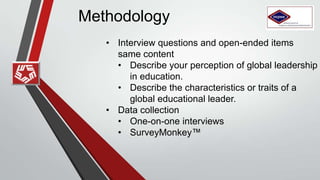
• Interview questions and open-ended items
same content
• Describe your perception of global leadership
in education.
• Describe the characteristics or traits of a
global educational leader.
• Data collection
• One-on-one interviews
• SurveyMonkey™
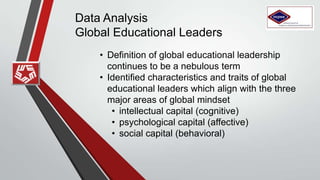
Data Analysis
Global Educational Leaders
• Definition of global educational leadership
continues to be a nebulous term
• Identified characteristics and traits of global
educational leaders which align with the three
major areas of global mindset
• intellectual capital (cognitive)
• psychological capital (affective)
• social capital (behavioral)
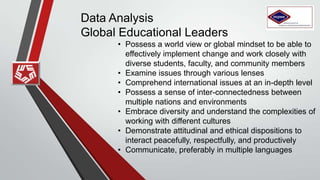
Data Analysis
Global Educational Leaders
• Possess a world view or global mindset to be able to
effectively implement change and work closely with
diverse students, faculty, and community members
• Examine issues through various lenses
• Comprehend international issues at an in-depth level
• Possess a sense of inter-connectedness between
multiple nations and environments
• Embrace diversity and understand the complexities of
working with different cultures
• Demonstrate attitudinal and ethical dispositions to
interact peacefully, respectfully, and productively
• Communicate, preferably in multiple languages
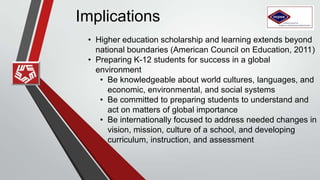
Implications
• Higher education scholarship and learning extends beyond
national boundaries (American Council on Education, 2011)
• Preparing K-12 students for success in a global
environment
• Be knowledgeable about world cultures, languages, and
economic, environmental, and social systems
• Be committed to preparing students to understand and
act on matters of global importance
• Be internationally focused to address needed changes in
vision, mission, culture of a school, and developing
curriculum, instruction, and assessment
Implications
• Professional development for teachers and PK-
12 leaders should be re-evaluated through the
lens of global competence and revised as
needed.
• Standards for global educational leadership
need to be developed, as well as, competencies
and skills for all leaders.
Future Research
• Application of global leadership concepts in
domestic school contexts
• Development of standards and competencies for
global educational leadership
• Application of global leadership concepts for
professional development
• Study and teaching abroad opportunities for
prospective teachers and leaders
• Infusion of international content and
perspectives into required education courses
Contact Information
Diane R, Mason, Ph.D.
Assistant Professor
Center for Doctoral Studies
in Educational Leadership
Lamar University
diane.mason@lamar.edu
Cynthia D. Cummings, Ed.D.
Assistant Professor
Educational Leadership
Lamar University
cdcummings@lamar.edu
Jason R. Mixon, Ed.D.
Associate Professor
Director of Doctoral Programs
Center for Doctoral Studies in
Educational Leadership
Lamar University
jason.mixon@lamar.edu
Paper and Presentation
Located at URLs
Paper
http://www.ncpeapublications.org/images/Mason2.pdf
Presentation
http://www.slideshare.net/dianemason/ncpea-final-8713-24951400

Ncpea final 8-7-13

  • 1.
    Global Educational Leadership: Perceptionsfrom International K-12 Educators Presenters: Diane D. Mason, Ph.D. Cynthia D. Cummings, Ed.D. Jason R. Mixon, Ed.D. Lamar University Beaumont, TX August 7, 2013
  • 2.
    Background • U.S. DepartmentInternational Strategy • Global competencies • Education diplomacy • International benchmarking • Advance U.S. priorities • Strengthen K-12 education • No mention of leadership skills (U.S. Department of Education, 2012)
  • 3.
    Purpose To investigate globaleducational leadership from the perspectives of four administrators and ten teachers living and working in seven international education contexts.
  • 4.
    Research Questions • Whatis global educational leadership? • What are the characteristics or traits of a global educational leader?
  • 5.
    Literature Review Global LeadershipFrameworks and Characteristics • Globalization necessitates leaders with global perspectives (or global mindset) and intercultural competencies • Commonalities • Interconnectedness • Cross-cultural leadership • Social responsibility – think globally, but implement locally (Beechler & Javidan, 2007; Bird & Osland, 2004; Drucker, 2012; Irving, 2010; Morrison, 2000; Story, 2011)
  • 6.
    Literature Review Global LeadershipFrameworks and Characteristics • Demands facing global leaders • Heightened urgency for cultural awareness • Challenges with ethical issues relating to global markets • Wider and expanding world boundaries • Need to focus on global competencies and traits that reinforce success with global ambitions (Beechler & Javidan, 2007; Bird & Osland, 2004)
  • 7.
    Literature Review Global Mindset •Paramount to success in global markets • Comprised of leadership traits that assist in influencing stakeholders from various cultural backgrounds, political affiliations, and institutional underpinnings • Consists of personal dimensions that utilize intellectual capital, psychological capital, and social capital – cognitive, affective, and behavioral dimensions (Bouquet, 2005; Drucker, 2012; Gupta & Govindarajan, 2002; Irving, 2012; Javidan & Walker, 2012; Kefalas, 1998; Kedia & Mukherji, 1999; Perlmutter, 1969; & Story, 2011)
  • 8.
    Methodology • Phenomenological, qualitativestudy • Interviews and open-ended response items • Purposeful, convenient sample of participants • Four K-12 school administrators and ten classroom teachers representing the American Overseas Schools in Italy, Lebanon, Egypt, Saudi Arabia, Thailand, Kazakhstan, and the Middle Eastern Northern Africa (MENA) American schools • Two administrators and five teachers from one school • Two administrators and five teachers from other locations
  • 9.
    Methodology • Interview questionsand open-ended items same content • Describe your perception of global leadership in education. • Describe the characteristics or traits of a global educational leader. • Data collection • One-on-one interviews • SurveyMonkey™
  • 10.
    Data Analysis Global EducationalLeaders • Definition of global educational leadership continues to be a nebulous term • Identified characteristics and traits of global educational leaders which align with the three major areas of global mindset • intellectual capital (cognitive) • psychological capital (affective) • social capital (behavioral)
  • 11.
    Data Analysis Global EducationalLeaders • Possess a world view or global mindset to be able to effectively implement change and work closely with diverse students, faculty, and community members • Examine issues through various lenses • Comprehend international issues at an in-depth level • Possess a sense of inter-connectedness between multiple nations and environments • Embrace diversity and understand the complexities of working with different cultures • Demonstrate attitudinal and ethical dispositions to interact peacefully, respectfully, and productively • Communicate, preferably in multiple languages
  • 12.
    Implications • Higher educationscholarship and learning extends beyond national boundaries (American Council on Education, 2011) • Preparing K-12 students for success in a global environment • Be knowledgeable about world cultures, languages, and economic, environmental, and social systems • Be committed to preparing students to understand and act on matters of global importance • Be internationally focused to address needed changes in vision, mission, culture of a school, and developing curriculum, instruction, and assessment
  • 13.
    Implications • Professional developmentfor teachers and PK- 12 leaders should be re-evaluated through the lens of global competence and revised as needed. • Standards for global educational leadership need to be developed, as well as, competencies and skills for all leaders.
  • 14.
    Future Research • Applicationof global leadership concepts in domestic school contexts • Development of standards and competencies for global educational leadership • Application of global leadership concepts for professional development • Study and teaching abroad opportunities for prospective teachers and leaders • Infusion of international content and perspectives into required education courses
  • 15.
    Contact Information Diane R,Mason, Ph.D. Assistant Professor Center for Doctoral Studies in Educational Leadership Lamar University diane.mason@lamar.edu Cynthia D. Cummings, Ed.D. Assistant Professor Educational Leadership Lamar University cdcummings@lamar.edu Jason R. Mixon, Ed.D. Associate Professor Director of Doctoral Programs Center for Doctoral Studies in Educational Leadership Lamar University jason.mixon@lamar.edu
  • 16.
    Paper and Presentation Locatedat URLs Paper http://www.ncpeapublications.org/images/Mason2.pdf Presentation http://www.slideshare.net/dianemason/ncpea-final-8713-24951400