Lamar University
                             College of Education
                           Educational Leadership
                                   Beaumont, TX

 Development of an E-Portfolio Process:
       Implementation and Use
           in PK-12 Schools
Kay Abernathy, Ed.D.
Diane Mason, Ph.D.
Sheryl Abshire, Ph.D.
Cindy Cummings, Ed.D.
• Cohort VI - 12 Universities -
  United States and Australia
• 3 year studies
• Various e-portfolios, including
  those embracing rich media and
  social software, which enact
  reflection and integration.
• Cohort VI investigating e-
  portfolios in a systemic way for
  assessment and inquiring into
  their effectiveness.
Introduction
The use of electronic portfolios, web 2.0
tools, and their transference to PK-12
schools emphasize a process which
engages learners at all levels to take
ownership of their learning.
Rationale for Study
• Validation of ETL Graduates e-portfolio process
  and transference of ETL candidates’ knowledge
  to PK-12 classroom practices.
• Authentic assessment and multiple measures
  used beyond standardized testing.
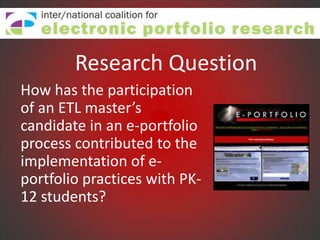
Research Question
How has the participation
of an ETL master’s
candidate in an e-portfolio
process contributed to the
implementation of e-
portfolio practices with PK-
12 students?
Theoretical Framework
                  Helen Barrett
• Developmental process
• Addresses both the diverse and growing
  technology competency of the students and
  teachers
• Addresses the varied experience with the
  portfolio learning and assessment process.
Levels of Implementation
• Level 1: e-Portfolio as Storage
• Level 2: e-Portfolio as Workspace
• Level 3: e-Portfolio as Showcase
Level 1: e-Portfolio as Storage
• The basic activity is converting student work
  into digital formats and saving these
  documents in the designated storage space
  (not on individual laptops).
• The role of the teacher at this level is to
  provide students with guidance on the types
  of artifacts to save.
Level 2: e-Portfolio as Workspace
•   Learner keeps a learning journal (organized
    chronologically, with a blog) and reflects on the
    learning as represented in the samples of the work.
•   Artifacts should represent more than a single
    curriculum area.
•   Artifacts should demonstrate the many ways that
    students are using technology across the curriculum.
•   The primary role of the teacher at this level is to
    provide formative feedback on the students' work so
    that they can recognize opportunities for
    improvement.
Level 3: e-Portfolio as Showcase
• Requires the student to organize one or more
  presentation portfolios around a set of learning
  outcomes, goals or standards (depending on
  purpose and audience).
• The teacher's role at this level is not only to
  provide feedback on the students' work, but also
  to validate the students' self-assessment of their
  work.
e-portfolios PK-12
• Web-based or electronic portfolios (e-
  portfolios, ePortfolios, efolios, digital portfolios, etc.) are a
  relatively new, but quickly expanding, component of teacher
  education programs (Strudler & Wetzel, 2005).
• e-Portfolio templates in teacher education programs range
   – highly structured(e.g., foliotek) to those that are
   – loosely defined by rubric where students independently
      organize and construct format of their own entries using
      website design program (e.g., Google Sites).
• Electronic portfolios (ePortfolios) basically operate as a
  "content-management system" (Jafari, 2004, p. 40).
e-portfolios PK-12
• Chen and Light (2010) observed that ePortfolios allow students to
  select a variety of digital artifacts and assemble them in one place
  in order to exhibit presentation skills or reflect, inquire, and
  analyze material.
• ePortfolios require students to reflect on their learning.
• Richards and Guilbault (2009) contend that reflection has become
  an essential way for students to speak in their own voices.
• Critical reflection at strategic points in the development of the
  ePortfolio creates a pathway for the formative examination and
  demonstration of learning.
Web 2.0
• Web 2.0 applications and mobile Internet devices add new issues to
  the safety/access situation in schools.
• The Children’s Internet Protection Act (CIPA) is the key federal law
  affecting ICT use in PK-12 schools.
• Title II of the Broadband Data Improvement Act, which became Public
  Law in 2008, is titled, “Protecting Children in the 21st Century.”
• As the result of serious implications for children engaged in social
  networking and Web 2.0 tools, state boards of education have
  enacted state requirements for school districts pertaining to
  bullying, hazing, and harassment (CoSN, 2010).
• Students use Web 2.0 social networking tools and other authoring
  tools regularly; parents may still be in a Web 1.0 world.
Web 2.0
• Inherent characteristics of Web 2.0 are so aligned with significant
  educational pedagogies we are going to have to dramatically rethink our
  educational institutions and expectations because of them.
  (Hargadon, 2009)
• Idea of students as authors is not new in education; what is new is scope of
  audience to which student authors can write or publish.
• Student authorship not just for teachers or local schools or even school
  communities, but the world.
• Students can now maximize the notion of airing their own work both
  creatively and academically via Internet tools in blogs or podcasts or even
  via social networking tools.
• Additionally, while student work could be displayed for a short while on the
  walls of rooms, it can now be captured and displayed without limits via Web
  2.0 tools and eportfolios. (Reynard, 2009)
Reflection
• Reflection is the "heart and soul" of a portfolio and is
  essential to brain-based learning (Kolb, 1984; Zull, 2002).
• Need to develop strategies that better support reflection in
  the learning process, supporting different types of reflection
  to improve learning.
• Reflection is the hallmark of many thoughtfully developed
  portfolios.
• Reflections on the products within a portfolio allow the
  audience to understand why these items were chosen to
  represent the student and his / her capacities and can provide
  some of the best indicators of student growth (Barrett &
  Richter, 2012).
Assessment
• Assessment portfolios, contain examples of student’s best work, as well as
  an explanation of why each work is significant.
• The explanation or reflection discusses how the particular work illustrates
  mastery of specific curriculum requirements or learning goals
  (Brown, 2011).
• No Child Left Behind (2001) federal legislation changed the focus of
  assessment from the PK-12 classroom to statewide standardized testing for
  high stakes accountability.
• Renewal of NCLB has not been finalized; there are indications that a
  broader definition of assessment will allow multiple measures of
  achievement, supporting more formative, classroom-based
  assessment, which will make portfolios more popular in PK-12 schools
  (Barrett, 2009).
Assessment
• The primary role of the teacher is to provide formative
  feedback on the students' work so that they can
  recognize opportunities for improvement.
• Used in the PK-12 classrooms, portfolios are not so
  much an instructional strategy to be researched, but
  more of a means to an end: to support reflection that
  can help students understand their own learning and
  to provide a richer picture of student work that
  documents growth over time (Barrett, 2011).
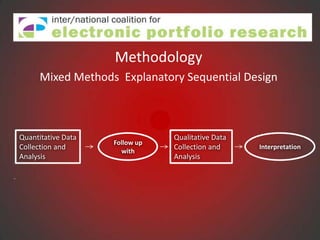
Methodology
          Mixed Methods Explanatory Sequential Design


    Quantitative Data               Qualitative Data
                        Follow up
    Collection and                  Collection and     Interpretation
                          with
    Analysis                        Analysis

-
Quantitative Sample
•   Distributed survey to 289 ETL graduates.
•   16 not valid email addresses
•   2 opt outs – not PK -12 educators
•   Possible respondents - 271
•   110 completed survey – 40.5 % response rate
•   Reporting specifically on the e-portfolio data
    (Question #13)
Quantitative Assumptions
• Assumption 1: The majority of Educational Technology
  Leadership graduates believe PK-12 students should use
  digital portfolios for assessment.

• Assumption 2: The majority of Educational Technology
  Leadership graduates believe PK-12 students in my school
  use traditional paper-based portfolios for assessment.

• Assumption 3: The majority of Educational Technology
  Leadership graduates believe PK-12 students in my district
  use traditional paper-based portfolios for assessment.
Quantitative Assumptions
• Assumption 4: The majority of Educational
  Technology Leadership graduates believe PK-12
  students in my school use digital portfolios as a
  form of assessment.

• Assumption 5: The majority of Educational
  Technology Leadership graduates believe PK-12
  students in my district use digital portfolios as a
  form of assessment.
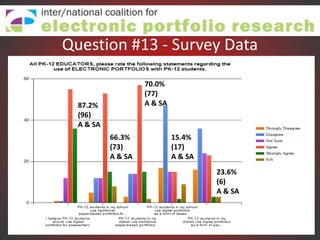
Question #13 - Survey Data

                    70.0%
                    (77)
  87.2%             A & SA
  (96)
  A & SA
           66.3%             15.4%
           (73)              (17)
           A & SA            A & SA
                                      23.6%
                                      (6)
                                      A & SA
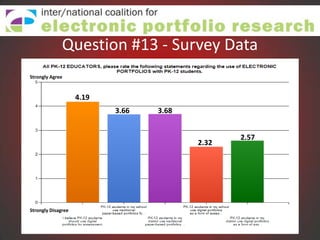
Question #13 - Survey Data
Strongly Agree


                    4.19
                           3.66   3.68


                                                2.57
                                         2.32


Strongly Disagree
Qualitative Question
How has the ETL Master’s graduates’
knowledge of e-portfolio assessment
supported the implementation of digital
portfolios with PK-12 students?
Qualitative Data Sample
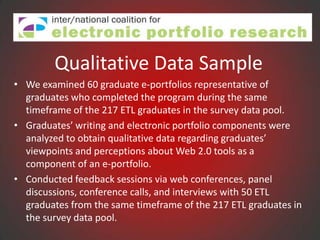
• We examined 60 graduate e-portfolios representative of
  graduates who completed the program during the same
  timeframe of the 217 ETL graduates in the survey data pool.
• Graduates’ writing and electronic portfolio components were
  analyzed to obtain qualitative data regarding graduates’
  viewpoints and perceptions about Web 2.0 tools as a
  component of an e-portfolio.
• Conducted feedback sessions via web conferences, panel
  discussions, conference calls, and interviews with 50 ETL
  graduates from the same timeframe of the 217 ETL graduates in
  the survey data pool.
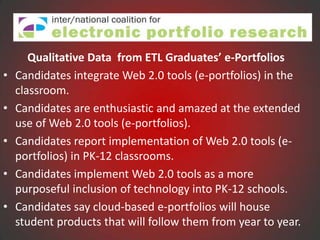
Qualitative Data from ETL Graduates’ e-Portfolios
•   Candidates integrate Web 2.0 tools (e-portfolios) in the
    classroom.
•   Candidates are enthusiastic and amazed at the extended
    use of Web 2.0 tools (e-portfolios).
•   Candidates report implementation of Web 2.0 tools (e-
    portfolios) in PK-12 classrooms.
•   Candidates implement Web 2.0 tools as a more
    purposeful inclusion of technology into PK-12 schools.
•   Candidates say cloud-based e-portfolios will house
    student products that will follow them from year to year.
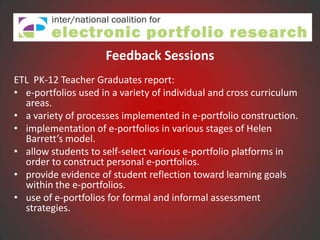
Feedback Sessions
ETL PK-12 Teacher Graduates report:
• e-portfolios used in a variety of individual and cross curriculum
  areas.
• a variety of processes implemented in e-portfolio construction.
• implementation of e-portfolios in various stages of Helen
  Barrett’s model.
• allow students to self-select various e-portfolio platforms in
  order to construct personal e-portfolios.
• provide evidence of student reflection toward learning goals
  within the e-portfolios.
• use of e-portfolios for formal and informal assessment
  strategies.
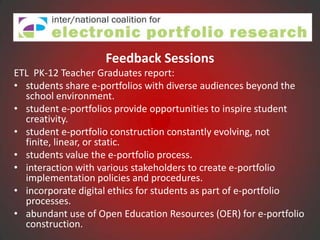
Feedback Sessions
ETL PK-12 Teacher Graduates report:
• students share e-portfolios with diverse audiences beyond the
  school environment.
• student e-portfolios provide opportunities to inspire student
  creativity.
• student e-portfolio construction constantly evolving, not
  finite, linear, or static.
• students value the e-portfolio process.
• interaction with various stakeholders to create e-portfolio
  implementation policies and procedures.
• incorporate digital ethics for students as part of e-portfolio
  processes.
• abundant use of Open Education Resources (OER) for e-portfolio
  construction.
Qualitative Data Analysis
• Survey data indicated questions
  regarding implementation of digital
  portfolios vs. paper portfolios for
  assessment at the PK-122 school and
  district levels.
• Developed qualitative question to guide
  coding and categorization of data
  gleaned from the ETL Masters’ candidate
  e-portfolios and feedback responses.
Results
1. Conclusions:
• Graduates of the ETL Master’s program are
  contributing to the evolving process of implementing
  both informal and formal e-portfolio assessment in PK-
  12 schools.
• The growth of Web 2.0 tools contributes to the
  implementation of the reflective e-portfolio practices
  in PK-12 schools.
• Teachers of PK-12 students are working to increase the
  use of e-portfolio assessments.
2. Implications:
• Reflection eportfolio assessment beyond standardizing
    testing will continue to grow and give more meaningful and
    richer pictures that can help students understand their own
    learning and to provide documentation that shows growth
    over time as suggested by Barrett.
• The teacher's role at this level is not only to provide
    feedback on the students' work, but also to validate the
    students' self-assessment of their work as Barrett indicated.
 • The use of Web 2.0 tools in the reflective e-portfolio process
    add value and reveal a depth of knowledge to the PK-12
    student learning.
3. Suggestions for Future Research:
• Researchers may seek more information related to the
   increased use of the reflective e-portfolio process in
   core curricula areas of PK-12 classrooms.
• Researchers may be interested in use of reflective e-
   portfolio practice related to informal assessments
   within project- and scenario-based learning
   environments.
• Interesting studies on the increased ownership of
   students for personal self-assessment could be
   beneficial to administrators and classroom teachers.
For More Information:
      Lamar University
       Beaumont, TX
    http://lamar.edu/ &
http://tinyurl.com/7wbjugf
& http://stateu.com/lamar/
Contact Information


•   Kay Abernathy, Ed.D. - lkabernathy@lamar.edu
•   Diane Mason, Ph.D. - diane.mason@lamar.edu
•   Sheryl Abshire, Ph.D. – sheryl.abshire@lamar.edu
•   Cindy Cummings, Ed.D. - cdcummings@lamar.edu

Nssa las vegas_4-2-12__final

  • 1.
    Lamar University College of Education Educational Leadership Beaumont, TX Development of an E-Portfolio Process: Implementation and Use in PK-12 Schools Kay Abernathy, Ed.D. Diane Mason, Ph.D. Sheryl Abshire, Ph.D. Cindy Cummings, Ed.D.
  • 2.
    • Cohort VI- 12 Universities - United States and Australia • 3 year studies • Various e-portfolios, including those embracing rich media and social software, which enact reflection and integration. • Cohort VI investigating e- portfolios in a systemic way for assessment and inquiring into their effectiveness.
  • 3.
    Introduction The use ofelectronic portfolios, web 2.0 tools, and their transference to PK-12 schools emphasize a process which engages learners at all levels to take ownership of their learning.
  • 4.
    Rationale for Study •Validation of ETL Graduates e-portfolio process and transference of ETL candidates’ knowledge to PK-12 classroom practices. • Authentic assessment and multiple measures used beyond standardized testing.
  • 5.
    Research Question How hasthe participation of an ETL master’s candidate in an e-portfolio process contributed to the implementation of e- portfolio practices with PK- 12 students?
  • 6.
    Theoretical Framework Helen Barrett • Developmental process • Addresses both the diverse and growing technology competency of the students and teachers • Addresses the varied experience with the portfolio learning and assessment process.
  • 7.
    Levels of Implementation •Level 1: e-Portfolio as Storage • Level 2: e-Portfolio as Workspace • Level 3: e-Portfolio as Showcase
  • 8.
    Level 1: e-Portfolioas Storage • The basic activity is converting student work into digital formats and saving these documents in the designated storage space (not on individual laptops). • The role of the teacher at this level is to provide students with guidance on the types of artifacts to save.
  • 9.
    Level 2: e-Portfolioas Workspace • Learner keeps a learning journal (organized chronologically, with a blog) and reflects on the learning as represented in the samples of the work. • Artifacts should represent more than a single curriculum area. • Artifacts should demonstrate the many ways that students are using technology across the curriculum. • The primary role of the teacher at this level is to provide formative feedback on the students' work so that they can recognize opportunities for improvement.
  • 10.
    Level 3: e-Portfolioas Showcase • Requires the student to organize one or more presentation portfolios around a set of learning outcomes, goals or standards (depending on purpose and audience). • The teacher's role at this level is not only to provide feedback on the students' work, but also to validate the students' self-assessment of their work.
  • 11.
    e-portfolios PK-12 • Web-basedor electronic portfolios (e- portfolios, ePortfolios, efolios, digital portfolios, etc.) are a relatively new, but quickly expanding, component of teacher education programs (Strudler & Wetzel, 2005). • e-Portfolio templates in teacher education programs range – highly structured(e.g., foliotek) to those that are – loosely defined by rubric where students independently organize and construct format of their own entries using website design program (e.g., Google Sites). • Electronic portfolios (ePortfolios) basically operate as a "content-management system" (Jafari, 2004, p. 40).
  • 12.
    e-portfolios PK-12 • Chenand Light (2010) observed that ePortfolios allow students to select a variety of digital artifacts and assemble them in one place in order to exhibit presentation skills or reflect, inquire, and analyze material. • ePortfolios require students to reflect on their learning. • Richards and Guilbault (2009) contend that reflection has become an essential way for students to speak in their own voices. • Critical reflection at strategic points in the development of the ePortfolio creates a pathway for the formative examination and demonstration of learning.
  • 13.
    Web 2.0 • Web2.0 applications and mobile Internet devices add new issues to the safety/access situation in schools. • The Children’s Internet Protection Act (CIPA) is the key federal law affecting ICT use in PK-12 schools. • Title II of the Broadband Data Improvement Act, which became Public Law in 2008, is titled, “Protecting Children in the 21st Century.” • As the result of serious implications for children engaged in social networking and Web 2.0 tools, state boards of education have enacted state requirements for school districts pertaining to bullying, hazing, and harassment (CoSN, 2010). • Students use Web 2.0 social networking tools and other authoring tools regularly; parents may still be in a Web 1.0 world.
  • 14.
    Web 2.0 • Inherentcharacteristics of Web 2.0 are so aligned with significant educational pedagogies we are going to have to dramatically rethink our educational institutions and expectations because of them. (Hargadon, 2009) • Idea of students as authors is not new in education; what is new is scope of audience to which student authors can write or publish. • Student authorship not just for teachers or local schools or even school communities, but the world. • Students can now maximize the notion of airing their own work both creatively and academically via Internet tools in blogs or podcasts or even via social networking tools. • Additionally, while student work could be displayed for a short while on the walls of rooms, it can now be captured and displayed without limits via Web 2.0 tools and eportfolios. (Reynard, 2009)
  • 15.
    Reflection • Reflection isthe "heart and soul" of a portfolio and is essential to brain-based learning (Kolb, 1984; Zull, 2002). • Need to develop strategies that better support reflection in the learning process, supporting different types of reflection to improve learning. • Reflection is the hallmark of many thoughtfully developed portfolios. • Reflections on the products within a portfolio allow the audience to understand why these items were chosen to represent the student and his / her capacities and can provide some of the best indicators of student growth (Barrett & Richter, 2012).
  • 16.
    Assessment • Assessment portfolios,contain examples of student’s best work, as well as an explanation of why each work is significant. • The explanation or reflection discusses how the particular work illustrates mastery of specific curriculum requirements or learning goals (Brown, 2011). • No Child Left Behind (2001) federal legislation changed the focus of assessment from the PK-12 classroom to statewide standardized testing for high stakes accountability. • Renewal of NCLB has not been finalized; there are indications that a broader definition of assessment will allow multiple measures of achievement, supporting more formative, classroom-based assessment, which will make portfolios more popular in PK-12 schools (Barrett, 2009).
  • 17.
    Assessment • The primaryrole of the teacher is to provide formative feedback on the students' work so that they can recognize opportunities for improvement. • Used in the PK-12 classrooms, portfolios are not so much an instructional strategy to be researched, but more of a means to an end: to support reflection that can help students understand their own learning and to provide a richer picture of student work that documents growth over time (Barrett, 2011).
  • 18.
    Methodology Mixed Methods Explanatory Sequential Design Quantitative Data Qualitative Data Follow up Collection and Collection and Interpretation with Analysis Analysis -
  • 19.
    Quantitative Sample • Distributed survey to 289 ETL graduates. • 16 not valid email addresses • 2 opt outs – not PK -12 educators • Possible respondents - 271 • 110 completed survey – 40.5 % response rate • Reporting specifically on the e-portfolio data (Question #13)
  • 20.
    Quantitative Assumptions • Assumption1: The majority of Educational Technology Leadership graduates believe PK-12 students should use digital portfolios for assessment. • Assumption 2: The majority of Educational Technology Leadership graduates believe PK-12 students in my school use traditional paper-based portfolios for assessment. • Assumption 3: The majority of Educational Technology Leadership graduates believe PK-12 students in my district use traditional paper-based portfolios for assessment.
  • 21.
    Quantitative Assumptions • Assumption4: The majority of Educational Technology Leadership graduates believe PK-12 students in my school use digital portfolios as a form of assessment. • Assumption 5: The majority of Educational Technology Leadership graduates believe PK-12 students in my district use digital portfolios as a form of assessment.
  • 22.
    Question #13 -Survey Data 70.0% (77) 87.2% A & SA (96) A & SA 66.3% 15.4% (73) (17) A & SA A & SA 23.6% (6) A & SA
  • 23.
    Question #13 -Survey Data Strongly Agree 4.19 3.66 3.68 2.57 2.32 Strongly Disagree
  • 24.
    Qualitative Question How hasthe ETL Master’s graduates’ knowledge of e-portfolio assessment supported the implementation of digital portfolios with PK-12 students?
  • 25.
    Qualitative Data Sample •We examined 60 graduate e-portfolios representative of graduates who completed the program during the same timeframe of the 217 ETL graduates in the survey data pool. • Graduates’ writing and electronic portfolio components were analyzed to obtain qualitative data regarding graduates’ viewpoints and perceptions about Web 2.0 tools as a component of an e-portfolio. • Conducted feedback sessions via web conferences, panel discussions, conference calls, and interviews with 50 ETL graduates from the same timeframe of the 217 ETL graduates in the survey data pool.
  • 26.
    Qualitative Data fromETL Graduates’ e-Portfolios • Candidates integrate Web 2.0 tools (e-portfolios) in the classroom. • Candidates are enthusiastic and amazed at the extended use of Web 2.0 tools (e-portfolios). • Candidates report implementation of Web 2.0 tools (e- portfolios) in PK-12 classrooms. • Candidates implement Web 2.0 tools as a more purposeful inclusion of technology into PK-12 schools. • Candidates say cloud-based e-portfolios will house student products that will follow them from year to year.
  • 27.
    Feedback Sessions ETL PK-12Teacher Graduates report: • e-portfolios used in a variety of individual and cross curriculum areas. • a variety of processes implemented in e-portfolio construction. • implementation of e-portfolios in various stages of Helen Barrett’s model. • allow students to self-select various e-portfolio platforms in order to construct personal e-portfolios. • provide evidence of student reflection toward learning goals within the e-portfolios. • use of e-portfolios for formal and informal assessment strategies.
  • 28.
    Feedback Sessions ETL PK-12Teacher Graduates report: • students share e-portfolios with diverse audiences beyond the school environment. • student e-portfolios provide opportunities to inspire student creativity. • student e-portfolio construction constantly evolving, not finite, linear, or static. • students value the e-portfolio process. • interaction with various stakeholders to create e-portfolio implementation policies and procedures. • incorporate digital ethics for students as part of e-portfolio processes. • abundant use of Open Education Resources (OER) for e-portfolio construction.
  • 29.
    Qualitative Data Analysis •Survey data indicated questions regarding implementation of digital portfolios vs. paper portfolios for assessment at the PK-122 school and district levels. • Developed qualitative question to guide coding and categorization of data gleaned from the ETL Masters’ candidate e-portfolios and feedback responses.
  • 30.
    Results 1. Conclusions: • Graduatesof the ETL Master’s program are contributing to the evolving process of implementing both informal and formal e-portfolio assessment in PK- 12 schools. • The growth of Web 2.0 tools contributes to the implementation of the reflective e-portfolio practices in PK-12 schools. • Teachers of PK-12 students are working to increase the use of e-portfolio assessments.
  • 31.
    2. Implications: • Reflectioneportfolio assessment beyond standardizing testing will continue to grow and give more meaningful and richer pictures that can help students understand their own learning and to provide documentation that shows growth over time as suggested by Barrett. • The teacher's role at this level is not only to provide feedback on the students' work, but also to validate the students' self-assessment of their work as Barrett indicated. • The use of Web 2.0 tools in the reflective e-portfolio process add value and reveal a depth of knowledge to the PK-12 student learning.
  • 32.
    3. Suggestions forFuture Research: • Researchers may seek more information related to the increased use of the reflective e-portfolio process in core curricula areas of PK-12 classrooms. • Researchers may be interested in use of reflective e- portfolio practice related to informal assessments within project- and scenario-based learning environments. • Interesting studies on the increased ownership of students for personal self-assessment could be beneficial to administrators and classroom teachers.
  • 33.
    For More Information: Lamar University Beaumont, TX http://lamar.edu/ & http://tinyurl.com/7wbjugf & http://stateu.com/lamar/
  • 34.
    Contact Information • Kay Abernathy, Ed.D. - lkabernathy@lamar.edu • Diane Mason, Ph.D. - diane.mason@lamar.edu • Sheryl Abshire, Ph.D. – sheryl.abshire@lamar.edu • Cindy Cummings, Ed.D. - cdcummings@lamar.edu

Editor's Notes