The power of open information in open
learning curriculum development
Naomi Cloutier
Carolyn Teare
Irwin DeVries
Thompson Rivers University, Open Learning
Kamloops, British Columbia, Canada
https://creativecommons.org/licenses/by/4.0/legalcode
The Institution
The Open Learning division of Thompson Rivers
University supports:
 Open access to undergraduate and graduate online
courses and programs
 Creating and using OER and open textbooks
 Creating and crediting open courses through OERu
 Open assessment practices using Prior Learning
Assessment and Recognition (PLAR).
2
Introduction
Discussions about technology in distance education
typically focus on pedagogy, design, learning
environments and effectiveness
Technological infrastructure is also critical in
managing the process of creating and sustaining
distance and open education courses with their
inter- and co-dependencies, linear and non-linear
aspects.
3
Philosophy and Context
 Institutions using a “project management” approach (Bates,
2011) to online course development face organizational
challenges as online learning demand grows.
 Paucity of research in “meso-level” online distance
education issues, i.e. management, organization and
technology (Zawaki and Anderson, 2014) led us to consider
this research project.
4
Prior to 2013: Workflows
• Tedious to analyze system productivity
• Difficult to assess historical events and trends
• Some projects “lost” in the system for years
Administration
• Set their own priorities without
knowing the needs of others, to
their mutual benefit or detriment.
• Each area was a silo
Managers/Supervisors
• Developed their own
spreadsheets and used
various tracking methods.
• Used and understood
terminology
inconsistently.
Team Members
5
Prior to 2013 6
Philosophy Shift
 Open Learning shifted from centralized to distributed project
management with a focus on established process workflow.
 Information sharing is one of the key elements in distributed
project management.
7
Philosophy Shift
 “The goal of distributed project management is to invert the
process of managing the project and place a significant amount
of the effort related to project management on the team
members themselves….In essence, each team member can be
viewed as an independent business unit with their own
accountability towards the tasks they are asked to perform as
part of the larger project outcome” (Ferrilla, 1997).
8
Design principles 9
Course Milestones
NOT Time
• Built-in Workflows
Democratic
Communication
Tool
• Minimal Project
Management
Open Source
Platform
• Web Data Entry
by Role
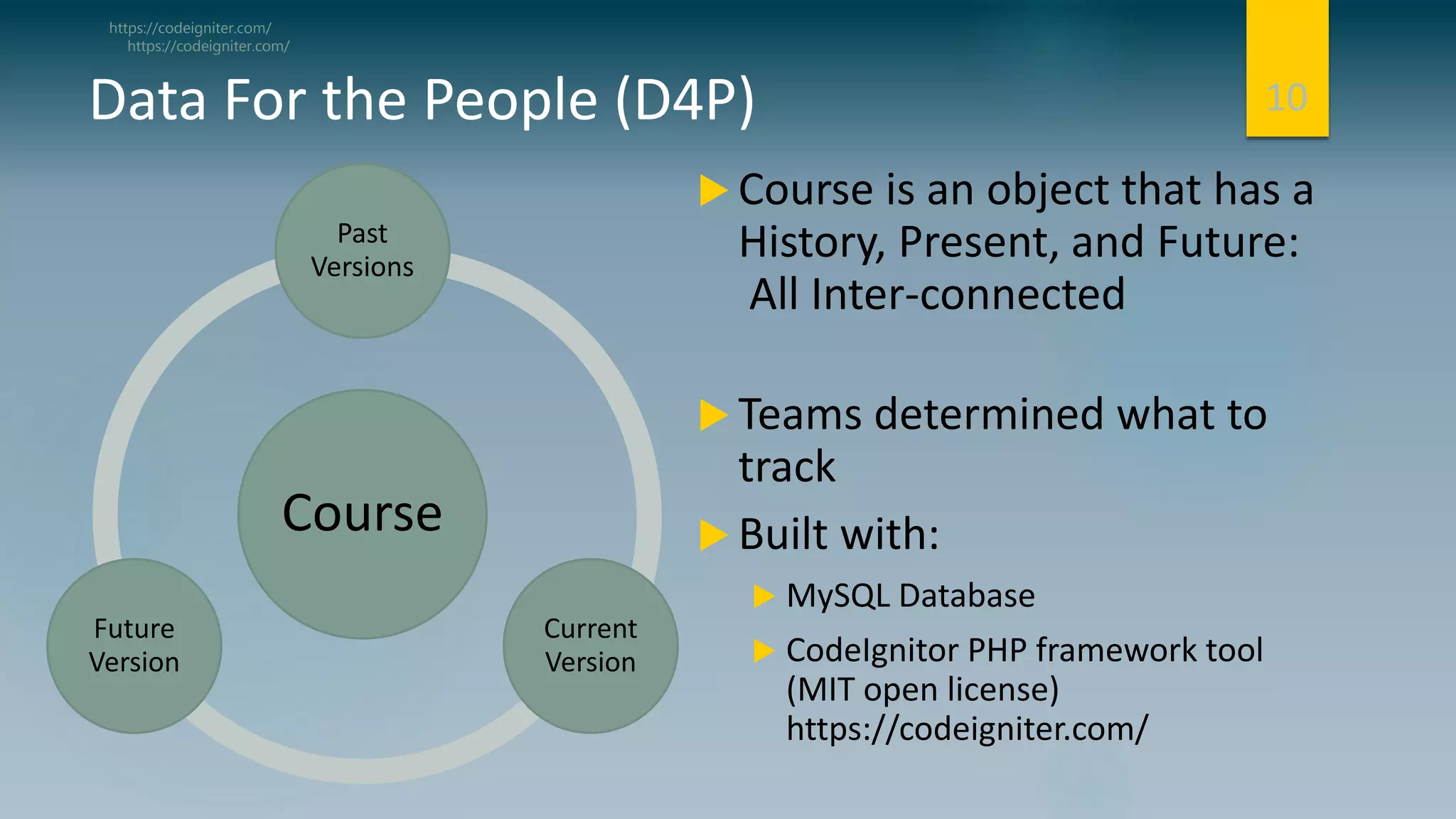
Course
Past
Versions
Current
Version
Future
Version
Data For the People (D4P)
 Course is an object that has a
History, Present, and Future:
All Inter-connected
 Teams determined what to
track
 Built with:
 MySQL Database
 CodeIgnitor PHP framework tool
(MIT open license)
https://codeigniter.com/
10
https://codeigniter.com/
D4P: Use Case – Team Member 11
Course
History
Version
Overview
Team Tab
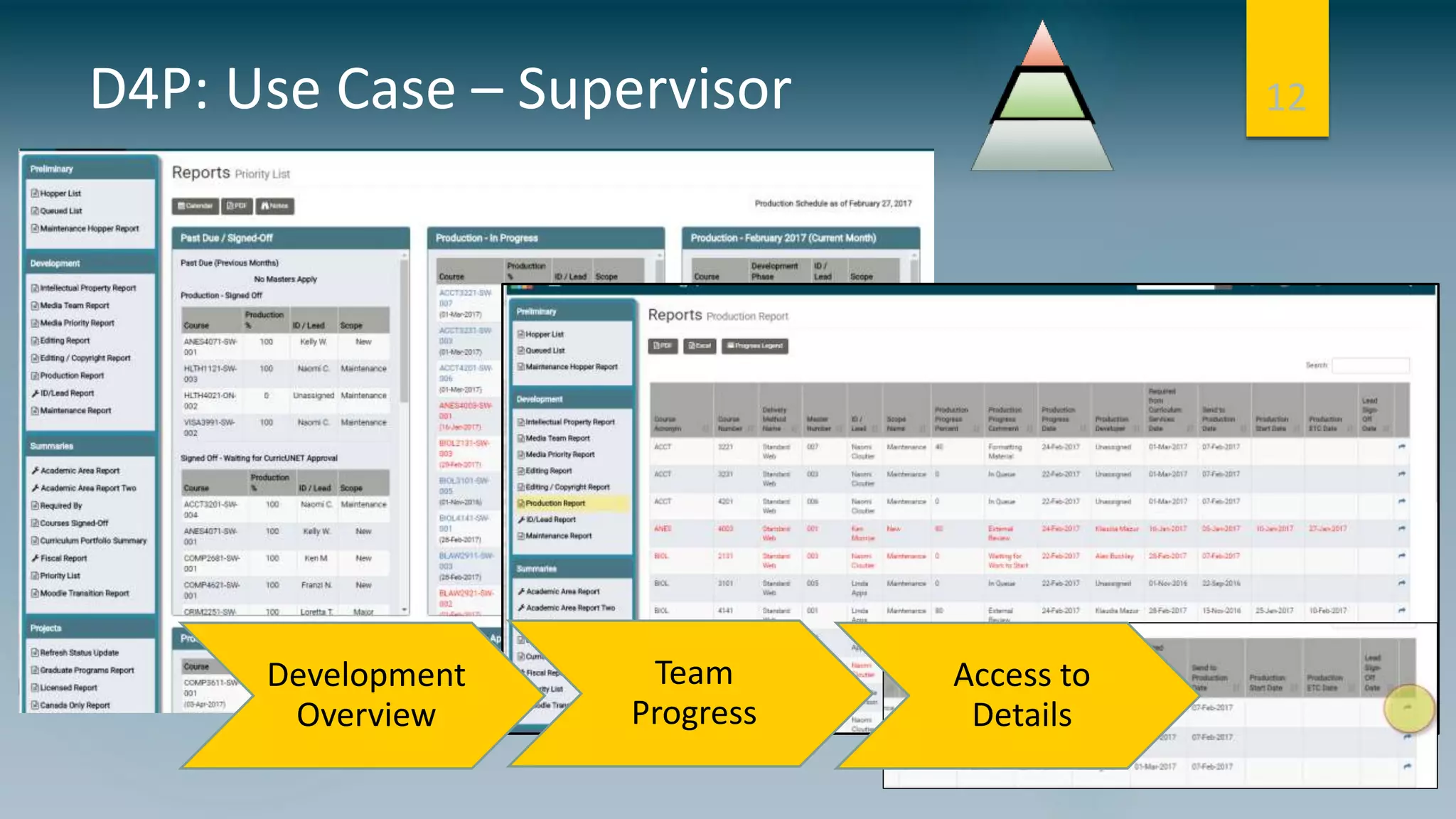
D4P: Use Case – Supervisor 12
Development
Overview
Team
Progress
Access to
Details
D4P: Use Case – Administration 13
Key Performance
Indicators
Academic Area
Overview
Portfolio
Summary
Results: After 5 years
 User Survey: All Staff/Faculty/Administrators
52 recipients received survey: 70% Response rate
14
High Use
• 51% Daily
Ease of Use
• 82%
Searching
• 88% Entering
Data
Provides
Needed
Overview
• 77%
Improves Work
Effectiveness
• 68%
Results: After 5 years
 Our own observations
 Provides common source of information – body of knowledge
 Still resistance to data entry: Some people don’t like the nuisance
 Doesn’t replace, but supports face to face communication
 Work in Progress – continual improvement
Alerts to Users
Adjusting location of information
Additional Reports
Sharing Data
15
Conclusions
 Distributed Project Management using openly
shared information offers a viable method to
handle curriculum development
 Effort in defining organizational needs by whole
organization will increase project success
 Flexible approach is key
16
Contact Information:
 Irwin Devries, idevries@tru.ca
 Naomi Cloutier, ncloutier@tru.ca
 Carolyn Teare, cteare@tru.ca
17
References
Bates, A. W., & Sangra, A. (2011). Managing technology in higher
education: Strategies for transforming teaching and learning. John
Wiley & Sons.
Ferrilla, B. (1996). Distributed Project Management-Managing the
Process of Managing Projects. In Proceedings – Project Management
Institute (pp. 899-906).
Zawacki-Richter, O., & Anderson, T. (Eds.). (2014). Online distance
education: Towards a research agenda. Athabasca University Press.
18

Tru open education_global2017

  • 1.
    The power ofopen information in open learning curriculum development Naomi Cloutier Carolyn Teare Irwin DeVries Thompson Rivers University, Open Learning Kamloops, British Columbia, Canada https://creativecommons.org/licenses/by/4.0/legalcode
  • 2.
    The Institution The OpenLearning division of Thompson Rivers University supports:  Open access to undergraduate and graduate online courses and programs  Creating and using OER and open textbooks  Creating and crediting open courses through OERu  Open assessment practices using Prior Learning Assessment and Recognition (PLAR). 2
  • 3.
    Introduction Discussions about technologyin distance education typically focus on pedagogy, design, learning environments and effectiveness Technological infrastructure is also critical in managing the process of creating and sustaining distance and open education courses with their inter- and co-dependencies, linear and non-linear aspects. 3
  • 4.
    Philosophy and Context Institutions using a “project management” approach (Bates, 2011) to online course development face organizational challenges as online learning demand grows.  Paucity of research in “meso-level” online distance education issues, i.e. management, organization and technology (Zawaki and Anderson, 2014) led us to consider this research project. 4
  • 5.
    Prior to 2013:Workflows • Tedious to analyze system productivity • Difficult to assess historical events and trends • Some projects “lost” in the system for years Administration • Set their own priorities without knowing the needs of others, to their mutual benefit or detriment. • Each area was a silo Managers/Supervisors • Developed their own spreadsheets and used various tracking methods. • Used and understood terminology inconsistently. Team Members 5
  • 6.
  • 7.
    Philosophy Shift  OpenLearning shifted from centralized to distributed project management with a focus on established process workflow.  Information sharing is one of the key elements in distributed project management. 7
  • 8.
    Philosophy Shift  “Thegoal of distributed project management is to invert the process of managing the project and place a significant amount of the effort related to project management on the team members themselves….In essence, each team member can be viewed as an independent business unit with their own accountability towards the tasks they are asked to perform as part of the larger project outcome” (Ferrilla, 1997). 8
  • 9.
    Design principles 9 CourseMilestones NOT Time • Built-in Workflows Democratic Communication Tool • Minimal Project Management Open Source Platform • Web Data Entry by Role
  • 10.
    Course Past Versions Current Version Future Version Data For thePeople (D4P)  Course is an object that has a History, Present, and Future: All Inter-connected  Teams determined what to track  Built with:  MySQL Database  CodeIgnitor PHP framework tool (MIT open license) https://codeigniter.com/ 10 https://codeigniter.com/ https://codeigniter.com/
  • 11.
    D4P: Use Case– Team Member 11 Course History Version Overview Team Tab
  • 12.
    D4P: Use Case– Supervisor 12 Development Overview Team Progress Access to Details
  • 13.
    D4P: Use Case– Administration 13 Key Performance Indicators Academic Area Overview Portfolio Summary
  • 14.
    Results: After 5years  User Survey: All Staff/Faculty/Administrators 52 recipients received survey: 70% Response rate 14 High Use • 51% Daily Ease of Use • 82% Searching • 88% Entering Data Provides Needed Overview • 77% Improves Work Effectiveness • 68%
  • 15.
    Results: After 5years  Our own observations  Provides common source of information – body of knowledge  Still resistance to data entry: Some people don’t like the nuisance  Doesn’t replace, but supports face to face communication  Work in Progress – continual improvement Alerts to Users Adjusting location of information Additional Reports Sharing Data 15
  • 16.
    Conclusions  Distributed ProjectManagement using openly shared information offers a viable method to handle curriculum development  Effort in defining organizational needs by whole organization will increase project success  Flexible approach is key 16
  • 17.
    Contact Information:  IrwinDevries, idevries@tru.ca  Naomi Cloutier, ncloutier@tru.ca  Carolyn Teare, cteare@tru.ca 17
  • 18.
    References Bates, A. W.,& Sangra, A. (2011). Managing technology in higher education: Strategies for transforming teaching and learning. John Wiley & Sons. Ferrilla, B. (1996). Distributed Project Management-Managing the Process of Managing Projects. In Proceedings – Project Management Institute (pp. 899-906). Zawacki-Richter, O., & Anderson, T. (Eds.). (2014). Online distance education: Towards a research agenda. Athabasca University Press. 18

Editor's Notes

  • #12  3 Levels of Drill Down for a Course History Overview of Current Team specific data