Level 1
David Mullich
Marketing and Monetization
The Los Angeles Film School
Who Am I?
 David Mullich
 dmullich@lafilm.edu
 @David_Mullich
 www.electricsheep.biz
 LAFS Game Program
Lead Faculty
 Former Producer at
Disney, Activision, 3DO
and the Spinmaster toy
company
PREPARE TO GET SCHOOLED!
Marketing and Monetization
What Do You Think This Class About?
What This Class Is Really About
 Marketing: The action or
business of promoting and
selling products or
services, including market
research and advertising.
 Monetization: The process
of converting something
into money.
How To Market Your Game
HOW THIS CLASS WORKS
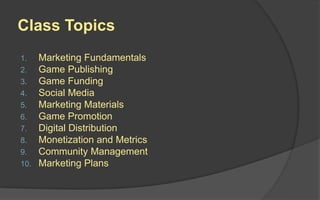
Class Topics
1. Marketing Fundamentals and Branding
2. Game Publishing
3. Game Funding
4. Social Media
5. Marketing Materials
6. Advertising and Publicity
7. Sales and Distribution
8. Monetization and Metrics
9. Community Development and Management
10. Marketing Plans
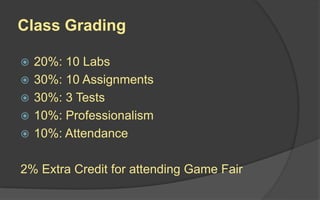
Class Grading
 20%: 10 Labs
 30%: 10 Assignments
 30%: 3 Tests
 10%: Professionalism
 10%: Attendance
2% Extra Credit for attending Game Fair
Be Your Own Career
Entrepreneur
Devotion Persistence Reinvention
3 Keys To Success
Remember, This Is A College Class
Studying game development at college is still
college study.
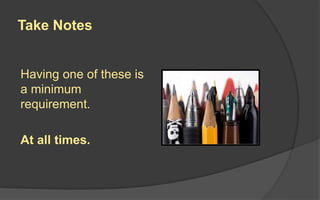
Take Notes
Having one of these is
a minimum
requirement.
At all times.
Study
 Review the online
Lecture Notes
 Think
 Understand
 Reflect and Connect
Tests
 Study for your tests! Refer to the
slides.
 If you see on a slide, it will
probably be on the test.
 If you don’t know the answer to a test
question, guess!
 There are no points deducted for wrong
answers on multiple-choice questions
 I will award some points for clever or
knowledgeable answers on short-answer
questions, even if they weren’t the answer
I was looking for.
Labs
Game development is a team sport. Each of
your labs is a group assignment in which
everyone must participate.
Assignments
Do your homework assignments on the LMS
(Learning Management System).
Word Counts
Word counts are there for a reason.
Use them wisely and avoid:
 Padding
 Going off topic
 Repeating yourself
 Padding by stating the obvious in a way that
takes quite a lot of words but really isn’t
saying anything new
 Repeating yourself but in a different way
 Padding, wadding, lining, extemporising,
extraneous content or going on any other
kind of Synonym Safari TM
Creativity Within Constraints
If you can’t be bothered to:
 be creative
 strive for originality even within
established norms or constraints
 look beyond your initial idea
 actually enjoy and actively want to
do the above
Then get used to the phrase
“Would you like fries with that?”
Deliver Work On Time
Develop a habit of delivering work
on time.
In the game industry, when work is
late, people don’t get paid.
Pssst....Sometimes developers make false
internal deadlines to avoid calamity such
as missed milestone payments. Maybe you
could do the same if graduation is at
stake?
School Is Your Job
Yes, these are important:
 Part-time work
 Family
 Friends
 Fun
But don’t neglect your school work!
PROFESSIONALISM
All Business is Communication
Good Communication
Precise Clear Brief
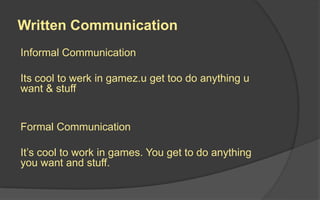
Written Communication
Informal Communication
Its cool to werk in gamez.u get too do anything u
want & stuff
Formal Communication
It’s cool to work in games. You get to do anything
you want and stuff.
Written Communication
 Capitalize the beginning of sentences,
names, game titles, and the word “I”
 Use proper spelling and punctuation
 Put a space between punctuation mark
ending a sentence and the start of the
next sentence
 Don’t use “u” for “you”, or “&” for “and”
 Don’t confuse “its” and “it’s”
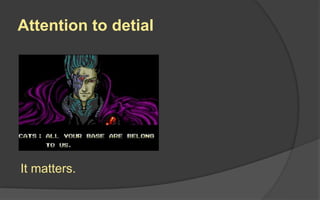
Attention to detial
It matters.
First Rule of Success: Show Up
 DON’T BE TARDY
But if you know you will be
late, EMAIL ME!
 DON’T BE ABSENT
But if you know you will be
gone, EMAIL ME!
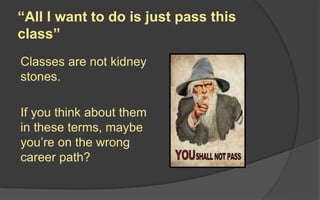
“All I want to do is just pass this
class”
Classes are not kidney
stones.
If you think about them
in these terms, maybe
you’re on the wrong
career path?
Impressions
Your colleagues and
faculty will most likely
be your doorway into
the industry.
How do you want them
to think of you?
ZERO HERO
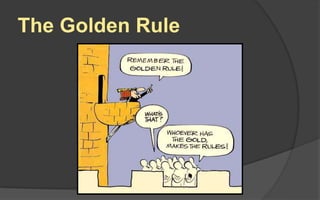
The Golden Rule
DESCRIBING YOUR GAME
What Is This Game?
“A puzzle game where several different types of colored
blocks continuously fall from above and you must arrange
them to make horizontal rows of blocks. Completing any
row causes those blocks to move downwards. The blocks
above gradually fall faster and the game is over when the
screen fills up and blocks can no longer fall from the top.”
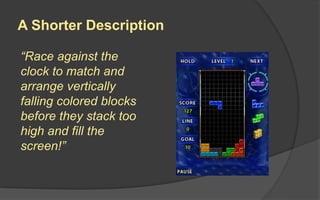
A Shorter Description
“Race against the
clock to match and
arrange vertically
falling colored blocks
before they stack too
high and fill the
screen!”
What Are The Ways To Describe A
Game?
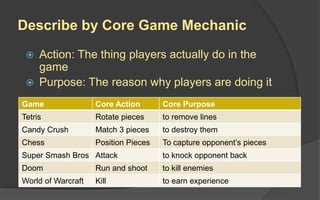
Describe by Core Game Mechanic
Game Action Purpose
Tetris Rotate pieces to remove lines
Candy Crush Match 3 pieces to destroy them
Chess Position pieces to capture opponent’s pieces
Super Smash Bros Attack to knock opponent back
Doom Run and shoot to kill enemies
World of Warcraft Kill to earn experience
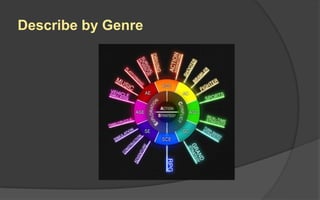
Describe by Genre
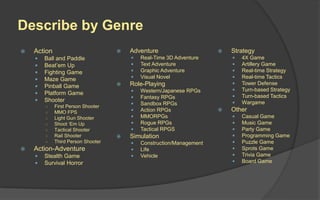
Describe by Genre
 Action
 Ball and Paddle
 Beat’em Up
 Fighting Game
 Maze Game
 Pinball Game
 Platform Game
 Shooter
○ First Person Shooter
○ MMO FPS
○ Light Gun Shooter
○ Shoot ‘Em Up
○ Tactical Shooter
○ Rail Shooter
○ Third Person Shooter
 Action-Adventure
 Stealth Game
 Survival Horror
 Adventure
 Real-Time 3D Adventure
 Text Adventure
 Graphic Adventure
 Visual Novel
 Role-Playing
 Western/Japanese RPGs
 Fantasy RPGs
 Sandbox RPGs
 Action RPGs
 MMORPGs
 Rogue RPGs
 Tactical RPGS
 Simulation
 Construction/Management
 Life
 Vehicle
 Strategy
 4X Game
 Artillery Game
 Real-time Strategy
 Real-time Tactics
 Tower Defense
 Turn-based Strategy
 Turn-based Tactics
 Wargame
 Other
 Casual Game
 Music Game
 Party Game
 Programming Game
 Puzzle Game
 Sprots Game
 Trivia Game
 Board Game
Describe in Other Terms
 Story-driven
 Run-and-gun
 Brain-teaser
 Hack n slash
 Sandbox
 God game
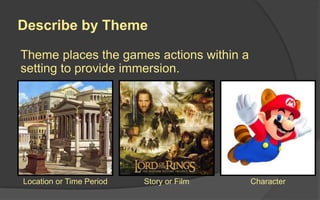
Describe by Theme
Location or Time Period Story or Film Character
Describe by Play Value
 Fantasy vs Reality
 Casual vs Hardcore
 Slow-Paced vs Fast-Paced
 Build vs Destroy
 Friendly vs Threatening
Describe by Target Players
Demographics
 Age
 Gender
 Favorite Genre
 Skill Level
 Play Session Length
 Income
Warning!
It is dangerous to enter a
market where gamers are
monogamous with their
game of choice!
It's far safer to woo those
gamers who love numerous
games.
Describe by Differentiation
Unique Selling Proposition (USP): Answers the
question, “What makes this game so special?”
What Makes A Game Special?
Unique Selling Proposition
 Different
 Compelling
 No Hyperbole
 No Empty Words
Unique Selling Proposition
Battlefield
 Huge open environments
 Large scale battles
 Vehicular combat
Modern Warfare
 Player customization and unique
loadouts
 Leveling up and unlocking new gear
What Are These Games’ USP’s?
Elevator Pitch
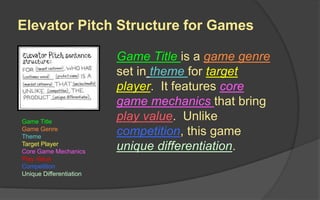
Elevator Pitch Structure for Games
Game Title is a game genre
set in theme for target
player. It features core
game mechanics that bring
play value. Unlike
competition, this game
unique differentiation.
Game Title
Game Genre
Theme
Target Player
Core Game Mechanics
Play Value
Competition
Unique Differentiation
Example Pitch
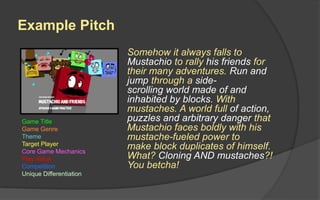
Somehow it always falls to
Mustachio to rally his friends for
their many adventures. Run and
jump through a side-
scrolling world made of and
inhabited by blocks. With
mustaches. A world full of action,
puzzles and arbitrary danger that
Mustachio faces boldly with his
mustache-fueled power to
make block duplicates of himself.
What? Cloning AND mustaches?!
You betcha!
Game Title
Game Genre
Theme
Target Player
Core Game Mechanics
Play Value
Competition
Unique Differentiation
Positioning Statement
Positioning: How your product compares to or
differs from other products in your target
market: it’s “position” on the landscape and in
the consumer’s mind.
Positioning Statement: A concise, specific
wording used to describe a product’s
positioning.
Positioning Statement Template
For [Target Market], [Brand] is [Point of
Differentiation] among all [Frame of
Reference] because [Reason to Believe].
Tetris is an exciting Russian-themed tile-
matching game for puzzle game players
combining fast action and strategic thinking
with a colorful, Russian aesthetic.
Tips For A Good Positioning
Statement
 Simple but memorable
 Clearly differentiates from competitors
 Credible
 Ownable
 Defines marketing decisions
 Allows growth
Tagline
Taglines are punchy, compelling one-liners
that capture interest and help with selling a
game.
“From Russia With Fun”
Taglines With Huge Pricetags To
Develop
Simple 3-Step Tagline Process
1. Describe your game in a few sentences
2. Trim it down
3. Trim it down again
Memory Test
What does Electronic Arts call a positioning
statement and tagline?
Hooks
Having a “good game” is not enough!
It needs some type of hook!
A hook is a compelling
feature or offer that the
Potential customer cannot
Say “no” to.
Reality Check
People don’t like “revolutionary”!
They say they do, but not
Really.
People want security.
Maslow Was Right!
So how do you be distinctive?
Tie It To Something People Know
 “It’s like Risk, but in first-person POV!”
 “It’s like basketball, but with spaceships!”
OR
 Market your game to early adopters.
Practice Round
Break into groups to determine your game’s
product positioning.
 List the top 5 features of your game in
descending order
 Identify which of these features are important,
pre-emptive and distinctive
 Compare this feature list with your number one
competitive game
 Identify your game’s unique features over your
competitors
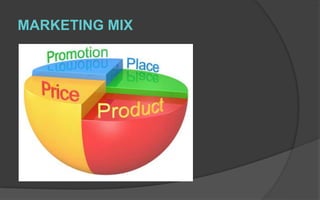
MARKETING MIX
The Four “P’s”
Marketers refer to the following of comprising
the Marketing Mix of a campaign:
 Product
 Price
 Promotion
 Place
Let’s take a closer look at each!
Product
 What is the essence of the idea?
 What makes it unique and compelling?
 Who is the audience?
 How big is that audience?
 How do we make it?
 What will it cost to make?
Price
 How much will your game sell for?
 Is it an impulse purchase?
 Is it a premium-priced purchase?
Promotion
The key vehicles, tactics, and programs used
to promote your game.
 Advertising
 Public Relations
 Social Media
 Word-of-mouth
Place
The places where you will sell your game.
 Retail stores
 Digital distribution
BRANDING
What is a “brand”?
A Philosophical Definition
 Branding is the unique identity, personality,
and characteristics identifying loyal
customers.
 It is the “who”, “what”, and most importantly
“why” of you and your product
A Philosophical Definition
 It is a promise kept.
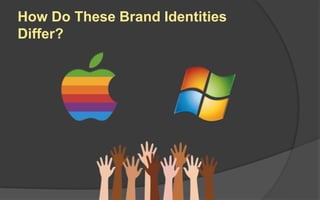
How Do These Brand Identities
Differ?
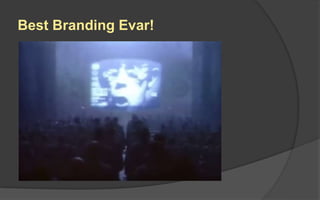
Best Branding Evar!
A Practical Definition
Branding includes all the physical and administrative
components of your company and game.
 Company and game name
 Company and game logos
 Messaging, slogans, taglines
 Advertising
 Website
 Trademarks
 Social Media
 Marketing strategy and tactics
No Brand Is Built Overnight!
Brand Building requires:
 Repetitive Exposure
 Coordinated approach across multiple
channels
 Time
 Patience
The Brand Development Process
 The Facts
 Answer Essential Questions
 Create Your Brand “Personality”
 Competitive Landscape
 Target Audience
 Differentiators
 Your Brand/Mission/Product Statement
 The Core Pitch
Let’s take a closer look at each!
The Facts
 The founders and their roles
 Where you’re located
 Your background and expertise
Answers To These Essential
Questions
 WHY are you?
 What makes you special?
 Why will people like you?
Define Your Brand Personality
 Independent
 High quality
 Great [at what]
 Funny
 Serious
 Determined
 Engaging
 Challenging
 Best [what]
 Expert
 Inspiring
 Artistic
 Ambitious
 Strategic
 Bold
 Risk Taking
 Confident
 Aggressive
 Accessible
 Dedicated
 Committed
 Craftsmanship
 Thoughtful
 World Changing
Competitive Landscape
 Who are the current leaders in your field?
 Why do you believe they have been so
successful?
 What games out there are closest to
yours?
Target Audience
Your customers are the heart and soul of your
company. So:
 Who do you want as your customers?
Be more specific than “anyone who likes
games”.
Differentiators
 What makes your game or product
special?
 How does it compare to other companies?
Your Brand/Mission/Product
Statement
A statement, primarily for internal use only, that
will become the driving force of your company.
“[My company] is committed to creating the most
challenging and engaging RPGs today. Our
expertise and dedication will ensure the highest
quality, and our sense of humor in our company
and games will remind us that we’re all in this for
fun – and if we’re having fun, our players will
have fun.”
The Core Pitch
Once you’ve determined all of the above, the
result will be The Core Pitch (also known as
your “brand bible.”)
Once implemented, your core pitch will be the
inspirational and practical source for all logos,
ad copy, tag lines, blogs, press releases,
human resources, and presentations for
funding.
Group Quest
Create a core pitch for your game.
PROTECTING YOUR BRAND
Assets For Establishing Your Brand
Minimum
 Company Logo
 Game Logo
 Screenshots
Additional
 Website
 Facebook Page
 Twitter
 Core Pitch Presentation
How Do You Protect Your Brand Identity
From Being Stolen?
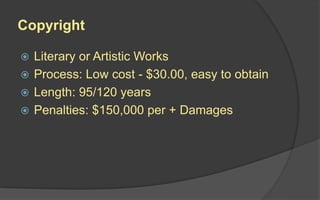
Copyright
The exclusive legal right, given to an
originator or an assignee to print, publish,
perform, film, or record literary, artistic, or
musical material, and to authorize others to
do the same.
Copyright infringement is the use of works
protected by copyright law without
permission, infringing certain exclusive
rights granted to the copyright holder, such
as the right to reproduce, distribute, display
or perform the protected work, or to make
derivative works.
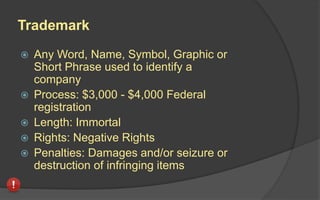
Trademark
A symbol, word, or words legally
registered or established by use as
representing a company or product.
Trademark infringement is the
unauthorized use of a trademark or
service mark on competing or related
goods and services. The success of a
lawsuit to stop the infringement turns on
whether the defendant's use causes a
likelihood of confusion in the average
consumer.
Patent
A government authority or license
conferring a right or title for a set period,
especially the sole right to exclude
others from making, using, or selling an
invention.
Patent infringement is the act of
making, using, selling, or offering to sell
a patented invention, or importing into
the United States a product covered by
a claim of a patent without the
permission of the patent owner.
Trade Secret
Information that derives
independent economic value,
actual or potential, from not being
generally known to or readily
ascertainable through appropriate
means by other persons who
might obtain economic value from
its disclosure or use; and is the
subject of efforts that are
reasonable under the
circumstances to maintain its
secrecy.
On Trademarks, Copyright and
Patents
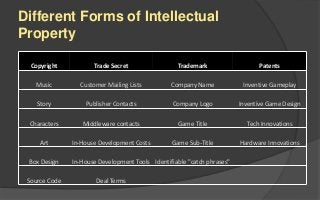
Different Forms of Intellectual
Property
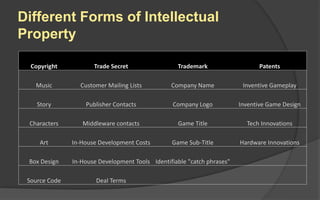
Copyright Trade Secret Trademark Patents
Music Customer Mailing Lists Company Name Inventive Gameplay
Story Publisher Contacts Company Logo Inventive Game Design
Characters Middleware contacts Game Title Tech Innovations
Art In-House Development Costs Game Sub-Title Hardware Innovations
Box Design In-House Development Tools Identifiable "catch phrases"
Source Code Deal Terms
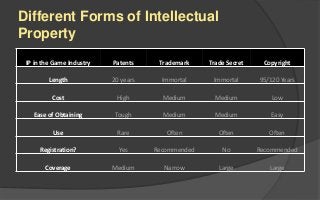
Different Forms of Intellectual
Property
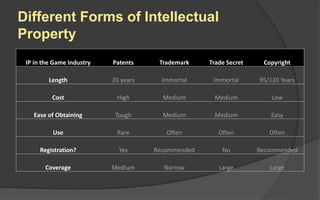
IP in the Game Industry Patents Trademark Trade Secret Copyright
Length 20 years Immortal Immortal 95/120 Years
Cost High Medium Medium Low
Ease of Obtaining Tough Medium Medium Easy
Use Rare Often Often Often
Registration? Yes Recommended No Recommended
Coverage Medium Narrow Large Large
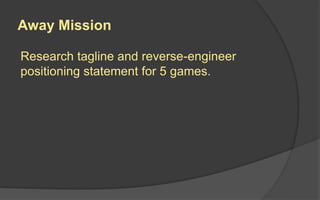
Away Mission
Research taglines and reverse-engineer
positioning statements for 4 games.