Mathematical Models and Simulation Techniques in
Game Development
What Are Mathematical Models?
• Definition: A mathematical model is a description of a
system using mathematical concepts like equations,
functions, and algorithms.
• These models help developers understand, test, and adjust
how a game behaves.
• Example: A formula to calculate how damage is dealt in a
combat system.
Why Use Mathematical Models in
Games?
• - Ensure gameplay is balanced and fair.
• - Predict and control difficulty curves.
• - Analyze player behavior and game economies.
• - Create scalable systems for complex games.
• - Help designers iterate quickly and efficiently.
Types of Mathematical Models in
Games
• - Deterministic Models: No randomness; same input always
gives the same output.
• - Probabilistic Models: Include elements of chance.
• - Discrete Models: Change at specific intervals (turn-based).
• - Continuous Models: Change constantly over time (real-time
physics).
Deterministic Models
• Definition: Models that produce the same result every time
for a given input.
• Use Case: Puzzle games, strategic board games like Chess.
• Benefits: Predictability, allows for deep strategy and
planning.
Probabilistic Models
• Definition: Models that use randomness or probability to
determine outcomes.
• Use Case: Card draws, dice rolls, critical hits in RPGs.
• Benefits: Adds variability and excitement to gameplay.
Discrete vs. Continuous Models
• Discrete: Game world updates in steps (e.g., turn-based
games).
• Continuous: Game world updates smoothly over time (e.g.,
physics-based simulations).
• Example: Chess is discrete; a car driving simulation is
continuous.
Common Game Systems Modeled
Mathematically
• - Health and Damage Systems
• - Resource Management
• - Movement and Physics
• - AI and Decision Making
• - Game Economy
• - Player Progression
Modeling Health and Damage
• Linear or non-linear equations can define how much
damage a player takes.
• Consider variables: player health, enemy attack power,
defense levels.
• Helps developers balance combat difficulty.
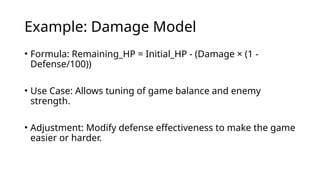
Example: Damage Model
• Formula: Remaining_HP = Initial_HP - (Damage × (1 -
Defense/100))
• Use Case: Allows tuning of game balance and enemy
strength.
• Adjustment: Modify defense effectiveness to make the game
easier or harder.
Modeling Game Economy
• Track how players earn and spend currency.
• Balance income (e.g., rewards) with expenses (e.g.,
upgrades).
• Prevent currency inflation or scarcity.
Example: In-Game Currency Model
• Formula: Net_Currency = (Earnings_per_minute × Play_Time)
- Total_Spend
• Analyze to ensure players can afford necessary upgrades.
• Adjust based on playtest feedback.
Modeling Player Behavior
• Predict likely choices using game theory.
• Model motivations and tendencies (e.g., risk vs. reward).
• Helps design systems players enjoy and engage with.
Game Theory Basics
• Definition: Study of mathematical models of strategic
interaction.
• Use Payoff Matrices to analyze player decisions.
• Identify dominant strategies and adjust game rules
accordingly.
Using Graphs in Game Models
• Graphs represent states (nodes) and transitions (edges).
• Useful in pathfinding, AI logic, and level design.
• Example: A graph to model enemy patrol routes.
Finite State Machines (FSM)
• Break down behavior into defined states.
• Use transitions triggered by conditions.
• Widely used in AI and cutscene scripting.
FSM Example: Enemy AI
• States: Patrol Chase Attack Flee
→ → →
• Transitions: Based on player distance or AI health.
• Allows structured and understandable AI behavior.
Probabilistic FSM
• Adds randomness to FSM transitions.
• Makes AI less predictable.
• Example: 70% chance to attack, 30% chance to flee.
Introduction to Simulation
• Definition: Use of models to imitate game behavior over
time.
• Allows developers to test ideas without full implementation.
• Helps discover balance issues early.
Types of Simulations in Games
• - Real-Time: Updates continuously (e.g., physics).
• - Turn-Based: Step-by-step updates (e.g., strategy).
• - Monte Carlo: Random sampling to simulate many possible
outcomes.
Real-Time Simulation
• Used for real-time physics, vehicle dynamics, weather.
• Requires optimization for performance.
• Must be consistent and deterministic for multiplayer games.
Turn-Based Simulation
• Ideal for games where players take actions one at a time.
• Easier to simulate and debug.
• Example: Simulating a battle in a strategy game.
Monte Carlo Simulation
• Run simulations with random variables many times.
• Collect statistics to determine likely outcomes.
• Used in RNG tuning and statistical balancing.
Example: Monte Carlo for Loot Drops
• Simulate 10,000 loot rolls.
• Analyze drop rates for each item.
• Adjust probabilities to ensure fairness.
Agent-Based Simulation
• Simulate multiple agents with rules (e.g., NPCs, animals).
• Observe emergent behavior.
• Used in crowd systems and ecological simulations.
Physics Simulations
• Models using laws of motion and force.
• Implemented with rigid body dynamics.
• Adds realism to movement, collisions, and object
interactions.
Collision Detection Algorithms
• Bounding Box: Fast, rough estimate.
• Bounding Sphere: Useful for circular objects.
• SAT: More precise for complex shapes.
Performance Optimization via
Simulation
• Run stress tests to evaluate game performance.
• Simulate worst-case AI or player scenarios.
• Identify and fix performance bottlenecks.
Simulation Tools and Libraries
• - Unity Physics Engine
• - Box2D, Bullet Physics
• - MATLAB/Simulink for academic prototyping
• - Python for scripting and testing logic
Game Balancing through Simulation
• Test different character builds.
• Simulate multiple matchups.
• Use results to tweak stats and rules.
Workflow for Simulation Analysis
• 1. Define the system and variables.
• 2. Run controlled simulations.
• 3. Record outcomes.
• 4. Visualize data.
• 5. Adjust and re-test.
Data Visualization in Simulation
• Translate results into visual formats:
• - Line Graphs: Show progression.
• - Bar Charts: Compare outcomes.
• - Heatmaps: Show density/frequency.
Tools for Data Visualization
• - Excel/Google Sheets: Quick graphs.
• - Python Libraries: Matplotlib, Seaborn.
• - Unity Analytics: Built-in for game metrics.
Case Study: Combat Simulation in RPG
• Simulate hundreds of battles.
• Compare class builds (e.g., warrior vs. mage).
• Determine which build is overpowered or underpowered.
Case Study: Traffic Simulation in Racing
Game
• Simulate AI vehicle movement.
• Observe collisions, overtaking behavior.
• Optimize road width and AI parameters.
Case Study: Economic Simulation in
Strategy Game
• Track trade between cities.
• Adjust taxes and resource prices.
• Use simulation to prevent resource hoarding or inflation.
Risks of Poor Modeling
• - Unintended player exploits
• - One strategy becomes dominant
• - Game becomes too easy or too difficult
• - Poor user retention
Summary
• Mathematical models represent and control game systems.
• Simulations allow testing and refinement.
• Together, they lead to better game design, balance, and
performance.
Class Activity
• Choose a game mechanic (e.g., damage, resource
collection).
• Create a simple formula or FSM.
• Share and get peer feedback.
Group Discussion
• What math models exist in your favorite game?
• Can you find flaws or exploits?
• How would you simulate and fix them?

Chapter 6: Mathematical Models and SImulation

  • 1.
    Mathematical Models andSimulation Techniques in Game Development
  • 2.
    What Are MathematicalModels? • Definition: A mathematical model is a description of a system using mathematical concepts like equations, functions, and algorithms. • These models help developers understand, test, and adjust how a game behaves. • Example: A formula to calculate how damage is dealt in a combat system.
  • 3.
    Why Use MathematicalModels in Games? • - Ensure gameplay is balanced and fair. • - Predict and control difficulty curves. • - Analyze player behavior and game economies. • - Create scalable systems for complex games. • - Help designers iterate quickly and efficiently.
  • 4.
    Types of MathematicalModels in Games • - Deterministic Models: No randomness; same input always gives the same output. • - Probabilistic Models: Include elements of chance. • - Discrete Models: Change at specific intervals (turn-based). • - Continuous Models: Change constantly over time (real-time physics).
  • 5.
    Deterministic Models • Definition:Models that produce the same result every time for a given input. • Use Case: Puzzle games, strategic board games like Chess. • Benefits: Predictability, allows for deep strategy and planning.
  • 6.
    Probabilistic Models • Definition:Models that use randomness or probability to determine outcomes. • Use Case: Card draws, dice rolls, critical hits in RPGs. • Benefits: Adds variability and excitement to gameplay.
  • 7.
    Discrete vs. ContinuousModels • Discrete: Game world updates in steps (e.g., turn-based games). • Continuous: Game world updates smoothly over time (e.g., physics-based simulations). • Example: Chess is discrete; a car driving simulation is continuous.
  • 8.
    Common Game SystemsModeled Mathematically • - Health and Damage Systems • - Resource Management • - Movement and Physics • - AI and Decision Making • - Game Economy • - Player Progression
  • 9.
    Modeling Health andDamage • Linear or non-linear equations can define how much damage a player takes. • Consider variables: player health, enemy attack power, defense levels. • Helps developers balance combat difficulty.
  • 10.
    Example: Damage Model •Formula: Remaining_HP = Initial_HP - (Damage × (1 - Defense/100)) • Use Case: Allows tuning of game balance and enemy strength. • Adjustment: Modify defense effectiveness to make the game easier or harder.
  • 11.
    Modeling Game Economy •Track how players earn and spend currency. • Balance income (e.g., rewards) with expenses (e.g., upgrades). • Prevent currency inflation or scarcity.
  • 12.
    Example: In-Game CurrencyModel • Formula: Net_Currency = (Earnings_per_minute × Play_Time) - Total_Spend • Analyze to ensure players can afford necessary upgrades. • Adjust based on playtest feedback.
  • 13.
    Modeling Player Behavior •Predict likely choices using game theory. • Model motivations and tendencies (e.g., risk vs. reward). • Helps design systems players enjoy and engage with.
  • 14.
    Game Theory Basics •Definition: Study of mathematical models of strategic interaction. • Use Payoff Matrices to analyze player decisions. • Identify dominant strategies and adjust game rules accordingly.
  • 15.
    Using Graphs inGame Models • Graphs represent states (nodes) and transitions (edges). • Useful in pathfinding, AI logic, and level design. • Example: A graph to model enemy patrol routes.
  • 16.
    Finite State Machines(FSM) • Break down behavior into defined states. • Use transitions triggered by conditions. • Widely used in AI and cutscene scripting.
  • 17.
    FSM Example: EnemyAI • States: Patrol Chase Attack Flee → → → • Transitions: Based on player distance or AI health. • Allows structured and understandable AI behavior.
  • 18.
    Probabilistic FSM • Addsrandomness to FSM transitions. • Makes AI less predictable. • Example: 70% chance to attack, 30% chance to flee.
  • 19.
    Introduction to Simulation •Definition: Use of models to imitate game behavior over time. • Allows developers to test ideas without full implementation. • Helps discover balance issues early.
  • 20.
    Types of Simulationsin Games • - Real-Time: Updates continuously (e.g., physics). • - Turn-Based: Step-by-step updates (e.g., strategy). • - Monte Carlo: Random sampling to simulate many possible outcomes.
  • 21.
    Real-Time Simulation • Usedfor real-time physics, vehicle dynamics, weather. • Requires optimization for performance. • Must be consistent and deterministic for multiplayer games.
  • 22.
    Turn-Based Simulation • Idealfor games where players take actions one at a time. • Easier to simulate and debug. • Example: Simulating a battle in a strategy game.
  • 23.
    Monte Carlo Simulation •Run simulations with random variables many times. • Collect statistics to determine likely outcomes. • Used in RNG tuning and statistical balancing.
  • 24.
    Example: Monte Carlofor Loot Drops • Simulate 10,000 loot rolls. • Analyze drop rates for each item. • Adjust probabilities to ensure fairness.
  • 25.
    Agent-Based Simulation • Simulatemultiple agents with rules (e.g., NPCs, animals). • Observe emergent behavior. • Used in crowd systems and ecological simulations.
  • 26.
    Physics Simulations • Modelsusing laws of motion and force. • Implemented with rigid body dynamics. • Adds realism to movement, collisions, and object interactions.
  • 27.
    Collision Detection Algorithms •Bounding Box: Fast, rough estimate. • Bounding Sphere: Useful for circular objects. • SAT: More precise for complex shapes.
  • 28.
    Performance Optimization via Simulation •Run stress tests to evaluate game performance. • Simulate worst-case AI or player scenarios. • Identify and fix performance bottlenecks.
  • 29.
    Simulation Tools andLibraries • - Unity Physics Engine • - Box2D, Bullet Physics • - MATLAB/Simulink for academic prototyping • - Python for scripting and testing logic
  • 30.
    Game Balancing throughSimulation • Test different character builds. • Simulate multiple matchups. • Use results to tweak stats and rules.
  • 31.
    Workflow for SimulationAnalysis • 1. Define the system and variables. • 2. Run controlled simulations. • 3. Record outcomes. • 4. Visualize data. • 5. Adjust and re-test.
  • 32.
    Data Visualization inSimulation • Translate results into visual formats: • - Line Graphs: Show progression. • - Bar Charts: Compare outcomes. • - Heatmaps: Show density/frequency.
  • 33.
    Tools for DataVisualization • - Excel/Google Sheets: Quick graphs. • - Python Libraries: Matplotlib, Seaborn. • - Unity Analytics: Built-in for game metrics.
  • 34.
    Case Study: CombatSimulation in RPG • Simulate hundreds of battles. • Compare class builds (e.g., warrior vs. mage). • Determine which build is overpowered or underpowered.
  • 35.
    Case Study: TrafficSimulation in Racing Game • Simulate AI vehicle movement. • Observe collisions, overtaking behavior. • Optimize road width and AI parameters.
  • 36.
    Case Study: EconomicSimulation in Strategy Game • Track trade between cities. • Adjust taxes and resource prices. • Use simulation to prevent resource hoarding or inflation.
  • 37.
    Risks of PoorModeling • - Unintended player exploits • - One strategy becomes dominant • - Game becomes too easy or too difficult • - Poor user retention
  • 38.
    Summary • Mathematical modelsrepresent and control game systems. • Simulations allow testing and refinement. • Together, they lead to better game design, balance, and performance.
  • 39.
    Class Activity • Choosea game mechanic (e.g., damage, resource collection). • Create a simple formula or FSM. • Share and get peer feedback.
  • 40.
    Group Discussion • Whatmath models exist in your favorite game? • Can you find flaws or exploits? • How would you simulate and fix them?