Fundamentals of Game Design
Game Balancing
Sayed Ahmed
BSc. Eng. in CSc. & Eng.
MSc. in CSc.
http://sayed.justetc.net
http://www.justETC.net
sayed@justetc.netWww.JustETC.net
Presented at the University of Winnipeg, Canada
Just E.T.C for Business, Education, and Technology Solutions
1
Introduction
 To be enjoyable
 A game must
 Be well balanced
 Be not too easy nor too difficult
 Feel fair to competing players
 Feel fair to the individual player itself
Topics
 Qualities of a well balanced game
 How to balance your game
 How to set up and balance both
 Transitive and intransitive relationships among player choices
 Make them simultaneously
 Interesting and well-balanced
 Dominant strategies and how they affect balancing
 Ways to incorporate chance into games
 Where the better player still enjoy better rewards
 Will focus on two major issues of game balance
 Fairness and difficulty
 Fairness
 Player versus player
 Player versus environment
Topics
 Difficulty
 Player versus environment
 Various factors that affect the player’s perception of difficulty
 How to manage the factors
 Role of positive feedbacks
 How to use it
 How to control it
 Investigate the problems of
 Stagnation
 Trivialities
 Design games so that the tuning stage is still easier
What is a Balanced Game
 Balanced Game
 Fair to the player (players)
 Neither too easy nor too hard
 Skill of the player is the most important factor to win
the game
 What makes a balanced game
 Several different features together make the game
balanced
 A collection of design and tuning process create those
balancing qualities in a game
What is a Balanced Game
 Techniques for balancing may differ for
 Player versus player (may be artificial opponent)
 Player versus environment
 A well balanced game posses the following characteristics
 The game provides meaningful choices
 The role of chance is not that extreme that player skill becomes
irrelevant
 Well balanced PvP posses the following
 The players perceive the game to be fair
 Any player who falls behind early in the game gets reasonable
opportunities to catch up again before the game ends
 The game seldom or never results in a stalemate
What is a Balanced Game: PvE
 A Well Balanced PvE game posses the following
 The player perceives the game to be fair
 The game’s level of difficulty must be consistent
Avoiding Dominant Strategies
 What is a strategy
 The plan to play the game for victory
 Can be aggressive
 Can be defensive
 Two player may prefer two different strategy
 Ideally, they should have equal chance of winning
 Dominant Strategy
 A strategy that results the best outcome
 A player may achieve
 No matter what her opponent does
 Are undesirable – makes all other choices useless
 Worse: if one player can use the strategy – others cannot
 Happens in asymmetric games
 Makes the game unfair
Avoiding Dominant Strategies
 One single choice can be a dominant strategy
 Strategies that avoid loss or prevent an opponent
from scoring points
 May qualify as dominant
 Before 1955, a basket ball player could use endless
tactics - dominant
Dominant strategies in Video Games
 Some video games permit dominant strategies
 Command and Conquer: Tank Rush
 Madden NFL
 Fighting games prone to dominant strategies
 Fighting and football games
 Large number of offensive and defensive actions
 Difficult to test (for fairness and balancing)
 Bad character design may lead to dominant strategies
 Super street fighter II turbo
 Akuma: Air fireball
Transitive relationships among Player Options
 Transitive
 Relationship among three or more entities
 A> B, B>C, A>C
 Example: Strategic options
 Aggressive > Defensive > Stealth
 Aggressive > Stealth
 Smart player will always choose Aggressive mode
 To address the imbalance
 You may assign direct costs to each strategy
 That may lead to players to consider the weak strategies as well
 Riding horse may be more fun but costlier than riding bi-cycle
 Traveling with a Hummer will cost more than travelling with Ford
 Shadow cost
 PvE players find shadow costs are unfair
 Designers use transitivity to reward players as well
 Can be back and forth
Intransitive relationships
 Here the relationships among strategies, or options are
intransitive
 A beats B, B beats C,
 Does not mean that A beats C
 Rock->paper->Scissors
 Paper beats rock, rock beats scissors, scissors beat paper
 Balanced three way intransitive relationship
 Classic design technique to avoid dominant design strategies
 Forms the basis for balancing player strategies in many games
 Virtua Fighter 3 (David Sirlin) uses RPS for players movements
 Attacking beats throwing, throwing beats blocking, blocking beats attacking
 The ancient art of war: RPS three unit types: Knights, Archers, Barbarians
 K>b, b>a, a>k
Intransitive relationships
 RPS simple
 Not suited to modern war games
 Offers no interesting choices
 Needs some variation
 Adjust system to produce different benefits
 Give players different amount of money to win with
 Rock, paper, or scissor
 Target to earn the most money
 So make your choices like
 One choice is better than others in some situations but not in all
 Implement it in the core-mechanics
 Example: Race game: lizard, frog, mouse
 Advantages remain slight than overwhelming
 Course complex mixture of rock, swamp, grass
 Partial freedom to select routes
 Add some shadow costs
 Careful adjustment will make the game balanced
Orthogonal Unit Differentiation
 Each type of unit a player can control in a game
 Should be orthogonally different from all others
 Each unit unlike than the others in a different dimension
 Not in the same dimension
 Race: ford, dodge – speed – differ in only one dimension
 Make the units differ in power at one aspect but offer different
qualities with each unit
 To offer a large variety of strategies
 To make the choice more interesting
 Every unit should have capabilities that others don’t have
 Each unit plays a distinct role
 Little point to offer weaker units only upgradable to more powerful
unit
Orthogonal Unit Differentiation
 The more diverse your challenges are
 The easier to offer orthogonally different units
 Racing games are not good places as all the players
will face similar challenges
 War games can easily offer orthogonal units
 Such units also help to prevent dominant
strategies
 Define the victory condition in such a way
 The player must use a variety of different units to win the
game
Dominant Strategies in PvE Games
 One action to surmount all challenges
 Makes a dull game
 Games usually offer more challenges than actions
 With a smaller set of actions players can
 Experiment with the actions to overcome the challenges
 Fewer actions does introduce a potential problem
 Powerful esp.
 Actions that can overcome several different kinds of challenges
 You risk to create exploits
 Actions so powerful that the player may become unstoppable
 No straight forward rule
 But testing will help
 Try to play with as many actions and combinations possible to defeat a challenge
 Smaller actions offer testability
 Be careful with power ups and special actions that gives the player more power than usual
Incorporating the Elements of Chance
 Use chance sparingly
 Chance affects only minority of actions
 Balance the effect of chance as follows
 Use chance in frequent challenges with small risks
and rewards
 Allow the player to choose actions to use the odds to
his advantage
 Allow the player to decide how much to risk
Making PvP Games Fair
 Fairness in PvP Games
 The rules give each player equal chance of winning
 At the beginning of the game
 The rules do not give advantages or disadvantages to players
unequally
 during the game in ways that they cannot influence or
prevent
 apart from the operation of chance
Balancing Games with Symmetry
 Decide the game to be symmetric or asymmetric
 At the beginning
 All PvE games are asymmetric
 Symmetric PvP games are easier to create
 Whatever you do for one player
 You do it for all players
 Give similar resources and power in the beginning
 Also same condition
Balancing Asymmetric Games
 Fox and Geese Example
 Testing all possible combinations
 Be lengthy
Making PvE Games Fair
 The game should offer the player challenges at a consistent maximum levels of difficulty
 No sudden spikes
 The player should not suddenly lose the game
 Without warning
 And through no fault of his own
 Learn by dying
 The immortal
 Give warning of danger
 A stalemate should not occur
 A condition from where both win or lose is impossible
 The game should not ask for critical decision without informing the player with all information
 Monty on the run
 All the factual knowledge required to win the game should be contained within the game
 The game should not require the player to meet challenges not normally presented in the game’s
genre
 Puzzle in Simulation Game
Managing Difficulty
 Flow State
 Ability balances with the difficulty
 Peak Productivity
 Too Much Challenging
 Causes anxiety
 Too Easy
 Causes boredom
 Absolute Difficulty
 Perceived Difficulty
 The perceived difficulty of a well balanced game should remain
within a certain range
 Should not have sudden spikes or dips
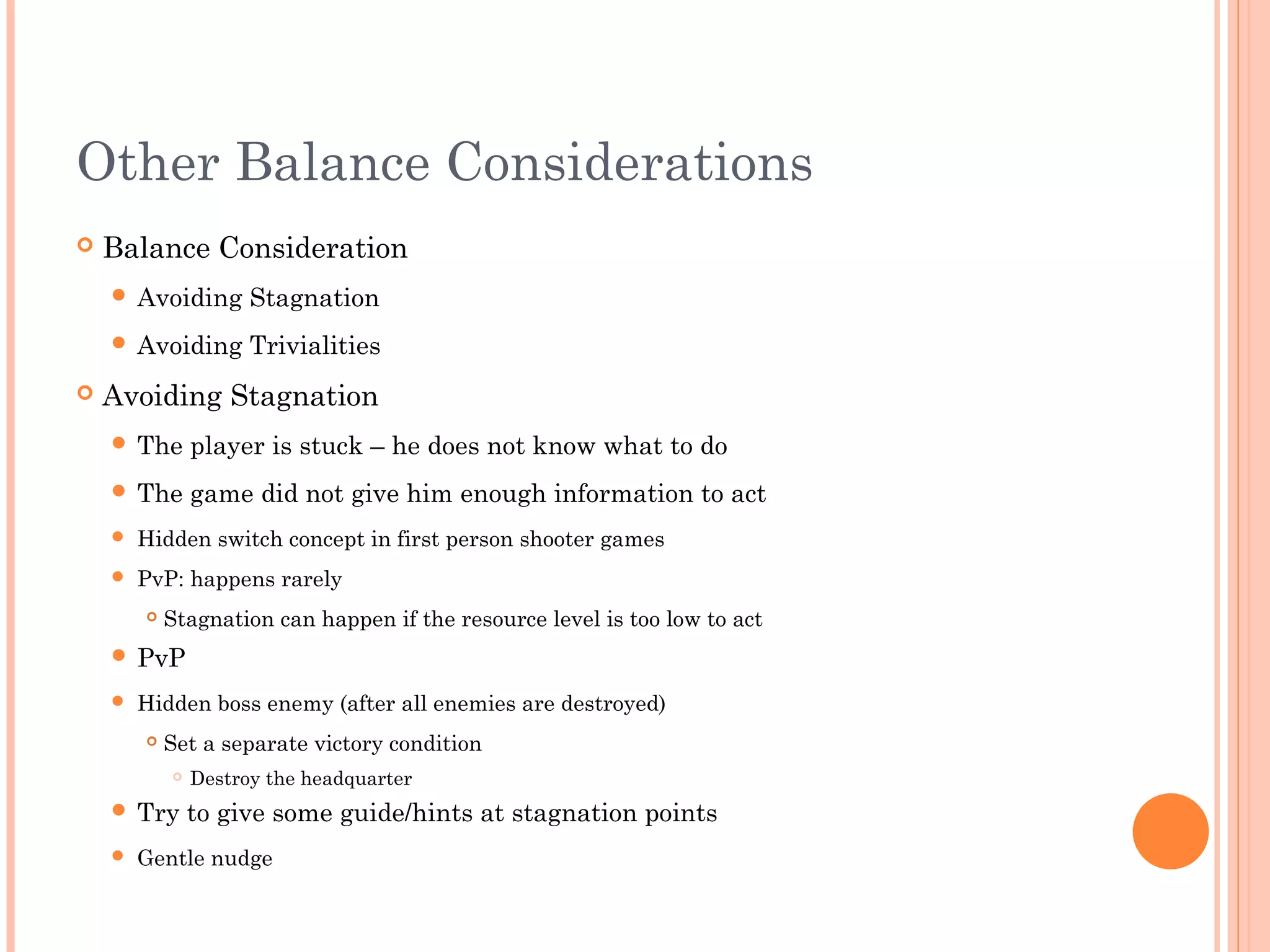
Other Balance Considerations
 Balance Consideration
 Avoiding Stagnation
 Avoiding Trivialities
 Avoiding Stagnation
 The player is stuck – he does not know what to do
 The game did not give him enough information to act
 Hidden switch concept in first person shooter games
 PvP: happens rarely
 Stagnation can happen if the resource level is too low to act
 PvP
 Hidden boss enemy (after all enemies are destroyed)
 Set a separate victory condition
 Destroy the headquarter
 Try to give some guide/hints at stagnation points
 Gentle nudge
Avoiding Trivialities
 Avoid uninteresting details
 Example
 Fuel Consumption, Where to store gold
 Police Game
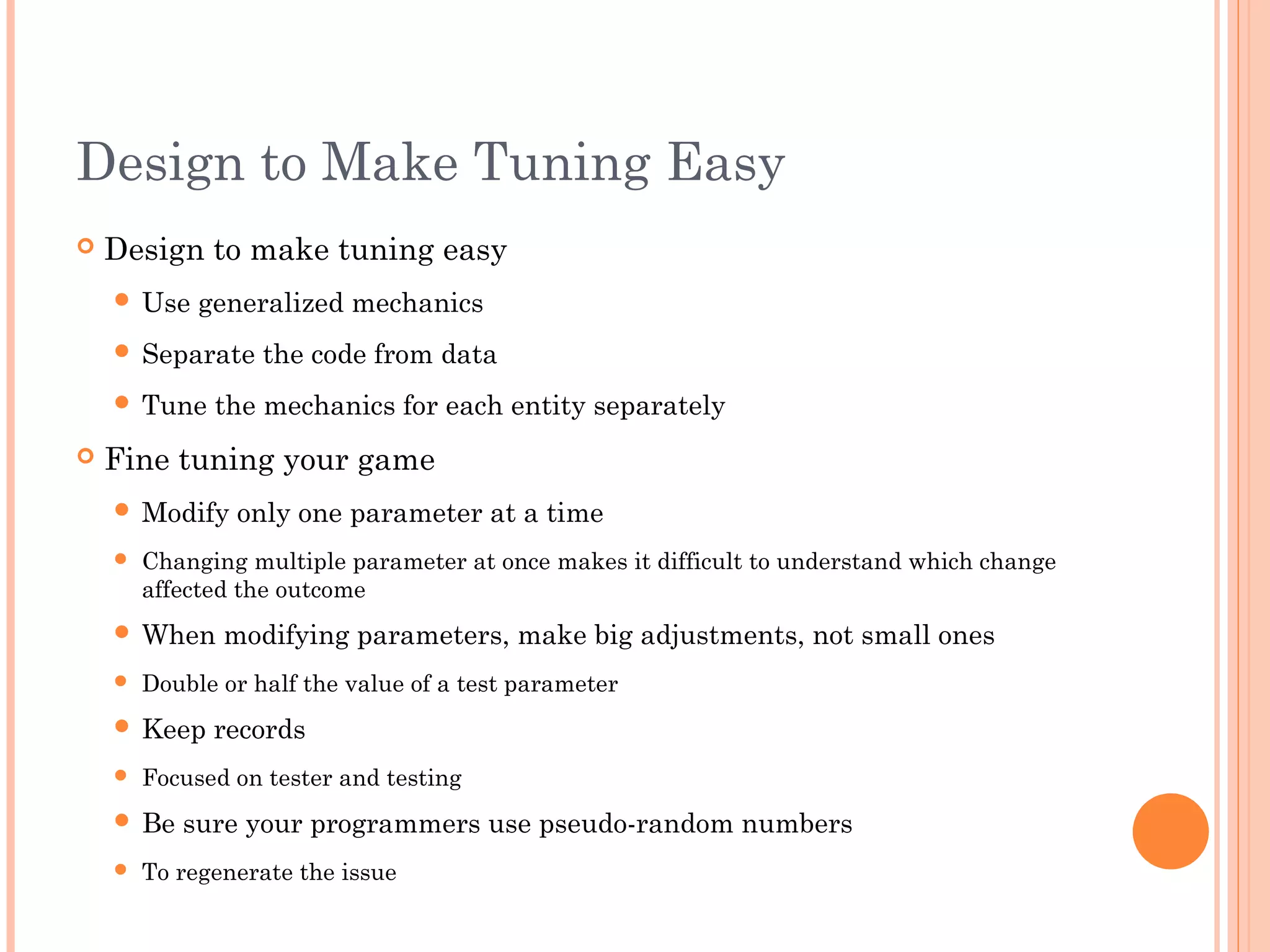
Design to Make Tuning Easy
 Design to make tuning easy
 Use generalized mechanics
 Separate the code from data
 Tune the mechanics for each entity separately
 Fine tuning your game
 Modify only one parameter at a time
 Changing multiple parameter at once makes it difficult to understand which change
affected the outcome
 When modifying parameters, make big adjustments, not small ones
 Double or half the value of a test parameter
 Keep records
 Focused on tester and testing
 Be sure your programmers use pseudo-random numbers
 To regenerate the issue
Managing Difficulty
 Perceived Difficulty
 Hard to compare difficulty level of different types of challenges
 Even with the same type of challenges, it’s difficult to compare
difficulty level
 Complexity differs from person to person
 Factors Outside the Control of the Designer
 How much time the player has spent playing the game
 Or faced similar challenges in similar games
 How much native talent the player brings to the game
 In multiplayer games, it’s the skills of the opponents that make the
game hard or easy
 Though if the game is fair not much effort to manage difficulty
 Set difficulty of the challenges as posed by the environment
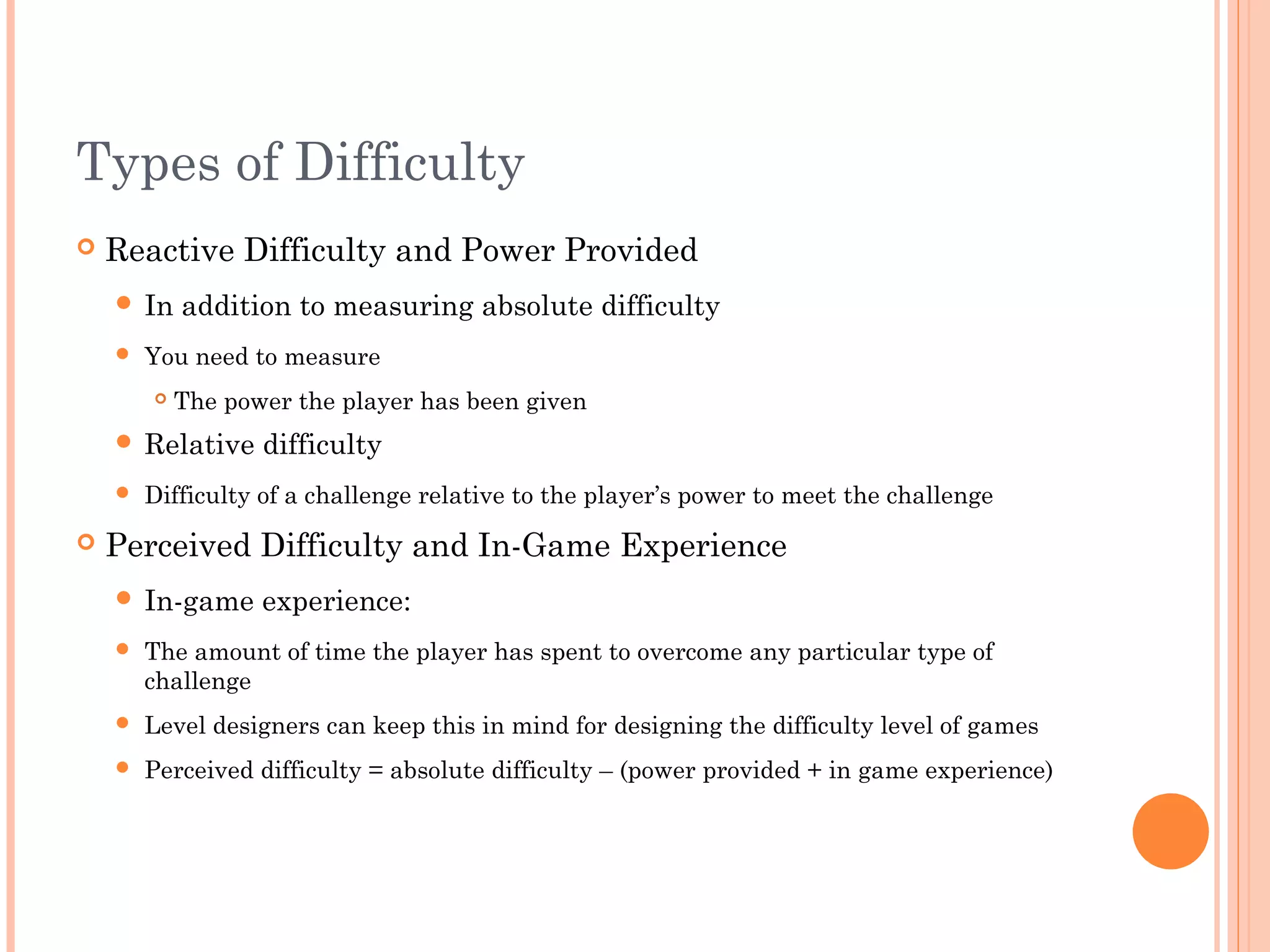
Types of Difficulty
 It is the perceived difficulty that matters most
 To design a challenge of your perceived difficulty
 You should consider the following
 Intrinsic skills required
 The stress
 Power provided
 In-game experience
 Absolute Difficulty
 By using the absolute difficulty
 you will be able to compare the difficulty level of different
challenges
Types of Difficulty
 Reactive Difficulty and Power Provided
 In addition to measuring absolute difficulty
 You need to measure
 The power the player has been given
 Relative difficulty
 Difficulty of a challenge relative to the player’s power to meet the challenge
 Perceived Difficulty and In-Game Experience
 In-game experience:
 The amount of time the player has spent to overcome any particular type of
challenge
 Level designers can keep this in mind for designing the difficulty level of games
 Perceived difficulty = absolute difficulty – (power provided + in game experience)
Managing Difficulty
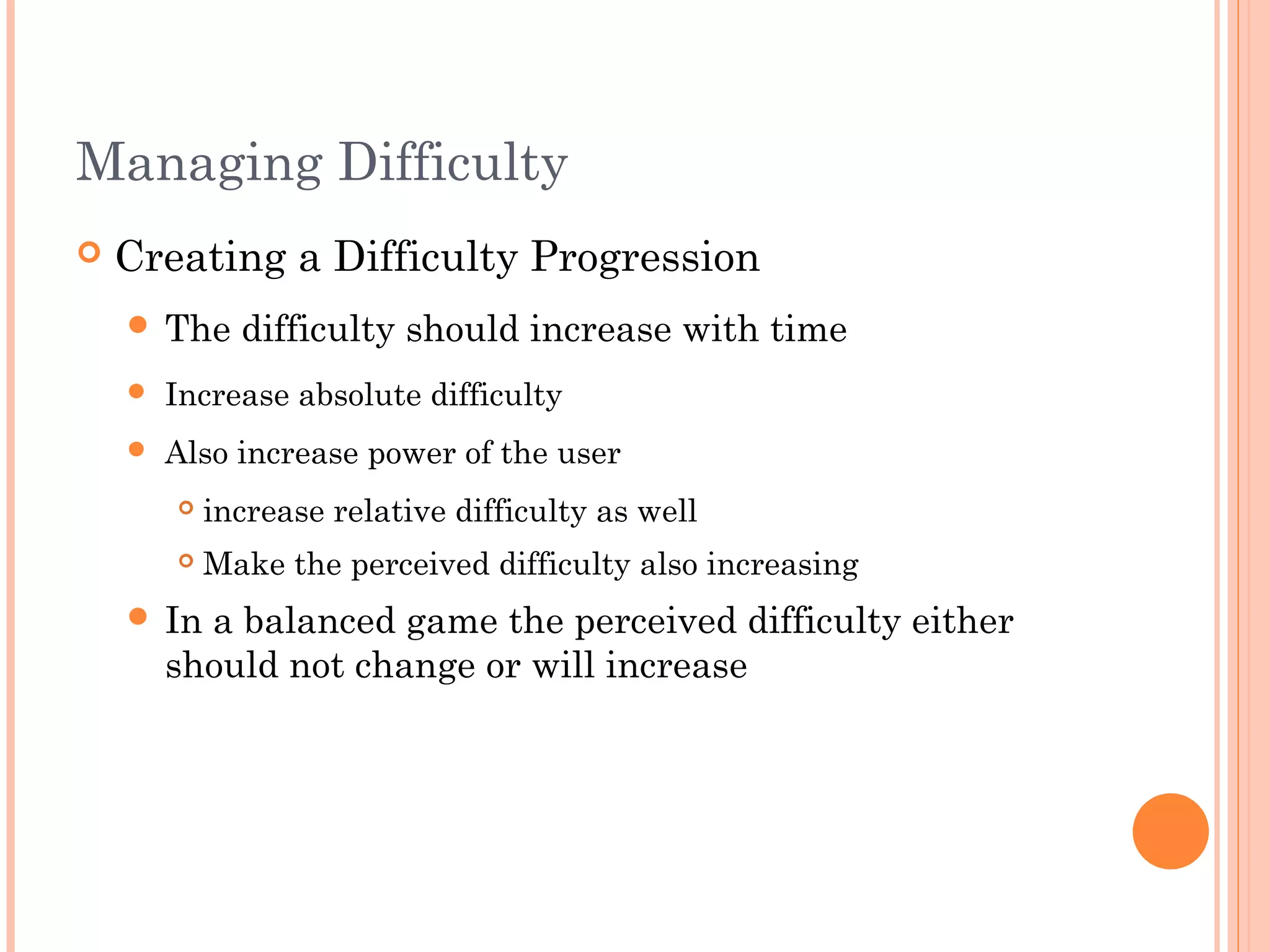
 Creating a Difficulty Progression
 The difficulty should increase with time
 Increase absolute difficulty
 Also increase power of the user
 increase relative difficulty as well
 Make the perceived difficulty also increasing
 In a balanced game the perceived difficulty either
should not change or will increase
Establishing Difficulty Modes
 Games with multiple difficulty level
 The perceived difficulty will not go above a certain
point for a level
 Action and Action Adventure Games
 Designers normally
 Give the enemies more health,
 allow them to do more damage
 Make them more numerous
 Adjust the AI of the enemies
Dynamic Difficulty Establishment
 Max Payne: First Person Shooter game:
 Adjust enemy power according to player’s
performance
 Half-life
 Check the state of the health of the avatar
Understanding Positive Feedback
 Benefits of Positive Feedback
 Positive feedback discourages stalemate
 Positive feedback rewards success
 Controlling Positive Feedback
 Don’t provide too much power as a reward for success
 Introduce negative feedback
 Raise the absolute difficulty level of challenges as the player
proceeds
 Allow collusion against the leader
 Define victory in terms unrelated to the feedback cycle
 Use the effects of chance to reduce the size of the player’s
rewards

Game balancing

  • 1.
    Fundamentals of GameDesign Game Balancing Sayed Ahmed BSc. Eng. in CSc. & Eng. MSc. in CSc. http://sayed.justetc.net http://www.justETC.net sayed@justetc.netWww.JustETC.net Presented at the University of Winnipeg, Canada Just E.T.C for Business, Education, and Technology Solutions 1
  • 2.
    Introduction  To beenjoyable  A game must  Be well balanced  Be not too easy nor too difficult  Feel fair to competing players  Feel fair to the individual player itself
  • 3.
    Topics  Qualities ofa well balanced game  How to balance your game  How to set up and balance both  Transitive and intransitive relationships among player choices  Make them simultaneously  Interesting and well-balanced  Dominant strategies and how they affect balancing  Ways to incorporate chance into games  Where the better player still enjoy better rewards  Will focus on two major issues of game balance  Fairness and difficulty  Fairness  Player versus player  Player versus environment
  • 4.
    Topics  Difficulty  Playerversus environment  Various factors that affect the player’s perception of difficulty  How to manage the factors  Role of positive feedbacks  How to use it  How to control it  Investigate the problems of  Stagnation  Trivialities  Design games so that the tuning stage is still easier
  • 5.
    What is aBalanced Game  Balanced Game  Fair to the player (players)  Neither too easy nor too hard  Skill of the player is the most important factor to win the game  What makes a balanced game  Several different features together make the game balanced  A collection of design and tuning process create those balancing qualities in a game
  • 6.
    What is aBalanced Game  Techniques for balancing may differ for  Player versus player (may be artificial opponent)  Player versus environment  A well balanced game posses the following characteristics  The game provides meaningful choices  The role of chance is not that extreme that player skill becomes irrelevant  Well balanced PvP posses the following  The players perceive the game to be fair  Any player who falls behind early in the game gets reasonable opportunities to catch up again before the game ends  The game seldom or never results in a stalemate
  • 7.
    What is aBalanced Game: PvE  A Well Balanced PvE game posses the following  The player perceives the game to be fair  The game’s level of difficulty must be consistent
  • 8.
    Avoiding Dominant Strategies What is a strategy  The plan to play the game for victory  Can be aggressive  Can be defensive  Two player may prefer two different strategy  Ideally, they should have equal chance of winning  Dominant Strategy  A strategy that results the best outcome  A player may achieve  No matter what her opponent does  Are undesirable – makes all other choices useless  Worse: if one player can use the strategy – others cannot  Happens in asymmetric games  Makes the game unfair
  • 9.
    Avoiding Dominant Strategies One single choice can be a dominant strategy  Strategies that avoid loss or prevent an opponent from scoring points  May qualify as dominant  Before 1955, a basket ball player could use endless tactics - dominant
  • 10.
    Dominant strategies inVideo Games  Some video games permit dominant strategies  Command and Conquer: Tank Rush  Madden NFL  Fighting games prone to dominant strategies  Fighting and football games  Large number of offensive and defensive actions  Difficult to test (for fairness and balancing)  Bad character design may lead to dominant strategies  Super street fighter II turbo  Akuma: Air fireball
  • 11.
    Transitive relationships amongPlayer Options  Transitive  Relationship among three or more entities  A> B, B>C, A>C  Example: Strategic options  Aggressive > Defensive > Stealth  Aggressive > Stealth  Smart player will always choose Aggressive mode  To address the imbalance  You may assign direct costs to each strategy  That may lead to players to consider the weak strategies as well  Riding horse may be more fun but costlier than riding bi-cycle  Traveling with a Hummer will cost more than travelling with Ford  Shadow cost  PvE players find shadow costs are unfair  Designers use transitivity to reward players as well  Can be back and forth
  • 12.
    Intransitive relationships  Herethe relationships among strategies, or options are intransitive  A beats B, B beats C,  Does not mean that A beats C  Rock->paper->Scissors  Paper beats rock, rock beats scissors, scissors beat paper  Balanced three way intransitive relationship  Classic design technique to avoid dominant design strategies  Forms the basis for balancing player strategies in many games  Virtua Fighter 3 (David Sirlin) uses RPS for players movements  Attacking beats throwing, throwing beats blocking, blocking beats attacking  The ancient art of war: RPS three unit types: Knights, Archers, Barbarians  K>b, b>a, a>k
  • 13.
    Intransitive relationships  RPSsimple  Not suited to modern war games  Offers no interesting choices  Needs some variation  Adjust system to produce different benefits  Give players different amount of money to win with  Rock, paper, or scissor  Target to earn the most money  So make your choices like  One choice is better than others in some situations but not in all  Implement it in the core-mechanics  Example: Race game: lizard, frog, mouse  Advantages remain slight than overwhelming  Course complex mixture of rock, swamp, grass  Partial freedom to select routes  Add some shadow costs  Careful adjustment will make the game balanced
  • 14.
    Orthogonal Unit Differentiation Each type of unit a player can control in a game  Should be orthogonally different from all others  Each unit unlike than the others in a different dimension  Not in the same dimension  Race: ford, dodge – speed – differ in only one dimension  Make the units differ in power at one aspect but offer different qualities with each unit  To offer a large variety of strategies  To make the choice more interesting  Every unit should have capabilities that others don’t have  Each unit plays a distinct role  Little point to offer weaker units only upgradable to more powerful unit
  • 15.
    Orthogonal Unit Differentiation The more diverse your challenges are  The easier to offer orthogonally different units  Racing games are not good places as all the players will face similar challenges  War games can easily offer orthogonal units  Such units also help to prevent dominant strategies  Define the victory condition in such a way  The player must use a variety of different units to win the game
  • 16.
    Dominant Strategies inPvE Games  One action to surmount all challenges  Makes a dull game  Games usually offer more challenges than actions  With a smaller set of actions players can  Experiment with the actions to overcome the challenges  Fewer actions does introduce a potential problem  Powerful esp.  Actions that can overcome several different kinds of challenges  You risk to create exploits  Actions so powerful that the player may become unstoppable  No straight forward rule  But testing will help  Try to play with as many actions and combinations possible to defeat a challenge  Smaller actions offer testability  Be careful with power ups and special actions that gives the player more power than usual
  • 17.
    Incorporating the Elementsof Chance  Use chance sparingly  Chance affects only minority of actions  Balance the effect of chance as follows  Use chance in frequent challenges with small risks and rewards  Allow the player to choose actions to use the odds to his advantage  Allow the player to decide how much to risk
  • 18.
    Making PvP GamesFair  Fairness in PvP Games  The rules give each player equal chance of winning  At the beginning of the game  The rules do not give advantages or disadvantages to players unequally  during the game in ways that they cannot influence or prevent  apart from the operation of chance
  • 19.
    Balancing Games withSymmetry  Decide the game to be symmetric or asymmetric  At the beginning  All PvE games are asymmetric  Symmetric PvP games are easier to create  Whatever you do for one player  You do it for all players  Give similar resources and power in the beginning  Also same condition
  • 20.
    Balancing Asymmetric Games Fox and Geese Example  Testing all possible combinations  Be lengthy
  • 21.
    Making PvE GamesFair  The game should offer the player challenges at a consistent maximum levels of difficulty  No sudden spikes  The player should not suddenly lose the game  Without warning  And through no fault of his own  Learn by dying  The immortal  Give warning of danger  A stalemate should not occur  A condition from where both win or lose is impossible  The game should not ask for critical decision without informing the player with all information  Monty on the run  All the factual knowledge required to win the game should be contained within the game  The game should not require the player to meet challenges not normally presented in the game’s genre  Puzzle in Simulation Game
  • 22.
    Managing Difficulty  FlowState  Ability balances with the difficulty  Peak Productivity  Too Much Challenging  Causes anxiety  Too Easy  Causes boredom  Absolute Difficulty  Perceived Difficulty  The perceived difficulty of a well balanced game should remain within a certain range  Should not have sudden spikes or dips
  • 23.
    Other Balance Considerations Balance Consideration  Avoiding Stagnation  Avoiding Trivialities  Avoiding Stagnation  The player is stuck – he does not know what to do  The game did not give him enough information to act  Hidden switch concept in first person shooter games  PvP: happens rarely  Stagnation can happen if the resource level is too low to act  PvP  Hidden boss enemy (after all enemies are destroyed)  Set a separate victory condition  Destroy the headquarter  Try to give some guide/hints at stagnation points  Gentle nudge
  • 24.
    Avoiding Trivialities  Avoiduninteresting details  Example  Fuel Consumption, Where to store gold  Police Game
  • 25.
    Design to MakeTuning Easy  Design to make tuning easy  Use generalized mechanics  Separate the code from data  Tune the mechanics for each entity separately  Fine tuning your game  Modify only one parameter at a time  Changing multiple parameter at once makes it difficult to understand which change affected the outcome  When modifying parameters, make big adjustments, not small ones  Double or half the value of a test parameter  Keep records  Focused on tester and testing  Be sure your programmers use pseudo-random numbers  To regenerate the issue
  • 26.
    Managing Difficulty  PerceivedDifficulty  Hard to compare difficulty level of different types of challenges  Even with the same type of challenges, it’s difficult to compare difficulty level  Complexity differs from person to person  Factors Outside the Control of the Designer  How much time the player has spent playing the game  Or faced similar challenges in similar games  How much native talent the player brings to the game  In multiplayer games, it’s the skills of the opponents that make the game hard or easy  Though if the game is fair not much effort to manage difficulty  Set difficulty of the challenges as posed by the environment
  • 27.
    Types of Difficulty It is the perceived difficulty that matters most  To design a challenge of your perceived difficulty  You should consider the following  Intrinsic skills required  The stress  Power provided  In-game experience  Absolute Difficulty  By using the absolute difficulty  you will be able to compare the difficulty level of different challenges
  • 28.
    Types of Difficulty Reactive Difficulty and Power Provided  In addition to measuring absolute difficulty  You need to measure  The power the player has been given  Relative difficulty  Difficulty of a challenge relative to the player’s power to meet the challenge  Perceived Difficulty and In-Game Experience  In-game experience:  The amount of time the player has spent to overcome any particular type of challenge  Level designers can keep this in mind for designing the difficulty level of games  Perceived difficulty = absolute difficulty – (power provided + in game experience)
  • 29.
    Managing Difficulty  Creatinga Difficulty Progression  The difficulty should increase with time  Increase absolute difficulty  Also increase power of the user  increase relative difficulty as well  Make the perceived difficulty also increasing  In a balanced game the perceived difficulty either should not change or will increase
  • 30.
    Establishing Difficulty Modes Games with multiple difficulty level  The perceived difficulty will not go above a certain point for a level  Action and Action Adventure Games  Designers normally  Give the enemies more health,  allow them to do more damage  Make them more numerous  Adjust the AI of the enemies
  • 31.
    Dynamic Difficulty Establishment Max Payne: First Person Shooter game:  Adjust enemy power according to player’s performance  Half-life  Check the state of the health of the avatar
  • 32.
    Understanding Positive Feedback Benefits of Positive Feedback  Positive feedback discourages stalemate  Positive feedback rewards success  Controlling Positive Feedback  Don’t provide too much power as a reward for success  Introduce negative feedback  Raise the absolute difficulty level of challenges as the player proceeds  Allow collusion against the leader  Define victory in terms unrelated to the feedback cycle  Use the effects of chance to reduce the size of the player’s rewards

Editor's Notes

  • #2 <number>
  • #3 <number>
  • #4 <number>
  • #5 <number>
  • #6 <number>
  • #7 <number>
  • #8 <number>
  • #9 <number>
  • #10 <number>
  • #11 <number>
  • #12 <number>
  • #13 <number>
  • #14 <number>
  • #15 <number>
  • #16 <number>
  • #17 <number>
  • #18 <number>
  • #19 <number>
  • #20 <number>
  • #21 <number>
  • #22 <number>
  • #23 <number>
  • #24 <number>
  • #25 <number>
  • #26 <number>
  • #27 <number>
  • #28 <number>
  • #29 <number>
  • #30 <number>
  • #31 <number>
  • #32 <number>
  • #33 <number>