

Prof. Pier Luca Lanzi
Game Balancing
Videogame Design and Programming
Prof. Pier Luca Lanzi
Readings
•  Jesse Schell. The Art of Game Design
(2nd Edition) Morgan Kaufmann 2015
2
Prof. Pier Luca Lanzi
Game Balancing
adjusting the elements of the game until
they deliver the experience you want
Prof. Pier Luca Lanzi
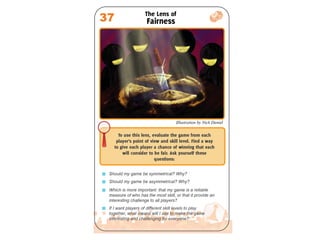
Balance Type #1
Fairness
Prof. Pier Luca Lanzi
Balance Type #1: Fairness
•  Fairness is the quality that players universally seek in games
•  Players want to feel that the forces working against them can be
defeated
•  Symmetrical games are the simplest way to ensure that your
game is fair, since all the players have all the same powers and
resources
•  All tabletop games and most sports are symmetrical
5
Prof. Pier Luca Lanzi
Asymmetrical Games
•  To simulate real-world situations
•  To give players another way to explore the game space
•  Personalization
•  To level the playing fields (noob vs expert)
•  To create interesting situations
§ Scotland Yard (players vs mr X)
§ Bhag-Chal (5 tigers vs 20 goats)
6
Prof. Pier Luca Lanzi
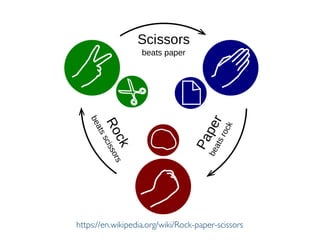
https://en.wikipedia.org/wiki/Rock-paper-scissors
Prof. Pier Luca Lanzi
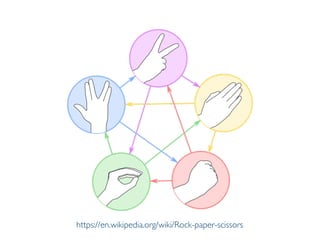
https://en.wikipedia.org/wiki/Rock-paper-scissors
Prof. Pier Luca Lanzi
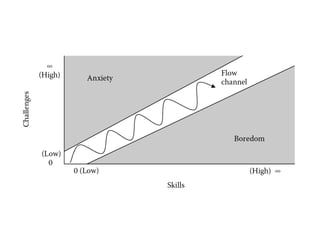
Balance Type #2
Challenge vs Success
Prof. Pier Luca Lanzi
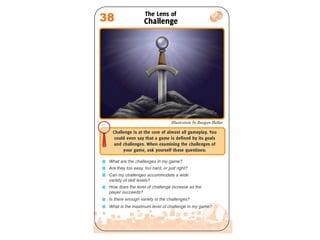
Balancing Challenge  Difficulty
•  Increase difficulty with each success
•  Let players get through easy parts fast
•  Create layers of challenge (with grades)
•  Let players choose the difficulty level
•  Playtest with a variety of players
•  Give the losers a break
12
Prof. Pier Luca Lanzi
https://www.youtube.com/watch?v=EitZRLt2G3w
Prof. Pier Luca Lanzi
Balance Type #3
Meaningful Choices
Prof. Pier Luca Lanzi
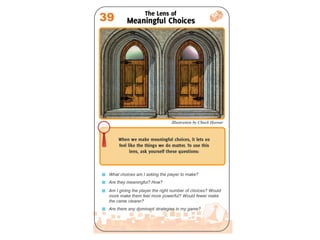
Good games give players
meaningful choices
Prof. Pier Luca Lanzi
dominant
strategy
Prof. Pier Luca Lanzi
Once a dominant strategy is discovered,
the game is no longer fun
the puzzle of the game has been solved
because there are no more choices to make
Prof. Pier Luca Lanzi
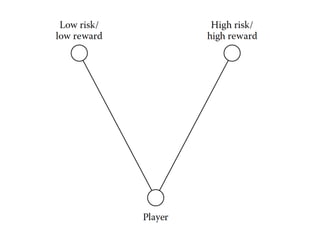
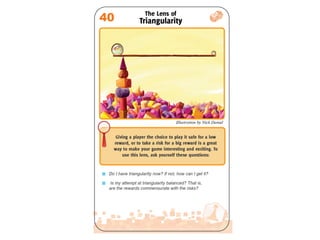
triangularity
Prof. Pier Luca Lanzi
Triangularity in Mario Kart
manual vs automatic? kart vs bike?
grab power-ups? use power-ups?
use speed boost pads?
left or right?
Prof. Pier Luca Lanzi
https://www.youtube.com/watch?v=45PdtGDGhac
Prof. Pier Luca Lanzi
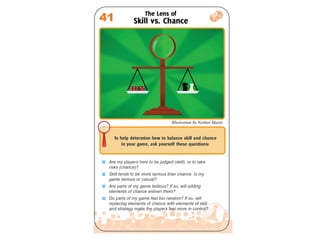
Balance Type #4
Skill vs Chance
Prof. Pier Luca Lanzi
dealing out cards = pure chance
choosing how to play them = skill
Prof. Pier Luca Lanzi
game design David Perry suggests
that at each moment players should
exercising a skill
taking risks
working a strategy
Prof. Pier Luca Lanzi
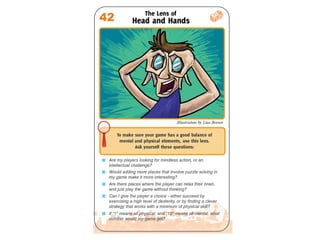
Balance Type #5
Head vs Hand
Prof. Pier Luca Lanzi
“baseball is 90% mental.
The other half is physical”
Yogi Berra
Prof. Pier Luca Lanzi
Balance Type #6
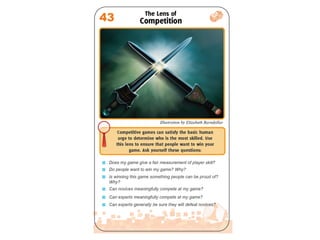
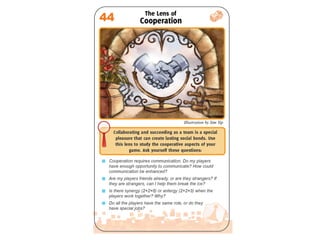
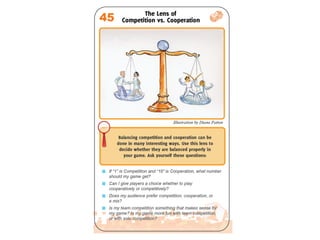
Competition vs Cooperation
Prof. Pier Luca Lanzi
Competition and cooperation
are human basic urges
Prof. Pier Luca Lanzi
Balance Type #7
Short vs Long
Prof. Pier Luca Lanzi
Length of the gameplay is one
important thing to balance
If the game is too short, players may not get
a chance to develop meaningful strategies
If the game goes on too long, players may
grow bored, or they may avoid the game
Prof. Pier Luca Lanzi
Balance Type #8
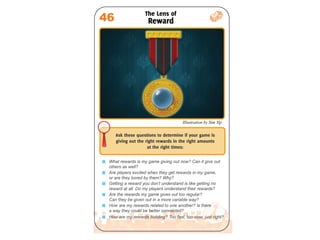
Reward
Prof. Pier Luca Lanzi
Common Types of Rewards
• Praise
• Points
• Prolonged play
• A gateway
• Resources
42
• Spectacle
• Expression
• Powers
• Status
• Completion
Prof. Pier Luca Lanzi
People tend to get acclimated to
rewards the more they receive them
Variable reward is more powerful
than fixed reward
Prof. Pier Luca Lanzi
Balance Type #9
Punishment
Prof. Pier Luca Lanzi
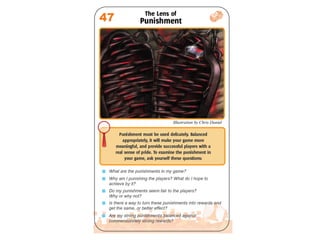
Why Should a Game Punish Players?
•  Punishment creates endogenous value
•  Taking risks is exciting
•  Possible punishment increases challenge
•  Shaming
•  Loss of potions
•  Shortened play
•  Terminated play
•  Setback
•  Removal of powers
•  Resource depletion
46
Prof. Pier Luca Lanzi
Gathering Food in Diablo
Version #1
collect food or suffer from
diminished powers due to hunger
Version #2
players are never hungry but get
a boost of ability if they eat
Prof. Pier Luca Lanzi
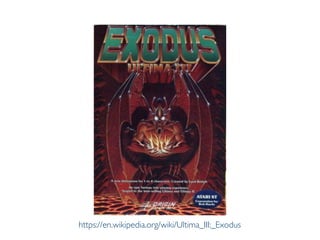
https://en.wikipedia.org/wiki/Ultima_III:_Exodus
Prof. Pier Luca Lanzi
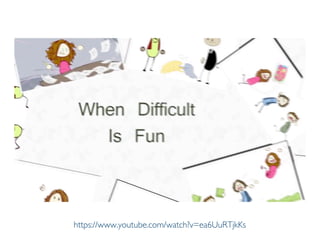
https://www.youtube.com/watch?v=ea6UuRTjkKs
Prof. Pier Luca Lanzi
Balance Type #10
Freedom vs Controlled Experience
Prof. Pier Luca Lanzi
Games are interactive, and the point of
interactivity is to give the player control,
or freedom, over the experience
How much control?
Giving the player control over everything
is more development and can also be
boring for the player
Prof. Pier Luca Lanzi
Balance Type #11
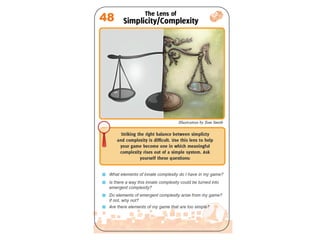
Simple vs Complex
Prof. Pier Luca Lanzi
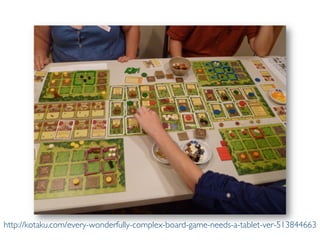
innate complexity
(e.g., agricola)
emergent complexity
(othello, go, chess, etc.)
Prof. Pier Luca Lanzi
http://kotaku.com/every-wonderfully-complex-board-game-needs-a-tablet-ver-513844663
Prof. Pier Luca Lanzi
Natural vs Artificial Balancing
space invaders go faster, the fewer they are
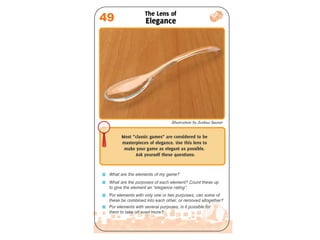
Elegance
dots in Pac-Man serve multiple purposes
they provide a short term goal, a long term goal,
triangularity, points/success, extra life
Prof. Pier Luca Lanzi
“if a line in a script doesn’t serve at
least two purposes, it should be cut”
Old Hollywood saying
Prof. Pier Luca Lanzi
Rule of thumb: a game element
should have at least three purposes
Prof. Pier Luca Lanzi
Balance Type #12
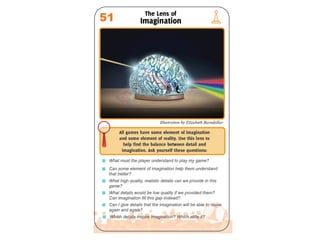
Detail vs Imagination
Prof. Pier Luca Lanzi
Only detail what you can do well
Give details the imagination can use
Familiar worlds do not need much detail
Use the “binocular” effect
Give details that inspire imagination
Prof. Pier Luca Lanzi
Game Balancing Methodologies
Prof. Pier Luca Lanzi
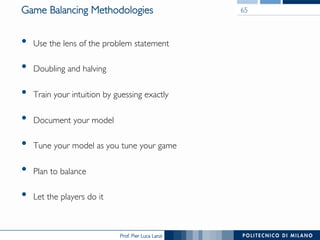
Game Balancing Methodologies
•  Use the lens of the problem statement
•  Doubling and halving
•  Train your intuition by guessing exactly
•  Document your model
•  Tune your model as you tune your game
•  Plan to balance
•  Let the players do it
65
Prof. Pier Luca Lanzi
Dynamic Game Balancing
Prof. Pier Luca Lanzi
It spoils the reality of the world
It is exploitable
Players improve with practice
Prof. Pier Luca Lanzi
Design in Detail: Changing the Time between Shots for the Sniper
Rifle from 0.5 to 0.7 Seconds for Halo 3 by Jaime Griesemer.
http://www.gdcvault.com/play/1012649/Design-in-Detail-Changing-the
Prof. Pier Luca Lanzi
https://www.youtube.com/watch?v=e31OSVZF77w
Prof. Pier Luca Lanzi
http://www.facebook.com/polimigamecollective
https://twitter.com/@POLIMIGC
http://www.youtube.com/PierLucaLanzi
http://www.polimigamecollective.org

Game Balancing

  • 1.
    Prof. Pier LucaLanzi Game Balancing Videogame Design and Programming
  • 2.
    Prof. Pier LucaLanzi Readings •  Jesse Schell. The Art of Game Design (2nd Edition) Morgan Kaufmann 2015 2
  • 3.
    Prof. Pier LucaLanzi Game Balancing adjusting the elements of the game until they deliver the experience you want
  • 4.
    Prof. Pier LucaLanzi Balance Type #1 Fairness
  • 5.
    Prof. Pier LucaLanzi Balance Type #1: Fairness •  Fairness is the quality that players universally seek in games •  Players want to feel that the forces working against them can be defeated •  Symmetrical games are the simplest way to ensure that your game is fair, since all the players have all the same powers and resources •  All tabletop games and most sports are symmetrical 5
  • 6.
    Prof. Pier LucaLanzi Asymmetrical Games •  To simulate real-world situations •  To give players another way to explore the game space •  Personalization •  To level the playing fields (noob vs expert) •  To create interesting situations § Scotland Yard (players vs mr X) § Bhag-Chal (5 tigers vs 20 goats) 6
  • 7.
    Prof. Pier LucaLanzi https://en.wikipedia.org/wiki/Rock-paper-scissors
  • 8.
    Prof. Pier LucaLanzi https://en.wikipedia.org/wiki/Rock-paper-scissors
  • 9.
  • 10.
    Prof. Pier LucaLanzi Balance Type #2 Challenge vs Success
  • 11.
  • 12.
    Prof. Pier LucaLanzi Balancing Challenge Difficulty •  Increase difficulty with each success •  Let players get through easy parts fast •  Create layers of challenge (with grades) •  Let players choose the difficulty level •  Playtest with a variety of players •  Give the losers a break 12
  • 13.
  • 14.
    Prof. Pier LucaLanzi https://www.youtube.com/watch?v=EitZRLt2G3w
  • 15.
    Prof. Pier LucaLanzi Balance Type #3 Meaningful Choices
  • 16.
    Prof. Pier LucaLanzi Good games give players meaningful choices
  • 17.
  • 18.
  • 19.
    Prof. Pier LucaLanzi dominant strategy
  • 20.
    Prof. Pier LucaLanzi Once a dominant strategy is discovered, the game is no longer fun the puzzle of the game has been solved because there are no more choices to make
  • 21.
  • 22.
    Prof. Pier LucaLanzi triangularity
  • 23.
  • 24.
  • 25.
    Prof. Pier LucaLanzi Triangularity in Mario Kart manual vs automatic? kart vs bike? grab power-ups? use power-ups? use speed boost pads? left or right?
  • 26.
    Prof. Pier LucaLanzi https://www.youtube.com/watch?v=45PdtGDGhac
  • 27.
    Prof. Pier LucaLanzi Balance Type #4 Skill vs Chance
  • 28.
    Prof. Pier LucaLanzi dealing out cards = pure chance choosing how to play them = skill
  • 29.
    Prof. Pier LucaLanzi game design David Perry suggests that at each moment players should exercising a skill taking risks working a strategy
  • 30.
  • 31.
    Prof. Pier LucaLanzi Balance Type #5 Head vs Hand
  • 32.
    Prof. Pier LucaLanzi “baseball is 90% mental. The other half is physical” Yogi Berra
  • 33.
  • 34.
    Prof. Pier LucaLanzi Balance Type #6 Competition vs Cooperation
  • 35.
    Prof. Pier LucaLanzi Competition and cooperation are human basic urges
  • 36.
  • 37.
  • 38.
  • 39.
    Prof. Pier LucaLanzi Balance Type #7 Short vs Long
  • 40.
    Prof. Pier LucaLanzi Length of the gameplay is one important thing to balance If the game is too short, players may not get a chance to develop meaningful strategies If the game goes on too long, players may grow bored, or they may avoid the game
  • 41.
    Prof. Pier LucaLanzi Balance Type #8 Reward
  • 42.
    Prof. Pier LucaLanzi Common Types of Rewards • Praise • Points • Prolonged play • A gateway • Resources 42 • Spectacle • Expression • Powers • Status • Completion
  • 43.
    Prof. Pier LucaLanzi People tend to get acclimated to rewards the more they receive them Variable reward is more powerful than fixed reward
  • 44.
  • 45.
    Prof. Pier LucaLanzi Balance Type #9 Punishment
  • 46.
    Prof. Pier LucaLanzi Why Should a Game Punish Players? •  Punishment creates endogenous value •  Taking risks is exciting •  Possible punishment increases challenge •  Shaming •  Loss of potions •  Shortened play •  Terminated play •  Setback •  Removal of powers •  Resource depletion 46
  • 47.
    Prof. Pier LucaLanzi Gathering Food in Diablo Version #1 collect food or suffer from diminished powers due to hunger Version #2 players are never hungry but get a boost of ability if they eat
  • 48.
    Prof. Pier LucaLanzi https://en.wikipedia.org/wiki/Ultima_III:_Exodus
  • 49.
  • 50.
    Prof. Pier LucaLanzi https://www.youtube.com/watch?v=ea6UuRTjkKs
  • 51.
    Prof. Pier LucaLanzi Balance Type #10 Freedom vs Controlled Experience
  • 52.
    Prof. Pier LucaLanzi Games are interactive, and the point of interactivity is to give the player control, or freedom, over the experience How much control? Giving the player control over everything is more development and can also be boring for the player
  • 53.
    Prof. Pier LucaLanzi Balance Type #11 Simple vs Complex
  • 54.
    Prof. Pier LucaLanzi innate complexity (e.g., agricola) emergent complexity (othello, go, chess, etc.)
  • 55.
    Prof. Pier LucaLanzi http://kotaku.com/every-wonderfully-complex-board-game-needs-a-tablet-ver-513844663
  • 56.
  • 57.
    Prof. Pier LucaLanzi Natural vs Artificial Balancing space invaders go faster, the fewer they are Elegance dots in Pac-Man serve multiple purposes they provide a short term goal, a long term goal, triangularity, points/success, extra life
  • 58.
    Prof. Pier LucaLanzi “if a line in a script doesn’t serve at least two purposes, it should be cut” Old Hollywood saying
  • 59.
    Prof. Pier LucaLanzi Rule of thumb: a game element should have at least three purposes
  • 60.
  • 61.
    Prof. Pier LucaLanzi Balance Type #12 Detail vs Imagination
  • 62.
    Prof. Pier LucaLanzi Only detail what you can do well Give details the imagination can use Familiar worlds do not need much detail Use the “binocular” effect Give details that inspire imagination
  • 63.
  • 64.
    Prof. Pier LucaLanzi Game Balancing Methodologies
  • 65.
    Prof. Pier LucaLanzi Game Balancing Methodologies •  Use the lens of the problem statement •  Doubling and halving •  Train your intuition by guessing exactly •  Document your model •  Tune your model as you tune your game •  Plan to balance •  Let the players do it 65
  • 66.
    Prof. Pier LucaLanzi Dynamic Game Balancing
  • 67.
    Prof. Pier LucaLanzi It spoils the reality of the world It is exploitable Players improve with practice
  • 68.
    Prof. Pier LucaLanzi Design in Detail: Changing the Time between Shots for the Sniper Rifle from 0.5 to 0.7 Seconds for Halo 3 by Jaime Griesemer. http://www.gdcvault.com/play/1012649/Design-in-Detail-Changing-the
  • 69.
    Prof. Pier LucaLanzi https://www.youtube.com/watch?v=e31OSVZF77w
  • 70.
    Prof. Pier LucaLanzi http://www.facebook.com/polimigamecollective https://twitter.com/@POLIMIGC http://www.youtube.com/PierLucaLanzi http://www.polimigamecollective.org