PROKARYOTIC TRANSCRIPTION: PROMOTERS;
STRUCTURE AND FUNCTION
Presented by: Muneeb ul islam
Enrollment No.:2016Cukmr24
Semester:7th
Teacher incharge: Dr M Owais Bhat
Department: Biotechnology
CONTENTS:
.INTRODUCTION TO TRANSCRIPTION
.PROKARYOTIC TRANSCRIPTIONAL PROMOTER
.PROMOTER STRUCTURE AND FUNCTION
.PROKARYOTIC TRANSCRIPTION
TRANSCRIPTION
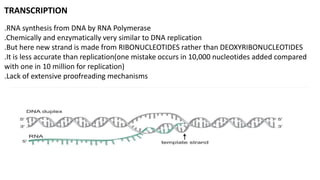
.RNA synthesis from DNA by RNA Polymerase
.Chemically and enzymatically very similar to DNA replication
.But here new strand is made from RIBONUCLEOTIDES rather than DEOXYRIBONUCLEOTIDES
.It is less accurate than replication(one mistake occurs in 10,000 nucleotides added compared
with one in 10 million for replication)
.Lack of extensive proofreading mechanisms
PROKARYOTIC TRANSCRIPTIONAL PROMOTER
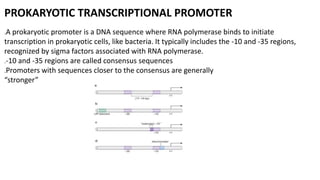
.A prokaryotic promoter is a DNA sequence where RNA polymerase binds to initiate
transcription in prokaryotic cells, like bacteria. It typically includes the -10 and -35 regions,
recognized by sigma factors associated with RNA polymerase.
.-10 and -35 regions are called consensus sequences
.Promoters with sequences closer to the consensus are generally
“stronger”
PROMOTER STRUCTURE AND FUNCTION
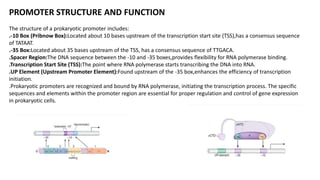
The structure of a prokaryotic promoter includes:
.-10 Box (Pribnow Box):Located about 10 bases upstream of the transcription start site (TSS),has a consensus sequence
of TATAAT.
.-35 Box:Located about 35 bases upstream of the TSS, has a consensus sequence of TTGACA.
.Spacer Region:The DNA sequence between the -10 and -35 boxes,provides flexibility for RNA polymerase binding.
.Transcription Start Site (TSS):The point where RNA polymerase starts transcribing the DNA into RNA.
.UP Element (Upstream Promoter Element):Found upstream of the -35 box,enhances the efficiency of transcription
initiation.
.Prokaryotic promoters are recognized and bound by RNA polymerase, initiating the transcription process. The specific
sequences and elements within the promoter region are essential for proper regulation and control of gene expression
in prokaryotic cells.
FUNCTIONS
Prokaryotic promoter serves a crucial role in gene expression by facilitating the initiation of
transcription. Its functions include:
.Recognition by RNA Polymerase:The promoter provides a recognition site for RNA polymerase, the
enzyme responsible for transcribing DNA into RNA.
.Initiation of Transcription:RNA polymerase binds to the promoter region, specifically recognizing the -
10 and -35 boxes, and initiates the synthesis of RNA from the DNA template.
.Determination of TSS:The promoter sequence helps in determining the exact point where transcription
begins, known as the transcription start site (TSS).
.Regulation of Gene Expression:Elements within the promoter, such as the UP element, play a role in
regulating the efficiency of transcription initiation. Upstream factors can influence the promoter's
activity.
.Specificity for Each Gene:Each gene has its own promoter with a unique sequence, ensuring the
specificity of transcription for individual genes.
PROKARYOTIC TRANSCRIPTION
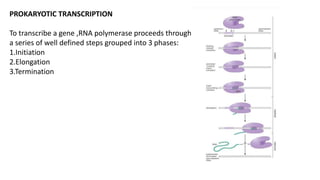
To transcribe a gene ,RNA polymerase proceeds through
a series of well defined steps grouped into 3 phases:
1.Initiation
2.Elongation
3.Termination
INITIATION
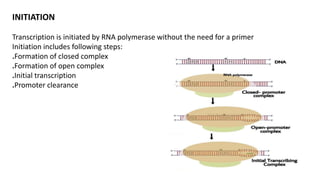
Transcription is initiated by RNA polymerase without the need for a primer
Initiation includes following steps:
.Formation of closed complex
.Formation of open complex
.Initial transcription
.Promoter clearance
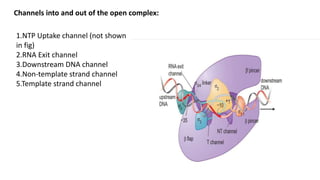
Channels into and out of the open complex:
1.NTP Uptake channel (not shown
in fig)
2.RNA Exit channel
3.Downstream DNA channel
4.Non-template strand channel
5.Template strand channel
ELONGATION
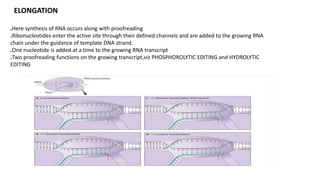
.Here synthesis of RNA occurs along with proofreading
.Ribonucleotides enter the active site through their defined channels and are added to the growing RNA
chain under the guidance of template DNA strand.
.One nucleotide is added at a time to the growing RNA transcript
.Two proofreading functions on the growing transcript,viz PHOSPHOROLYTIC EDITING and HYDROLYTIC
EDITING
TERMINATION
.Sequences called TERMINATORS trigger the elongating polymerase to dissociate from the DNA
and release the RNA chain
.In prokaryotes terminators come in 2 types:
a)Rho-dependent
b)Rho-independent
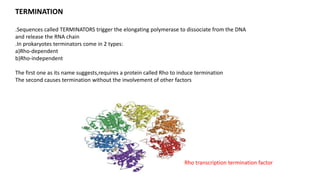
The first one as its name suggests,requires a protein called Rho to induce termination
The second causes termination without the involvement of other factors
Rho transcription termination factor
Rho-dependent termination
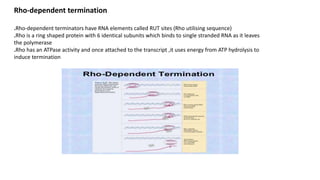
.Rho-dependent terminators have RNA elements called RUT sites (Rho utilising sequence)
.Rho is a ring shaped protein with 6 identical subunits which binds to single stranded RNA as it leaves
the polymerase
.Rho has an ATPase activity and once attached to the transcript ,it uses energy from ATP hydrolysis to
induce termination
Rho-Independent termination
.Also known as Intrinsic termination because there is no use of any factor
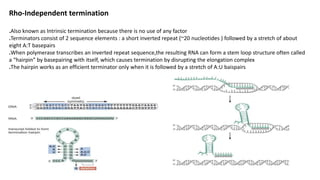
.Terminators consist of 2 sequence elements : a short inverted repeat (~20 nucleotides ) followed by a stretch of about
eight A:T basepairs
.When polymerase transcribes an inverted repeat sequence,the resulting RNA can form a stem loop structure often called
a “hairpin” by basepairing with itself, which causes termination by disrupting the elongation complex
.The hairpin works as an efficient terminator only when it is followed by a stretch of A:U baispairs
REFERENCE
.James D. Watson, Tania A. Baker, Stephen P. Bell, Alexander Gann, Michael Levine, Richard Losick-
Molecular Biology of the Gene (2013, Benjamin Cummings)

Prokaryotic transcription: Promoters, Structure and Function

  • 1.
    PROKARYOTIC TRANSCRIPTION: PROMOTERS; STRUCTUREAND FUNCTION Presented by: Muneeb ul islam Enrollment No.:2016Cukmr24 Semester:7th Teacher incharge: Dr M Owais Bhat Department: Biotechnology
  • 2.
    CONTENTS: .INTRODUCTION TO TRANSCRIPTION .PROKARYOTICTRANSCRIPTIONAL PROMOTER .PROMOTER STRUCTURE AND FUNCTION .PROKARYOTIC TRANSCRIPTION
  • 3.
    TRANSCRIPTION .RNA synthesis fromDNA by RNA Polymerase .Chemically and enzymatically very similar to DNA replication .But here new strand is made from RIBONUCLEOTIDES rather than DEOXYRIBONUCLEOTIDES .It is less accurate than replication(one mistake occurs in 10,000 nucleotides added compared with one in 10 million for replication) .Lack of extensive proofreading mechanisms
  • 4.
    PROKARYOTIC TRANSCRIPTIONAL PROMOTER .Aprokaryotic promoter is a DNA sequence where RNA polymerase binds to initiate transcription in prokaryotic cells, like bacteria. It typically includes the -10 and -35 regions, recognized by sigma factors associated with RNA polymerase. .-10 and -35 regions are called consensus sequences .Promoters with sequences closer to the consensus are generally “stronger”
  • 5.
    PROMOTER STRUCTURE ANDFUNCTION The structure of a prokaryotic promoter includes: .-10 Box (Pribnow Box):Located about 10 bases upstream of the transcription start site (TSS),has a consensus sequence of TATAAT. .-35 Box:Located about 35 bases upstream of the TSS, has a consensus sequence of TTGACA. .Spacer Region:The DNA sequence between the -10 and -35 boxes,provides flexibility for RNA polymerase binding. .Transcription Start Site (TSS):The point where RNA polymerase starts transcribing the DNA into RNA. .UP Element (Upstream Promoter Element):Found upstream of the -35 box,enhances the efficiency of transcription initiation. .Prokaryotic promoters are recognized and bound by RNA polymerase, initiating the transcription process. The specific sequences and elements within the promoter region are essential for proper regulation and control of gene expression in prokaryotic cells.
  • 6.
    FUNCTIONS Prokaryotic promoter servesa crucial role in gene expression by facilitating the initiation of transcription. Its functions include: .Recognition by RNA Polymerase:The promoter provides a recognition site for RNA polymerase, the enzyme responsible for transcribing DNA into RNA. .Initiation of Transcription:RNA polymerase binds to the promoter region, specifically recognizing the - 10 and -35 boxes, and initiates the synthesis of RNA from the DNA template. .Determination of TSS:The promoter sequence helps in determining the exact point where transcription begins, known as the transcription start site (TSS). .Regulation of Gene Expression:Elements within the promoter, such as the UP element, play a role in regulating the efficiency of transcription initiation. Upstream factors can influence the promoter's activity. .Specificity for Each Gene:Each gene has its own promoter with a unique sequence, ensuring the specificity of transcription for individual genes.
  • 7.
    PROKARYOTIC TRANSCRIPTION To transcribea gene ,RNA polymerase proceeds through a series of well defined steps grouped into 3 phases: 1.Initiation 2.Elongation 3.Termination
  • 8.
    INITIATION Transcription is initiatedby RNA polymerase without the need for a primer Initiation includes following steps: .Formation of closed complex .Formation of open complex .Initial transcription .Promoter clearance
  • 9.
    Channels into andout of the open complex: 1.NTP Uptake channel (not shown in fig) 2.RNA Exit channel 3.Downstream DNA channel 4.Non-template strand channel 5.Template strand channel
  • 10.
    ELONGATION .Here synthesis ofRNA occurs along with proofreading .Ribonucleotides enter the active site through their defined channels and are added to the growing RNA chain under the guidance of template DNA strand. .One nucleotide is added at a time to the growing RNA transcript .Two proofreading functions on the growing transcript,viz PHOSPHOROLYTIC EDITING and HYDROLYTIC EDITING
  • 11.
    TERMINATION .Sequences called TERMINATORStrigger the elongating polymerase to dissociate from the DNA and release the RNA chain .In prokaryotes terminators come in 2 types: a)Rho-dependent b)Rho-independent The first one as its name suggests,requires a protein called Rho to induce termination The second causes termination without the involvement of other factors Rho transcription termination factor
  • 12.
    Rho-dependent termination .Rho-dependent terminatorshave RNA elements called RUT sites (Rho utilising sequence) .Rho is a ring shaped protein with 6 identical subunits which binds to single stranded RNA as it leaves the polymerase .Rho has an ATPase activity and once attached to the transcript ,it uses energy from ATP hydrolysis to induce termination
  • 13.
    Rho-Independent termination .Also knownas Intrinsic termination because there is no use of any factor .Terminators consist of 2 sequence elements : a short inverted repeat (~20 nucleotides ) followed by a stretch of about eight A:T basepairs .When polymerase transcribes an inverted repeat sequence,the resulting RNA can form a stem loop structure often called a “hairpin” by basepairing with itself, which causes termination by disrupting the elongation complex .The hairpin works as an efficient terminator only when it is followed by a stretch of A:U baispairs
  • 14.
    REFERENCE .James D. Watson,Tania A. Baker, Stephen P. Bell, Alexander Gann, Michael Levine, Richard Losick- Molecular Biology of the Gene (2013, Benjamin Cummings)