Microbial Genetics The Operon:  Regulation of bacterial gene expression
Controlling enzymes We know that  … Bacterial cells carry out a huge number of chemical reactions catalyzed by enzymes And ….. Bacterial cells respond rapidly to changing environments e.g., presence of a new carbon source So …. control of Enzymes is VERY important and must be efficient
Enzyme activity can be regulated by feedback inhibition of synthesized enzyme BUT  making enzyme requires energy a a bacterium cannot make ALL enzymes ALLTHE TIME * SO  it is better to stop synthesizing enzymes that are not needed THUS,  many genes such as those for enzymes involved in lactose metabolism or amino acid production are regulated and only expressed when required Enzyme Regulation *  However, 60-80% of genes are not regulated and are termed  Constitutive
Regulation of gene expression Constitutive Enzymes –  No regulation Enzyme Induced Enzyme Repressed
Regulation of gene expression The process of transcription plays an important role in the ability of bacteria to respond to changing environments: mRNA compared to DNA is inherently unstable. Thus, the expression levels of certain proteins can be controlled at the level of transcription (mRNA synthesis).
Transcriptional control Two genetic control mechanisms which regulate transcription of mRNA and, therefore the synthesis of corresponding protein Induction -turning on gene expression Repression -turning off gene expression
Repression Inhibition of gene expression Often in response to an excess of endproduct, shuts down synthesis of the enzyme Mediated by regulatory proteins called  repressors Block RNA polymerase from initiating transcription Repressible genes are transcribed until they are repressed
Induction Turns on transcription of a gene A substance which acts to induce transcription of a gene is an  inducer ,   often the substrate Enzymes synthesized in the presence of inducers are called  inducible enzymes Example: lactose utilization genes Inducible genes are not transcribed until they are induced
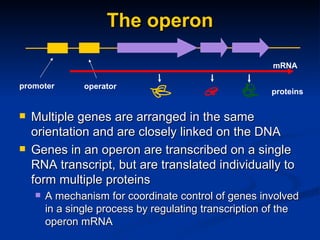
The operon Multiple genes are arranged in the same orientation and are closely linked on the DNA Genes in an operon are transcribed on a single RNA transcript, but are translated individually to form multiple proteins  A mechanism for coordinate control of genes involved in a single process by regulating transcription of the operon mRNA promoter operator mRNA proteins
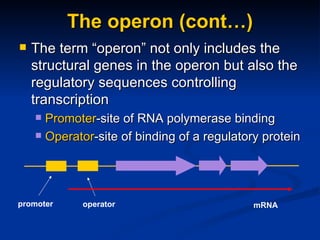
The operon (cont…) The term “operon” not only includes the structural genes in the operon but also the regulatory sequences controlling transcription Promoter -site of RNA polymerase binding Operator -site of binding of a regulatory protein promoter operator mRNA
Operons and regulation About 27% of  E. coli  genes are in operons Many of the genes arranged in operons are regulated  For example, genes for the lactose utilization are controlled by the  presence of lactose   genes for pathogenesis are often controlled by  temperature or physiologic factor
Two regulated operons Two  E. coli  operons reflect how operons in general are regulated The  lac  operon Encodes inducible catalytic enzymes involved in the lactose utilization and uptake The  arg  operon Encodes repressible anabolic enzymes involved in the production of the amino acid arginine
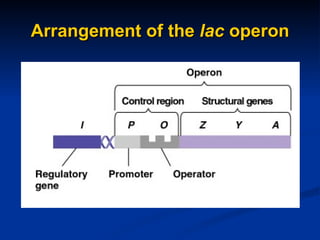
The  lac  operon Three structural genes lacZ :  β -galactosidase: splits lactose to glucose and galactose lacY : a permease involved in transport of lactose lacA : a transacetylase, function unknown A regulatory gene  lacI   The LacI protein is a  repressor  of the  lac  operon  A promoter where RNA polymerase binds to transcribe the operon An operator site where the LacI repressor binds to block transcription
Arrangement of the  lac  operon
In the absence of lactose In the absence of lactose, the repressor binds to operator site preventing binding of RNA polymerase and transcription
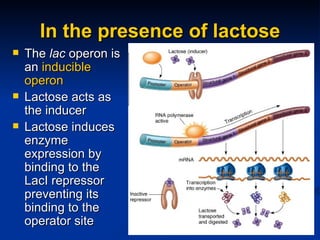
In the presence of lactose The  lac  operon is an  inducible operon  Lactose acts as the inducer Lactose induces enzyme expression by binding to the LacI repressor preventing its binding to the operator site
The  arg  operon   A repressible operon: genes are transcribed until turned off or repressed Three structural genes  argCBH  encoding enzymes in the arginine biosynthetic pathway
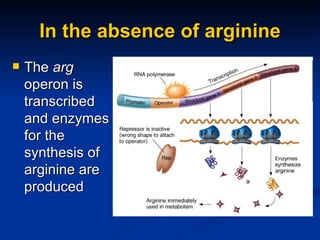
In the absence of arginine The  arg  operon is transcribed and enzymes for the synthesis of arginine are produced
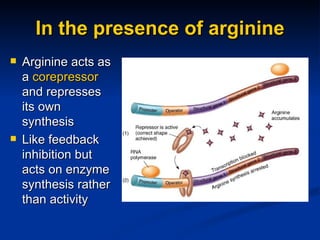
In the presence of arginine Arginine acts as a  corepressor   and represses its own synthesis Like feedback inhibition but acts on enzyme synthesis rather than activity
Summary of gene regulation The production of many bacterial proteins are controlled by regulating transcription endproduct  Functionally related genes are arranged in operons to allow coordinate regulation Operons can be  Induced in the presence of substrate Repressed in the presence of endproduct Transcripition mechanisms can be more complex with DNA sequences known as activators and attenuators.

Genetics c

  • 1.
    Microbial Genetics TheOperon: Regulation of bacterial gene expression
  • 2.
    Controlling enzymes Weknow that … Bacterial cells carry out a huge number of chemical reactions catalyzed by enzymes And ….. Bacterial cells respond rapidly to changing environments e.g., presence of a new carbon source So …. control of Enzymes is VERY important and must be efficient
  • 3.
    Enzyme activity canbe regulated by feedback inhibition of synthesized enzyme BUT making enzyme requires energy a a bacterium cannot make ALL enzymes ALLTHE TIME * SO it is better to stop synthesizing enzymes that are not needed THUS, many genes such as those for enzymes involved in lactose metabolism or amino acid production are regulated and only expressed when required Enzyme Regulation * However, 60-80% of genes are not regulated and are termed Constitutive
  • 4.
    Regulation of geneexpression Constitutive Enzymes – No regulation Enzyme Induced Enzyme Repressed
  • 5.
    Regulation of geneexpression The process of transcription plays an important role in the ability of bacteria to respond to changing environments: mRNA compared to DNA is inherently unstable. Thus, the expression levels of certain proteins can be controlled at the level of transcription (mRNA synthesis).
  • 6.
    Transcriptional control Twogenetic control mechanisms which regulate transcription of mRNA and, therefore the synthesis of corresponding protein Induction -turning on gene expression Repression -turning off gene expression
  • 7.
    Repression Inhibition ofgene expression Often in response to an excess of endproduct, shuts down synthesis of the enzyme Mediated by regulatory proteins called repressors Block RNA polymerase from initiating transcription Repressible genes are transcribed until they are repressed
  • 8.
    Induction Turns ontranscription of a gene A substance which acts to induce transcription of a gene is an inducer , often the substrate Enzymes synthesized in the presence of inducers are called inducible enzymes Example: lactose utilization genes Inducible genes are not transcribed until they are induced
  • 9.
    The operon Multiplegenes are arranged in the same orientation and are closely linked on the DNA Genes in an operon are transcribed on a single RNA transcript, but are translated individually to form multiple proteins A mechanism for coordinate control of genes involved in a single process by regulating transcription of the operon mRNA promoter operator mRNA proteins
  • 10.
    The operon (cont…)The term “operon” not only includes the structural genes in the operon but also the regulatory sequences controlling transcription Promoter -site of RNA polymerase binding Operator -site of binding of a regulatory protein promoter operator mRNA
  • 11.
    Operons and regulationAbout 27% of E. coli genes are in operons Many of the genes arranged in operons are regulated For example, genes for the lactose utilization are controlled by the presence of lactose genes for pathogenesis are often controlled by temperature or physiologic factor
  • 12.
    Two regulated operonsTwo E. coli operons reflect how operons in general are regulated The lac operon Encodes inducible catalytic enzymes involved in the lactose utilization and uptake The arg operon Encodes repressible anabolic enzymes involved in the production of the amino acid arginine
  • 13.
    The lac operon Three structural genes lacZ : β -galactosidase: splits lactose to glucose and galactose lacY : a permease involved in transport of lactose lacA : a transacetylase, function unknown A regulatory gene lacI The LacI protein is a repressor of the lac operon A promoter where RNA polymerase binds to transcribe the operon An operator site where the LacI repressor binds to block transcription
  • 14.
    Arrangement of the lac operon
  • 15.
    In the absenceof lactose In the absence of lactose, the repressor binds to operator site preventing binding of RNA polymerase and transcription
  • 16.
    In the presenceof lactose The lac operon is an inducible operon Lactose acts as the inducer Lactose induces enzyme expression by binding to the LacI repressor preventing its binding to the operator site
  • 17.
    The arg operon A repressible operon: genes are transcribed until turned off or repressed Three structural genes argCBH encoding enzymes in the arginine biosynthetic pathway
  • 18.
    In the absenceof arginine The arg operon is transcribed and enzymes for the synthesis of arginine are produced
  • 19.
    In the presenceof arginine Arginine acts as a corepressor and represses its own synthesis Like feedback inhibition but acts on enzyme synthesis rather than activity
  • 20.
    Summary of generegulation The production of many bacterial proteins are controlled by regulating transcription endproduct Functionally related genes are arranged in operons to allow coordinate regulation Operons can be Induced in the presence of substrate Repressed in the presence of endproduct Transcripition mechanisms can be more complex with DNA sequences known as activators and attenuators.