Experiments
Using Experiments to study Crime and
Deviance
 PRACTICAL ISSUES
 ETHICAL ISSUES
 REPRESENTATIVENESS
 VALIDITY
 EXAMPLE
 RELIABILITY
 THEORETICAL ISSUES (positivist, interpretivist)
 EVALUATE
 DATA (quantitative, qualitative)
 CAM: COMPARE ANOTHER METHOD
Lab Experiments
Lab experiments are a controlled experiment in an artificial
environment. This means the researcher can control different
variables. They do this by taking a set of subjects and dividing
them into two random groups…
 The Control Group
 The Experimental Group
This allows the researchers to develop cause-and-effect
relationships.
Lab Experiments
Practical Issues
 Hawthorne Effect (the subject will act accordingly because they know
they are being researched)
 Individuals are complex and not exactly alike
 Can only use small samples
 Can’t study the past, and they only provide ‘snapshots’ of the present
 Expectancy effect (risk of bias on behalf of the researcher)
 Keat and Urry note lab experiments aren’t useful because society
has countless factors which can’t be identified, let alone controlled.
This is because lab experiments operate in an open system.
Ethical Issues
There is the need for informed consent from the subject because
there is a chance of being deceived. Also, the experimental group
may benefit more than the control group so treatment must be
equal.
Theoretical Issues
Positivists see lab experiments as highly reliable because there
are precise steps to be taken, it is a detached method and it yields
quantitative data. This method is also effective in testing a
hypothesis as you can isolate and control variables. However,
there is doubt as to whether it is representative. The small
samples and the high level of control the researcher has means
there isn’t external validity. Also, there isn’t internal validity due to
the artificial environment encouraging the Hawthorne Effect. On
the same hand, interpretivists note how our behaviour isn’t caused
by external forces so can’t explain in terms of cause-and-effect.
Lab Experiment: Example
Banduro et al conducted an experiment using a Bobo doll. They
found children imitated the aggressive behaviour towards the doll
once they had witnessed adults acting violent towards it.
https://www.youtube.com/watch?v=dmBqwWlJg8U
There was a risk of psychological harm to the children during this
research and also the experiment isn’t very valid. For example,
the Bobo doll is designed to invite violence so this bears little
relation to everyday reality.
Lab Experiments: Example
Zimbardo investigated the effect of prison on the behaviour of the
prisoners and the guards by creating a simulated prison and
randomly allocating 21 volunteers as either a prisoner or a guard.
He found the guards eventually became aggressive so as a result,
the prisoners became submissive.
https://www.youtube.com/watch?v=GePFFf5gRKo
Field Experiment
Field experiments take place in a natural environment but those
involved don’t know they are subjects. It involves isolating and
manipulating one or more variables to see the effect (you may
remember Rosenthal and Jacobson ‘spurters’ study from AS!)
Ethical Issues
 The subject aren’t usually aware they are a subject or given a
choice
 Chances of rehabilitation vary
 Juveniles are more vulnerable and likely to change, so using
there imprisonment experimentally isn’t an option
Field Experiments
The Tougher Regimes Project: In the 1980s, Thatcher introduced
a ‘short, sharp, shock’ regime to deal with juvenile offenders. 2
institutions were selected to undergo this regime of education,
exercise and inspections whilst 4 other institutions were used as a
control group. It was clear this approach has no effect on the
youths re-conviction rates. This would have been a timely and
expensive experiment had the government not funded it.
However, Tilly notes how this wasn’t a reliable experiment. The
Safercities strategy aimed to replicate a project conducted in
Kirkholt which successfully decreased the burglary rate in 3 other
areas. However, the replication produced marked differences,
proving you can’t replicate a real life experiment in a other
locations. Also, it isn’t very valid.
Field Experiment: Example
Poyner and Webb discovered there was a high rate of theft of
purses from women’s shopping bags in the Bull Ring in
Birmingham. Most of the thefts occurred in the 2 markets where
the stalls were most densely packed. When one of the stalls was
redesigned (stalls set further apart, lighting improved), thefts fell
by nearly 70%.
But, it must be remembered that it is not possible to control all of
the variables and it may have been something else that caused
the reduction. For example, there was also a decline in the
amount of trade at the same time. This decreases the validity of
the experiment.
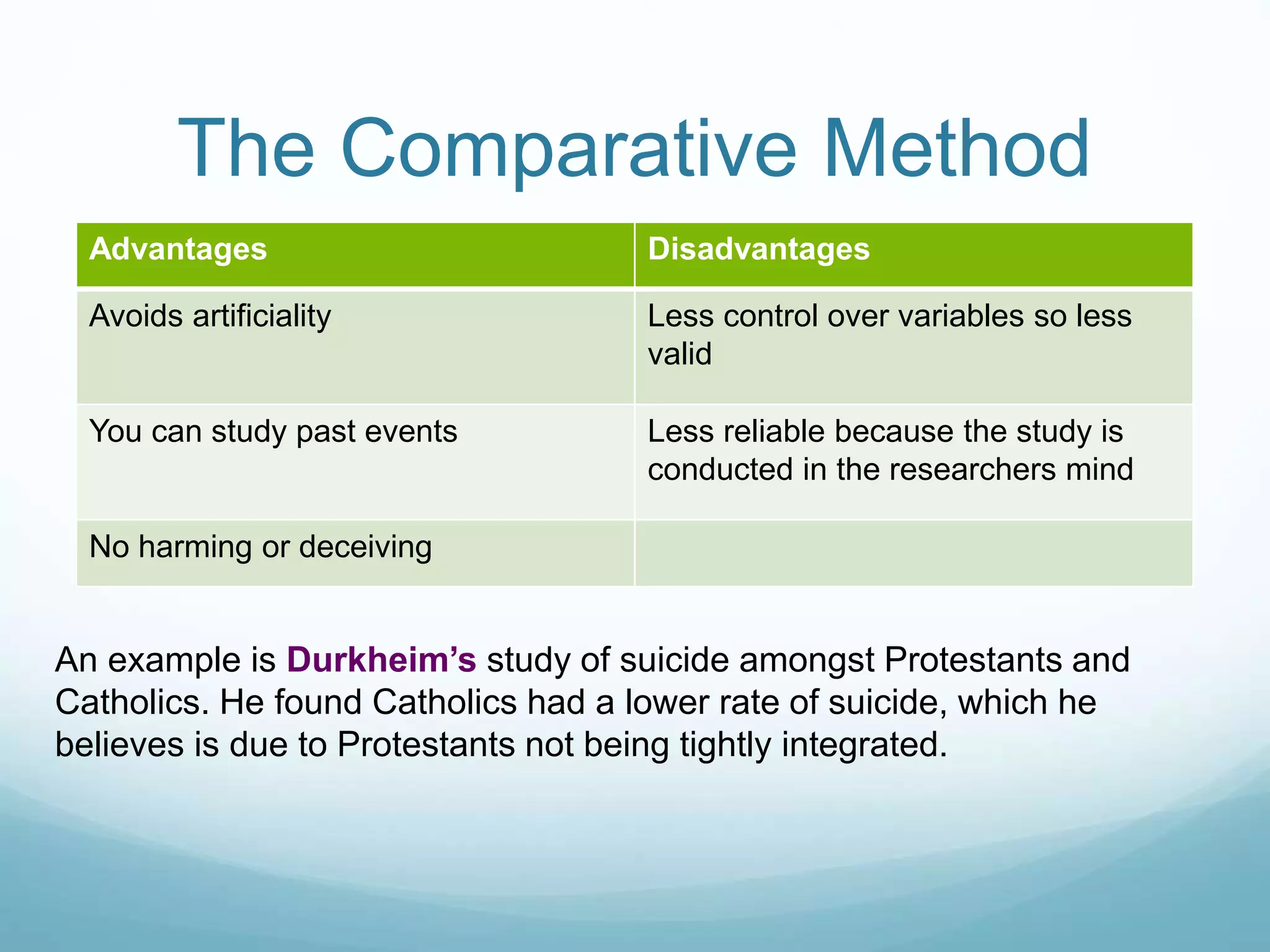
The Comparative Method
Advantages Disadvantages
Avoids artificiality Less control over variables so less
valid
You can study past events Less reliable because the study is
conducted in the researchers mind
No harming or deceiving
An example is Durkheim’s study of suicide amongst Protestants and
Catholics. He found Catholics had a lower rate of suicide, which he
believes is due to Protestants not being tightly integrated.

Lab & Field Experiments

  • 1.
    Experiments Using Experiments tostudy Crime and Deviance
  • 2.
     PRACTICAL ISSUES ETHICAL ISSUES  REPRESENTATIVENESS  VALIDITY  EXAMPLE  RELIABILITY  THEORETICAL ISSUES (positivist, interpretivist)  EVALUATE  DATA (quantitative, qualitative)  CAM: COMPARE ANOTHER METHOD
  • 3.
    Lab Experiments Lab experimentsare a controlled experiment in an artificial environment. This means the researcher can control different variables. They do this by taking a set of subjects and dividing them into two random groups…  The Control Group  The Experimental Group This allows the researchers to develop cause-and-effect relationships.
  • 4.
    Lab Experiments Practical Issues Hawthorne Effect (the subject will act accordingly because they know they are being researched)  Individuals are complex and not exactly alike  Can only use small samples  Can’t study the past, and they only provide ‘snapshots’ of the present  Expectancy effect (risk of bias on behalf of the researcher)  Keat and Urry note lab experiments aren’t useful because society has countless factors which can’t be identified, let alone controlled. This is because lab experiments operate in an open system.
  • 5.
    Ethical Issues There isthe need for informed consent from the subject because there is a chance of being deceived. Also, the experimental group may benefit more than the control group so treatment must be equal. Theoretical Issues Positivists see lab experiments as highly reliable because there are precise steps to be taken, it is a detached method and it yields quantitative data. This method is also effective in testing a hypothesis as you can isolate and control variables. However, there is doubt as to whether it is representative. The small samples and the high level of control the researcher has means there isn’t external validity. Also, there isn’t internal validity due to the artificial environment encouraging the Hawthorne Effect. On the same hand, interpretivists note how our behaviour isn’t caused by external forces so can’t explain in terms of cause-and-effect.
  • 6.
    Lab Experiment: Example Banduroet al conducted an experiment using a Bobo doll. They found children imitated the aggressive behaviour towards the doll once they had witnessed adults acting violent towards it. https://www.youtube.com/watch?v=dmBqwWlJg8U There was a risk of psychological harm to the children during this research and also the experiment isn’t very valid. For example, the Bobo doll is designed to invite violence so this bears little relation to everyday reality.
  • 7.
    Lab Experiments: Example Zimbardoinvestigated the effect of prison on the behaviour of the prisoners and the guards by creating a simulated prison and randomly allocating 21 volunteers as either a prisoner or a guard. He found the guards eventually became aggressive so as a result, the prisoners became submissive. https://www.youtube.com/watch?v=GePFFf5gRKo
  • 8.
    Field Experiment Field experimentstake place in a natural environment but those involved don’t know they are subjects. It involves isolating and manipulating one or more variables to see the effect (you may remember Rosenthal and Jacobson ‘spurters’ study from AS!) Ethical Issues  The subject aren’t usually aware they are a subject or given a choice  Chances of rehabilitation vary  Juveniles are more vulnerable and likely to change, so using there imprisonment experimentally isn’t an option
  • 9.
    Field Experiments The TougherRegimes Project: In the 1980s, Thatcher introduced a ‘short, sharp, shock’ regime to deal with juvenile offenders. 2 institutions were selected to undergo this regime of education, exercise and inspections whilst 4 other institutions were used as a control group. It was clear this approach has no effect on the youths re-conviction rates. This would have been a timely and expensive experiment had the government not funded it. However, Tilly notes how this wasn’t a reliable experiment. The Safercities strategy aimed to replicate a project conducted in Kirkholt which successfully decreased the burglary rate in 3 other areas. However, the replication produced marked differences, proving you can’t replicate a real life experiment in a other locations. Also, it isn’t very valid.
  • 10.
    Field Experiment: Example Poynerand Webb discovered there was a high rate of theft of purses from women’s shopping bags in the Bull Ring in Birmingham. Most of the thefts occurred in the 2 markets where the stalls were most densely packed. When one of the stalls was redesigned (stalls set further apart, lighting improved), thefts fell by nearly 70%. But, it must be remembered that it is not possible to control all of the variables and it may have been something else that caused the reduction. For example, there was also a decline in the amount of trade at the same time. This decreases the validity of the experiment.
  • 11.
    The Comparative Method AdvantagesDisadvantages Avoids artificiality Less control over variables so less valid You can study past events Less reliable because the study is conducted in the researchers mind No harming or deceiving An example is Durkheim’s study of suicide amongst Protestants and Catholics. He found Catholics had a lower rate of suicide, which he believes is due to Protestants not being tightly integrated.